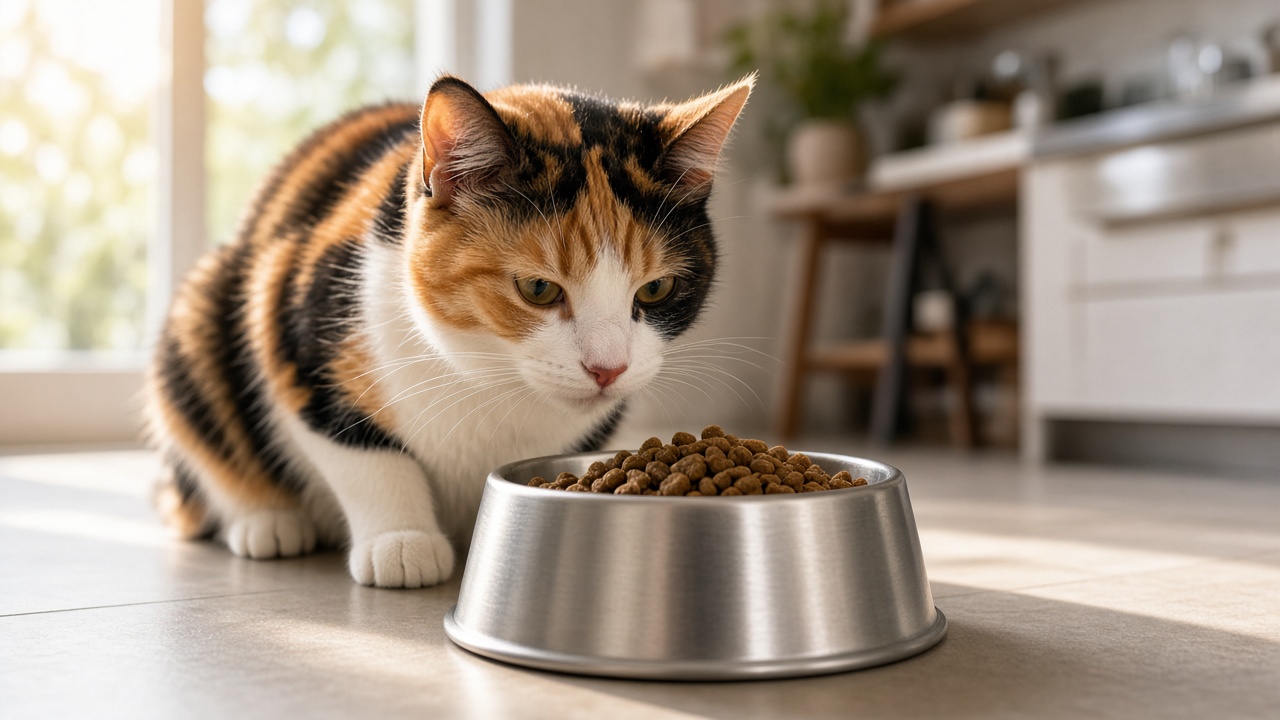
Quick answer: Call a clinic if your cat eats nothing for 24 hours. Do not wait several days. Kittens under six weeks need help after 12 hours without food.
A household cat should see a clinic if it eats nothing for 24 hours; 48 hours is already late.
This page is a household-anorexia briefing that did not use feeding trials, clinic charts, or force-feeding recipes.
Selection rule: we included only complete meal refusal in indoor or indoor-outdoor pet cats. We left out crash-diet protocols, outdoor-colony starvation, wildlife cases, and homemade syringe-feeding recipes.
Our research team analyzed published clinic manuals and nutrient profiles. We lined those texts up as the Household Fast Clock. That clock is a reading aid, not a diagnosis.
The Household Fast Clock
The search query asks how long a cat can go without food. Survival in a narrow biological sense is the wrong clock. Liver failure can start while the cat still looks like it might eat later.
Cornell University’s Feline Health Center states that anorexia can severely affect a mature cat after 24 hours. The same Cornell anorexia page states that food avoidance for 12 hours can threaten a kitten younger than six weeks.
An AVMA Journals paper on reduced food intake discusses feeding tubes when an animal is anorexic for more than 3 to 5 days. That later window is a hospital planning number. It is not a home waiting period.
| Situation | Hours without food | Organization that named it |
|---|---|---|
| Mature cat, severe-impact window | 24 hours | Cornell Feline Health Center |
| Kitten younger than 6 weeks | 12 hours | Cornell Feline Health Center |
| Hospital papers on tube-feeding risk | 3 to 5 days | AVMA Journals |
If you are not sure when the last full meal was, treat the first missed bowl as hour zero. Licking gravy is not a meal.
Why Food Refusal Hits a Cat’s Liver
Cats are obligate carnivores. The Merck Veterinary Manual’s nutrition chapter states that cats cannot downregulate gluconeogenesis during fasting. They keep burning amino acids for glucose when the bowl is empty.
Fat then floods the liver. The liver cannot export that load. Fat fills the cells.
That syndrome is feline hepatic lipidosis.
Cornell’s hepatic lipidosis page quotes Sharon Center. She states that in more than 90 percent of cases the fatty liver is secondary to another problem. Obesity, diabetes, cancer, hyperthyroidism, pancreatitis, kidney disease, and other liver disease sit on that list.
The Merck Veterinary Manual’s feline hepatic lipidosis chapter says true idiopathic cases are typically under 10 percent. Most cats that stop eating have a reason. The reason still needs a clinic, not a new flavor chosen at midnight.
Cornell’s page notes Center has seen the condition from 3 months to 25 years of age. Incidence appears higher in obese cats. Extra body fat does not buy time.
The Merck chapter describes dramatic weight loss over 25 percent in affected cats. Peripheral fat wastes while belly fat can remain. A cat can look padded and still be in liver failure.
On cytology, the Merck chapter states that lipid vacuoles involve more than 80 percent of aspirated hepatocytes. That is a lab finding, not a home check. The home check is the empty bowl.
Who Reaches Danger Sooner
Kittens under six weeks sit on Cornell’s 12-hour clock. Their energy stores are small. They cannot coast on adult fat reserves.
Overweight adults sit on the high-risk side of Cornell’s lipidosis page. The fat they carry becomes the problem once intake stops.
Cats with kidney disease already eat poorly in published data. An AVMA Journals review of reduced food intake cites chronic kidney disease studies in cats. Reported prevalence of reduced appetite in those studies ranged from 20.9 percent to 92.3 percent.
A senior on a kidney-support wet food still needs a clinic visit if the bowl goes untouched. Kidney diets do not pause the 24-hour clock.
Boarding and hospital stays also appear on Cornell’s anorexia page as common settings for food refusal. A boarded cat that seems only stressed is still on the 24-hour clock.
Dental pain is another Cornell-noted cause. A cat that approaches the bowl and walks away may have a sore mouth. That still counts as not eating.
What Counts as Not Eating
Anorexia means no food, not a picky mood. The AVMA Journals paper asks clinics to record how many days passed before the exam. Your notes should do the same.
Nibbling three treats is not a day’s ration. The Merck lipidosis chapter gives a resting energy formula of body weight in kilograms times 30, plus 70. For a 4 kilogram cat that is 190 kilocalories a day.
The same chapter says feeding starts at 25 percent of that number after fluids and electrolytes are stable. For that 4 kilogram cat, 25 percent is about 48 kilocalories. A few licks of juice do not reach 48 kilocalories.
The Merck nutrition chapter lists maintenance multipliers on top of resting needs. Neutered healthy adult cats sit at 1.2 times resting energy. Obesity-prone cats sit at 1.0 times.
Those figures are starting points from that chapter. They are not home feeding orders.
AAFCO’s Cat Food Nutrient Profiles, as restated in the Merck nutrition chapter, set adult cat food at a minimum of 26 percent protein on a dry-matter basis. Growth and reproduction sit at 30 percent.
Those minima are 65 grams and 75 grams of protein per 1,000 kilocalories. A fasting cat takes in none of that protein.
AAFCO’s own profiles also set a 9.0 percent fat minimum for adult and growth cat foods. Taurine minima are 0.10 percent in extruded food and 0.20 percent in canned food.
The U.S. Food and Drug Administration’s pet-food page states that labels must list ingredients from most to least by weight. Reading a label does not tell you whether the cat ate. Weigh the leftovers and write the time.
Water Does Not Replace Food
A cat that still drinks is not safe. Cornell’s 24-hour warning applies even when water intake looks normal.
The Merck nutrition chapter calls water the most important nutrient. It states that a lack of water can lead to death in a matter of days. That is a separate clock from food.
The same chapter estimates most mammals need about 44 to 66 milliliters of water per kilogram of body weight in a thermoneutral setting. A 4 kilogram cat lands near 176 to 264 milliliters a day from food plus the bowl.
Canned foods, the Merck chapter states, hold 60 percent to more than 87 percent moisture. Dry foods hold 3 percent to 11 percent. A dry-fed cat that also stops drinking is on both clocks at once.
Vomiting or diarrhea cancels the comfort of a wet chin. Fluid leaves faster than the bowl can replace it. That is a same-day clinic problem.
If the water bowl is full and untouched, assume both clocks are running. Do not wait for dry gums to appear.
What Published Protocols Report
This desk does not treat cats. The numbers below come from published manuals. They show why waiting is costly.
The Merck lipidosis chapter reports hypokalemia in about 28 percent of patients at presentation. Hypophosphatemia appears in about 14 percent. Hypomagnesemia appears in about 20 percent.
Those deficits can worsen when food returns. That pattern is refeeding syndrome. It is one reason clinics stabilize electrolytes before a full meal plan.
The chapter says hepatic lipidosis either resolves in 14 to 21 days or the patient dies. Chronic survival in the sick state does not occur.
A 50 percent drop in total bilirubin within the first 7 to 10 days is a positive sign in that text. Liver enzyme trends are not treated as useful recovery predictors there.
Survival in the author’s hospital is given as about 75 percent to 80 percent with customized critical care. Cats given only nutritional support are listed at 50 percent. Cornell’s page says owners often continue tube feeding for a month or so after early discharge.
The Merck chapter doses L-carnitine at 250 to 500 milligrams per cat each 24 hours. Taurine is listed at 250 to 500 milligrams per cat. Parenteral vitamin B12 is listed at 250 to 500 micrograms per cat.
Those are clinic doses from that manual. They are not home supplements to try first.
The same chapter says appetite stimulants will not recover cats with severe lipidosis. Early on they may raise intake. The underlying cause still has to be found.
Cornell’s anorexia page states that forcing marble-sized balls of food into the mouth can worsen food aversion. The clinic’s job is to get calories in without teaching the cat to fear the bowl.
Diet Changes, Coat Clues, and False Comfort
A sudden food swap can look like fussiness. It can also start the 24-hour clock. Do not run a pantry trial after a missed day.
If chicken is the protein the cat now refuses, skip a full cupboard swap at hour 30. A later, stable cat may use a chicken-free cat food. A sick cat needs a clinic first.
Long-haired cats hide weight loss under fur. A grooming glove for long-hair cats can show loose hair and a dull coat. It cannot restart a liver.
Use grooming as an observation tool. Then look at the bowl record.
The FDA’s pet-food page notes that the agency does not rank products for individual health issues. That matches our rule.
This article names nutrient minima. It does not rank cans.
AAFCO’s nutritional-labeling page requires a guaranteed analysis with minimum crude protein and crude fat. It also requires maximum crude fiber and moisture. Those four numbers describe the bag, not whether your cat ate from it.
FAQ
Can a healthy cat go a week without food?
A week without food is not a safe household plan. Cornell’s mature-cat warning starts at 24 hours. The Merck lipidosis chapter describes recovery or death within 14 to 21 days once the disease is established.
Does drinking water make fasting safe?
Water and food are different clocks. Merck’s nutrition chapter says lack of water can kill in a matter of days. Cornell’s anorexia page still flags 24 hours without food in a mature cat.
What if my cat only licks gravy or eats one treat?
That is not a day’s calories. The Merck lipidosis formula gives a 4 kilogram cat about 190 kilocalories at rest. A lick of juice does not meet 25 percent of that figure.
Are overweight cats safer because they have fat stores?
Cornell’s lipidosis page states incidence seems much higher in obese cats. Extra fat is the load the liver cannot process during a fast. An overweight cat that stops eating is a higher-risk case, not a well-padded one.
Should I switch foods at home to tempt my cat?
A well cat can transition over days. A cat that has already missed meals can form a food aversion. Cornell’s anorexia page warns that forcing food into the mouth can make aversion worse.
How is a kitten different from an adult?
Cornell’s anorexia page sets a 12-hour lethal-threat window for kittens younger than six weeks. Adult clocks start at 24 hours. Kittens also need the higher AAFCO growth protein floor of 30 percent dry matter once they are eating again.
What if I do not know when the last meal was?
Start the clock at the first empty bowl you can confirm. The AVMA Journals paper tells clinics to record days of anorexia before the exam. Write the time, a body weight if you have a scale, and a list of what was offered.