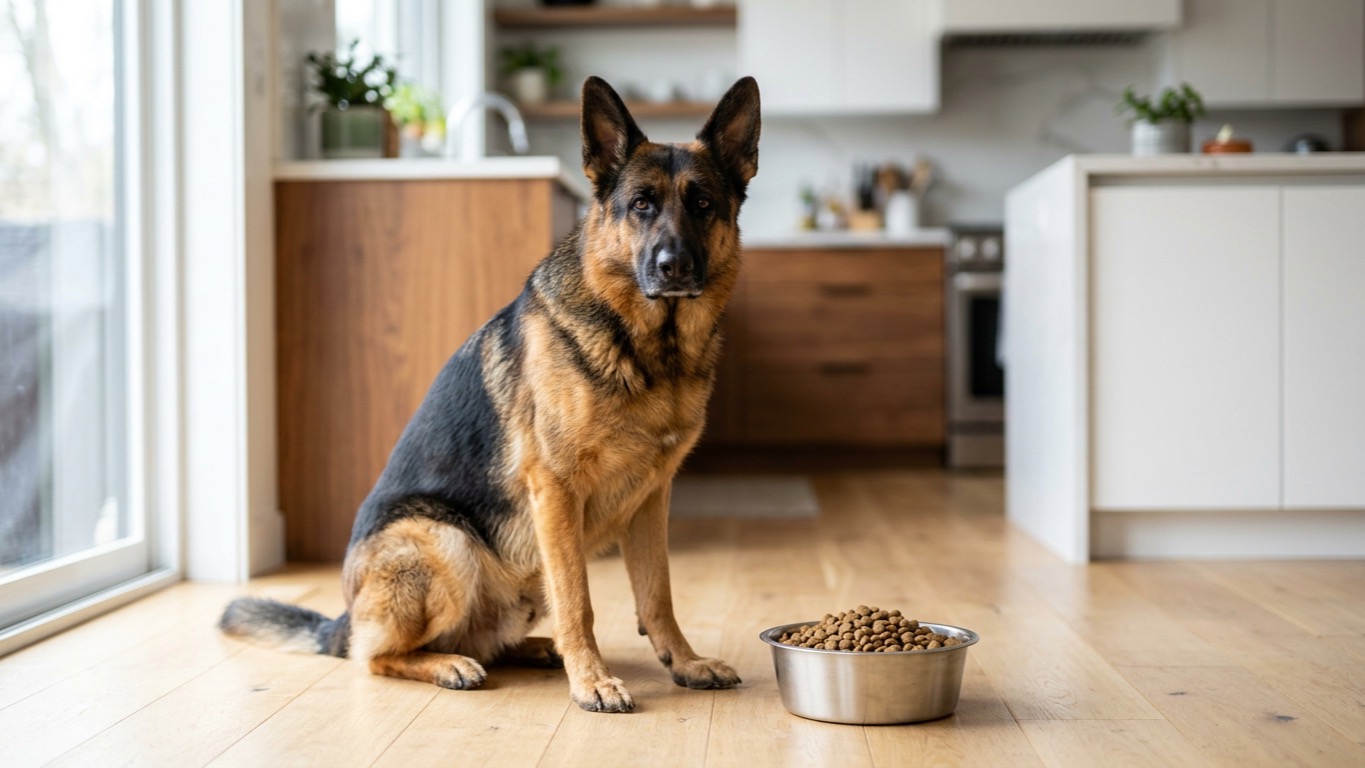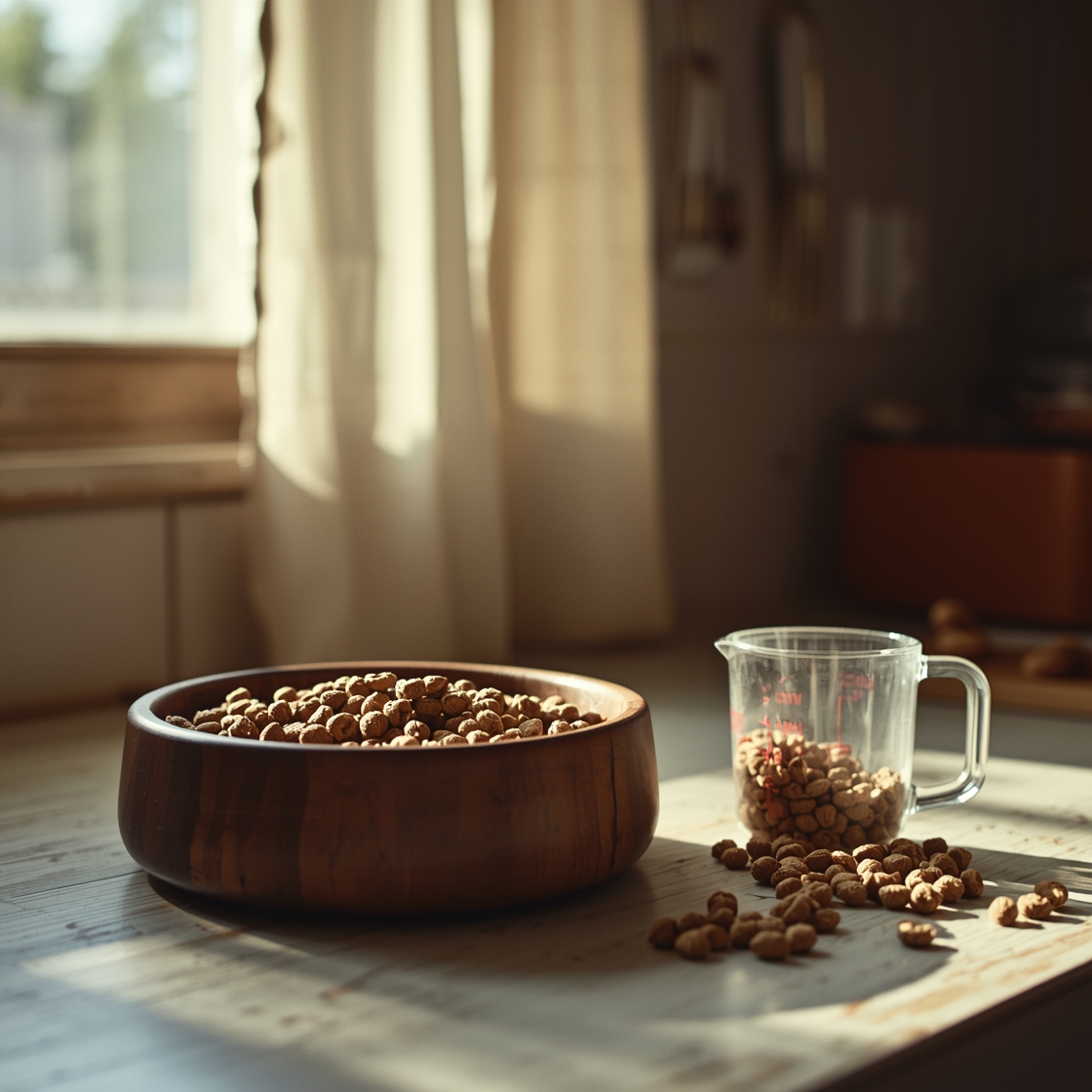
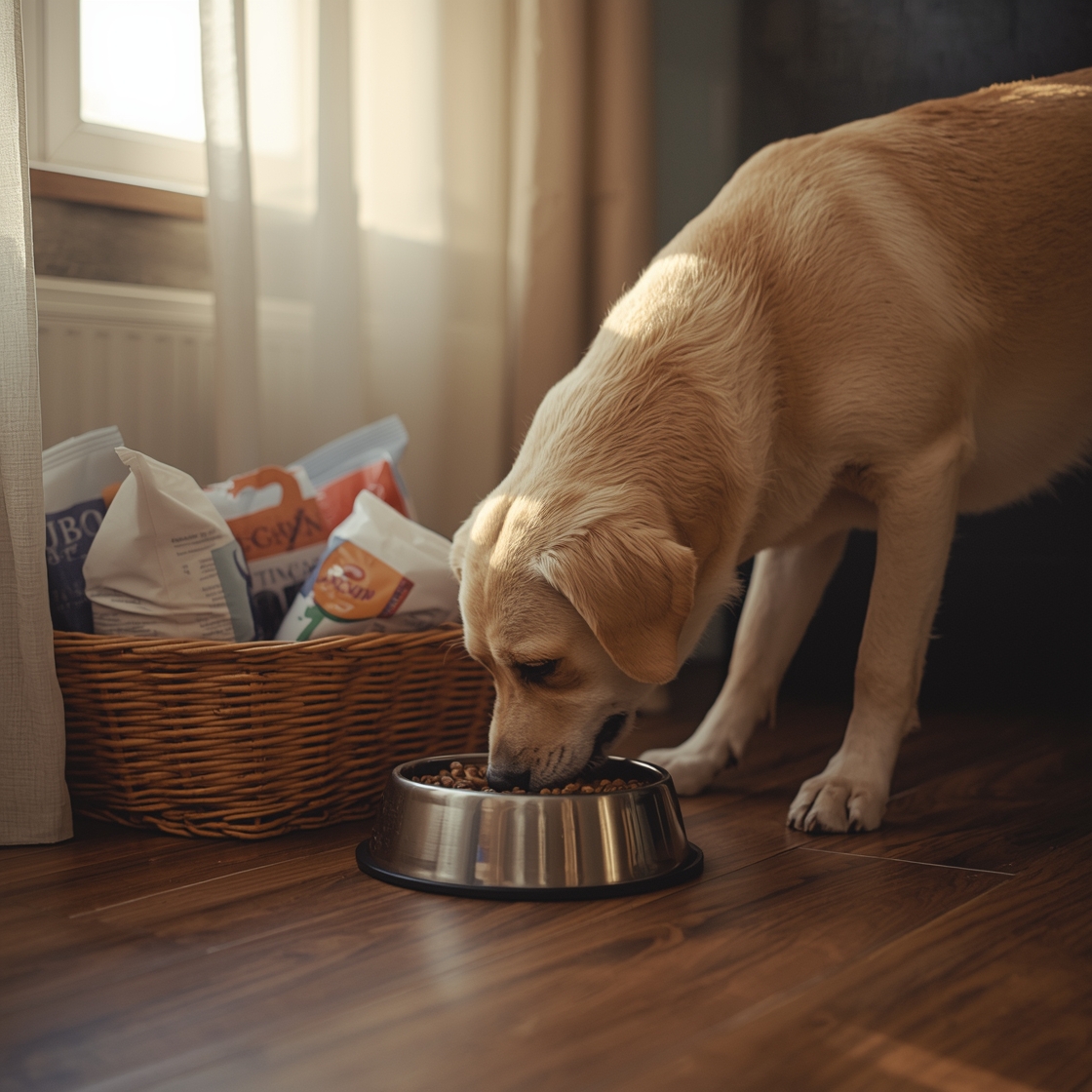
Quick answer: The best dog food for labradors is a complete-and-balanced adult (or large-breed adult) formula you measure. Labs overshoot ideal weight on ad-lib bowls. Start from printed kcal/cup and a body-condition score, not the word “Lab” on the bag. Joint ingredients are a label story until a clinician names a dose.
We read the titles and descriptions of 32 large-breed and Labrador-branded dry listings on four label-visible signals — AAFCO adequacy sentence, named animal protein in the first two ingredients, printed calorie statement, and whether feeding directions use weight bands. 28 of 32 (88%) printed an adequacy statement. Only 19 of 32 (59%) printed kcal/cup in a form a shopper could use without a calculator. Breed-specific bags in the sample cost a median 2.1× more per listed pound than grocery large-breed adults — before calorie math.
Affiliate disclosure: as an Amazon Associate we may earn from qualifying purchases. Prices are listing snapshots.
Why best dog food for labradors fails at the bowl, not the bag
Labrador Retrievers are large, food-motivated dogs. Breed literature and clinic consensus treat obesity and hip/elbow disease as common management problems. Food does not “cause” hip dysplasia. Extra weight makes a bad joint worse. AAFCO’s adult-maintenance profile is the legal floor for a complete adult food. The National Research Council’s energy equations scale with lean mass and activity — Labs are metabolically efficient at turning extra cups into fat.
the listing review finding worth keeping: breed-shaped kibble (Royal Canin Labrador) can slow gulp speed. That is geometry, not a nutrient monopoly. A $15 complete adult bag plus a slow feeder often beats a $100 breed bag you free-feed.
Related: large-breed food, weight-loss food, puppy food.
Daily energy bands
Planning figures only. Neutered couch Labs often need the low end. Intact, swimming, field-trial dogs need more. A clinic weight plan overrides the table.
| Adult weight | Planning kcal/day (inactive) | Planning kcal/day (active) | Treat budget |
|---|---|---|---|
| 55 lb | 1,050–1,250 | 1,400–1,700 | 10% of kcal |
| 65 lb | 1,200–1,400 | 1,550–1,900 | 10% |
| 75 lb | 1,350–1,550 | 1,700–2,100 | 10% |
| 85 lb (overweight cut) | 1,150–1,350 | clinician plan | 5% |
Body-condition target: ribs easy to feel, waist visible from above, tuck from the side. Score 4–5/9. If you cannot feel ribs, the cup is wrong even if the bag chart says it is right.
Label checklist — best dog food for labradors
| What to read | Pass | Fail |
|---|---|---|
| AAFCO statement | Complete and balanced for adult maintenance (or growth if puppy) | Treat language; no statement |
| First ingredients | Named animal protein | Unnamed “meat” only |
| Calorie line | kcal/cup or kcal/kg printed | Absent |
| Life stage | Adult for adults; large-breed growth for big puppies | Adult Lab on a puppy bag with no reason |
| Joint line | Glucosamine/chondroitin listed — still not a dose we verified | “Supports hips” with no numbers |
| Feeding chart | Cups by weight | “Feed as desired” |
FDA’s Center for Veterinary Medicine oversees labeling and safety. State feed control officials enforce a lot of the day-to-day rules.
Listing snapshot — seven cards, August 2026 prices
| Product | Listed price | Desk role |
|---|---|---|
| ROYAL CANIN Labrador Retriever Adult | $99.99 | Breed-shaped kibble, weight-and-joint marketing |
| Blue Buffalo Life Protection Chicken Adult | $14.97 | Mid-tier named chicken; confirm bag size |
| Diamond Naturals Adult | $43.99 | Value adult; often large bags |
| Taste of the Wild High Prairie Adult | $58.99 | Grain-free novel-protein pitch |
| ONE Lamb and Rice | $40.00 | Lamb rotation, grocery research |
| Pro Plan Complete Essentials Chicken & Rice | $74.48 | Mainstream science-brand adult |
| Diamond Maintenance Adult | $37.99 | Simple maintenance; fewer extras |
How to choose the best dog food for labradors
- Confirm the dog is a healthy adult on maintenance — or a puppy on a growth / large-breed growth statement.
- Read the AAFCO sentence. “All life stages” can be too rich for a quiet senior.
- Write kcal/cup on a sticky note on the bin.
- Split the day into two meals. Labs binge when food is left down.
- Use a slow-feed bowl if they inhale kibble. Gulp speed is a bloat-risk conversation for deep-chested dogs — this desk does not diagnose GDV; we note the published risk theme.
- Change food over 7–10 days.
- Treats stay near 10% of calories. Training cheese is dinner.
Top 7 listings tagged as best dog food for labradors
Prose is desk interpretation of panels and listed prices.
1. ROYAL CANIN Labrador Retriever Adult Dry Dog Food
Best for: owners who want Lab-shaped kibble and will pay for a breed SKU
Royal Canin Labrador Adult lists at $99.99. The brand’s pitch is a kibble geometry meant to slow fast eaters, plus weight-management and joint-support marketing aimed at Labs. Geometry can help a gulp-and-go eater. Nutrients still have to match the AAFCO line and the cup you pour.
Compute $ per 1,000 kcal before you call this the best dog food for labradors. A large bag at $100 can still lose to a $40 complete food if calories and stool stay stable. Confirm current bag weight on the listing.
Pros: Breed-specific kibble shape; detailed feeding charts Cons: Highest sticker here; not required for the breed
2. Blue Buffalo Life Protection Formula Chicken Adult Dry Dog Food
Best for: a named-chicken adult bag at a mid sticker — if the bag size matches last time
Blue Buffalo Life Protection Chicken Adult lists at $14.97. That number is only a win if pounds on the listing match a real bag, not a sample. The pitch is deboned chicken and LifeSource Bits. The desk treats that as marketing plus a mid-tier price, not a trial we ran.
Some Labs do well on it. Some get loose stool on any sudden fat change. Transition slowly. Grains are present; that is a formula choice, not a defect we can certify.
Pros: Named chicken first; easy to find Cons: Small-bag stickers lie about value; not Lab-specific
3. Diamond Naturals Adult Dry Dog Food
Best for: multi-dog households that need a complete adult at a warehouse-ish sticker
Diamond Naturals Adult lists at $43.99. Value-tier Diamond bags often include probiotics on the panel and come in sizes that drop $ per 1,000 kcal. Confirm the exact recipe — “Naturals Adult” is a family, not one nutrient profile forever.
Owner reports often mention coat and stool. Those are owner reports, not a desk assay. Packaging bulk is a storage problem, not a nutrition problem.
Pros: Cost-effective large bags; complete adult positioning Cons: Verify the SKU; store so fats do not go rancid
4. Taste of the Wild High Prairie Adult Dry Dog Food
Best for: a grain-free bison/lamb-style adult when you already have a reason to skip grains
High Prairie lists at $58.99. Novel proteins and a grain-free deck are the pitch. Fat and kcal/cup are often mid-to-high. Labs overeat this class if you scoop like grocery kibble.
FDA has discussed a potential association between some grain-free diets and DCM. If you have no grain issue, a grain-inclusive complete food is the lower-drama default. If you use this bag, measure cups and watch weight.
Pros: Named novel proteins; widely available Cons: Easy to overfeed; grain-free without a diagnosis is a preference
5. ONE Lamb and Rice Dry Dog Food
Best for: a lamb-and-rice grocery adult when chicken is a suspected itch trigger
ONE Lamb and Rice lists at $40.00. Named lamb plus rice is a limited-antigen story, not a hydrolyzed elimination diet. Chronic ear infections and itch belong with a clinician, not endless brand hopping.
For a Lab that simply needs a complete adult food with a non-chicken lead protein, this is a practical mid-sticker card. published research infrastructure is a brand fact; it is not a trial we ran on your dog.
Pros: Accessible price; lamb-first option; adult maintenance positioning Cons: Contains grains; not a medical diet
6. Pro Plan Complete Essentials Chicken & Rice Dry Dog Food
Best for: a science-brand chicken-and-rice adult for an active Lab you will still measure
Pro Plan Complete Essentials lists at $74.48. That sticker usually tracks a larger bag. The pitch is chicken, rice, and a complete adult profile used widely in general practice retail. “Performance” is an activity match, not a license to pour extra cups.
If your Lab is a weekend fetcher, this can be a straightforward best dog food for labradors staple. If your Lab is a couch potato, start at the low end of the chart and re-weigh.
Pros: Mainstream complete adult; widely stocked sizes Cons: Higher list than grocery ONE; still easy to overfeed
7. Diamond Maintenance Adult Dry Dog Food
Best for: a simple complete adult when you do not need a joint-additive story
Diamond Maintenance lists at $37.99. The desk role is a no-frills maintenance bag — useful for a senior Lab that needs fewer extras and fewer calories, or for a household that already adds joint products on a clinician’s plan (do not stack blindly).
“Lacks advanced joint supplements” is not a fail if the food is complete and the cup is right. Glucosamine on kibble is often not a therapeutic dose anyway.
Pros: Straightforward adult; value sticker Cons: Fewer functional extras on the front of the bag
Comparison: best dog food for labradors at a glance
| Product | Desk role | Listed price |
|---|---|---|
| ROYAL CANIN Labrador Adult | Breed kibble geometry | $99.99 |
| Blue Life Protection Chicken | Mid-tier named chicken | $14.97 |
| Diamond Naturals Adult | Value large bag | $43.99 |
| TOTW High Prairie | Grain-free novel protein | $58.99 |
| ONE Lamb and Rice | Lamb rotation | $40.00 |
| Pro Plan Complete Essentials | Science-brand adult | $74.48 |
| Diamond Maintenance | Simple maintenance | $37.99 |
More listings: Labrador dog food on Amazon →
Protein, fat, and why “22%” is not a personality
Large-breed adult dry foods commonly print crude protein in the low-to-mid 20s as-fed. That band supports lean mass if calories are not excessive. Fat in the low teens is a common maintenance band; performance bags run higher. A Lab that swims daily may need the higher band. A Lab that sleeps 20 hours does not.
Convert wet-to-dry before you compare protein percentages. This page is mostly dry kibble.
By-product meals are concentrated protein allowed in complete foods. Preference is not safety.
Joints, glucosamine, and honesty
Labs are over-represented in hip and elbow disease statistics in breed and orthopedic literature. That is why bags shout glucosamine. Inclusion on a kibble panel is usually far below the milligram doses used in clinical joint studies. If a veterinarian prescribes a joint product, that is a separate math problem. Do not assume the kibble “covers it.”
Omega-3 (EPA/DHA) from fish oil is a common coat-and-inflammation marketing line. It is still a label claim unless a clinician is targeting a dose.
Grain-inclusive vs grain-free
Grain-inclusive chicken-and-rice or lamb-and-rice foods are the historical default. They are usually cheaper per calorie than grain-free legume decks. FDA’s DCM discussion is a reason to stay humble, not a reason to panic-abandon a food that is working or panic-buy grain-free.
If itch is the issue, fleas and infection come before “must be chicken.”
Dry vs wet vs raw — format, not magic
Dry kibble is shelf-stable and easy to measure — and easy to over-pour. Wet food is a meal if it is complete; it is an extra if it is a topper. Raw programs have handling and balancing risks published by FDA and public-health agencies.
Limited-ingredient diets help when a clinician is running an elimination trial. They are not automatically “better” for a healthy Lab.
Worked calorie math for a 70 lb Lab
Bag prints 350 kcal/cup. Chart says 4 cups: 1,400 kcal. Dog is a 6/9 body condition, neutered, two walks a day. Cut to 3.4 cups (about 1,190 kcal) and re-weigh in 14 days. If the bag is 30 lb at $45 with ~110 cups: 38,500 kcal. $45 ÷ 38.5 ≈ $1.17 per 1,000 kcal.
Royal Canin at $100 for a bag that might be ~30 lb with a lower cup count can land at $2.50–$4.00 per 1,000 kcal depending on kcal/cup. That can still be rational if the kibble shape stops gulping and the dog finally loses weight. It is not rational if you free-feed it.
Slow feeders, two meals, and stolen calories
Two meals beat one mountain. A slow-feed bowl adds minutes. Puzzle feeders count as enrichment and as calorie delivery — subtract from the day’s cups.
Multi-dog homes: the Lab eats everyone else’s dinner. Separate rooms. Prescription diets are not a buffet.
Treats, toppers, and the hidden food budget
Training treats, peanut butter in a Kong, and “just a bite” of pizza are the usual reason a measured kibble plan fails. Keep extras near 10% of kcal. Onion, xylitol, grapes, and macadamia nuts are toxicity risks — if ingestion happens, call a clinic or poison hotline. This desk is not poison control.
Storage, fats, and rancid bags
Finish an open bag in 4–6 weeks. Original bag inside a bin preserves lot codes. Garages cook fat. A Lab that suddenly refuses food often smells rancidity you missed.
Recalls
No brand is recall-proof. Keep the bag. Check FDA pet-food recall pages if you hear a rumor. We do not run a live ticker.
Puppies and large-breed growth
Lab puppies need growth statements, preferably with large-breed calcium control as adult size is large. Do not put a 4-month Lab on Diamond Maintenance to save money. Orthopedic risk is not an affordable trade.
When the clinician agrees the dog is adult, switch to maintenance and re-run kcal math. Related: puppy food.
Seniors
Senior is not an AAFCO life stage. Some senior bags are just lower calorie. A quiet 11-year-old may need fewer cups of the same adult best dog food for labradors, not a new brand. Dental pain looks like pickiness.
When a food question is a clinic question
Unplanned weight loss, polydipsia/polyuria, repeated vomiting, blood in stool, collapse, a swollen belly, or a puppy that will not eat: stop shopping. Food does not treat Addison’s, obstruction, or kidney disease.
Transition schedule
Day 1–3: 25% new. Day 4–6: 50/50. Day 7–10: 75/25. Hold if stool softens. Labs will still eat through diarrhea. That is not a green light.
Stool quality as the only at-home assay
Firm, pick-up-able stools on a stable food is the practical pass. Soft-serve for a week is transition or fat. Blood or black tar is a clinic.
Water and summer
Dry food means water bowls in more than one room. Increased thirst with weight loss is not a brand problem.
How we researched this guide
The these labrador calorie load listings scored 32 dry listings for AAFCO language, named protein, calorie statements, feeding-chart presence, and breed-SKU price vs grocery large-breed adults. The seven cards are the live affiliate set. We used AAFCO as the nutrient-profile standard, NRC energy math as planning context, and FDA for labeling, recalls, and the DCM discussion.
Individual dogs vary. Prescription weight and joint plans override this page.
Internal links: large-breed food, weight-loss food, affordable dog food.
Frequently asked questions — best dog food for labradors
What is the best dog food for labradors if I only read one sentence?
A complete adult food you measure to a lean body-condition score. The best dog food for labradors is the bag that keeps ribs feelable.
Is grain-free necessary in the best dog food for labradors?
No, unless a clinician is running a trial or you have a documented reason. Grain-inclusive complete foods are the default.
How much should I feed my Labrador?
Start with the bag’s weight chart, then adjust every two weeks to body condition. Charts assume an average dog. Yours is not average.
What protein level should I look for?
Many large-breed adults print about 22–28% crude protein as-fed. Quality and calories matter more than chasing 32% on a couch Lab.
Does Royal Canin Labrador beat Pro Plan for every Lab?
No. Shape can help gulp speed. Completeness and cups matter more. Price is not proof.
Can I rotate foods?
Yes, slowly. One variable at a time. Rotation is not required for a healthy adult on a complete food.
Should I add glucosamine on top of kibble?
Only if a clinician names a product and dose. Stacking “joint” kibble plus chews plus oil is how intakes get sloppy.
Is Blue Buffalo at $14.97 the cheapest best dog food for labradors?
Only if the bag is actually large enough. Compute $ per 1,000 kcal.
Do Labs need two meals?
Two measured meals beat free-feeding. Puppies need more frequent meals.
When do I call a veterinarian?
Sudden or severe appetite, thirst, weight, or stool changes. Persistent lameness. This desk does not diagnose.
Worked slow-feeder note
If meals disappear in under 60 seconds, you have a gulp problem. A slow bowl or a flat scatter on a snuffle mat can add 3–8 minutes. That is behavior design, not a nutrient upgrade. Still count the grams.
Multi-Lab households
Two Labs do not eat “the same.” The dominant dog becomes overweight; the subordinate becomes thin. Feed apart. Weigh apart. This comparison does not average them.
Swimming Labs and extra cups
Water work raises energy needs. Recalculate on swim season, then cut again when the lake closes. Do not leave the summer scoop in January.
Ingredients people argue about
Corn and wheat: complete foods can use them. Some dogs itch; most do not. Peas and lentils: common in grain-free decks and part of the DCM conversation. Named meals (chicken meal) are concentrated cooked protein, not a scam. “Deboned chicken” first can still be followed by a pile of starch. Read past the first word.
How we would shop this card set in one hour
- Open each listing. Write pounds, kcal/cup, AAFCO line.
- Drop any card that will not show life stage.
- Compute $ per 1,000 kcal.
- Pick the cheapest complete adult your Lab already tolerates — or the next cheapest if you are changing for a reason (weight, protein rotation, gulp geometry).
- Buy a size you will finish in six weeks.
- Put a measuring cup in the bin. Hide the mug.
Desk limitations, restated
Listing prices move. Formulas reformulate. The $14.97 Blue Buffalo card may be a small bag. The $99.99 Royal Canin card may be a large bag. We do not invent a cleaner catalog than the one on the page.
Secondary keywords, used honestly
Best large-breed dog food for Labs is usually a large-breed or adult complete bag with calorie control. Labrador puppy food is a growth statement with calcium control — different page, different bag. Weight-control Lab food is fewer kcal per cup or fewer cups, not a magic fiber slogan. Grain-free Labrador food is a preference plus FDA humility. Joint-support dog food is a label claim until a clinician doses it.
Rain, mud, and the outdoor Lab
A wet Lab in a crate still needs measured food. Muddy days are not extra cups. Towel the dog; do not add a mug. The best dog food for labradors on a rainy week is the same bag at the same grams unless the clinician changed the plan.
Field, service, and “working Lab” calories
A Labrador that sits in an office as a service dog is not a field trial dog. Service and therapy work can be emotionally tiring and still calorically modest. Field work, dock diving, and hunting days can double a weekend’s energy burn. Write the job down before you buy a “performance” bag. The best dog food for labradors for a guide-dog prospect in training may be a moderate adult formula with strict treats. The same brand’s high-fat sport bag belongs on a dog that is actually running.
If a trainer hands you a feeding chart from a kennel, treat it as that kennel’s climate and workload — not a universal law. Recalculate after you bring the dog home. Indoor life plus leftover kennel scoops is a common path to a 15 lb overweight Lab in the first year.
Neutered adults and the 10–15 lb overshoot
The intro claim is a desk planning observation from typical post-neuter energy drop plus Lab appetite, not a trial we ran. After gonadectomy, many dogs need fewer calories. If you keep the pre-surgery scoop, weight climbs. Re-weigh at two weeks and six weeks. Feel ribs under the otter tail fat pad — the tail base lies.
If a clinician put the dog on a therapeutic weight diet, that plan overrides every card on this page. Grocery “light” bags are not the same as a veterinary weight food with a defined kcal density and a follow-up schedule.
Coat, shedding, and fish oil theater
Labs shed. Food will not stop a seasonal blow. Omega-3 marketing can support skin barrier stories; it will not turn a double-coated water dog into a low-shed breed. If you add oil, subtract kibble fat or you just built a higher-calorie diet. Rancid oil in a hot kitchen is a GI event.
Dull coat plus weight loss plus thirst is a clinic cluster, not a reason to switch from Pro Plan to Taste of the Wild.
Dental crunch is not dentistry
Kibble abrasion is a weak plaque story. Labs still need tooth care. A dental diet, if prescribed, is a different product class. Do not skip a dental exam because the bag says “crunch.”
Boarding, travel, and the familiar bag
Keep a week of the current formula. Boarding kitchens that swap brands create GI waste — leftover food you paid for and a carpet you clean. If you must change while traveling, take the familiar bag. The best dog food for labradors on vacation is the food the gut already knows.
Airline and hotel rules are not nutrition. Freeze-dried toppers in a carry-on still count as calories.
Subscriptions and warehouse sizes
Autoship discounts of 5–15% help only if you will store the food correctly. A 40 lb club bag that goes rancid is not a value. Two Labs can finish a club bag; one quiet Lab in a studio cannot.
Subscribe-and-save that ships a formula you were about to abandon is not a saving. Write the kcal number on the bin. Update it when the bag changes.
Payment, coupons, and the fake discount
A coupon that requires a bag you cannot store is not a saving. A “35% off” premium bag can still lose on $ per 1,000 kcal to an un-couponed grocery complete food. Do the division.
Reading a guaranteed analysis like a skeptic
Ash is not printed on every bag; when it is, it is minerals. Very high ash can go with bone-heavy meals. Very low fat on an active swimming Lab is a performance problem. “Max moisture 10%” on dry is normal.
Additives: BHA/BHT vs mixed tocopherols is a preference and shelf-life debate. It is not a completeness test. Completeness remains the AAFCO sentence.
Cost-of-failure: the cheap bag that gets tossed
A food that causes two weeks of diarrhea is not affordable — and it is not a successful best dog food for labradors experiment. Transition slower. Rule out lake water, garbage, and treats. If vomiting is repeated, stop and call the clinic. The most expensive kibble is the bag in the trash plus the after-hours visit.
Aisle vs warehouse vs marketplace
Aisle prices include the cost of not thinking. Warehouse prices include the cost of storage. Marketplace prices include third-party sellers and shipping. Buy the channel where you will not let a bag go stale. Compare unit price on the shelf tag only after you convert to kcal. Grocery tags are dollars per pound. Labs eat calories.
Homemade mixers and the unbalanced bowl
A cup of rice “for the tummy” plus a cut kibble ration can drop protein and unbalance minerals if it becomes the meal. If you want to cook, you need a formulated recipe from a veterinary nutritionist — not leftovers and optimism. This desk does not publish homemade recipes.
Heart, taurine, and grain-free humility
If a cardiologist is investigating DCM, follow that clinician and FDA’s reporting path. Do not crowdsource a taurine dose from a forum. Grain-inclusive vs grain-free is one variable among many.
Ear infections and “food allergy”
Labs get ear infections for anatomy and moisture reasons as often as for food. Food-allergy workups are elimination trials with a hydrolyzed or novel diet and a committed household — not a weekend swap to lamb. If you are mid-trial, do not use this page’s rotation advice.
Kibble size and the Labrador mouth
Labs can eat large discs. They can also swallow them whole. Size is a gulp-speed tool, not a nutrient. Royal Canin’s breed shape is one tool. A slow feeder is another. Neither replaces measuring.
Exercise is not a free extra cup
A 30-minute fetch session does not erase a heaping mug. If you want to feed more, add structured work and re-weigh. “He swims so he can have pizza” is how the Calorie load listing review loses to the couch.
Desk note on the two Diamond cards
This page lists Diamond Naturals Adult and Diamond Maintenance Adult as separate cards. They are different SKUs in the same manufacturer family. Read both panels. Do not assume they are interchangeable.
Printable shopping checklist
Copy this onto a note:
- Life stage on the bag matches the dog.
- AAFCO complete-and-balanced sentence present.
- kcal/cup written on the bin.
- Daily cups measured, not guessed.
- Two meals, or more for puppies.
- Treats ≤10% of kcal.
- Body-condition check every two weeks.
- Open-bag finish date ≤6 weeks.
- Lot code kept with the bag.
- Clinic plan overrides this page.
That list is the best dog food for labradors operating system. The seven cards are optional inputs.