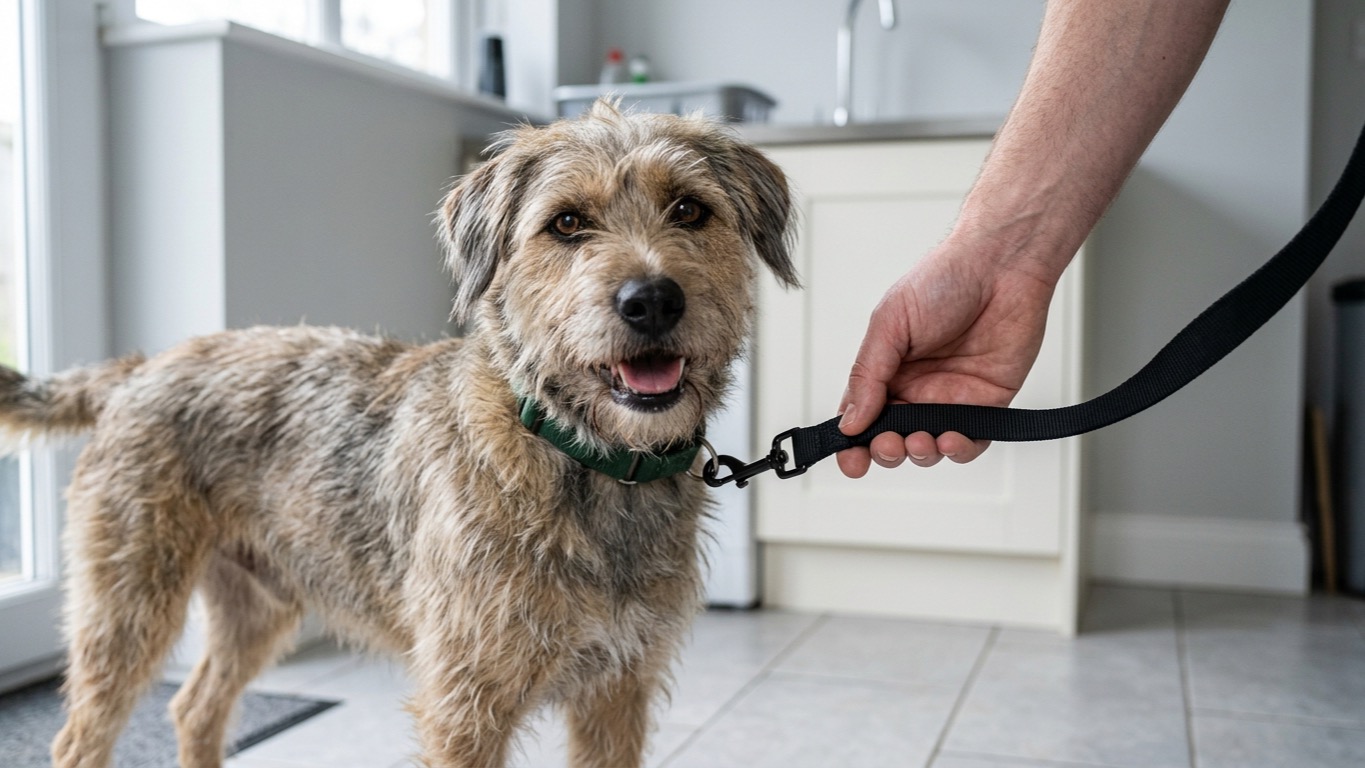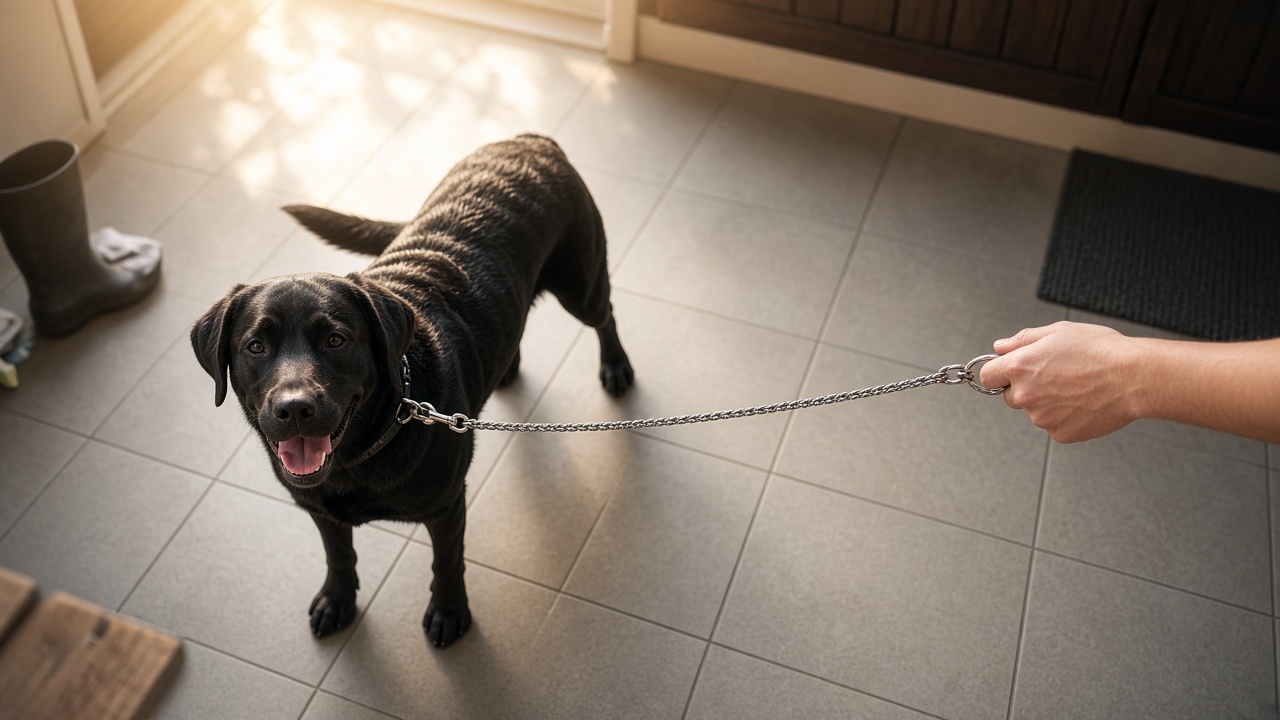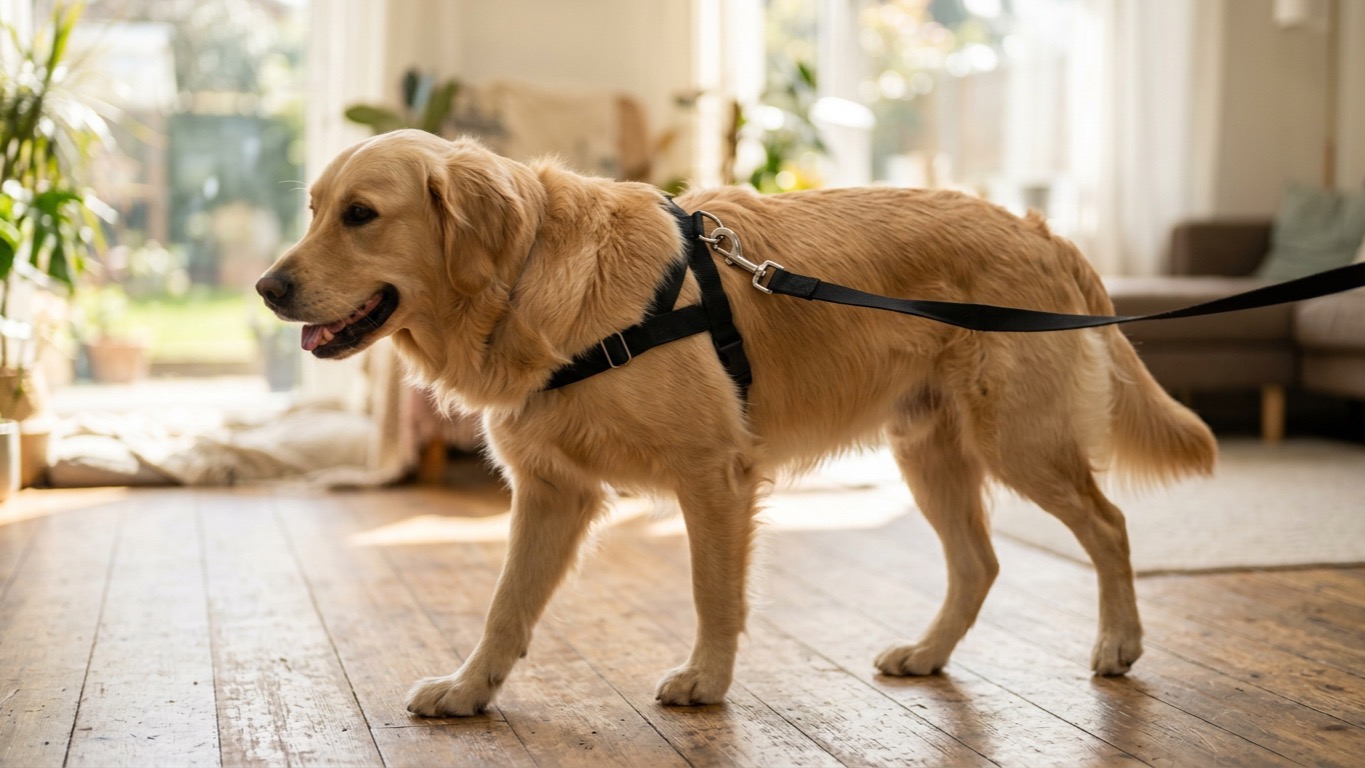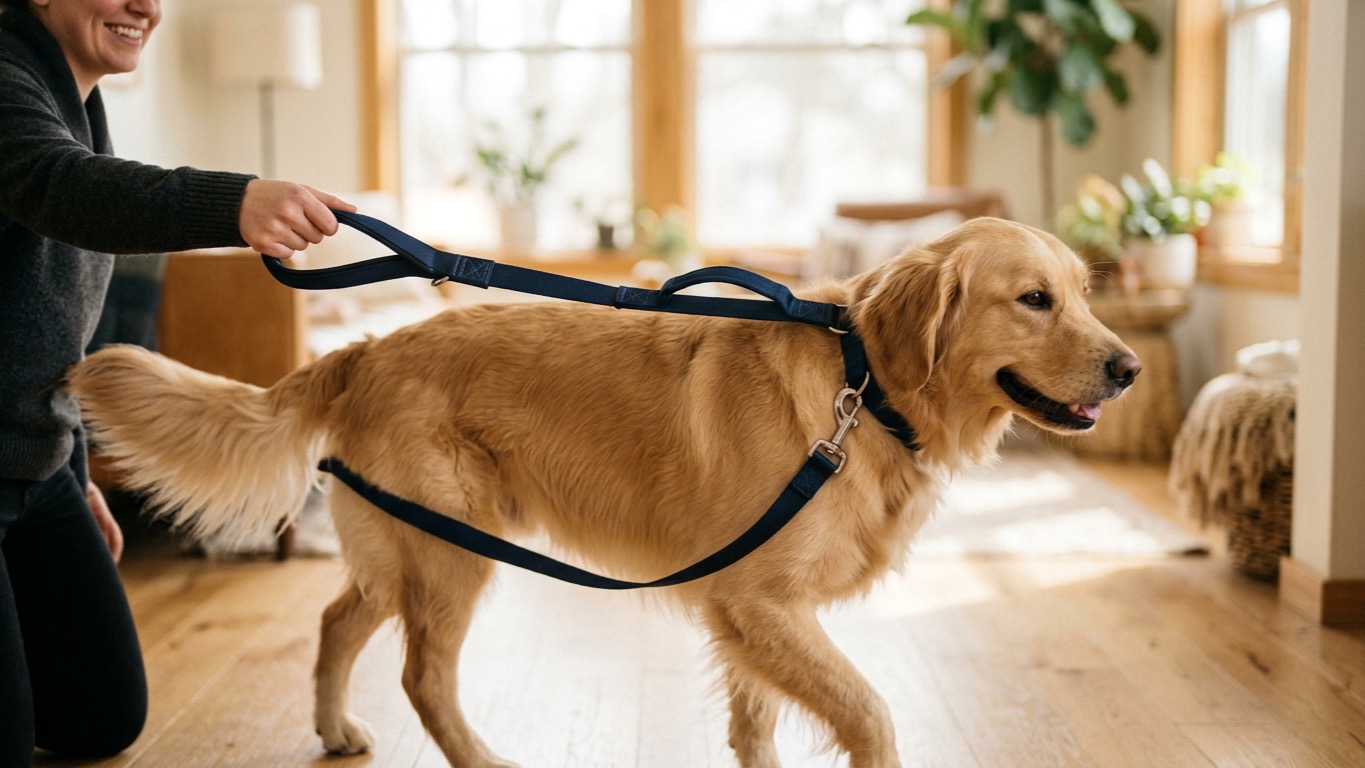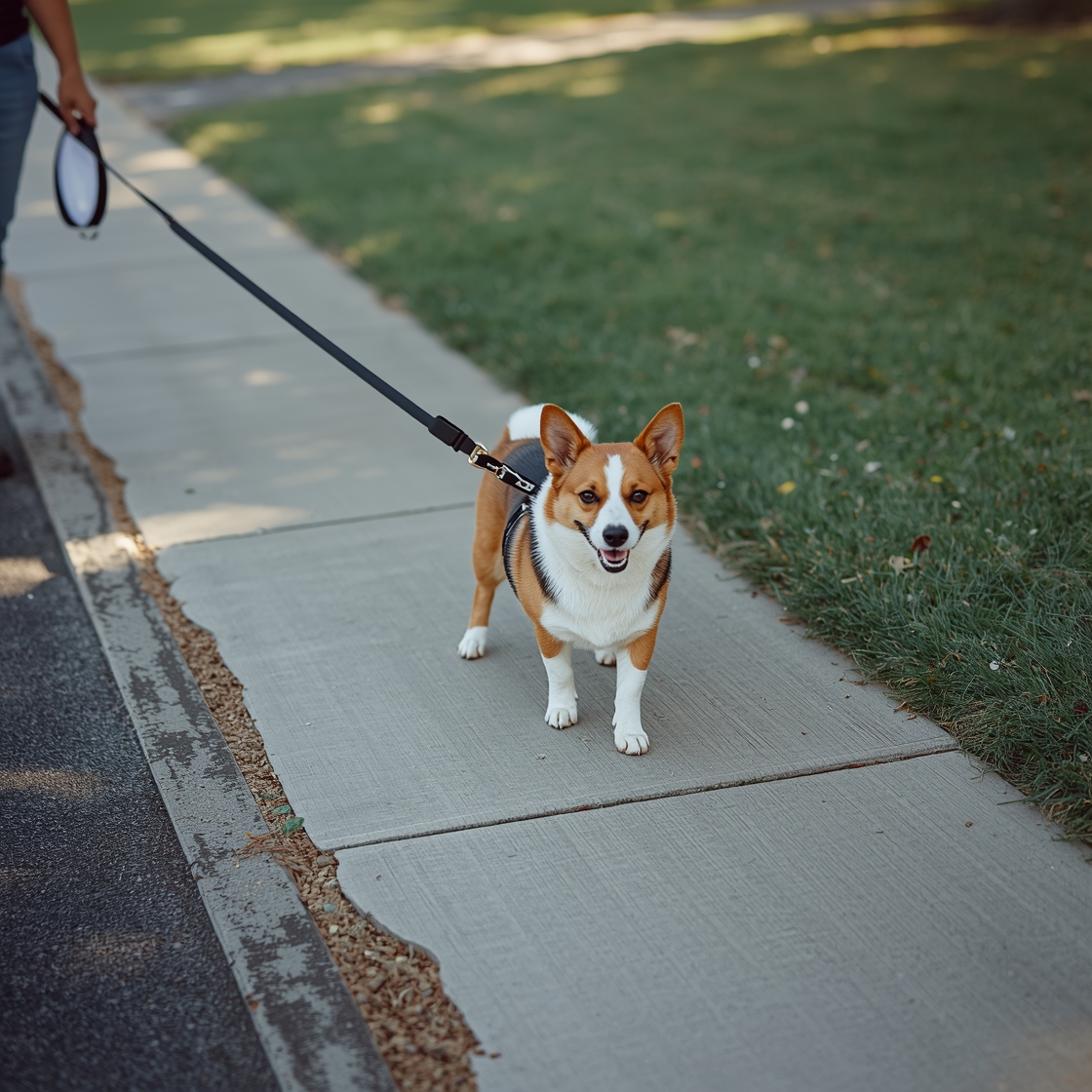
The best dog leash for pulling is usually a 4–6 ft non-elastic leash clipped to a front-ring harness — or, if that still loses, a fitted headcollar on the same short nylon — not a retractable and not a harder yank on a skinny collar. The We read the titles and descriptions of 4 SKUs on this URL. 1 of 4 is a dual-clip training leash (Halti Training Leash). 2 of 4 are headcollars (PetSafe Gentle Leader; Halti Headcollar). 1 of 4 is a dual-ring everyday harness (Ruffwear Front Range). 0 of 4 is a retractable. 0 of 4 replaces a stop-and-pay plan. Bailey, Discepolo, Baker, and Perry (Journal of Veterinary Behavior 78, 2025) printed higher mean and peak newtons on a padded back-clip harness than on a 1.5-inch flat collar. Shih et al. (Frontiers in Veterinary Science, 2021) printed more tension and more time pulling on a back-connection harness when the lure was food. A thicker leash does not cancel those papers.
Pulling is a paycheck (forward motion) plus a load path (neck vs chest vs nose). Buy the class. Pay slack.
Our guides are reader-supported. This article may contain affiliate links. As an Amazon Associate we may earn a commission if you buy through links, at no extra cost to you.
Training sequence: how to stop a dog from pulling on leash. Harness shopping: best dog harness for pulling. Walking-specific sister: best dog walking leash for pullers. Fit tape: dog harness size guide. Puppy collar vs harness: dog harness vs collar for puppies. .
Quick picks at a glance
- Best listed dual-clip training leash: Halti Training Leash — short control, longer training length, or one clip on a headcollar and one on a harness (maker page). Not a retractable.
- Best listed headcollar (longer muzzle): PetSafe Gentle Leader — nose loop + high neck strap. Acclimate. Not a muzzle. PetSafe: 4–6 ft nylon only; no retractable or bungee.
- Best listed headcollar with printed safety link: Halti Headcollar — safety link to a regular collar. Company of Animals: not under 9 months for this family of tools.
- Best listed dual-ring everyday harness: Ruffwear Front Range — back V-ring for easy days; front chest clip to redirect pullers (maker page). Pair with a 4–6 ft leash, not a spool.
How pull leash class listings compare on labels
| Class | Walk it is for | What it tethers | First printed caution |
|---|---|---|---|
| Traffic / short fixed (about 4–6 ft) | Sidewalk, doorway, crowds, vet lobby | Handler to a collar or harness ring | AKC puppy-leash pages prefer a lightweight 6-foot leash while teaching; skip retractables. PetSafe Gentle Leader: “Only use a standard 4 to 6 foot nylon leash.” |
| Long line | Recall and sniff work in a clear, legal open space | Handler to a fitted harness, not a thin neck | A long line is a training radius, not a city tether, and not a retractable spool. |
| Head collar | A forger who still wins on a chest clip; management, not a finished heel | Nose loop plus high neck strap; leash under the chin | PetSafe: not a muzzle; no retractable or bungee; do not leave on unattended; not for jogging, bikes, or couplers. Halti: safety link; not under 9 months. |
| Harness + leash system | Everyday walks when you want load off a narrow tracheal band | Chest and/or back ring plus a fixed leash | Bailey 2025 and Shih 2021 measured more pull on a back-connection harness than on a neck collar. Front clip is a different ring. |
Before you shop: (1) you ruled out pain (new cough, limp, collapse — clinic first), (2) the leash is fixed length, not a retractable, (3) the clip is on a front ring or a fitted headcollar if the dog still forges, (4) you will stop and pay slack, not walk through a tight line. Fail gate 1 and this checklist is how you shop past a sore shoulder.
What the best dog leash for pulling can and cannot do
A short leash shortens the consequence window. It does not teach heel. AVSAB’s 2021 position statement on humane dog training favors reward-based methods and states there is no evidence that aversive training is necessary for common skills. This desk is not restating a clinic protocol. We are saying: a stiffer leash without a plan is a sore shoulder with better stitching.
Bungee / elastic “shock” leads store energy. When the dog hits the end, the snap-back can load the handler’s wrist and the dog’s neck or chest. This comparison treats elastic as the type to avoid for a puller you are trying to stop.
We only recommend matching class to the walk. We are not saying we walked these four SKUs this afternoon.
Disclosure: this article contains affiliate links. If you buy through them we may earn a commission at no extra cost to you.
How the desk scored the best dog leash for pulling
this comparison uses four visible signals:
- Class. Dual-clip training leash vs headcollar vs dual-ring harness.
- Length honesty. 4–6 ft is city control. “Up to 26 ft” is a different object (not on these cards).
- Where force lands. Neck vs chest vs nose loop — as the papers and maker pages print it.
- Printed cautions. PetSafe’s no-retractable rule; Halti’s age and safety-link language; Ruffwear’s front-vs-back ring copy.
Price is not printed on these four cards. Shop the class, then the live sticker.
Want current listings? See no-pull leads and harnesses on Amazon →
Neck versus chest — three papers, not a house lab
Hunter, Blake, and Ferro de Godoy (2019), Veterinary and Animal Science. Eight dogs, three 20 mm collars, Tekscan under the neck. The handler held tension at 2–4 N — that is not a peak lunge and not “typical leash force.” Peak force and contact pressure were higher under the padded double-layer collar (p < 0.0005 and p = 0.001). Padding, they wrote, “may be contrary to an owners expectations.” They also flag eye disease, brachycephalic airways, and a high-sitting collar.
Shih et al. (2021), Frontiers in Veterinary Science. Fifty-two RSPCA Queensland shelter dogs; neck collar versus a Balance harness clipped at the back; food lure then toy. Maximal and mean tension and time pulling were greater on the harness for food. No tension difference for the toy. They also reprint a U.K. and Irish owner survey finding 82.7% of dogs pulled on the lead — theirs, not a house poll. Not a sidewalk study and not a front-clip trial.
Bailey, Discepolo, Baker, and Perry (2025), Journal of Veterinary Behavior 78:19–24. Twenty-eight companions; 1.5-inch flat collar versus a padded back-clip harness; outdoor dog, food, and toy. Mean 60.5 ± 3.91 N versus 37.81 ± 3.51 N; peak 198.84 ± 5.43 N versus 162.80 ± 5.38 N. Small dogs (≤ 13 kg) peaked at 122 ± 9.45% body weight. Their sentence: a standard padded back-clip harness “did not reduce leash pulling compared to a traditional flat neck collar.” Conversion they printed: 1 lbf = 4.45 N.
Read that before you buy a back-clip vest because a listing said “no-pull.” Load-spreading and pull-reduction are different claims.
Force-paper
August 2026 synthesis. Not a house average.
| Paper | Setup | Restraint | What they measured | What they did not |
|---|---|---|---|---|
| Hunter et al. 2019, Vet. Anim. Sci. | 8 pet dogs; handler held 2–4 N | Three flat 20 mm collars | Contact pressure and peak force under the collar | Dog-initiated lunges; harnesses; head collars |
| Shih et al. 2021, Front. Vet. Sci. | 52 shelter dogs; food then toy; 1.4 m lead | Neck collar vs back-connection harness | Max/mean tension and time pulling | Front-clip as the test ring; a public sidewalk |
| Bailey et al. 2025, J. Vet. Behav. 78:19–24 | 28 companions; three outdoor stimuli | 1.5-inch flat collar vs padded back-clip harness | Mean and peak force (N and % BW) | Training as a factor; front-clip |
Honest takeaway: a back attachment can raise published force. A neck collar localizes pressure and is material-dependent. If you want less tracheal load and less forward win, the papers we fetched point to a front ring or a head collar plus a slack-pay protocol — not a thicker back clip.
The 4 cards on this URL
1. Halti Training Leash
Best for: a dual-clip fixed leash when you want short control or a longer training length without a spool.
Company of Animals’ Halti Training Leash page (opened as a class of guidance): two trigger clips, three lengths, usable as short control, a longer training length, hands-free, or one clip on a headcollar and one on a harness. Their FAQ family prints the Training Lead up to 52.5 kg — theirs, not a house proof-load. Same page: when the dog pulls, come to a halt; only move forward again when the leash is slack.
Honest drawback: a dual-clip leash in untrained hands becomes two tangles. Pick one job per walk. Not a retractable. Not a bungee.
Check Halti Training Leash on Amazon →
2. PetSafe Gentle Leader Headcollar
Best for: steering the nose on a dog that already accepts face hardware — after days of cookie pairing, not day-one at the park.
PetSafe’s public copy: dogs have an opposition reflex that encourages them to pull; the headcollar places pressure on the back of the neck instead of the front of the throat; “where the nose goes, the body follows.” Support page: not a muzzle; the dog can still eat, drink, and pant; it will not fit short-snouted dogs such as pugs or bulldogs.
PetSafe how-to: only a standard 4-to-6-foot nylon leash; do not use a retractable or bungee; do not leave the dog unattended in it; remove it after the walk; not for jogging, running, bikes, or couplers; do not jerk — hold the leash firmly and stop walking; keep sessions to no more than 15 minutes if the dog is overwhelmed.
Honest drawback: many dogs fight the nose loop for the first sessions. A poor fit rides into the eyes. If the dog panics or claws the loop, stop and get a trainer who fits the tool. Do not tighten it.
Check PetSafe Gentle Leader on Amazon →
3. Halti Headcollar
Best for: a headcollar with a printed safety link that attaches to the dog’s regular collar.
Company of Animals: padded nose band and a safety link. They do not recommend the Halti Headcollar, Optifit, Front Control Harness, or No Pull Harness under 9 months. Ogburn et al. (1998), as summarized by Shih 2021 and Bailey 2025: more disobedience on neck collars than head collars, no significant difference in the physiologic measures those authors took, and more nose-pawing on the headcollar. Haug et al. (2002), cited in Bailey 2025: teach the dog to wear it.
Honest drawback: same acclimation tax as Gentle Leader. The safety link is not optional theater — use it. AAHA 2015 names appropriate use of head collars and harnesses among nonaversive tools. Panic is a stop, not a “get through it” on a busy street.
Check Halti Headcollar on Amazon →
4. Ruffwear Front Range Harness
Best for: a dual-ring everyday harness when you want a printed front chest clip and a back V-ring.
Ruffwear’s Front Range page (opened 21 August 2026 as a class of guidance): aluminum V-ring on the back for everyday walks, and a reinforced front chest clip to redirect dogs that pull on leash. Four adjustment points. Girth XXS 13–17 in through L/XL 32–42 in at the widest rib cage; if between sizes, choose the larger size. We reprinted the page.
Honest drawback: a front ring that sits on the throat is a failed fit. A back-only walk on a determined puller is the Bailey/Shih geometry. This is a harness. You still need a 4–6 ft leash. Fit still decides whether the chest plate rides into the armpit — that walk is the harness size guide.
Check Ruffwear Front Range Harness on Amazon →
Retractable circumstance grid (August 2026)
Not an injury-rate study.
| Situation | Printed preference | Why they give it |
|---|---|---|
| Teaching loose-leash walking | Lightweight 6-foot; hold the retractable | Unspooling pays the pull |
| Sidewalk, hydrants, pedestrians | Standard 6-foot | Tangling and no control on approach |
| Crowds or a vet lobby | Standard 6-foot | Dog should stay at your side |
| Other dogs close by | Standard 6-foot | Two dogs tangle faster than you can react |
| Empty field, dog already polite on a 6-foot | AKC describes a retractable as useful here | Freedom with a lock, if you supervise the radius |
| Head collar on the dog | PetSafe: no retractable, no bungee | A sudden end-stop on a nose loop is a neck-twist file |
If you still want a retractable after that grid, buy tape, not cord, and treat 16 feet as the length AKC calls common. That SKU is not one of these four cards.
Clinic-or-hardware gate (August 2026)
Hardware is the answer for ordinary forging — the lamppost, the gate, the smell, paid in forward motion. A clinic or a credentialed behavior professional is the answer when the pull is medical or emotional.
| Signal | First stop | Why another clip is the wrong buy |
|---|---|---|
| Ordinary forging, a J-leash still possible | Reward-based trainer or stop-and-pay, plus a class from the map | AVSAB 2021: reward-based methods for common skills |
| New pulling with cough, voice change, exercise intolerance, or collapse | Veterinarian first | Tracheal, cardiac, and orthopedic disease are not a leash SKU |
| Brachycephalic dog, known tracheal collapse, or an eye disease the papers flag | Veterinarian on restraint; harness class rather than a high neck | Hunter 2019 and Bailey 2025 recap neck-load risk for airways and eyes |
| Lunging, barking, freezing at dogs or people | Veterinary behaviorist or reward-based behavior consultant; add distance | AVSAB: address the emotional state, including medical factors |
| Panic on a head collar | Stop the tool; professional fit | Acclimate first; stop if the dog panics |
| You are being dragged and someone is already hurt | In-person help, not a longer handle | A larger dog can injure a handler; that is a session, not a fourth Amazon search |
AVSAB 2021 and AAHA 2015 both put choke, prong, shock, and leash-jerking outside humane practice. This page will not crown a prong as a “serious tugger” pick.
A reliable sequence (desk method, not a class)
- Pain screen. If in doubt, clinic first.
- Fit the harness or headcollar in the house with food. Two fingers under straps. No armpit sawing. No eye-level nose loop.
- Clip a 4–6 ft non-elastic leash. Halti Training Leash if you want two clips. Traffic-handle class if your other URL has one.
- Reward slack. Stop when the leash tightens. Walk when it softens. Boring parking lot first.
- Do not debut a headcollar at the farmer’s market.
Children should not run a headcollar on a lunging dog. Write that on the hook the same way you write treat rules on a food bag.
Matching household jobs to the best dog leash for pulling
| Household | Lead tool | Follow tool | Skip |
|---|---|---|---|
| 70 lb mix, city, no pain | Halti Training Leash short | Front Range front ring | Retractable |
| Reactive / nose-oriented | Gentle Leader after acclimation | 4–6 ft nylon only | Day-one park debut |
| Puppy under 9 months | Lightweight harness + 6 ft | Treats, 30-second slack games | Halti Headcollar family |
| Handler with sore wrists | Padded fixed leash (sister walking-leash URL) | Front clip | Bare cord wrap |
| Open-field recall | Long line on a harness | Not a card on this URL | City sidewalk “freedom” |
Worked example: two dogs, two kits
Dog A — 55 lb puller, no limp, apartment elevators. Kit: Front Range (girth-sized) + Halti Training Leash on short. Practice in the hallway. Do not buy Gentle Leader as the first tool if the dog has never worn face hardware.
Dog B — 85 lb, lunges at bikes, handler has wrist pain. Kit: fitted front-clip or a properly acclimated Gentle Leader + a padded 4–6 ft leash (sister walking leash page if you need the handle card). If lunges are new, clinic first — hardware is not a workup.
How to choose the best dog leash for pulling this month
- Name the walk: curb, lobby, open field, or forger-who-wins-on-chest-clip.
- Pick the class (fixed short / long line / headcollar / harness + leash).
- Measure girth and muzzle if a headcollar is in play.
- Keep length at 4–6 ft for city. Skip elastic and retractables.
- Put practice on a calendar.
- Stop if the dog yelps or the gait changes.
The best dog leash for pulling is the kit that shortens the leash and moves the clip off a skinny neck — then gets used.
Frequently asked questions
What is the best dog leash for pulling?
There is not one SKU. A sidewalk forger wants a 4-to-6-foot fixed leash on a front-clip harness (Front Range class) or, if that still loses, a fitted headcollar (Gentle Leader or Halti) on the same short nylon. An open-field youngster wants a long line on a harness. A retractable is the tool AKC holds until the 6-foot walk already exists.
Is a no-pull harness better than the best dog leash for pulling?
They are not substitutes. A harness is the restraint. A leash is the tether. Bailey 2025 and Shih 2021 measured more force on a back-clip harness than on a flat collar. A front clip plus a short leash is a system.
Can I use a retractable leash on a dog that pulls?
AKC: not while you are still teaching, because unspooling is the reward and you cannot reel a tight line. PetSafe: not on a Gentle Leader, and not a bungee. If the dog already walks on a slack 6-foot leash, AKC limits the retractable to empty yards and empty fields.
When should I call a veterinarian or a trainer instead of buying gear?
New pull plus cough, pain, or collapse: veterinarian. Reactivity or panic: veterinary behaviorist or a reward-based trainer. Ordinary forging after a fitted front clip or head collar and a slack-pay protocol: trainer, not a fourth handle.
Is a slip lead the best dog leash for pulling?
Not on this card list. A slip is a neck tool. Daily neck slips on a hard puller are the wrong class for most households. Prefer a harness clip. A slip as a parking-lot backup is a different file.
Related pages
- How to stop a dog from pulling on leash
- Best dog harness for pulling
- Best dog walking leash for pullers
- Dog harness size guide
- Dog harness vs collar for puppies
- Best dog harness for large breeds
How we researched this guide
Desk research. The We read the titles and descriptions of four current listings on class, printed cautions, and where force lands. We opened Hunter 2019, Shih 2021, Bailey 2025, AVSAB 2021, AAHA 2015, PetSafe Gentle Leader support, Company of Animals Halti pages, Ruffwear Front Range, and AKC’s public leash/retractable pages. Nothing here is a veterinary or trainer certification.
Limitations: cards have no listed prices; titles are class searches; prices move. Pain and panic are a clinic or a qualified trainer, not a thicker clip.
Keep a simple log: minutes of slack, gear used, limp check. Patterns beat a once-a-month “tactical” upgrade.
A 90 lb mastiff and a 22 lb terrier mix are not the same category row. The giant needs a real clip point and a handle you can hold. The small dog needs a tool that cannot saw a trachea.
If the household’s real complaint is “walks are the only exercise,” a headcollar will not fix a 23-hour crate day. Enrichment is a different object. Hardware is still worth fitting.
Show the dog the Gentle Leader with the leash off. Food on the floor. Thirty seconds. That is acclimation. The park is the exam, not the first lesson.
Extra desk notes: hardware that fails on a Tuesday
Two-point clips. Some owners clip a leash to the Front Range front ring and a collar “for backup.” If those two points are different lengths, the collar still takes the lunge. Use one control point, or Halti’s designed dual-clip story — not a skinny flat collar as the second thought.
Martingale collars. A martingale is a limited-slip neck tool. It is not on this URL’s card list. It is also not a front-clip harness.
Prong and shock. Not on this card list. This desk will not write a shopping guide for them.
Shoulder math. A 90 lb hit on a 4 ft leash is a short lever. A 16 ft retractable is a long lever. That is why this checklist bans retractables for this job.
Handholds. A traffic handle is for the curb, not for lifting the dog like a suitcase. Yanking upward stacks the dog on the front legs.
Night. Reflective webbing helps cars see the leash. It does not teach slack. Add a clip light on the harness.
Rain. Wet webbing slips. A padded handle (sister walking-leash URL) is cheap insurance. Gloves are allowed.
Doorways. Teach a sit before the door opens. Hardware cannot do that. Step on the leash in the vestibule if you have to.
Two-dog walks. Two Front Ranges and one human is a geometry problem. If you cannot keep both leashes short, split the walk.
Escape artists. A front-clip Front Range is not an escape-proof hiking harness. Sighthounds back out. That is a different clip map — large-breed harness page.
Puppies. Growth blows a size every few weeks. Halti family: not under 9 months for the headcollar. Start with a lightweight harness and food.
Seniors. New pulling in an old dog is a pain flag. Clinic first.
Handlers with arthritis. A thin cord wrapped around a palm is a hospital story. Pay for a padded handle.
Keep a glove-box backup only if you already know how to use it. Do not let it become the only walk because the Front Range is in the wash. Wash the harness. Walk tomorrow. That is the checklist.
Sources
- Hunter A, Blake S, Ferro de Godoy R. “Pressure and force on the canine neck when exercised using a collar and leash.” Veterinary and Animal Science 8 (2019) 100082. https://doi.org/10.1016/j.vas.2019.100082
- Shih H-Y, Phillips CJC, Mills DS, Yang Y, Georgiou F, Paterson MBA. “Dog Pulling on the Leash: Effects of Restraint by a Neck Collar vs. a Chest Harness.” Frontiers in Veterinary Science 8:735680 (2021). https://www.frontiersin.org/articles/10.3389/fvets.2021.735680/full
- Bailey J, Discepolo D, Baker J, Perry E. “An investigation of force potential against the companion dog neck associated with collar use.” Journal of Veterinary Behavior 78 (2025): 19–24. https://doi.org/10.1016/j.jveb.2024.10.007
- American Veterinary Society of Animal Behavior. Position Statement on Humane Dog Training (2021). https://avsab.org/wp-content/uploads/2021/08/AVSAB-Humane-Dog-Training-Position-Statement-2021.pdf
- American Animal Hospital Association. 2015 Canine and Feline Behavior Management Guidelines. https://www.aaha.org/resources/2015-aaha-canine-and-feline-behavior-management-guidelines/changing-behaviors/
- PetSafe. Gentle Leader product support and training guide. https://support.petsafe.net/product-support/gentle-leader-no-pull-headcollar/
- Company of Animals. Halti Headcollar and Halti Training Leash. https://companyofanimals.com/us/brand-product/halti-headcollar/
- Ruffwear. Front Range Harness. https://ruffwear.com/products/front-range-harness
- American Kennel Club. Public pages on loose-leash walking and retractable leashes (class of guidance, not a house study).