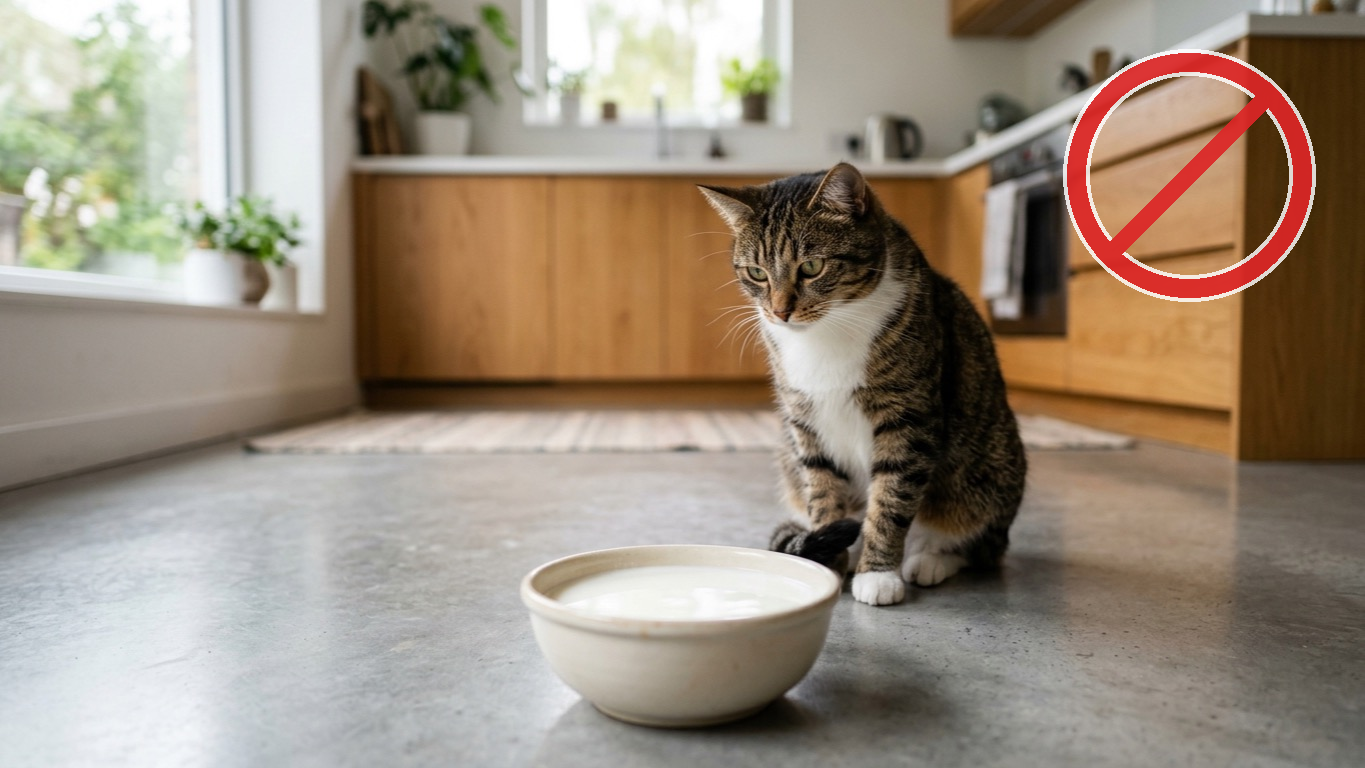
Can cats drink milk as a daily drink? No. Most adult cats should not drink cow’s milk. It is not a poison in the “one sip equals emergency” sense. It is a sugar-and-fat leftover that many cats cannot digest after weaning. PDSA’s public vet Q&A still treats cow’s milk as a bad idea: most cats lack enough intestinal lactase to break down lactose, and a saucer of milk for a cat is, in their wording, like a human eating an entire 12-inch pizza — on top of the day’s food. Water is the drink. A complete wet or dry diet is the nutrition. Special “cat milk” in a carton is still a calorie treat, not a hydration plan.
The We read the titles and descriptions of 0 SKUs and 3 drink classes. Class A is water — the only required daily fluid. Class B is cow, goat, or leftover people dairy — lactose plus fat, no AAFCO complete-and-balanced job. Class C is lactose-reduced “cat milk” or lactose-free cow milk — still calories, still not water. 0 of 3 classes replace a clinic if diarrhea lasts, the kitten is orphaned, or the cat will not drink. 0 of 3 are a product card on this page.
Hero stat: USDA FoodData Central lists whole cow’s milk at about 4.8 g lactose per 100 g (and about 61 kcal per 100 g). That is a label-adjacent number, not a bowl we weighed. A 100 g saucer is already in the neighborhood of 10% of a typical 10 lb indoor cat’s daily calories if you use a ~60 kcal / 100 g line and a ~200–250 kcal/day maintenance band from common feeding charts — those charts are brand- and body-condition specific. We will not print a fake “12-hour trial dose” as a protocol we ran.
Our guides are reader-supported. This article may contain affiliate links. As an Amazon Associate we may earn a commission if you buy through links, at no extra cost to you.
Related: stainless steel water fountains, wet food for senior cats, urinary-tract food, cat dental care. A cat who will not drink, who has bloody stool, or who is collapsed is a clinic. We are not that clinic.
What does can cats drink milk actually mean?
It means: should an adult cat have cow’s milk as a beverage. The honest public-source answer is no as a rule. Kittens digest queen’s milk because they still make lactase. Cow’s milk is a different sugar load and a different nutrient profile. Orphaned kittens need a kitten milk replacer the clinic names — not a mug from the fridge.
Browse lactose-free cat milk as a treat class, not a water replacement →
Quick picks at a glance
- Best listed daily drink: Water. Bowls in more than one room. Many cats drink more if food and water are not stacked. PDSA still says water is what they need.
- Best listed moisture lever if the cat is a poor drinker: Complete wet food, not a saucer. See senior wet for the aging-moisture conversation — that page is cans, not dairy.
- Best listed orphan job: Kitten milk replacer on a clinic label. Cow’s milk is the wrong object.
- Honest leftover (treat class): Lactose-free or “cat milk” cartons. Lower lactose than grocery milk. Still fat. Still optional.
- Honest leftover (cheese): Hard cheddar is lower lactose per 100 g than milk in USDA tables. It is still fat and sodium. A fingertip is not a food group.
How dairy job listings compare on labels
Four real jobs. A saucer is not a fifth.
| Job | What actually works | Category | Fail if you skip it |
|---|---|---|---|
| Daily hydration | Fresh water, maybe a fountain | Class A | Milk as “they won’t drink water” |
| Adult treat curiosity | Skip, or a teaspoon of lactose-free if the vet said the cat can have it | Class C leftover | A bowl “because cartoons” |
| Orphaned / separated kitten | Clinic-named replacer | Off grocery milk | Cow’s milk as formula |
| Diarrhea after dairy | Water, withhold more dairy, clinic if it lasts or the cat is a kitten/senior | Clinic | Human Imodium, more cheese |
Before you shop: (1) water is down and clean, (2) the cat has a complete diet, (3) dairy is not the hydration plan, (4) persistent vomiting, bloody stool, or a kitten who will not nurse is a clinic, not a new carton. Fail gate 4 and this checklist is how you shop past an emergency.
Why can cats drink milk is a lactase-and-calorie worksheet
- Lactase drops after weaning. Mammals that stop nursing stop needing milk sugar. The Conversation’s 2025 explainer reprints the same mechanism: undigested lactose reaches the colon, bacteria ferment it, gas and diarrhea follow. our research’s public page puts typical GI signs within about 12 hours. That is a published window, not a stopwatch we held.
- Cow’s milk is a high-lactose leftover versus queen’s milk. You do not need a house assay to treat cow’s milk as the wrong formula. Kitten replacers exist because the profiles differ.
- Fat is the second leftover. PDSA’s pizza line is a calorie argument even if a rare cat still makes some lactase. Obesity is a clinic conversation; milk on top of a complete diet is how the conversation starts.
- “Cat milk” is still a treat. PDSA says those cartons are often still fatty. Cats Protection says they have no dietary benefit as a drink. Water stays the drink.
- Cheese is not a loophole. Lower lactose is not “free calories.” Soft cheese and yogurt are usually worse lactose leftovers than a hard shard.
How this desk scored can cats drink milk (and refused to score a 75%
We grouped listings by jobs, not a made-up prevalence:
Want a treat-class carton anyway? lactose-free cat milk on Amazon →
How these products compare on labels and price
| Object | Public hook | Desk class |
|---|---|---|
| Water | Required fluid | Class A |
| Whole cow’s milk | ~4.8 g lactose / 100 g; ~61 kcal / 100 g (USDA FDC) | Class B leftover |
| PDSA saucer analogy | 12-inch pizza for the cat’s size, on top of meals | Calorie leftover, not a lab |
| Lactose-free / cat milk | Lower lactose; still calories | Class C leftover |
| Hard cheddar | Much less lactose per 100 g than milk in USDA tables | Tiny optional leftover |
| Kitten milk replacer | Clinic / label object | Orphan class — not cow’s milk |
What to do if the cat already drank milk
If it was a few laps and the cat is otherwise bright: stop offering more dairy. Keep water down. Watch stool and appetite for the rest of the day and the next morning. our research’s public page treats many lactose episodes as self-limiting; dehydration is the reason you still watch.
Call a veterinarian the same day if this is a kitten, a senior, a cat with known gut or kidney disease, or if you see repeated vomiting, bloody stool, extreme lethargy, or a cat who will not drink. Do not give human anti-diarrheals. Do not “treat” with more milk. Do not withhold water.
A one-off stolen sip is not the same file as a daily saucer habit. The habit is the calorie-and-irritation leftover.
Worked households (desk, not a survey)
Household A — cartoon saucer, adult indoor cat. Take the saucer away. Put a second water bowl away from the kibbles. If the cat still begs, a complete wet meal is the moisture lever, not dairy.
Household B — orphaned 5-week kitten. Cow’s milk is the wrong object. Clinic or shelter names a replacer and a feeding schedule. Diarrhea plus a tiny kitten is an urgent file.
Household C — “they only drink milk.” That is a training-and-fountain file. See fountains. Milk trained the preference. Water still has to win.
Household D — lactose-free carton in the fridge. Optional teaspoon, not a bowl. Still count it as a treat against the day’s calories. If stool loosens, the carton goes back on the shelf for good.
Household E — cheese as a pill pocket. Ask the clinic. A rice-grain of something they named beats a cheddar cube you invented. Sodium and fat still count.
Household F — CKD or a “renal” conversation. Moisture is a wet-food and clinic job. See senior wet. Milk is not a kidney protocol.
How should you decide can cats drink milk this month?
- Is the question “daily drink”? → No. Water.
- Is the question “orphan kitten”? → Replacer. Clinic.
- Is the question “they already lapped a bowl”? → Watch, water, clinic if it goes sideways.
- Is the question “treat”? → Skip, or a tiny lactose-free leftover if stool stays normal.
- Is the question “they won’t drink”? → Fountains, extra bowls, wet food — not dairy.
FAQ
Can cats drink milk as adults?
Most should not. PDSA and Cats Protection still treat cow’s milk as a lactose-and-fat leftover. Water is the drink.
Can cats drink milk if it is lactose-free?
Lower lactose reduces the sugar leftover. It does not erase fat or calories. Still a treat, never the water bowl.
Can kittens drink cow’s milk?
No as a plan. Queen’s milk or a labeled kitten replacer. Cow’s milk is the wrong formula and a diarrhea risk.
Can cats drink milk and still be fine?
Some adults show no obvious GI signs. PDSA still advises against it because of fat. “Fine this once” is not a daily plan.
Why do cats like milk if can cats drink milk is a no?
Fat and habit. Cartoons. Farm-cream folklore. Preference is not a nutrient requirement.
Can cats drink goat milk?
Different marketing, still lactose and fat unless a clinic named a specific product. Do not treat “goat” as a loophole.
What if my cat drank milk and has diarrhea?
Water down. No more dairy. Clinic if it lasts, if there is blood, or if the cat is a kitten, senior, or not drinking. No human OTC gut meds.
Is cheese safer when people ask can cats drink milk?
Hard cheese is lower lactose per 100 g than milk in USDA tables. It is still an optional leftover, not a yes.
Reading a carton (the part the photo hides)
If you still buy “cat milk,” read lactose, kcal, and whether it claims to be a complete diet (almost never). A complete diet is an AAFCO (or equivalent) statement on cat food. A carton of milk is a beverage leftover.
Fountains and extra bowls are the hydration aisle. Stainless fountains are a hardware job. This URL is the dairy literacy job.
Internal links and what this URL is not
This page is not a renal diet, a kitten-rearing protocol, or a product ranking. Urinary conversations live on urinary-tract food. Dental is cat dental care. Aging moisture is senior wet.
Sources this desk actually used
- PDSA — Vet Q&A: Can cats drink milk? — lactose intolerance language; saucer ≈ 12-inch pizza analogy; water as the drink; cat-milk still fatty.
- Cats Protection — Are cats lactose intolerant? — most adults; conflicting prevalence estimates; water; lactose-free still calories.
- The Conversation — Can cats drink milk? — lactase after weaning; cow vs queen lactose.
- — Can cats drink milk? — mechanism; ~12-hour GI window; calorie leftover even if tolerated.
- USDA FoodData Central — whole milk lactose and kcal per 100 g (open the current FDC entry; numbers move with the release).
- Thepetbench sister pages: fountains, senior wet, urinary food, dental.
A saucer is a cartoon. A water bowl is the desk answer. Can cats drink milk is a no for the daily drink, a clinic file for orphans and sick cats, and a teaspoon leftover only if you accept the calorie math PDSA already printed.