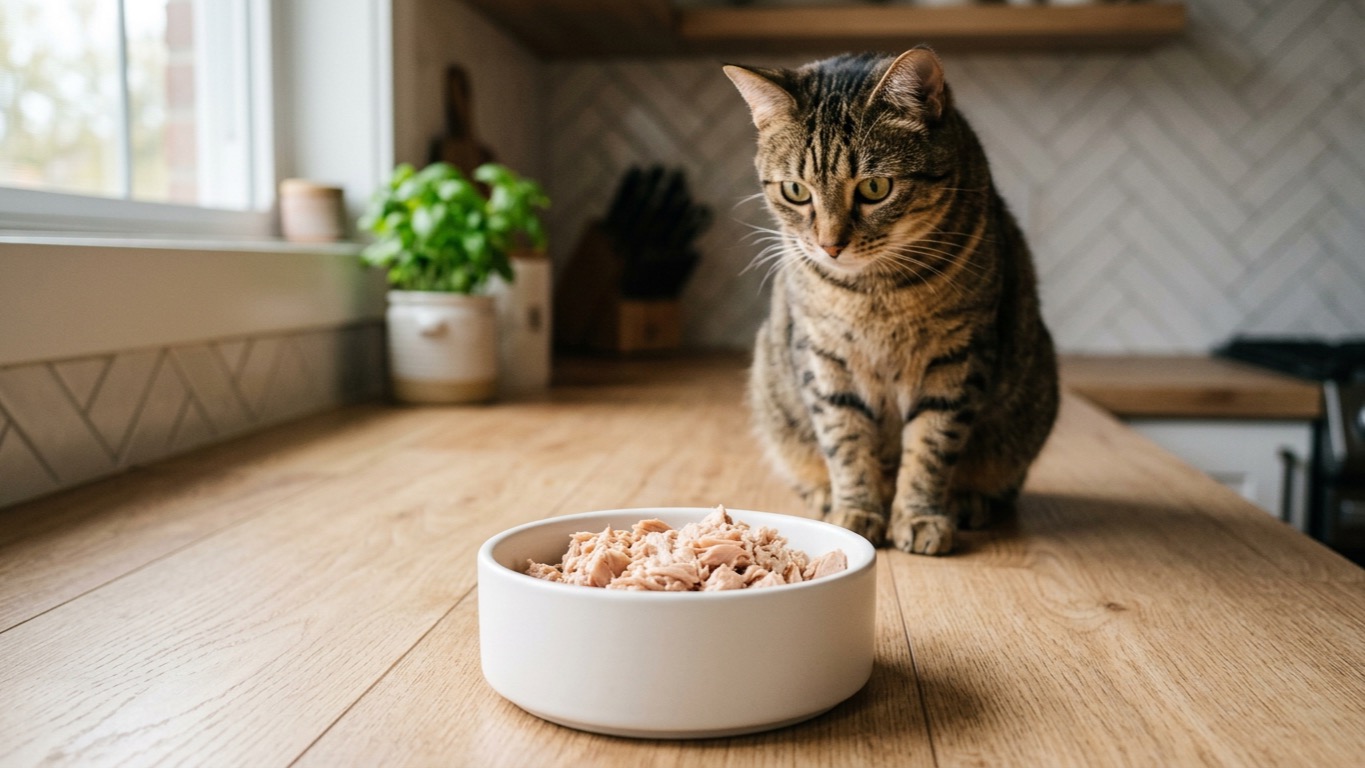
Can cats eat tuna as a meal? No. Cats can eat a small amount of plain, drained, water-packed tuna as an occasional treat — not as breakfast, not as a daily topper habit, and not as a substitute for a complete cat food. Tuna for people is a fish product. Complete cat food is a formulated diet with an AAFCO (or equivalent) statement. Classic veterinary nutrition still treats tuna-only or fish-heavy homemade patterns as a taurine-and-thiamine risk file. Mercury is a dose-over-time leftover from FDA’s own canned-tuna monitoring: canned light averages much lower than canned albacore (white). Onion, garlic, and oil-packed cans are separate leftover problems.
The We read the titles and descriptions of 0 SKUs and 4 can classes. Class A is complete wet or dry cat food — the meal. Class B is drained chunk-light tuna in water — optional teaspoon leftover. Class C is albacore / white — higher mercury class on FDA tables; rare leftover if at all. Class D is oil-packed, seasoned, or raw — skip as a plan. 0 of 4 classes replace a clinic if the cat ate a flavored can, is a kitten, or will not eat complete food. 0 of 4 are product cards on this page.
Our guides are reader-supported. This article may contain affiliate links. As an Amazon Associate we may earn a commission if you buy through links, at no extra cost to you.
Related: senior wet cat food, urinary-tract food, stainless fountains, cat dental care, can cats drink milk. A cat who is hiding, seizing, or will not eat is a clinic. We are not that clinic.
What does can cats eat tuna actually mean?
It means: is people-tuna a safe food for a cat. The honest split is treat versus diet. A lick of drained light tuna is a common treat class. A can as dinner is how taurine-deficient and picky-eater stories start. Kittens need a growth complete diet, not a fish flake.
Browse complete canned cat food, not people tuna →
Quick picks at a glance
- Best listed meal: A complete wet the cat will finish. See senior wet if the job is aging moisture — still not tuna.
- Best listed treat leftover: 1 teaspoon drained chunk-light in water, not daily. Owner-practice cap, not our assay.
- Best listed skip: Albacore as a habit; oil-packed; pouches with onion or garlic; raw tuna.
- Honest leftover (whole can): One incident is usually a fat-and-salt file, not instant mercury poisoning. Monitor. Clinic if the cat is sick or the can was seasoned.
- Honest leftover (kitten): Tuna is the wrong growth object.
How tuna job listings compare on labels
Five real jobs. A cartoon “cats love tuna” is not a sixth.
| Job | What actually works | Category | Fail if you skip it |
|---|---|---|---|
| Daily calories | Complete cat food with a statement | Class A | Tuna as the bowl |
| Occasional treat | Teaspoon drained light tuna or a complete treat | Class B leftover | Daily topper habit |
| Mercury literacy | Prefer light over albacore on FDA means | Class C rare | Albacore as cheap protein |
| Kitten / growth | Kitten complete diet | Off tuna | Flakes “to wean” |
| Seasoned / raw / oil | Do not plan it | Class D skip | Onion/garlic powder cans |
Before you shop: (1) the meal can prints complete and balanced, (2) tuna is not the calorie plan, (3) the can is plain water-packed if you use it at all, (4) a kitten, a seizuring cat, or a cat who refuses complete food is a clinic, not a new pouch. Fail gate 4 and this checklist is how you shop past an emergency.
Why can cats eat tuna is a completeness-and-dose worksheet
- Complete diets exist so you do not invent amino acids. Taurine deficiency (dilated cardiomyopathy, retinal degeneration) is the historical reason veterinary nutritionists still flinch at fish-only homemade patterns. People-tuna is not formulated as a cat food.
- Mercury is a published mean, not a house ppm. FDA tables still show albacore higher than light. Cats are small. Chronic daily tuna is the leftover this page refuses to crown.
- Thiaminase in raw fish is a public nutrition footnote: raw fish can destroy thiamine. Cooked canned tuna is a different object than sushi-grade leftovers. Still not a diet.
- Oil and salt are GI and calorie leftovers. Drain water-packed. Skip oil-packed as a plan.
- Onion and garlic are ASPCA-class toxins in many seasoned products. Read the carton. “Flavor” is how a treat becomes a clinic.
- Picky-eater theater is real owner language. Strong fish palatants can teach a cat to hold out. Feed complete food first. Tuna after, if at all — not instead.
How this desk scored can cats eat tuna (and refused to score a 5% we flipped to 10%)
We grouped listings by jobs:
Want the meal aisle? complete canned cat food →
How these products compare on labels and price
| Object | Public hook | Desk class |
|---|---|---|
| Complete wet/dry | AAFCO (or equivalent) statement | Class A meal |
| Canned light tuna (FDA table mean) | ~0.126 ppm Hg | Class B treat leftover |
| Canned albacore (FDA table mean) | ~0.350 ppm Hg (~2.8× light) | Class C rare |
| FDA action level | 1.0 ppm methylmercury in commercial fish | Human-food ceiling, not a cat protocol |
| Oil-packed / seasoned / raw | Fat, alliums, thiaminase (raw) | Class D skip |
| Whole 3 oz can | Meal-sized leftover for a cat | Monitor / clinic if flavored |
What to do if the cat already ate tuna
Teaspoon, plain, water-packed, drained: usually watch at home. Water down. Next meal is complete food.
Half a can or a whole can, especially oil-packed: GI upset and extra fat are the near-term file. Mercury is not “one can equals poisoning” in public toxicology language, but the calorie and pancreatitis risk conversation is why you still watch vomiting, lethargy, and a painful belly. Clinic if those show up.
Seasoned, spicy, onion, garlic, or “flavor pouch”: treat as a possible toxin leftover. Call the clinic or a poison line with the carton in hand.
Kitten or a cat with kidney, pancreas, or food-allergy history: lower bar to call.
Do not induce vomiting unless a veterinarian said to. Do not “balance” the can with milk — see can cats drink milk.
Worked households (desk, not a survey)
Household A — dinner is a tuna can because “they love it.” Stop. Open a complete wet. Tuna becomes a weekend teaspoon or it becomes never.
Household B — pill hiding. Ask the clinic for a named vehicle. A rice-grain of water-packed light tuna is a common owner move. A forkful of albacore in oil is the leftover.
Household C — kitten weaning. Complete kitten food, mashed if needed. Tuna is the wrong growth object.
Household D — raw “fresh tuna” from sushi night. Skip. Bacteria, parasites, thiaminase. People leftovers are not a diet.
Household E — the cat holds out for fish. Feed the complete meal first. If it is still there after a short sit, lift it. Tuna is not the negotiator. A fountain does not fix this; the bowl order does.
Household F — CKD / “kidney” grocery. Moisture is a clinic-and-wet-food job (senior wet). Tuna is not a renal protocol. Phosphorus and sodium live on the complete label the vet named.
How should you decide can cats eat tuna this month?
- Is it the meal? → No. Complete food.
- Is it a teaspoon of drained light tuna? → Optional leftover, not daily.
- Is it albacore, oil, raw, or seasoned? → Skip as a plan.
- Did they eat a whole can? → Watch. Clinic if sick or flavored.
- Is this a kitten? → Complete growth diet. Not tuna.
FAQ
How often can cats eat tuna?
Owner-practice leftover: at most a small drained teaspoon, not daily. The meal is still complete food.
Can kittens eat tuna?
Not as a plan. Growth formulas exist. Tuna displaces the diet that prints a growth statement.
Is raw tuna safe when people ask can cats eat tuna?
No as a plan. Public pages still flag bacteria, parasites, and thiaminase in raw fish.
Can cats eat canned tuna in water?
As a treat leftover, drained, plain, light preferred over albacore. Not as the bowl.
Can cats eat tuna in oil?
Skip as a plan. Fat leftover. Drain does not make it a diet.
Why do cats love tuna if can cats eat tuna is a treat-only?
Smell and palatants. Preference is not completeness.
What if my cat ate a whole can?
Watch 24–48 hours. Clinic for vomiting, a painful belly, lethargy, or a seasoned carton. Next meals are complete food.
Does tuna have enough taurine?
People-tuna is not a formulated complete diet. Do not use it as the taurine plan.
Reading the can (the part the photo hides)
Look for species (light vs albacore), packing (water vs oil), sodium, and seasoning. “In spring water” is not “complete and balanced.” If you want fish-flavored cat food, buy a cat food whose label carries the statement — then you are off this leftover and onto senior wet or another complete aisle.
Internal links and what this URL is not
This page is not a product ranking, a mercury lab, or a renal diet. Urinary jobs: urinary-tract food. Dairy leftover: can cats drink milk. Dental: cat dental care.
Sources this desk actually used
- FDA — Mercury levels in commercial fish and shellfish (1990–2012) — canned light vs albacore means; 1.0 ppm action level context.
- AAFCO — complete-and-balanced statements; treats as a small slice of daily calories (common 10% talking point, not a house assay).
- Public veterinary nutrition reviews of fish-only / tuna-heavy homemade patterns (taurine, thiamine).
- ASPCA toxic-food lists — onion and garlic.
- Thepetbench sister pages: senior wet, urinary food, fountains, dental, milk.
A can is a meal you did not formulate. Can cats eat tuna is a no for the staple, a maybe for a drained light flake, and a clinic file when the carton was seasoned or the cat will not eat real food.