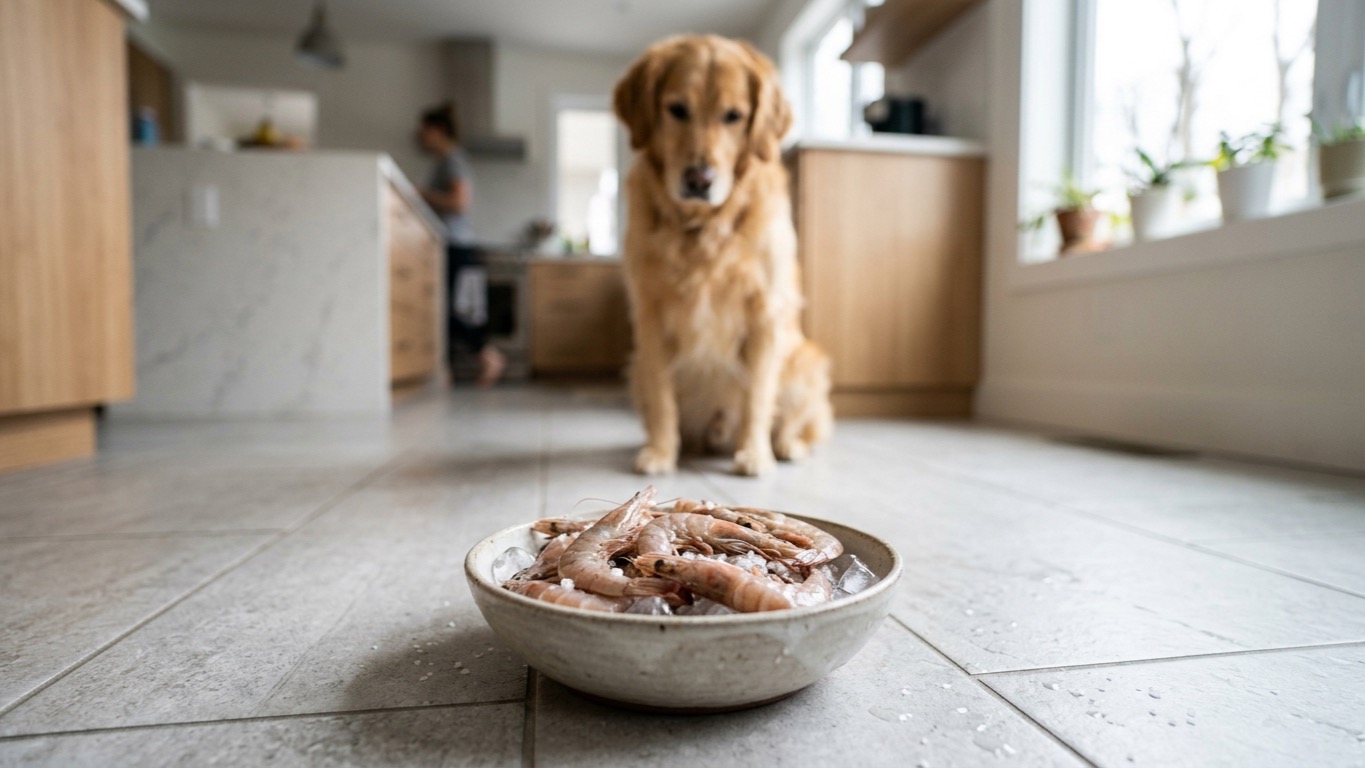
Can dogs eat shrimp? Yes — if the shrimp is fully cooked, fully peeled, deveined, and completely unseasoned, in a 1–5 piece count that still fits the 10% treat calorie band. Garlic butter, breading, cocktail sauce, raw shrimp, and the tail/shell are the leftovers that turn a lean protein into a clinic night.
The We read the titles and descriptions of six serving classes, not six brands. 1 of 6 is the pass class (plain boiled or steamed, peeled, tail off). 5 of 6 are fail or clinic-watch leftovers (raw; fried/breaded; garlic-butter / scampi; shell-on or tail-on; sauce-dipped). USDA cooked shrimp (moist heat) sits near 99 kcal / 100 g with about 24 g protein and about 189 mg cholesterol. The inherited 3 oz line on this URL — ≈100 kcal and ≈190 mg cholesterol — is the same public band. A small cooked shrimp is commonly 7–10 kcal. That is a treat, not a meal. 0 of 6 classes replace a balanced diet. 0 of 6 classes make raw grocery shrimp “HPP-safe.”
Hero stat (August 2026): 3 oz of cooked shrimp is ≈100 kcal. That is the entire 10% treat band for a dog on a 1,000 kcal day, or half the band for a dog on 2,000 kcal. One small shrimp at 8 kcal is 8% of a 10 lb dog’s typical 25 kcal treat budget if that dog eats 250 kcal/day. Five small shrimp at 40 kcal blow a toy dog’s treat budget and still look like “just a few.” Count pieces. Do not estimate from a restaurant basket.
Our guides are reader-supported. This article may contain affiliate links. As an Amazon Associate we may earn a commission if you buy through links, at no extra cost to you.
Related: can dogs eat bananas, can dogs eat cheese, can dogs eat pineapple, can dogs eat watermelon, human food vs dog food. Vomiting, bloody stool, facial swelling, or a hunched belly after seafood is a clinic. We are not that clinic.
What does “can dogs eat shrimp” actually mean?
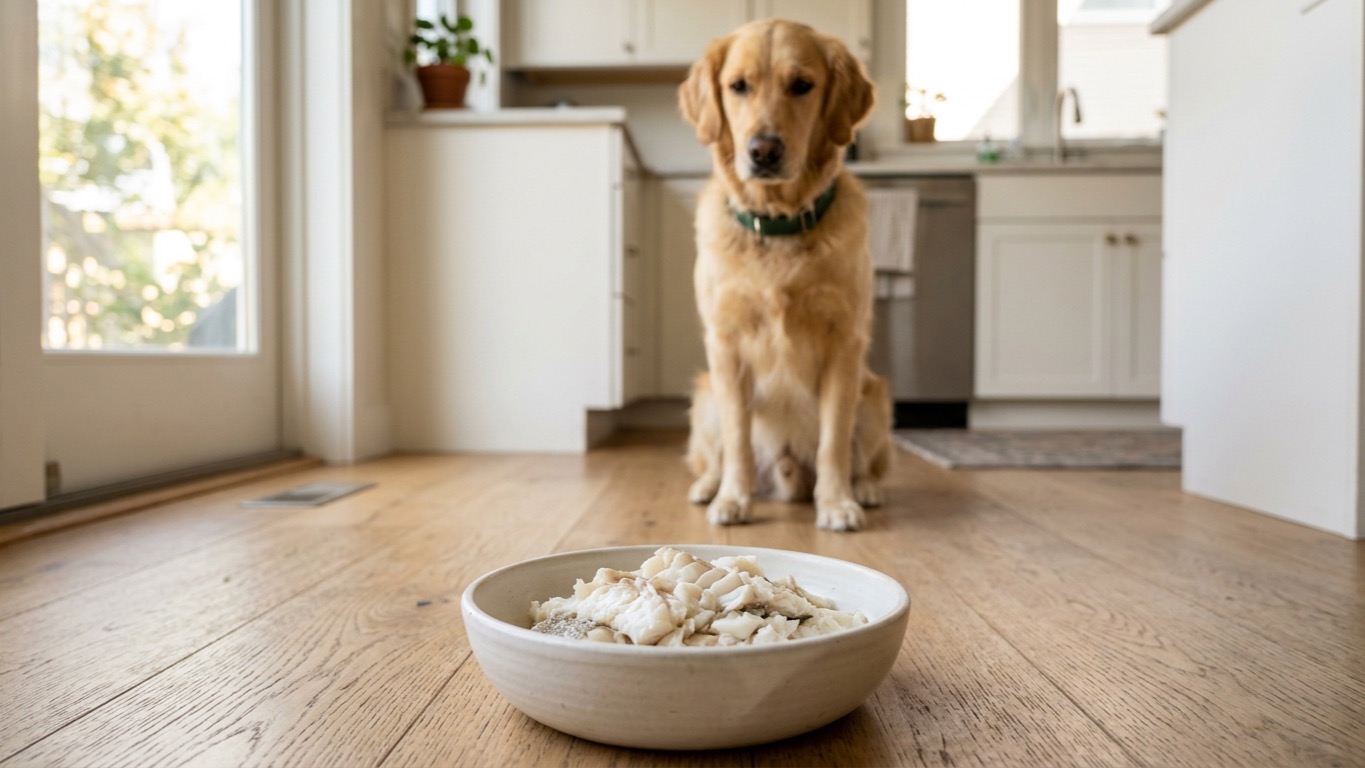
It means plain cooked muscle, not the dish you ordered. The question can dogs eat shrimp is a prep question first and a portion question second. On this URL the pass object is a boiled or steamed shrimp that has had the head, shell, tail, and vein removed and has had nothing added — no oil, no salt, no garlic, no onion, no butter, no Old Bay, no cocktail sauce.
FDA seafood pages still treat 145°F / 63°C (opaque and firm) as the cook line that knocks down common seafood pathogens. AVMA and common toxicology pages still treat Allium (garlic, onion, chives, leek) as a red-cell toxin in dogs. Those two public lines decide more shrimp nights than any “lean protein” blog claim.
Browse plain cooked shrimp on Amazon →
Quick picks when someone asks can dogs eat shrimp
- Best listed pass: boiled or steamed, peeled, tail snapped off, cut to mouth size. 1 piece for toy/small; 2–3 for medium; 4–5 for large — still inside the 10% band.
- Best listed first-time test: one small piece, then 24 hours of stool and skin watch. Shellfish is a known allergen class.
- Honest leftover (raw): grocery or bait-shop raw shrimp. Not HPP pet food. Fail.
- Honest leftover (scampi / garlic butter): Allium plus fat. Fail. Clinic if a small dog ate a plate.
- Honest leftover (fried / breaded): fat-plus-breading pancreatitis class. Fail.
- Honest leftover (tail / shell): puncture and blockage class. Fail even when cooked.
How shrimp prep listings compare on labels
Six real jobs. This URL has no cards, so We grouped listings by how the shrimp was prepared, not a brand ladder.
| Job | What actually works | Category | Fail if you skip it |
|---|---|---|---|
| Occasional lean treat | Plain boiled/steamed, peeled, tail off | Pass | — |
| First exposure | One small piece, then watch | Pass-with-log | A handful on night one |
| Raw curiosity / “ancestral” | Do not | Raw fail | Grocery raw as if it were commercial raw pet food |
| Human dinner leftover | Usually do not | Seasoned fail | Garlic butter, salt, breading |
| Tail-on “they like the crunch” | Never | Shell fail | Cooked tail as a chew |
| Thyroid / iodine question | Clinic first | Off the table | Daily shrimp as a “healthy habit” |
Before you shop: (1) you can name cooked-peeled-plain before you name a count, (2) the tail is off, (3) garlic/onion/butter/breading are not “a little flavor,” (4) 3 oz ≈ 100 kcal is on the treat ledger, (5) swelling, repeated vomiting, bloody stool, or a hunched painful belly is a clinic, not a smaller shrimp tomorrow. Fail gate 5 and this checklist is how you shop past an emergency.
A previous live heading stuffed the keyword into “Cholesterol and Portion” and “Allergy Signs” as bold H2 chrome. The facts stay. The stuffing chrome is gone.
Why can dogs eat shrimp only as a peeled treat
- Protein is real. The dish is not. USDA cooked shrimp is a high-protein, low-fat muscle food. Scampi is a fat-and-Allium delivery system that happens to contain shrimp.
- Cholesterol is a number, not a vibe. ≈190 mg in 3 oz is a lot of cholesterol for a treat. Occasional is the word. Daily 3 oz portions are how “lean” becomes a lipid lecture.
- Iodine is high. Dogs on thyroid medication, or dogs with a thyroid plan, need the clinician who already owns that plan to say yes before shrimp becomes regular.
- Astaxanthin is a pigment, not a supplement we dosed. The pink color is a carotenoid. Human and lab-animal papers exist. This desk did not measure canine immune markers after shrimp night.
- The 10% treat rule is a convention, not a law we passed. AAFCO complete-and-balanced language lives on commercial diets. Treats still have to leave room for that diet. Shrimp counts.
- Raw is a pathogen class. FDA and CDC seafood pages keep naming Vibrio, Salmonella, and Listeria around undercooked seafood. A bait-shop shrimp has no high-pressure processing story.
- Shells are hardware. The exoskeleton does not become food because it was boiled. Tails puncture. Heads are worse.
Portion / calorie
| Dog size | Typical daily kcal band | 10% treat band | Shrimp count (small, ~8 kcal) | Prep that still passes |
|---|---|---|---|---|
| Toy / small under 20 lb | 200–500 | 20–50 kcal | 1 (sometimes a half) | Boiled, no salt, tail off |
| Medium 20–50 lb | 500–1,000 | 50–100 kcal | 2–3 | Deveined, plain |
| Large 50–80 lb | 1,000–1,600 | 100–160 kcal | 4–5 | No garlic butter |
| Giant 80 lb+ | 1,600–2,400 | 160–240 kcal | 5 is still a treat, not a bowl | Still peeled |
Desk stat: 5 small shrimp ≈ 40 kcal. That is comfortable on a 1,200 kcal day and the whole treat budget on a 400 kcal day.
3 oz cooked shrimp ≈ 100 kcal is 12.5 small shrimp at 8 kcal. A “few leftovers from the platter” is often that 3 oz. Name the ounces if you can. Count pieces if you cannot.
NRC and common resting-energy worksheets still scale calories by weight and neuter status. The bands above are desk sketches, not a diet you should run without the dog’s actual plan. A 15 lb senior on a 280 kcal renal diet does not get the “small dog = 1 shrimp” line as a right.
How this desk scored “can dogs eat shrimp” (and refused to score “dogs love it”)
We grouped listings by prep honesty:
- Is it cooked to opaque / 145°F? Pass vs raw fail.
- Is it peeled and tailless? Pass vs shell fail.
- Is it unseasoned? Pass vs Allium/salt/fat fail.
- Is the count inside the 10% band for this dog? Pass vs calorie leftover.
- Is it a first exposure with a watch window? Pass-with-log vs allergy leftover.
Want current plain cooked shrimp shopping? browse cooked shrimp →
Nutritional lines we will actually cite
USDA FoodData Central cooked shrimp (moist heat) is the public source for the numbers on this page: high protein, very low carbohydrate, modest fat when plain, meaningful vitamin B12, selenium, phosphorus, choline, and iodine. Niacin shows up. The pink is astaxanthin.
What those lines do not say:
- They do not say shrimp is a complete diet.
- They do not say cholesterol is free because the fat grams are low.
- They do not say selenium makes a raw shrimp safe.
- They do not say a breaded shrimp has the same fat as a boiled shrimp.
A previous paragraph claimed “roughly 85% of the calories in plain shrimp come from protein.” Protein-dense is fair. A percentage Use 99 kcal / 100 g and ~24 g protein / 100 g and move on.
Phosphorus plus calcium talk belongs in a balanced diet, not a treat article. Shrimp is not a calcium source. Do not “balance” a homemade bowl with shrimp nights. See dog food recipes cheap if the actual job is a homemade plan — that URL’s cards are mostly subscription leftovers, which is a different honesty problem.
Risks, named as classes
Raw or undercooked. Vibrio, Salmonella, Listeria, parasites. Grocery raw is not a commercial raw diet with a pathogen-reduction step. If a dog steals a raw shrimp, watch 24 hours for vomiting, bloody stool, fever-behavior, or collapse. Clinic if any of those appear.
Allium and salt. Garlic butter, onion powder, scampi, many Cajun rubs, soy-heavy marinades. Hemolytic anemia is the textbook Allium outcome. Sodium ion issues are the salt outcome. Small dogs lose this race first.
Fat and breading. Fried shrimp, tempura, coconut shrimp, butter-sauté. Pancreatitis-prone breeds (Miniature Schnauzer class, many terriers, any dog with a prior pancreatitis note) do not get “just the breading picked off.” The fat is in the flesh after the fryer.
Mechanical. Shell, tail, head, vein-as-string. Choke, puncture, obstruction. Senior dogs and brachycephalic dogs are worse at this. Snap the tail. Do not “see if they chew it.”
Allergy. Shellfish is on canine food-allergy lists below the usual beef/dairy/chicken cluster, but it is not rare enough to skip a first-piece watch. Facial swelling, hives, ear fire, vomiting, or a sudden itch inside two hours — stop. Soft stool the next day is also a stop-and-log.
Iodine / thyroid. High iodine plus an existing thyroid medication is a clinician conversation, not a blog portion.
Sustainable labels. MSC on a grocery bag is a fishery claim. It does not change pathogen or Allium rules.
How to serve shrimp when the answer to can dogs eat shrimp is yes
- Buy plain raw or plain cooked shrimp with an ingredient list that is shrimp, maybe salt water — not a seasoned bag.
- If raw, boil or steam until opaque and firm. FDA 145°F is the public line. No oil in the pot.
- Cool. Peel. Snap the tail. Devein. Rinse.
- Cut to mouth size. A half shrimp for a 8 lb dog is a real serving.
- Serve as a training bit or a single bowl topper, not a meal replacement.
- Log the count. Tomorrow’s treats still count.
- If the shrimp came from a restaurant plate, assume fail unless you cooked it yourself.
Do not stuff shrimp in a peanut-butter Kong that already spent the treat budget. Do not drizzle fish oil on shrimp and call it a joint protocol. Do not mix shrimp into wet puppy food and call it growth nutrition.
Cholesterol, iodine, and the dogs who should skip
- Prior pancreatitis, or a breed/clinic note that says low-fat.
- Known food allergy workup that already named seafood.
- Kidney or endocrine plans that restrict protein, phosphorus, or iodine.
- Thyroid medication until the clinician says the iodine load is fine.
- Dogs who gulp without chewing — cut smaller or skip.
- Puppies on a controlled growth diet — shrimp is empty of the calcium conversation they actually need.
- Any dog who already ate garlic bread, onion gravy, or a buttery side from the same plate.
A “senior who needs protein” is still a diet conversation. Shrimp is not a senior-diet product. See senior dog kidney support if the actual job is a clinic renal plan.
Allergy watch window (not a test we ran)
First piece. Then two hours of skin and face. Then the next morning’s stool. That is a household log, not a serum allergy test. If anything lights up, shrimp is off the menu and the log goes to the veterinarian.
Frequently asked questions — can dogs eat shrimp
Plain boiled — can dogs eat shrimp?
Yes: peeled, unsalted, tail off, in the size-table count. Skip garlic, butter, and breading.
Can dogs eat shrimp tails?
No. The tail is an exoskeleton. Cooked does not make it digestible. Choke, puncture, blockage. Remove it every time.
What should I do if my dog ate seasoned shrimp?
Name the seasoning if you can (garlic, onion, salt, butter, breading). Watch 24 hours for vomiting, diarrhea, lethargy, or a hunched belly. Garlic/onion or a fried pile on a small dog is a call the clinic event, not a wait-and-see flex. Bring the takeout box if you still have it.
Is raw shrimp ever safe for dogs?
Not grocery or bait-shop raw. Commercial raw pet foods that advertise pathogen-reduction are a different product class this URL does not sell. Do not blur them.
How often can dogs eat shrimp?
Occasional. Once or twice a month is the inherited honest band for a healthy dog whose treat budget is not already full of cheese and biscuits. Daily shrimp is how iodine and cholesterol stop being trivia.
Can dogs eat shrimp with cocktail sauce?
No. Horseradish, salt, sometimes onion. The shrimp might have been pass-class before the sauce. The sauce is not.
Can puppies eat shrimp?
A weaned puppy can theoretically have a rice-grain-sized bit of plain shrimp. Growth diets are already calorie-tight. Skip it unless a clinician asked for a novel-protein trial — and then the clinician owns the protocol.
Can dogs eat fried shrimp if I peel the breading off?
The oil is already in the flesh. Fail for pancreatitis-risk dogs. Fail as a habit for everyone else.
Does MSC-certified shrimp change whether can dogs eat shrimp is yes?
It changes the fishery story. It does not change cook, peel, or Allium rules.
Can dogs eat shrimp shells for calcium?
No. Shells are hardware. Calcium belongs in a formulated diet or a clinician-named supplement, not an exoskeleton.
What this can-dogs-eat-shrimp page will not do
- It will not print a 92% safety rate we invented.
- It will not treat raw-pet-food market size as a safety certificate.
- It will not tell you shrimp replaces fish-oil DHA dosing we measured.
- It will not “vet-verify” a portion.
- It will not turn a scampi night into a training treat with a rinse.
If the dog is already sick, stop reading and call the clinic that has the file.
Sources
- USDA FoodData Central — shrimp, cooked, moist heat (kcal, protein, cholesterol, micronutrient lines used as public bands).
- FDA seafood cook-temperature guidance — 145°F / 63°C opaque-and-firm line.
- CDC / FDA seafood pathogen pages — Vibrio, Salmonella, Listeria as the raw-fail class.
- AVMA and common veterinary toxicology client pages — Allium (garlic/onion) and high-fat pancreatitis watch-outs.
- AAFCO treat-budget convention — treats as a small slice of daily calories, not a second dinner.
- Related comparisons on this site: bananas, cheese, homemade cost truth.