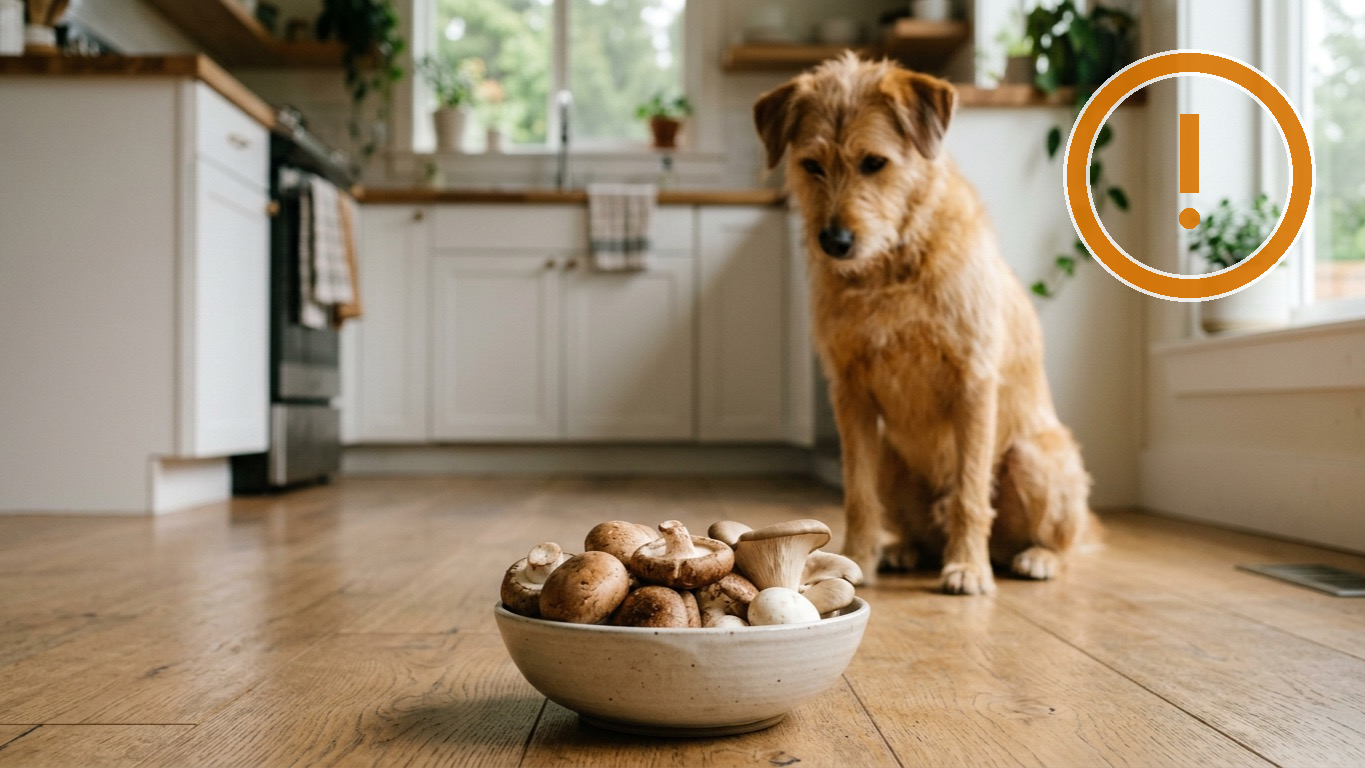
The PetBench Yard-Mushroom Protocol (August 2026 desk compilation) is a fork, not a ranking. Fork A: a labeled clamshell from a store, cooked without oil, butter, garlic, or onion. Fork B: anything that grew in grass, mulch, a trail, or a planter. Fork B does not get a portion table. Fork B gets ASPCA Animal Poison Control or your emergency clinic, a photo, and the mushroom in a bag if you can take it safely.
Our guides are reader-supported. This article may contain affiliate links. As an Amazon Associate we may earn a commission if you buy through links, at no extra cost to you.
Related: cheese (garlic sauté is an Allium problem), grapes (another “looks like food, is not a snack” page).
What can dogs eat mushrooms does not mean
- A mushroom you cannot name to species
- “The squirrels ate it, so it’s fine”
- Raw grocery mushrooms as a crunchy treat
- Canned buttons in brine as a low-effort extra
- Butter-and-garlic sides “just a bite”
- Reishi / turkey-tail / lion’s mane capsules from a human cabinet
- A desk-written ID from a phone photo
Mycologists describe thousands of mushroom species; field guides disagree, and look-alikes are the point of the danger. This page will not publish a backyard ID key. Visual ID from an SEO article is how people delay a call.
Browse a “leave it” training setup →
Yard-Mushroom Protocol
| Fork | Object | Desk action | Why |
|---|---|---|---|
| A — grocery | Labeled Agaricus bisporus (button / cremini / portobello) | Cook plain; teaspoon portions | Common market species; still an extra, not a food group |
| A — grocery reject | Canned, stuffed, breaded, or seasoned | Skip | Sodium, Allium, fat |
| B — wild | Lawn, trail, mulch, planter, “pretty white cap” | Emergency pathway | Amatoxin and other classes; delayed liver stories exist in the literature |
| B — unknown cooked leftover | Restaurant “wild mushroom” mix | Call if more than a taste; do not guess species | You cannot audit the sauté |
Before you shop: (1) if it grew outside the clamshell, it is Fork B, (2) do not wait for vomiting to “confirm,” (3) do not induce vomiting unless a professional tells you to, (4) garlic and onion stay out of Fork A, (5) seizures, collapse, or a dog who cannot stand is ER, not a home watch. Fail gate 5 and this page is closed.
USDA-class raw white mushroom is about 22 kcal, 3.3 g carbohydrate, and 3.1 g protein per 100 g. That protein is not a meal plan. A tablespoon of cooked, squeezed buttons is a garnish.
How much store mushroom is safe — Fork A only
| Dog weight | Cooked plain max / session | Frequency |
|---|---|---|
| Under 20 lb | ½ teaspoon chopped | 1–2× / week |
| 20–50 lb | 1 teaspoon | 1–2× / week |
| 50+ lb | 1 tablespoon | 1–2× / week |
Cook to soften chitin-rich cell walls. This desk will not claim cooking “makes nutrients more bioavailable” as a finding we measured. We will say raw grocery mushrooms are a common GI-upset extra in owner reports and are not worth the crunch.
Skip canned as a default. Brine sodium is a label problem; a half-cup of canned mushrooms can land in the hundreds of milligrams of sodium depending on brand. Read the can or do not use the can.
Why wild mushrooms are not a “can dogs eat mushrooms” trivia answer
Published veterinary toxicology treats mushroom ingestion as a time-sensitive problem because some toxins — amatoxins in Amanita species such as the death cap (Amanita phalloides) — can produce a delayed liver picture after a quiet interval. Other species hit the gut or the nervous system faster. You cannot sort those classes by Instagram.
Dogs mouth first. People spit a bitter cap. That behavioral difference is why this desk will not write a cute “dogs are statistically more likely to die” line as if we owned a mortality registry. The operational fact is enough: they swallow what you would spit.
If ingestion already happened:
- Note time, estimated amount, and dog weight.
- Photograph the mushroom and the site. Bag a sample without touching unknown caps with bare hands if you can avoid it.
- Call your veterinarian, an emergency hospital, or a pet poison hotline (ASPCA APCC is a commonly cited US number: 888-426-4435; Pet Poison Helpline is another). Hotlines may charge a consult fee. That is still cheaper than waiting.
- Follow their instructions only.
Do not crowdsource an ID in a Facebook group while the clock runs.
Cooking method for Fork A — can dogs eat mushrooms without Allium
Sauté in a dry pan or steam. No butter puddle. No oil bath you will then call “a teaspoon.” No garlic, no onion, no chive, no shallot. Allium species are a documented oxidative red-cell risk class in dogs; published notes often mention garlic in the grams-per-kilogram range as a concern. You do not need a gram/kg calculator to keep garlic off a dog garnish.
Salt is for your plate. The dog’s teaspoon stays unsalted.
Do not mix Fork A mushrooms into a human stir-fry and then “pick out the safe bits.” You will miss the garlic.
Medicinal mushroom supplements
Reishi, turkey tail, and lion’s mane show up in holistic marketing. Extract strength varies. Drug interactions are a clinician problem. This desk does not dose an immune capsule. If a product is not labeled for dogs and your veterinarian did not name it, it stays on the shelf.
Yard prevention that is not a product ranking
Walk the lawn after rain. Kick or bag mushrooms before the dog is let out — you, not the dog, do the kicking. Mulch beds grow surprises. A short lead in wet woods is a management tool, not cruelty. Teach leave it with food the dog is allowed to have, then proof it around dirt. A treat pouch is for the training bits, not for packing wild caps.
Frequently asked questions — can dogs eat mushrooms
Can dogs eat mushrooms from the grocery store?
Plain cooked button / cremini / portobello in the teaspoon table: conditional yes. Seasoned, stuffed, or canned: default no.
Can dogs eat raw mushrooms?
This desk’s default is no for raw grocery caps. GI upset is the common complaint. Cooking is the Fork A method.
Are canned mushrooms safe for dogs?
Generally skip. Sodium and brine are the reasons, not a mystery preservative we named. If you must, rinse and still count sodium — or use fresh.
How can I tell if a wild mushroom is poisonous?
You cannot, from this page. Assume poisonous. Prevent access. If already eaten, photograph and call — do not wait for a perfect ID.
What should I do if my dog eats a wild mushroom on a walk?
Protocol above. Immediate call. Sample and photo if safe. No home peroxide protocol from a video.
Are medicinal mushroom supplements safe for dogs?
Not as a casual bowl topper. Ask the veterinarian who knows the chart.
Can dogs eat mushrooms cooked in butter?
Butter is fat. See cheese for why fat extras stack. A butter sauté is a different calorie object. Dry-cook or skip.
What if my dog ate one grocery button raw off the floor?
Often a monitor-and-call-if-symptomatic event for a medium healthy dog — still tell the clinic if the dog is tiny, already sick, or you are unsure it was grocery. If it might have been a yard cap, treat it as Fork B.
Sources and method
- USDA FoodData Central, raw white mushroom.
- ASPCA Animal Poison Control mushroom / people-foods framing.
- Published veterinary toxicology discussions of amatoxin-class Amanita (including death cap) as a delayed liver risk — used as a why we do not wait rule, not as a home treatment recipe.
- Allium warnings as commonly stated in poison-control class sources.
” For Fork B, use a licensed veterinarian or a poison hotline — not a second SEO article.