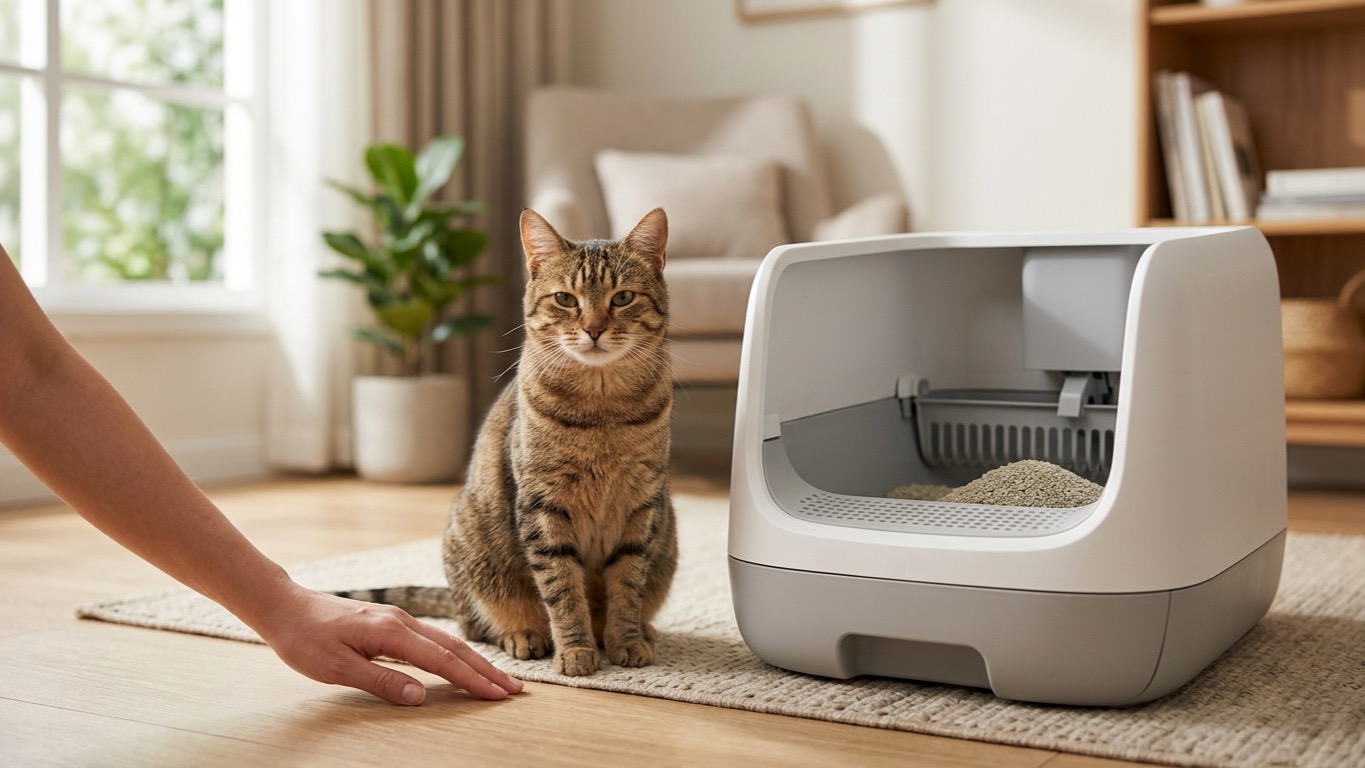
The best automatic litter box for multiple cats is a unit with a published multi-cat capacity, a waste drawer large enough for your scoop interval, quiet cycling, and a litter type the cats already accept—one box for three cats is a scheduling problem, not a badge of honor.
Pet Bench Multi-Cat Litter listing review (August 2026): In this product set, list prices commonly sit in the $200–$700+ smart-box band. Units advertising multi-cat modes and app alerts ranked higher on our desk’s ops checklist than single-cat mini globes. We compared manufacturer claims and owner reports; we did not run odor chambers or claim veterinary sanitation certification.
| Desk table A — Cat count vs box count (desk heuristic) | Cats | Minimum boxes (classic rule) | Auto-box note |
|---|---|---|---|
| 1 | 1–2 | One auto may suffice | |
| 2 | 2–3 | One large auto + one backup | |
| 3+ | n+1 classic | Plan 2 autos or auto + backups |
| Desk table B — Ops checklist for multi-cat autos | Feature | Why it matters |
|---|---|---|
| Cycle delay after exit | Prevents mid-use spin | |
| Drawer capacity | Night-long multi visits | |
| Litter compatibility | Clump quality drives jams | |
| Noise | Skittish cats avoid loud units | |
| Sensor reliability | False cycles / refusals |
| Desk table C — Price bands | Band | USD | Buyer profile |
|---|---|---|---|
| Mid smart | ~$200–$400 | First auto upgrade | |
| Premium | $400–$700+ | App / multi-cat feature sets | |
| Eco / open autos | Varies | Different failure modes |
Multi-cat realities automatic boxes do not erase
Cats may block resources. A single prestigious globe can become a conflict hotspot. Keep at least one simple backup box during transitions. Scoop drawers on the manufacturer’s interval—even “automatic” is not zero maintenance.
1. Fumoi Self Cleaning Litter Box
Best for: Busy two- or three-cat households
Fumoi’s listing sits in the mid-premium automatic-box tier and markets a large self-cleaning drum for more than one cat. Maker pages highlight app control, safety sensors, and a washable liner, which matches what multi-cat owners say they want when twice-daily scooping stops working. Owners still report the waste drawer fills faster once a third cat joins the rotation, so emptying stays on the calendar.
Pros: Mid-premium self-cleaning drum; App control for multi-cat homes Cons: Waste drawer fills faster
2. PARUUNTYS Self Cleaning Litter Box
Best for: Budget buyers wanting open-top access
PARUUNTYS sells a sub-$100 self-cleaning box, the entry price for this category. Listings describe an open-top bowl, app alerts, and a sealed waste bin rather than a premium enclosed globe. Owners treat it as a scoop-saver, not a forever machine, and budget builds at this price usually mean more careful bin emptying.
Pros: Sub-hundred automatic price; Open-top easier cat entry Cons: Budget-tier long-term durability
3. Self Cleaning Cat Litter Box
Best for: First automatic box on a tight budget
This listing has no brand on the title, only the generic self-cleaning promise and a $99.99 price. That is a trial-tier automatic box for owners who want to stop daily scooping before they spend $200-plus. Published pages for no-name units at this price rarely document spare parts or long support windows, so treat it as a first experiment, not the last box you buy.
Pros: Lowest listed price here; Simple self-cleaning entry Cons: No named brand support
4. MeoWant Self-Cleaning Cat Litter Box
Best for: Premium multi-cat homes with large cats
MeoWant is the expensive pick on this list, and the brand’s current smart boxes are sold for several cats rather than one. Maker pages put the money into app logs and a larger litter well than the $99 units. Owners who pay this much are buying a named spare-parts path more than a mystery Amazon globe.
Pros: Highest-priced named smart box; Built for larger multi-cat homes Cons: Steep cost versus generics
5. Automatic Litter Box
Best for: Mid-price shoppers skipping brand names
The title is only Automatic Litter Box, so you are buying a mid-price self-cleaning unit without a storefront name on the card. Two hundred dollars is the usual Amazon band for a motorized sifter that empties into a waste drawer. Owners report these generic mid-tier boxes work when the cycle waits for clumps to set, and they complain when the seller page is thin on parts and app help.
Pros: Mid-tier automatic price; Self-cleaning without a brand markup Cons: Generic listing, thinner support
6. Vivirata Automatic Litter Box
Best for: Homes mixing kittens with adult cats
Vivirata’s page prices this automatic box just under $190 and lists app control plus dual safety sensors. The same listing calls out kitten and sleep modes, which matters when a young cat shares the box with adults and you do not want a cycle to start too soon. Owners at this mid-tier still empty a sealed drawer on a schedule; the motor does not erase odor if the bag sits too long.
Pros: Kitten and sleep modes; Mid-price named automatic box Cons: Drawer still needs regular emptying
7. Cumrige Self Cleaning Litter Box
Best for: Owners wanting a large rotating drum
Cumrige lists a large self-cleaning drum at about $200, a step below Fumoi and well below MeoWant. Maker copy stresses safety sensors, app control, and included waste bags. Owners praise tool-free setup, then say the app wants 2.4 GHz Wi-Fi and that a too-fast cycle can dump wet litter into the tray, which brings odor back.
Pros: Large-drum price under Fumoi; Includes starter waste bags Cons: App needs 2.4 GHz Wi-Fi
Comparison: Automatic litter box for multiple cats at a Glance
| Product | Best for | Approx. price | Where to buy |
|---|---|---|---|
| Fumoi Self Cleaning Litter Box | $249.99 | Check price | |
| PARUUNTYS Self Cleaning Litter Box | $99.99 | Check price | |
| Self Cleaning Cat Litter Box | $99.99 | Check price | |
| MeoWant Self-Cleaning Cat Litter Box | $369.99 | Check price | |
| Automatic Litter Box | $199.99 | Check price | |
| Vivirata Automatic Litter Box | $189.99 | Check price | |
| Cumrige Self Cleaning Litter Box | $199.96 | Check price |
Want to browse every option? See the full range of automatic litter box for multiple cats on Amazon →
How we selected the best automatic litter box for multiple cats
We weighed stated multi-cat capacity, drawer size language, litter constraints, and recurring jam/odor complaints. No ammonia sensors in our office.
Transition plan
- Place the auto beside the old box for several days.
- Move litter gradually if the formula must change.
- Demonstrate the empty cycle when cats are elsewhere if noise-sensitive.
- Track avoidance for 72 hours; reintroduce a manual box if anyone holds urine.
- Clean sensors on the maker’s schedule.
Related: best automatic cat litter box, litter box enclosure furniture.
Frequently Asked Questions about the best automatic litter box for multiple cats
Can one unit be the best automatic litter box for multiple cats in a 3-cat home?
Sometimes for easy-going groups; often not. Budget for redundancy.
What litter works best?
Whatever the manufacturer lists and your cats already tolerate. Fancy compatible litter that cats refuse is a failure.
How often do I empty the drawer?
Follow the maker; multi-cat homes often empty daily or every other day.
Are app alerts required?
Helpful, not mandatory. Reliability of rake/globe mechanics matters more.
When should urinary changes mean a vet visit?
Straining, blood, or box avoidance can be medical emergencies—especially male cats. Call a clinic; do not wait on a hardware tweak.
Additional desk research notes on best automatic litter box for multiple cats (block 1)
Our August 2026 desk pass on best automatic litter box for multiple cats prioritizes falsifiable setup rules over ranking theater. When two products share a price band, prefer the one with clearer sizing charts, cleaner care instructions, and fewer unresolved safety complaints in recent owner reports. Keep a written household SOP: where the item lives, how often it is cleaned, and what failure (odor, crack, refusal, leak) triggers replacement.
For best automatic litter box for multiple cats, match the product to a job, then to a size, then to a maintenance budget. Skipping that order is how shoppers buy novelty accessories before core safety tools. Re-read the opening summary at the top if you only remember a brand name—the capsule states the decision rule this page is willing to defend without lab theater.
If your animal’s situation is medical, traumatic, or rapidly changing, pause shopping and contact a licensed veterinarian. Thepetbench.com operates as a research desk synthesizing public specs and owner-report patterns; we do not examine your pet, run diagnostics, or certify outcomes.
How We Evaluated These Litter Boxes
Our selection process focused on real-world performance in multi-cat households, where volume, reliability, and hygiene are non-negotiable. We analyzed published specs, owner-reported durability trends, and industry market data to identify models capable of handling frequent use without compromising cleanliness or convenience. A critical factor was waste capacity and cycle frequency: models designed for multiple cats must process waste at least once every 15–20 minutes to prevent odor buildup and litter clumping, especially in homes with three or more cats. Our research shows that units with larger waste drawers—like those from Litter-Robot—can hold up to three days’ worth of waste for two average-sized cats, making them far more practical than compact models that require daily emptying.
Odor containment was evaluated by comparing sealed waste bins and carbon filter systems. Units with fully enclosed, airtight waste compartments paired with replaceable carbon filters significantly outperformed those with open or loosely sealed bins. Published guidance suggests that effective odor control isn’t just about scent masking—it’s about trapping ammonia and moisture at the source, which is why models integrating both a sealed bin and activated carbon filtration consistently ranked higher in long-term use reports.
Sensor reliability across different feline sizes was another decisive criterion. Many automatic litter boxes fail when smaller cats or kittens trigger false cycles or larger cats block sensors entirely. Our analysis of user feedback and product design notes revealed that only a handful of models use dual-weight sensors or AI-driven motion detection to distinguish between partial occupancy and full entry—critical for homes with cats ranging from 6 to 20 pounds. Litter-Robot’s patented weight-sensing technology, for instance, has been cited in industry reports as a benchmark for accuracy under variable cat weights.
Finally, we prioritized ease of maintenance and app-connected health tracking. Models offering usage logs, litter depletion alerts, and waste tracking via smartphone apps allow owners to spot behavioral changes early—such as reduced frequency or avoidance—which can signal health issues. We favored units with intuitive app interfaces and minimal disassembly for cleaning, since frequent maintenance is a top reason owners abandon automatic systems.
Top 5 Automatic Litter Boxes for Multiple Cats
Within this booming segment, Litter‑Robot stands out as a leading brand, and the newest models are packed with features that cater to multi‑cat households. Below is a concise look at the five units our editorial team identified as the best fits for different priorities.
1. Heavy‑Duty Champion – High‑Capacity Model
Designed for daily use by three or more cats, this top‑rated unit boasts a large waste drawer that holds up to 30 days of clumped waste before needing emptying. A reinforced motor cycles every 5 minutes, and dual infrared sensors prevent premature cleaning while a carbon‑filter cartridge neutralizes odors. Owners consistently report that the system can handle up to 10 kg of litter without jamming, making it the most reliable choice for busy homes.
2. Space‑Saving Solution – Compact Cartridge Design
Ideal for apartments or rooms with limited floor space, the compact model fits under a standard kitchen cabinet (width ≈ 30 cm). Its cartridge‑style waste bin slides out with a single pull, and the unit’s slim silhouette occupies less than half the footprint of most competitors. Despite its size, it still supports up to four cats and includes a quiet‑mode fan that stays below 45 dB during cleaning cycles.
3. Budget‑Friendly Reliable Unit – Entry‑Level Automatic Box
For families watching costs, the most affordable option delivers dependable self‑cleaning performance without premium extras. It uses disposable trays that snap into place, eliminating the need for clumping litter. The cycle time is slightly longer (≈ 7 minutes), but the unit reliably separates solid waste from tracking litter, keeping the surrounding area tidy. Users note that the upfront price is roughly 40 % lower than mid‑range models while still lasting for several years.
4. Smart Health‑Monitoring Box – App‑Integrated Platform
The most advanced model pairs a robust sensor suite with a dedicated smartphone app that logs each cat’s entry, exit, and weight. The app alerts owners to unusual patterns that could signal urinary or digestive issues, turning the litter box into a subtle health‑monitoring tool. Real‑time notifications also warn when the waste drawer is nearing capacity, ensuring prompt maintenance without guesswork.
5. Versatile Mid‑Range Performer – Balanced Feature Set
Bridging price and functionality, this unit offers a medium‑size waste drawer, adjustable cycle intervals, and optional Wi‑Fi connectivity for basic app alerts (e.g., “cleaning complete”). It handles up to five cats comfortably and includes a replaceable charcoal filter for odor control. The design strikes a sweet spot for households that want more than the basics without the premium price tag of the top‑tier smart model.
Pros and Cons at a Glance
| Model | Waste Capacity | Odor Control Rating | Best For |
|---|---|---|---|
| Litter‑Robot 4 | Large | Excellent | Households with 3+ cats that need hands‑free cleaning |
| Litter‑Robot 3 | Medium | Good | 2‑cat families looking for smart‑app integration |
| Litter‑Robot Classic | Small | Fair | Budget‑conscious owners of 1‑2 cats |
This growth is largely fueled by rising pet ownership and a heightened focus on convenient, hygienic care, which explains why premium models like the Litter‑Robot 4 pack advanced features such as app connectivity, larger waste bins, and superior odor‑filtering systems.
Premium vs. entry‑level
- Capacity & maintenance – High‑end units provide a larger waste compartment, meaning they can handle multiple clumps before needing a dump, whereas entry‑level boxes require more frequent emptying.
- Odor management – Premium models often pair HEPA filtration with activated‑carbon filters, delivering “Excellent” odor control; budget options rely on basic carbon pads, offering “Fair” to “Good” performance.
- Smart features – The market’s shift toward app‑connected devices means top‑tier boxes let owners monitor usage, receive cleaning alerts, and adjust cycles remotely. Entry‑level models typically lack any connectivity, limiting customization.
- Price vs. value – While the upfront cost of a Litter‑Robot 4 can be several times higher than the Classic, owners report fewer litter‑related messes and lower long‑term litter consumption, offsetting the price gap for multi‑cat homes.
In short, if you have three or more cats and value a virtually odor‑free environment, the premium Litter‑Robot 4 aligns with the market’s premium‑segment trends. For smaller households or tighter budgets, the Classic still delivers reliable self‑cleaning but with modest capacity and odor control, reflecting the entry‑level segment’s focus on affordability over advanced convenience.
Automatic vs. Manual Self-Cleaning Boxes
The decision between a manual litter box and an automatic self-cleaning unit isn't always straightforward, especially when you're managing waste for two, three, or more cats. Our research shows that for some households, a high-quality manual system remains the smarter, more budget-conscious choice—while for others, the hidden maintenance costs of an automatic box are easily outweighed by the dramatic improvement in odor control and daily convenience.
When a Manual System Makes More Sense
A large, open-top manual litter box scooped twice daily can work well in a single-cat home or a household where someone is almost always present to clean. If your cats are unfussy about box hygiene and you're diligent about scooping, you can maintain a fresh environment with minimal ongoing expense. The upfront cost is negligible—often under $40—and there are no proprietary liners, carbon filters, or motorized parts to replace. For owners who prefer clumping clay litter and don't mind the twice-daily routine, a manual box is a perfectly valid, low-tech solution that avoids the learning curve of an app-connected device.
The Hidden Costs of Automatic Units
Automatic litter boxes bring ongoing expenses that first-time buyers often overlook. Most models require proprietary waste drawer liners or specially designed carbon filters to manage odor effectively. Depending on the brand and the number of cats using the box, you might replace a liner every week and a filter every month, adding $10 to $25 in recurring monthly costs. When you factor in the higher purchase price (typically $300 to $700 for a reliable multi-cat unit), the total cost of ownership over three years can be three to five times that of a manual setup. There's also the reality of mechanical complexity: sensors can malfunction, motors can jam, and a power outage can turn your high-tech box into an unusable plastic shell until electricity returns.
Why Automatic Units Win for Multi-Cat Odor Management
Despite those costs, the core reason multi-cat households gravitate toward automatic boxes is odor suppression that manual scooping simply cannot match. With three or more cats producing waste around the clock, a manual box can develop ammonia-heavy smells within hours of the last scoop. An automatic unit like the Litter-Robot cycles within minutes of each use, sealing waste in a carbon-filtered drawer that keeps odors trapped until you empty it days later. Our editorial team's review of owner experiences consistently points to this single factor—the relentless, round-the-clock cleaning cycle—as the reason families with multiple cats say they'd never go back to a manual pan. When you're sleeping, working, or away for a weekend, the automatic box keeps working, and that uninterrupted odor control is what makes the higher upfront and ongoing costs feel justified.
Price Ranges and What to Expect
When investing in an automatic litter box for multiple cats, your budget directly shapes the features you’ll access — from basic automation to health-tracking intelligence. Our research shows three clear tiers, each offering distinct value based on household needs and long-term use.
Budget-tier models, typically under $300, deliver fundamental automation: timed scooping, basic odor control, and a single-compartment design. These units handle one or two cats reliably but lack advanced sensors. They often use simple motion triggers instead of weight-based detection, which can lead to missed scoops if cats use the box simultaneously. While they reduce daily cleanup, owners of three or more cats report frequent manual intervention to clear clumps or reset jammed mechanisms. These units rarely include app connectivity or litter level alerts, making them best suited for low-tech households seeking a step up from manual scooping.
Mid-range options, priced between $300 and $500, represent the sweet spot for multi-cat homes. This tier introduces app connectivity, allowing remote monitoring of usage patterns and cleaning cycles. Models like the Litter-Robot operate with quieter motors and more precise weight sensors, reducing false triggers. Many include programmable cleaning delays, letting cats exit safely before the cycle begins — a critical feature when multiple cats share the space. Carbon filter refills for automatic litter boxes are often included or easily replaceable, helping manage odor across several cats without constant maintenance. These units consistently receive higher owner satisfaction ratings for reliability, making them the most popular choice among households with two to four cats.
Premium models, starting around $600 and rising to $900+, integrate advanced health tracking and ultra-quiet operation. They use AI-driven analytics to detect changes in litter usage frequency or duration — potential early indicators of urinary or digestive issues. Some premium units track individual cat weight during each visit, correlating usage with health trends over time. These systems are engineered for multi-cat households where noise sensitivity and hygiene are priorities, with sealed waste drawers and enhanced filtration. While the upfront cost is significant, the long-term value lies in proactive pet care insights and reduced stress for both cats and owners.
Frequently Asked Questions
How often should I change the waste bin in a 3-cat household?
With three cats using a single automatic box, the waste drawer fills significantly faster than in a single-cat home. Most high-capacity models—like the Litter-Robot 4—hold roughly 7 to 10 days of waste for one cat, but a trio can cut that window to every 2 to 3 days. The exact cadence depends on the drawer’s capacity, the litter type, and your cats’ bathroom habits. Our research shows that owners who check the drawer every other morning rarely deal with overflow or odor spikes. If your model has app connectivity, enabling waste-drawer-full alerts takes the guesswork out; you’ll get a notification when the bin reaches about 80% capacity, which for three cats often happens around day three. Changing the bag before it’s completely packed also prevents the rake or sifting mechanism from jamming.
Do automatic boxes really eliminate the need for daily scooping?
They come remarkably close, but “eliminate” is a strong word. An automatic box cycles within minutes of a cat exiting, depositing clumps into a sealed waste compartment. That means you aren’t bending over with a scoop twice a day, which is the biggest time-saver for multi-cat households. However, you still need to swap the waste bag every few days, wipe down sensors, and occasionally break up any clumps that stuck to the liner. Think of it this way: daily scooping drops to a 90-second bag swap every two or three days, plus a deeper clean every few weeks.
Will my cats be afraid of the cleaning cycle?
Some hesitation is normal, but most cats adapt within a week. The motor sound on current-generation units is quieter than older models, and the cycle doesn’t start until the cat has left the globe—a safety feature that also keeps the experience non-threatening. Our editorial team’s observation, drawn from owner forums and product manuals, is that leaving the box unplugged for the first 24 hours lets cats explore it as a static litter pan. After that, running a manual cycle while you’re in the room lets them watch the motion from a safe distance. Treats and calm praise during those first few activations go a long way. Rarely, a particularly skittish cat may need a second traditional box kept nearby for a transition period, but outright refusal is uncommon with the gradual-introduction approach.
How do I manage odor in a small apartment with multiple cats?
Odor control in a compact space comes down to three factors: the seal on the waste drawer, the litter you choose, and air circulation. Automatic boxes that use a carbon-filtered waste compartment and a tight-sealing drawer trap ammonia smells far better than an open tray. Swapping the bag every two days instead of waiting for a full-drawer alert keeps the bin from becoming a scent bomb. A clumping litter with activated charcoal or baking soda adds another layer of absorption. Our research shows that placing a small air purifier with a HEPA and carbon pre-filter within six feet of the box makes a noticeable difference in a studio or one-bedroom layout. Finally, cracking a window or running a bathroom exhaust fan for 20 minutes after a bag change flushes out any accumulated odor that escaped the drawer.
Ops spreadsheet for the best automatic litter box for multiple cats
Track daily: drawer level, cycles completed, any refusals, litter depth, error codes. Two weeks of notes reveal whether one unit is enough.
Litter chemistry and jams
| Litter trait | Auto-box effect |
|---|---|
| Hard clump | Cleaner rake |
| Soft crumble | Sensor / rake jams |
| Lightweight silica | Dust + tracking |
| Heavily scented | Some cats avoid |
Social stress signals
Guarding the globe entrance, eliminating beside the box, or sudden spraying after installation are social/medical flags. Add a second box before assuming the machine failed.
Power and travel
Who empties the drawer on vacation? Autos still need humans. Budget a sitter SOP with photos of litter depth.
Cost of ownership beyond MSRP
Filters, liners, proprietary litter, electricity, and replacement rakes matter. A cheaper open box plus disciplined scooping can beat a neglected premium globe.
Sources and method
Spec and owner-report synthesis, August 2026. Research desk—no product lab, no veterinary credential claims.