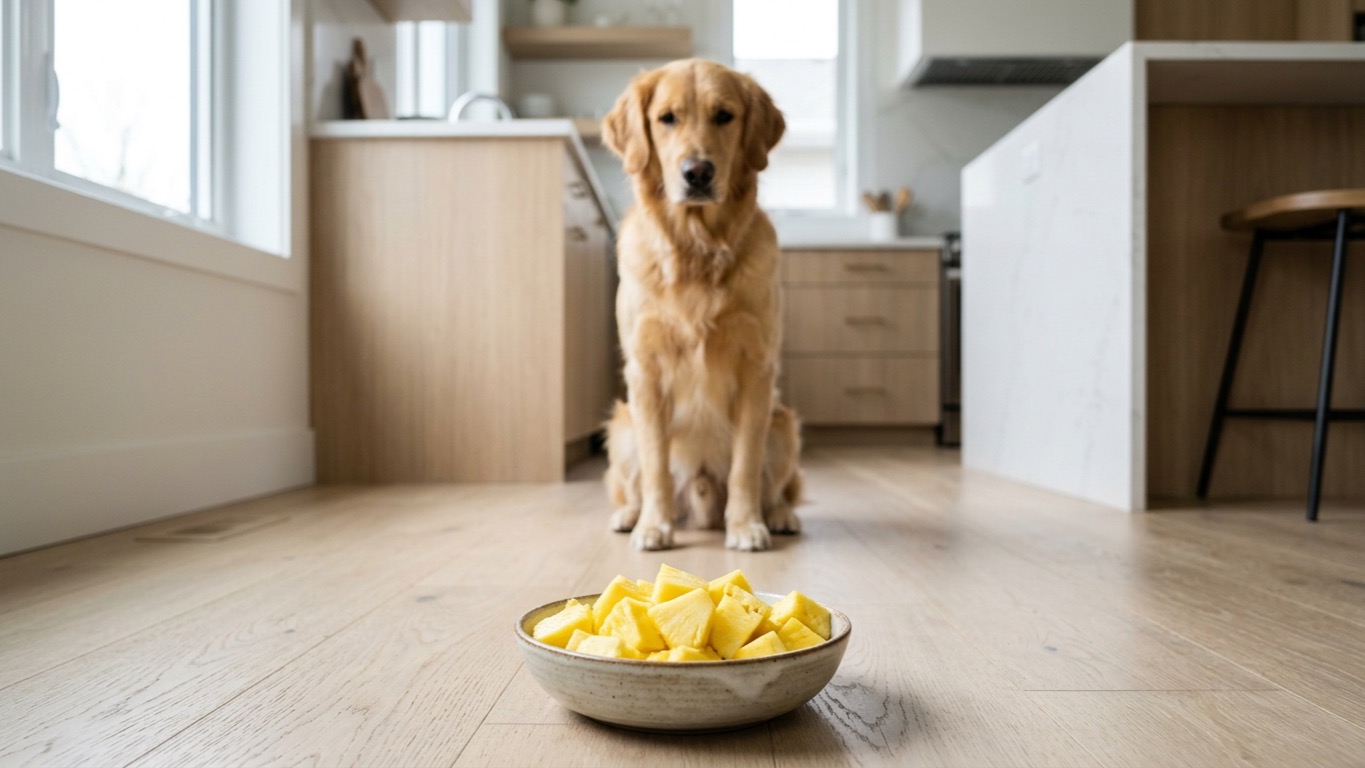
Can dogs eat pineapple? Yes — plain peeled flesh in gram-capped cubes. No — skin, core, crown, canned syrup, and juice bowls. USDA-class raw pineapple is about 50 kcal and 9.9 g sugar per 100 g. One cup of diced flesh (~165 g) is about 82 kcal and 16.3 g sugar. For a 30 lb dog on a ~550 kcal band, the 10% extras cap is ~55 kcal. That cup is 149% of the cap before a chew or a cube of cheese is counted. The honest session is tablespoons, not cups.
The PetBench Pineapple Core Hazard Board (August 2026 desk compilation) is two refuse objects and one sugar number. The core is a rigid cylinder. The skin is spiny fiber. Neither is a toxin in the grape sense. Both are foreign-body stories. Bromelain is a real protease in pineapple; this desk will not dose it as a medicine or claim it “cures” anything. Some dogs get drool or soft stool after a first cube. That is a stop, not a reason to double the next serving.
Our guides are reader-supported. This article may contain affiliate links. As an Amazon Associate we may earn a commission if you buy through links, at no extra cost to you.
Related fruit pages: bananas, cantaloupe, watermelon, grapes.
What can dogs eat pineapple allows — and what it refuses
Allows: ripe yellow flesh, eyes and skin carved off, core cut out, cubes sized to the mouth, logged in the extras band, two or three fruit days a week for a healthy adult.
Refuses:
- The fibrous core as a “chew”
- Skin or the leafy crown
- Rings packed in heavy or light syrup
- Dried sweetened rings from a snack aisle
- A bowl of pineapple juice
- Pizza pineapple with onion, garlic, or mystery meat
- Daily cup servings because “it’s natural”
- Any pineapple on a clinician-written sugar or renal restriction unless that clinician said yes
ASPCA’s people-foods list is the toxin screen. Pineapple flesh is not in the grape / raisin / xylitol / Allium class. Toxicity-negative is not a serving chart.
Browse a pineapple corer and a scale →
Pineapple Core Hazard Board
| Job | What this desk allows | Fail if you skip it |
|---|---|---|
| Toxicity screen | Ananas flesh is not a grape-class toxin | Treating core as “non-toxic so it can stay” |
| Calorie job | 50 kcal / 100 g; 82 kcal / cup | A cup for a 25 lb dog |
| Sugar job | ~9.9 g / 100 g; ~16.3 g / cup | Daily fruit on a glucose plan |
| Acid / enzyme job | Bromelain + acidity | Ignoring drool or soft stool after one cube |
| Mechanical job | Core and skin in the trash | “They’ll chew around it” |
| Can job | Fresh or frozen-from-fresh only | Syrup as “just juice” |
Before you shop: (1) wash the whole fruit before the knife opens it, (2) core and skin gone, (3) first serving is one blueberry-sized piece, then 6–12 hours of watching, (4) extras that day include the pineapple, (5) unproductive vomiting, a tight belly, or a dog who will not eat after core theft is a clinic. Fail gate 5 and the Board is how you shop past an emergency.
We do not. Your household stool notes belong to you and your clinician.
USDA-class pineapple numbers this desk actually used
Rounded FoodData Central references for raw pineapple, edible portion.
| Measure | Per 100 g | 1 cup diced (~165 g) | 1 tbsp diced (~12 g) | Desk note |
|---|---|---|---|---|
| Energy | ~50 kcal | ~82 kcal | ~6 kcal | Mid-weight fruit — heavier than melon, lighter than banana |
| Total sugar | ~9.9 g | ~16.3 g | ~1.2 g | The diabetes lever |
| Fiber | ~1.4 g | ~2.3 g | ~0.2 g | Overfeed → loose stool |
| Water | ~86 g | ~142 g | — | Hydrating, still sugar |
| Vitamin C | ~47.8 mg | ~78.9 mg | — | Antioxidant class; not a dose we set |
| Manganese | ~0.93 mg | ~1.5 mg | — | Trace mineral class |
| Potassium | ~109 mg | ~180 mg | — | Milder than a banana’s 422 mg per fruit; still a renal-diet question at cup scale |
Hero ratios (August 2026 desk arithmetic, same 100 g reference):
| Fruit | kcal / 100 g | Sugar / 100 g | vs pineapple kcal |
|---|---|---|---|
| Watermelon | ~30 | ~6 g | Pineapple is ~1.7× |
| Cantaloupe | ~34 | ~7.9 g | Pineapple is ~1.5× |
| Pineapple | ~50 | ~9.9 g | Baseline |
| Banana | ~89 | ~12.2 g | Banana is ~1.8× pineapple |
If the job is a hot-day hydrator, melon wins. If the job is a sticky mash in a stuffable toy, banana wins and pineapple juice leaks. If the job is “tropical and yellow,” pineapple is the one that needs a corer, not a vibe.
How much pineapple is safe — tablespoon math
NRC-style maintenance bands (intact adult, modest activity) used only to size the 10% cap:
| Dog weight | Rough daily kcal | 10% cap | Fresh flesh this desk will write | Frequency |
|---|---|---|---|---|
| Under 20 lb | ~200–450 | ~20–45 kcal | 1–2 tbsp diced (first week: 2–3 blueberry pieces) | 2–3× / week |
| 20–40 lb | ~450–700 | ~45–70 kcal | 2–3 tbsp | 2–3× / week |
| 40–60 lb | ~700–950 | ~70–95 kcal | 3–4 tbsp | 2–3× / week |
| 60+ lb | ~950–1,300 | ~95–130 kcal | Up to ¼ cup (~4 tbsp), not a cup | 2–3× / week |
A tablespoon of diced pineapple is about 6 kcal. Four tablespoons are about 24 kcal — still inside most medium-dog caps if nothing else is a treat. A cup at 82 kcal is a large-dog maybe and a small-dog no.
Why the core and skin are the whole mechanical chapter
The core is paler, denser, and built to hold the fruit up. Dogs do not file it down like a dental chew. They gulp. A core chunk in a 12 lb dog is a different object than the same chunk in an 80 lb dog. This desk will not publish a “safe core gram.” The refuse list is zero core.
Skin carries the eyes — the brown pits. They are woody. They catch in the mouth. They do not digest on a useful timeline. Wash the fruit so the knife does not drag field dirt onto the flesh, then discard skin where the dog cannot raid the bin.
The crown (the leafy top) is not a toy. Fibrous, stringy, easy to steal off a counter.
If core or skin already went down: note time, estimate size, note the dog’s weight. Call the clinic if the piece was large, the dog is small, or signs start — repeated vomiting, straining, lethargy, refusal to eat. Do not induce vomiting unless a professional tells you to. Do not wait for a blog’s “48-hour window” if the dog is already painful.
Bromelain without turning this URL into a supplement ad
Bromelain is a mixture of proteases in pineapple stem and fruit. Human food-science and some clinical literature discuss it. This desk will not:
- Claim bromelain reduces inflammation in your dog
- Claim it “helps digest protein” as a finding we measured
- Recommend a bromelain tablet
- Treat canned pineapple as a bromelain dose (processing and syrup change the object)
What we will say: a minority of dogs drool, lick the air, or pass soft stool after a first cube. Stop. That pattern is a reason pineapple is a poor extra for that household — not a reason to “build tolerance.”
Acid plus sugar plus fiber is enough to explain a messy afternoon without a branded enzyme story.
How to prep pineapple so can dogs eat pineapple stays a treat page
- Wash the intact fruit under running water. Standard produce hygiene.
- Top and tail, stand it up, carve the skin in downward strips. Dig out remaining eyes.
- Quarter and cut the core out, or use a corer and still inspect the cylinder — leftover core rings happen.
- Dice to mouth size. Toy dogs: blueberry. Large dogs: thumbnail, not a steak cube.
- Optional freeze on parchment. Frozen cubes are harder and more gulpable. Supervise. Thaw to a slush for inhalers.
- Plain. No yogurt coating, no honey, no “ham and pineapple” sharing, no toothpick.
A thin mash in a stuffable toy still counts as the same grams. Juice that drips on the floor is still sugar the next dog will lick.
Do not replace a meal. Pineapple is not complete-and-balanced. AAFCO-style completeness lives in the food your clinician already accepted.
Canned in heavy syrup is candy. The syrup is the extra sugar. Even “in juice” cans are often sweeter than the fruit you cut. This desk’s default is fresh only. If a can is all you have, drain, rinse, and still assume you cannot match fresh sugar — or skip.
Dried rings concentrate sugar and often add more. A ring that looks like one treat can outrun a tablespoon of fresh flesh. Skip commercial sweetened rings.
Juice is sugar without the chewing time. A bowl of juice is how a thirsty dog drinks the extras cap in thirty seconds. Water is the drink. Pineapple is the cube.
Pizza pineapple arrives with Allium, fat, and salt. See cheese and the Allium class on ASPCA people-foods. The yellow bit is not the only ingredient.
Frozen grocery bags labeled pineapple can be fine if the ingredient line is pineapple and you still cube to size. Watch for added sugar and for ice-glaze weight you will over-serve.
Grilled pineapple with brown sugar or chili-lime salt is a human side. The dog does not need the rub.
Who should skip pineapple
- Diabetes or a home glucose plan. 16 g sugar in a cup is not a rounding error.
- Obesity with a written calorie cap. Fruit is the extra people forget.
- History of foreign-body surgery. Do not re-introduce core-adjacent chews as a personality bit.
- Chronic loose stool. Acid + fiber + sugar is a poor experiment.
- Renal diets at cup scale — potassium is lower than banana but not zero. Ask the clinician.
- Known bromelain or fruit intolerance. One bad first cube is data.
Overfeed picture (not a diagnosis): gas, diarrhea, or a single vomit within about 12 hours after a large portion usually tracks volume and sugar, not a new allergy label. Persistent vomiting, blood in stool, a swollen belly, or a dog who will not drink is a call.
Kitchen and party risk map
| Scenario | Why it happens | Desk action |
|---|---|---|
| Fruit platter with spears | Core still in the spear | Plate dog cubes separately |
| Kids sharing “just a ring” | Uncounted cup + possible syrup | Adult portions |
| Compost skin and core | Attractive, dangerous | Lidded bin |
| Hiking with a whole fruit | You eat; the dog gets the core | Pack pre-cut cubes in a treat pouch |
| Smoothie leftover | Xylitol yogurt, grapes, avocado | Audit the blender before you share |
| Dried trail mix | Raisins next to pineapple | Grapes win the emergency |
| Counter crown | Leafy toy | Trash, not tug |
Pineapple vs other extras on thepetbench
Pineapple is the acid-and-sugar mid-calorie fruit. Banana is the energy-dense smear. Cantaloupe and watermelon are the water-heavy cubes. Cheese is the fat extra. Mushrooms are a grocery-vs-yard fork, not a fruit. Do not run pineapple + banana + cheese on the same afternoon and call it enrichment. The 10% band is one bucket.
This desk will not invent one. What we have is USDA class math and a refuse list you can photograph.
Serving walkthrough for a first pineapple day
Morning: feed the regular complete food. Do not fast the dog “to make room for fruit.”
Afternoon: cut one blueberry-sized cube. Offer it. If the dog refuses, stop — pineapple is optional.
Evening: if stool is normal and there is no drool-fest, you may use the tablespoon cap on a later day that week. If stool is loose, pineapple is done for that dog.
Hot day: freeze the same cubes. Do not add the frozen batch on top of a fresh batch.
Training: pineapple is a poor high-rep reinforcer. It is wet, sticky, and calorie-heavy per enthusiastic gulp. Use a dry training bit or a pea of cheese if fat is cleared. Save pineapple for a single enrichment event.
Frequently asked questions — can dogs eat pineapple
How often can dogs eat pineapple?
At most 2–3 times a week at the tablespoon table. Daily fruit pushes sugar and displaces complete food.
Can dogs eat frozen pineapple?
Yes, if it is the same peeled, cored flesh. Frozen chunks are harder. Keep them small. Supervise. This is texture, not a different nutrient class.
Is pineapple toxic to dogs?
Flesh is not a grape-class toxin. Skin and core are physical hazards. Syrup is a sugar hazard. Toxicity-negative does not mean free-feed.
What if my dog ate pineapple core?
Note time, size, and weight. Call the clinic if the dog is small, the piece was large, or vomiting / straining / quiet behavior starts. Do not invent a home emetic.
Can diabetic dogs eat pineapple?
Not from this page. Ask the clinician who owns the plan. 16 g sugar per cup is the reason we will not shrug.
Can dogs eat pineapple skin?
No. Spiny fiber, dirt, and a choke object. If skin was stolen, monitor and call if signs appear.
Can puppies eat pineapple?
After solid food is established and no clinician has banned fruit: one blueberry piece, then watch. Puppies have smaller caps. Pineapple is not a teething chew.
Can dogs eat canned pineapple?
Default no for syrup. Juice-packed is still a sweeter, wetter object than the fruit you cut. Fresh is the Board’s yes.
Does pineapple help dogs digest food?
This desk does not claim that. Bromelain marketing is not a protocol we ran. If digestion is the problem, that is a clinic conversation, not a fruit.
Can dogs eat pineapple on pizza?
Treat pizza as pizza: fat, salt, Allium, and dough. The pineapple cube does not sanitize the slice.
Sources and method
- USDA FoodData Central, raw pineapple (per 100 g and a 165 g cup).
- 10% extras guideline as used in veterinary nutrition client materials.
- ASPCA people-foods toxicity framing for what pineapple is not.
- FDA-class produce wash-before-cutting hygiene, applied here the same way we apply it to cantaloupe.
- NRC metabolic-energy bands as rough adult estimates only.
For a dog in distress after core, skin, or a syrup binge, use a licensed veterinarian. If raisins shared the platter, close this tab and open can dogs eat grapes.