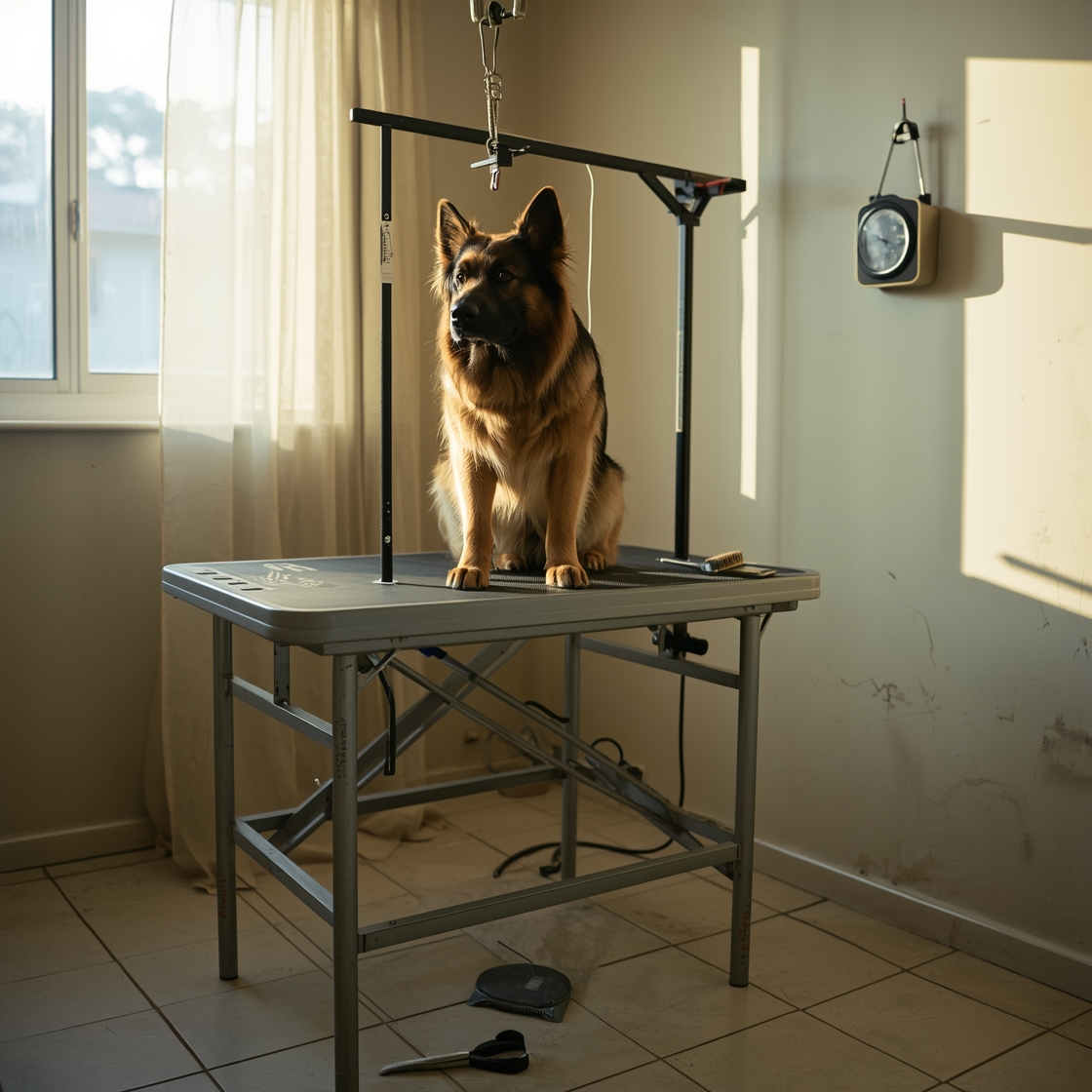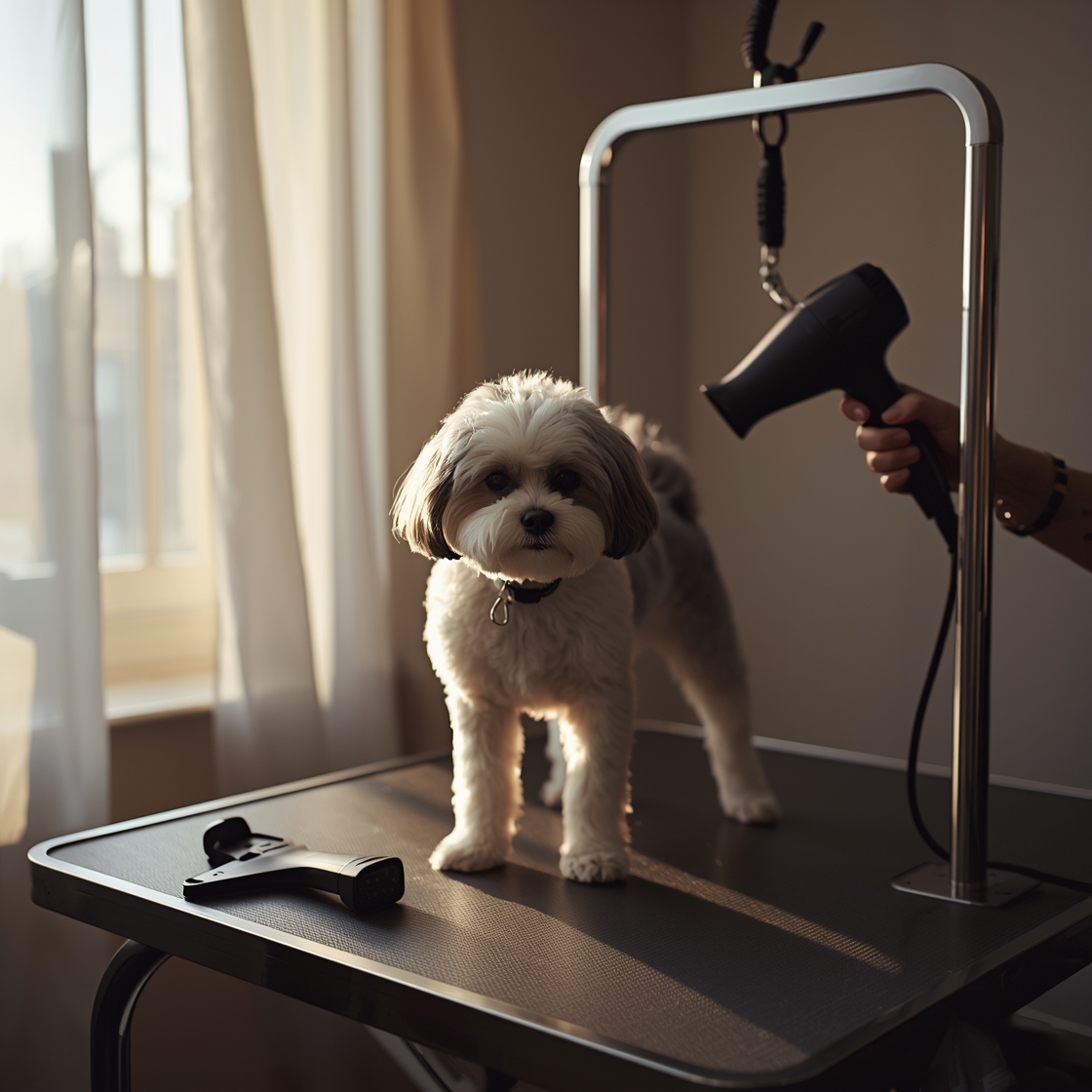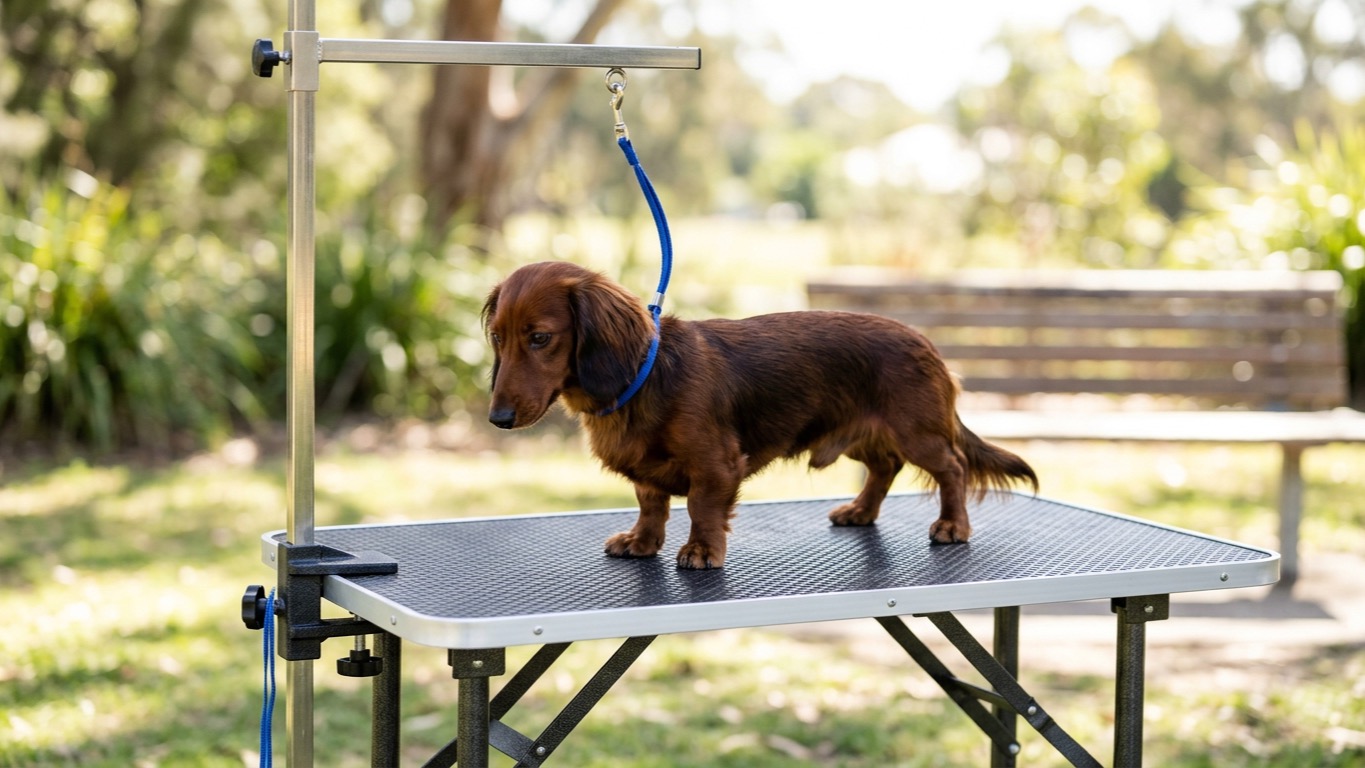
This is not veterinary advice, and it is not a salon lesson. This is a research desk. We are not licensed groomers or veterinarians. Our research team analyzed public safety pages from the American Kennel Club, the Professional Pet Groomers and Stylists Alliance (the standard IPPGA says NDGAA and IPG programs teach), the AVMA physical-restraint policy, the ASPCA’s at-home grooming tips, and printed cautions from currently sold hydraulic tables.
A grooming table is useful only if the dog cannot fall: stay within an arm’s length on a sturdy non-slip top, and treat a loop as a positioning aid — not a hanger — because the institutions we fetched do not print a hang warning, and the makers who speak print “do not suspend” and “never leave the dog.”
The large-breed shopping page is our best dog grooming table for large breeds guide. This URL is the setup-and-safety how-to.
Quick answer
- Use a sturdy table with a clean, non-slip top (AKC PSPP2.3; PPGSA).
- Stand it on a dry, flat, level floor (GARVEE; Shor-Line: not on uneven flooring).
- Set a height you can work without strain (AKC PDGS1.9). ”
- Do not let the dog jump onto or off a raised deck. Seniors may need a ramp, steps, or assisted lifting (GARVEE, maker instruction).
- A loop is a positioning aid under a person who stays put — not a hanger. Master Equipment Z-Lift II: never leave the animal; prefer quick-release “to prevent injury, in case animal accidentally jumps off the table.” GARVEE: do not suspend, lift, or fully restrain; never leave the pet, even with a loop on.
- Stay within an arm’s length. AKC SHHP3.5, the AKC S.A.F.E. oath, and PPGSA all print the no-unattended rule.
- Brush and inspect on the table. Bath happens in a tub (AKC owner how-to). ASPCA: trim only dry, clean fur; never shave.
- Get the dog off for stress signs, parked dryer heat, or a senior dog that cannot stand the session.
Coat order — brush, bath, nails, ears — is on our step-by-step home grooming guide. This page is only how the table is used.
If a named institution or a currently sold hydraulic/folding-table maker did not print the step, it is not here.
The selection rule
This URL is not a ranking. The large-breed cluster already compares decks. The filter here is safety and setup:
- Keep a step if AKC, PPGSA (the public standard NDGAA and IPG member programs are told to teach), AVMA, or ASPCA describes it, or if a currently sold hydraulic/folding-table maker prints it.
- Label maker copy as maker copy. One printed caution is not a house spec for every table.
- Do not invent a hang warning. We searched AKC, NDGAA, IPG, AVMA, and ASPCA for a sentence that says a grooming noose can hang a dog. We stay with “do not leave the dog,” plus the jump-off and “do not suspend” wording makers print.
- Do not invent a harness-on-table class. AKC SHHP3.2 names leashes, cross ties, muzzles, groomer’s helpers, and loops, used only under constant direct supervision. No fetched institution page walks through a table harness.
Setup: height, surface, location
Location. AKC’s S.A.F.E. oath wants floors “free of hair and water.” GARVEE: dry, flat, and level; check clamps before each use. Shor-Line: do not operate on uneven flooring; level the feet. Master Equipment: store at the lowest height, away from weather and animals. GARVEE and Shor-Line both warn to keep paws and people off the foot pedal — an unintentional raise or drop is an injury path they name.
Height. Adjust so you can stay close without fighting your back. That is as far as AKC PDGS1.9 goes. SHELANDY and GARVEE advertise a comfortable working height. We are not converting that into an elbow measurement
Stage every tool before the dog is up. If you have to walk away for a brush, the dog comes down first.
Getting the dog on
AKC SHHP3.3A exchanges the dog on a slip lead “with the pet on floor level.” That is a floor-level start, not a lift recipe.
GARVEE, a currently sold hydraulic table, prints the on/off rule: do not allow pets to jump onto or off an elevated tabletop. Senior, injured, or less-mobile dogs “may require a compatible ramp, steps or assisted lifting.” If the dog cannot step onto a lowered top or accept a ramp, the table is the wrong tool that day.
Shor-Line’s printed controls: full control while the lift moves; keep people and animals off the foot switch; do not sit, stand, or lean on the table.
Restraint classes
AVMA’s physical-restraint policy is the frame: least restraint, minimum time, methods that “minimize fear, pain, distress and suffering,” and “constant observation” so the period does not end in “severe distress or death.” Expose the dog to the device first. If the method fails, change it. Positive reinforcement is an alternative the policy names. AVMA is writing for veterinary handling. We are not stretching it into a noose tutorial.
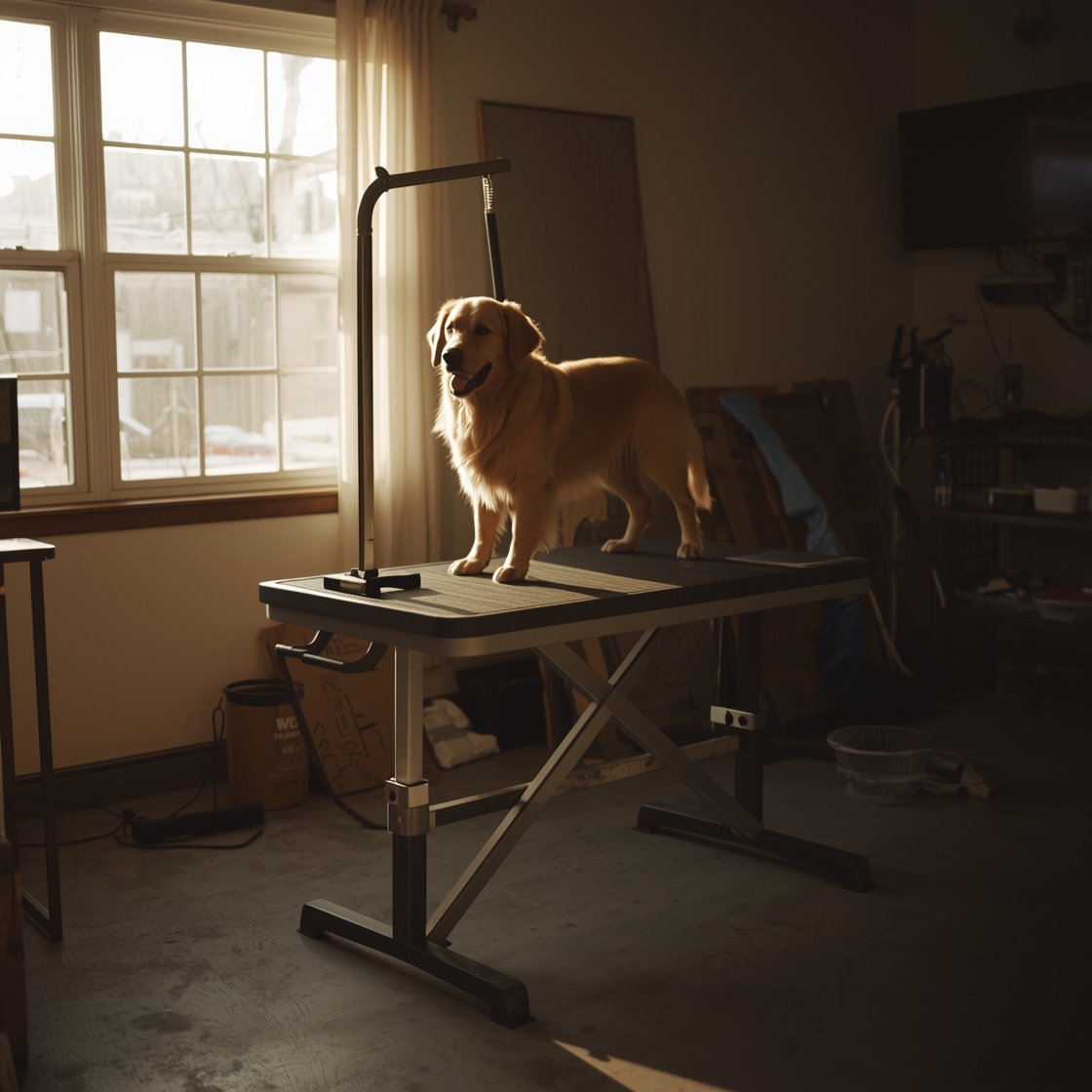
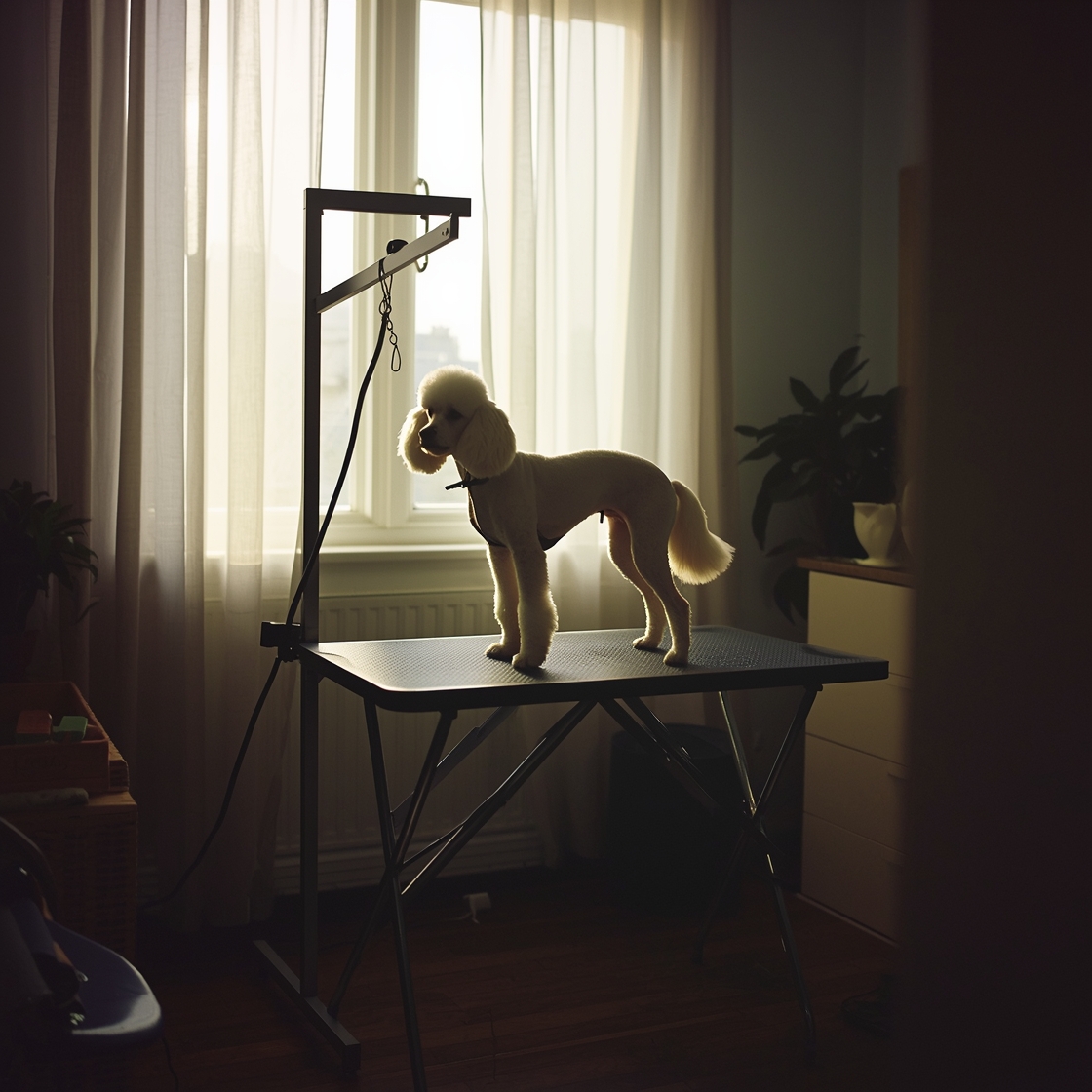
Loop — the grooming-arm restraint AKC names. AKC SHHP3.2 allows “loops” only under “constant direct human supervision.” PPGSA calls the arm the fixture “by which the pet is restrained” and requires it to be pet-friendly and secure. Makers print:
- Master Equipment Z-Lift II (hydraulic, currently sold): never leave the animal; use a loop; prefer quick-release “to prevent injury, in case animal accidentally jumps off the table.”
- GARVEE hydraulic: loops are “positioning aids only”; “Do not use them to suspend, lift or fully restrain an animal”; never leave the pet, even with a loop attached.
- Shor-Line hydraulic/electric guide: do not leave patients unattended — “SERIOUS INJURY or DEATH”; the arm “can be used to secure a lead.” That death line is unattended-table language, not a hang diagram.
Handheld / manual. AVMA includes “manual” means. AKC’s arm’s-length rule is a person, not hardware. If the dog will stand for a hand on the body and you never step back, that is the least-restraint class those pages describe.
Harness. Cut as a sourced class. We are not inventing a chest-strap risk.
If the dog fights the loop, AVMA’s instruction is to reassess the method, not to tighten it. Get the dog off.
Groom sequence on the table
The table is a dry workstation. GARVEE lists brushing, trimming, post-bath drying, and nail care — not a shower, and not a hose-down of the lift. AKC’s owner how-to stands the dog in a tub or basin for the bath, cotton in the ears, a few drops of mineral oil in the eyes, then a towel and a dryer “if necessary.”
On the table, keep the order those pages already print:
- Brush first. AKC: several weekly sessions, down to the skin; check mats behind the ears and under the legs, and any cuts. ASPCA: brush out dirt and dead hair before water tightens mats.
- Inspect while you brush. AKC: coat, teeth, eyes, ears, nails. ASPCA: eyes clear; wipe the outer ear only. Injuries go to a veterinarian — AKC’s owner don’ts say do not treat wounds yourself.
- Trim only dry, clean fur. ASPCA: never shave; hold the ear leather. AKC PSPP2.11: introduce clippers slowly and watch for clipper burns.
- Nails if they click. AKC: clicking nails are too long; clip only the hook; styptic powder if you nick the quick; a veterinarian or groomer if you cannot finish.
- Dry with moving air, low heat. AKC PSPP2.9: low heat, do not park hot air on one spot. PPGSA: monitor drying closely and often.
Have the home-grooming tool order already staged. A missing clipper is not a reason to leave the dog on the deck.
When to get the dog off the table
Stress. AKC SHBM4.2: evaluate stress and reduce fear. SHBM4.5 names pacing, showing teeth, and ears pinned back. AVMA: stop a method that produces severe distress. Those signs mean the dog comes down. Finish on the floor or end the session.
Heat. AKC SHHP3.9 wants air and water “safe and comfortable,” and PSPP2.9 forbids cooking one patch of skin. If the dog is panting hard, the room is hot, or the dryer has sat still, get off the table. AKC’s owner page also says not to bathe outdoors in cool or cold weather — body temperature can drop. Still a session-ender.
Senior dogs and arthritis. AKC SHBM4.10: geriatric dogs “require accommodations for age-related needs.” GARVEE’s printed accommodation is a ramp, steps, or assisted lifting — and a ban on jumping off a raised top. A dog that cannot stand square, that cries when lifted, or that folds on the deck is done for the day.
Shor-Line’s closer: leaving the dog up can end in serious injury or death. The institutions we fetched say the same thing without the capital letters — stay in arm’s reach, or the dog is not on the table.
How this page differs from the large-breed table roundup
Our best dog grooming table for large breeds page is the shopping cluster: named decks, published capacities, folding versus hydraulic versus electric. This page does not repeat that list and does not pick a winner. It answers a different query: how to use the table you already have without a fall. Capacity numbers belong on the maker’s label and on that roundup. The first filter here is a person who does not walk away, a non-slip top on a sturdy frame, and a restraint that is not asked to hang the dog.