
Quick answer: Pair a click or a short “yes” with a tiny treat the instant your dog offers the behavior you want. Work in a quiet room for a few minutes. Skip shock, prong, and choke tools.
A marker plus food within one second is the home start for positive reinforcement dog training.
This page is a home-methods briefing; we did not run kennel trials, film sessions, or rank kits.
The Hallway Rule we used
We used one selection rule: the Hallway Rule. A skill entered only if you can run it in a kitchen this week. The same rule applied to products.
The work must use food and a marker. It cannot use pain, startle, or electric stimulation.
We left out sports titles, protection work, and behavior-disorder protocols. We also left out shock collars, prong collars, choke chains, and leash pops.
The Association of Professional Dog Trainers amended its Standards of Practice on June 14, 2023. Those standards list those tools as outside member practice.
If you later want distance lines, tugs, or backyard obstacles, that is a different job. See our K9 training equipment notes.
What the method actually pays
Positive reinforcement means a consequence that makes a behavior more likely. At home, that consequence is usually food. Play and access to a door can work too.
The American Veterinary Society of Animal Behavior still stands on its 2021 Position Statement on Humane Dog Training. That 2021 statement recommends only reward-based methods for all dog training, including behavior problems.
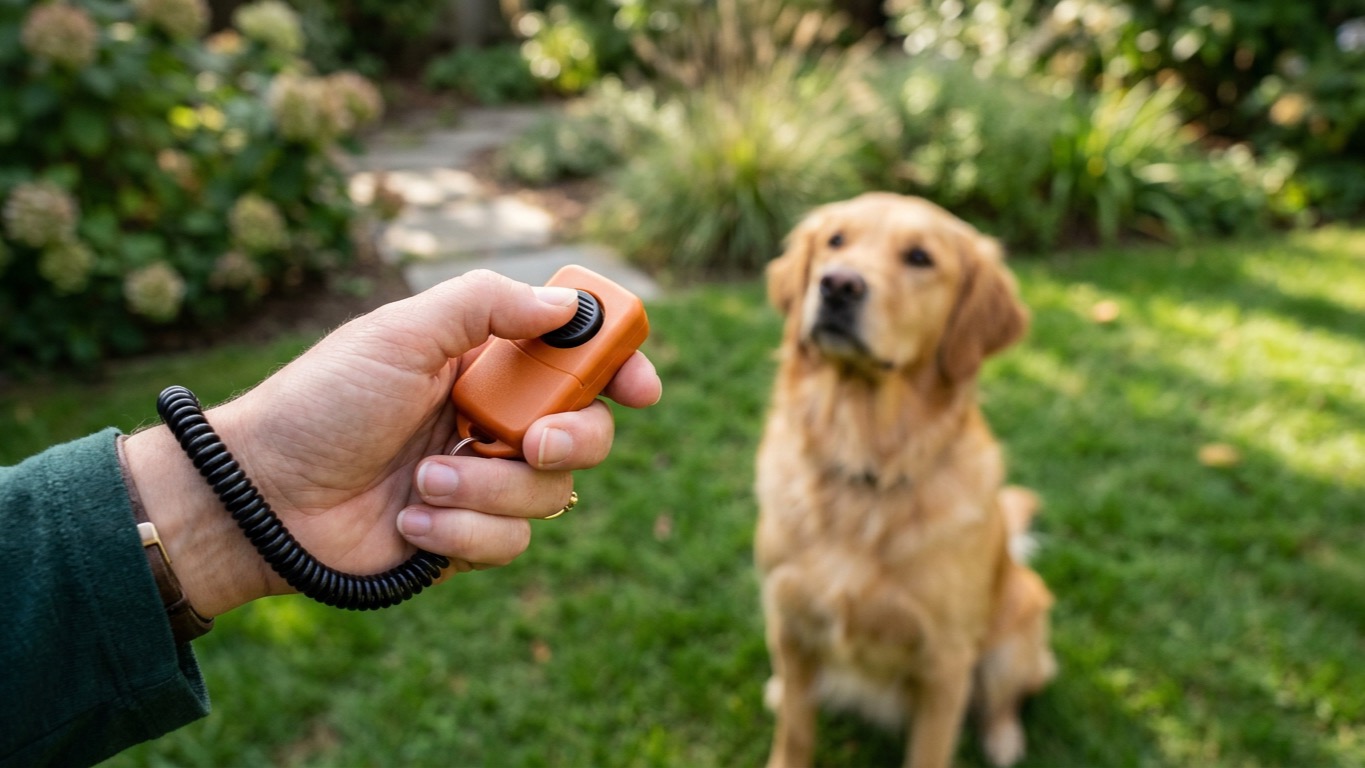
A marker is not magic. It is a short sound that pinpoints the exact second you like. A clicker or a crisp spoken “yes” both count.
Pay after the marker. The food is the paycheck. The marker is the timestamp.
Our research team analyzed maker pages and those organization texts. We did not clock dogs in a lab.
The One-Second Pay Rule
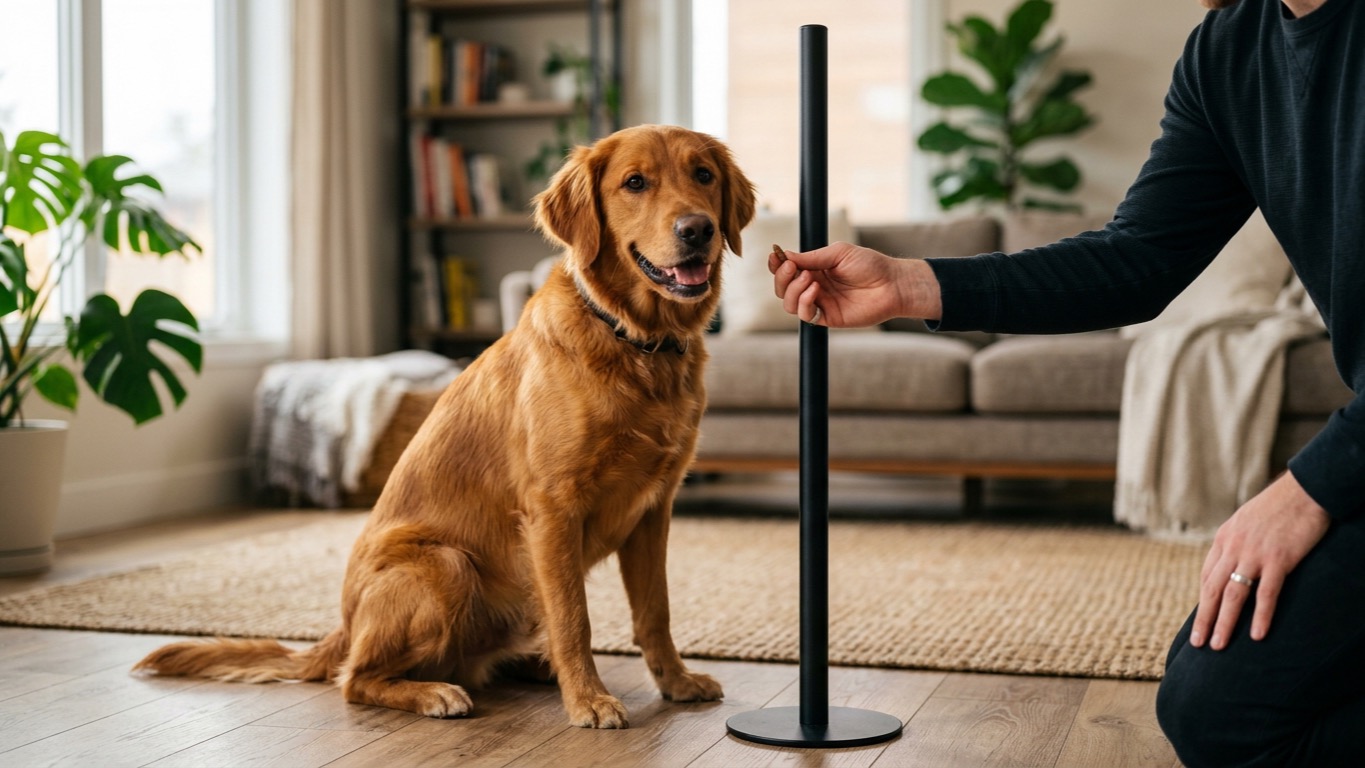
Use this sequence. Cue or wait, then mark the instant the behavior happens. Deliver food within one second.
That one-second gap is the claim you can watch fail. If the treat arrives after the dog has already stood, sniffed, or left, you paid the wrong picture.
Charge the marker first. Click or say “yes,” then feed. Repeat in a quiet room until the dog orients to you at the sound.
Keep early sessions short. Five to ten minutes is enough for a first week. Stop while the dog still wants the next bite.
Name one behavior per session. Sit is enough on day one. Hand target is enough on day two.
A first-week map you can run
Start with name response. Say the dog’s name once. Mark a head turn and pay.
Teach sit by waiting, or by lifting a treat over the nose. Mark the sit and pay. Do not push the rump down.
Teach a hand target next. Present an open palm a few inches away. Mark the nose touch and pay.
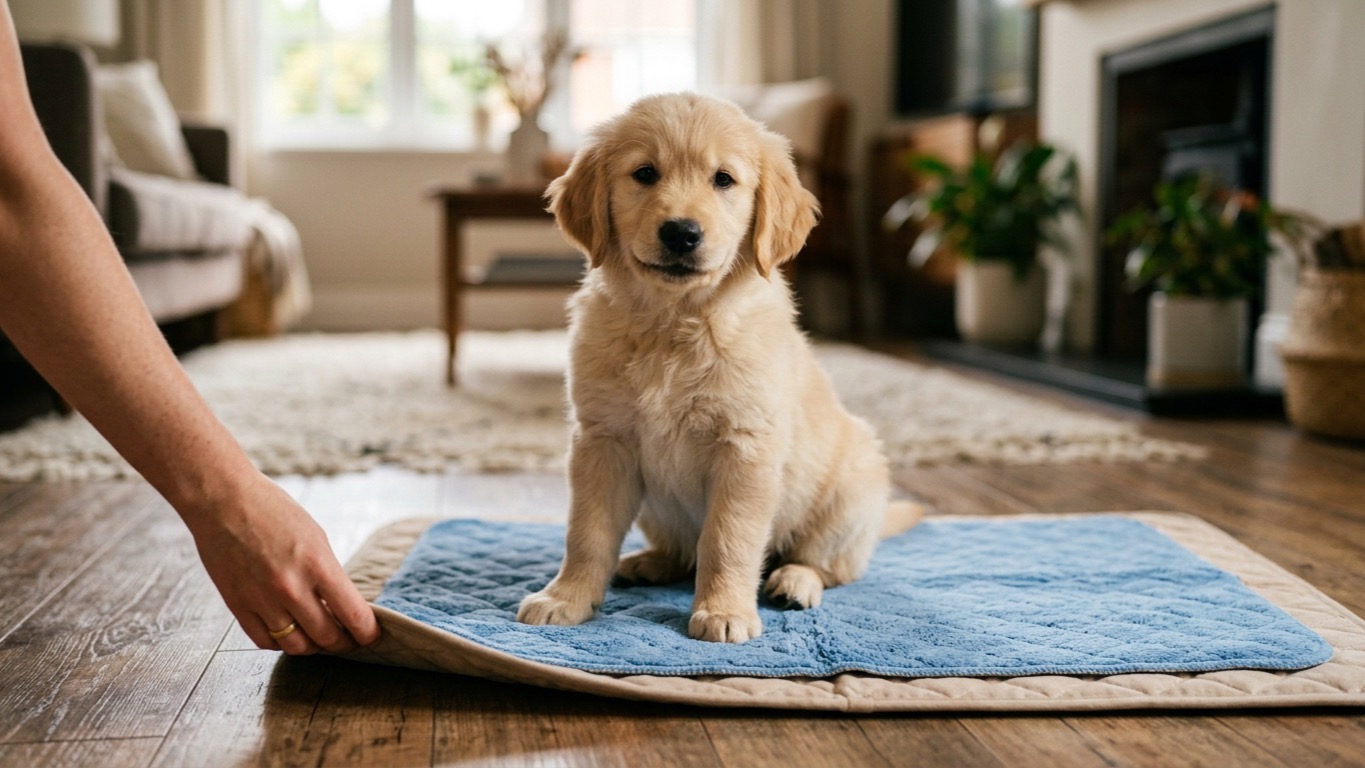
Add a mat or towel. Mark four paws on the cloth and pay. This is a settle start, not a long down-stay yet.
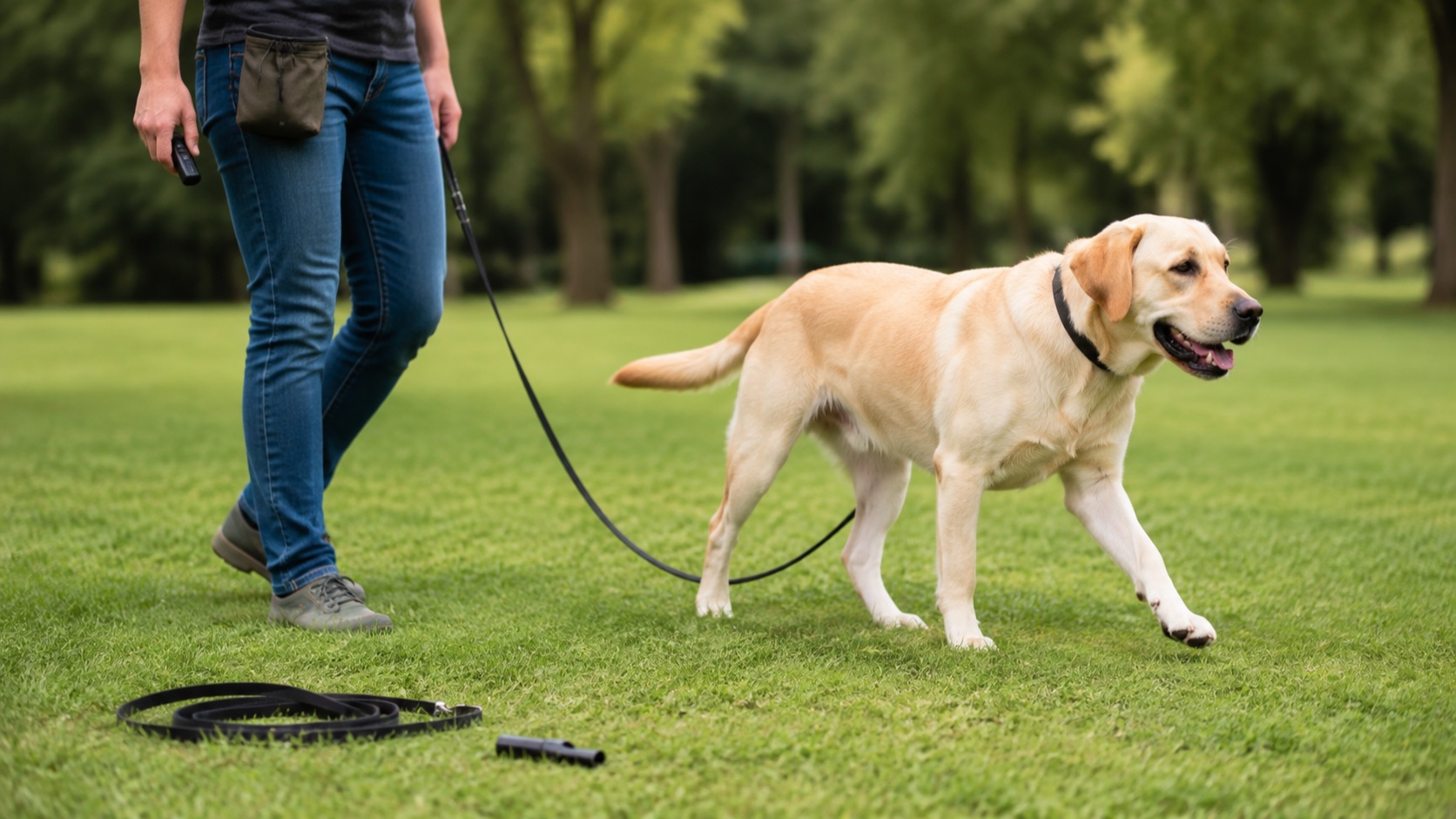
Loose-leash starts belong in the hallway, not on a busy sidewalk. Mark slack and pay.
If the dog hits the end of the leash, stop walking. Resume when the leash bends.
Capture good manners you already see. Mark a four-on-the-floor greeting and pay. Ignore jumping if you can do so safely.
Lure less as the week goes on. Fade the food in your cue hand. Keep paying from the other hand or from a pouch.
Calories, labels, and the treat budget
Training food still counts as food. The World Small Animal Veterinary Association caps treats under 10 percent of daily calories.
The same WSAVA treat guide lists a 10-kilogram dog’s treat budget at 47 kilocalories a day. It lists a 20-kilogram dog at 79 kilocalories.
That table is easy to blow. WSAVA lists 1 tablespoon of peanut butter at 81 kilocalories. That already exceeds the 47-kilocalorie budget it gives a 10-kilogram dog.
WSAVA lists 1 ounce of cheddar cheese at 120 kilocalories. That exceeds the 79-kilocalorie budget it gives a 20-kilogram dog.
The Association of American Feed Control Officials does not require treats to be complete and balanced. AAFCO does require the words “snack” or “treat” on the front panel.
If those words appear, AAFCO says the product should be given sparingly. Too many extras can unbalance the main diet and add unneeded calories.
Zuke’s Mini Naturals Chicken Recipe lists 2 kilocalories per piece and 2,710 kilocalories per kilogram. The maker also lists pouch sizes of 3, 6, 10, and 16 ounces.
Our research team compared those two published caps. Zuke’s feeding line allows 3 treats per pound of body weight per day. For a 22-pound dog, that is 66 pieces, or 132 kilocalories.
WSAVA’s 47-kilocalorie line for a 10-kilogram dog is tighter. At 2 kilocalories each, that is about 23 Mini Naturals pieces, not 66.
Zuke’s chicken recipe lists 9.0 percent minimum crude protein. It lists 3.0 percent minimum crude fat, 2.0 percent maximum crude fiber, and 30.0 percent maximum moisture.
Use the day’s kibble as some of the pay if the dog will work for it. Save the stronger scent for harder cues.
Need bite-size and bag jobs next? See our J and J training-supplies notes. That page stays on treats, not hardware.
Gear that supports timing, not force
You do not need a catalog to start. A quiet room, a marker, and measured food are enough.
A clicker helps if your spoken “yes” drags. A pouch helps if your pocket delays the pay.
The table below compares five currently sold products our research team pulled from maker pages. We compared listed attributes only. We did not wear-test fabric or time a click.
| Product | Maker | Role | Listed spec | Carry or pack | Power or calories |
|---|---|---|---|---|---|
| i-Click Original Clicker | Karen Pryor Clicker Training | Quiet marker | Palm-hidden, always-clickable hold | Sold as 3-pack, 5-pack, or 30-pack | No batteries |
| Clik-R Training Tool | PetSafe | Marker with finger band | Purple body 2.5 x 1.8 x 0.9 inches | Finger band; indoor and outdoor | No batteries or apps |
| Treat Trader | Ruffwear | Waist treat pouch | Bag 6 x 5.3 x 4.9 inches | Belt 30 to 48 inches, or clip | Lining rated 4,000 mm water column |
| Terry Ryan Treat Pouch | Karen Pryor Clicker Training | Hinged treat pouch | Pouch about 6.5 x 8.5 inches; opening 3 x 6 inches | Detachable waistband 46.5 inches | Water-resistant lining; machine washable |
| Mini Naturals Chicken Recipe | Zuke’s | Soft training treat | 2 kcal per piece; 2,710 kcal/kg | 3, 6, 10, or 16 ounce pouches | Maker cap: 3 pieces per pound of body weight per day |
Karen Pryor Clicker Training describes the i-Click as a quiet click for classes or sound-sensitive animals. It says the tool stays in a clickable position no matter how you hold it.
PetSafe lists the Clik-R for dogs or cats, all ages and sizes, with no batteries or apps. The maker says puppies as young as 8 weeks can learn the click-treat pair.
Ruffwear lists a 300-denier polyester ripstop front shell with 100 percent post-consumer recycled content. The pouch has a magnetic closure and a clicker-compatible loop.
The Terry Ryan Treat Pouch uses a hinge that stays open, then closes with a touch. Karen Pryor Clicker Training lists a key ring for a clicker. The front pocket fits a whole hand.
Building a wider marker-and-line kit later? Our Prodigy gear notes sit next to this method page.
Mistakes that pay the wrong picture
Late treats teach a different behavior. If you mark a sit and pay a stand, you just bought the stand.
Talking through the click muddies the timestamp. One sound. Then food.
Huge biscuits stall the next rep. The dog should swallow and look back.
A busy yard is a hard classroom. Proof later. Teach first.
Leash pops are not a “reminder.” APDT lists leash-pop corrections as outside its standards. That ban covers any collar or harness.
Yelling is on that same APDT list. So are shaker cans, citronella spray, and water sprays used to startle.
If the dog freezes, hides, or leaves the room, stop the drill. Change the setup. Do not push through fear.
Do not stack ten new cues in one night. Fluency on one cue beats a messy list.
When the hallway is not enough
Growling, biting, or panic is not a first-week sit project. Get qualified in-person help.
AVSAB’s 2021 statement says more serious concerns need a treatment plan. That plan can include management and, in some cases, medication decided with the dog’s clinic team.
Look for a trainer who uses food, toys, and management. APDT members agree not to use intentional aversive punishment-based interventions.
Ask what happens when the dog is wrong. If the answer is a shock, a jerk, or a flip, walk out.
A group class can help once the dog can take food in a room with mild motion. It is optional for week one.
This desk does not certify trainers. We also do not promise an outcome. APDT tells its members not to offer guarantees.
FAQ
What is positive reinforcement dog training at home?
It is teaching by paying the behavior you want. You mark the moment, then deliver something the dog wants, usually food. You do not use pain or startle to suppress the other choices.
Do I need a clicker, or is a word enough?
A word is enough if it is short and consistent. A clicker can be cleaner because it always sounds the same. PetSafe and Karen Pryor Clicker Training both treat the click as a marker, not the reward.
How many treats can I use in a session?
Stay inside the day’s treat budget. WSAVA’s less-than-10-percent rule is the cap we used. For a 10-kilogram dog, that 47-kilocalorie line is about 23 Mini Naturals pieces.
How long should a home session last?
Keep it short enough that the dog still wants the next rep. Five to ten minutes is a practical first-week block. Several short blocks beat one long grind.
Can I start with a puppy?
PetSafe states that puppies as young as 8 weeks can learn the click-and-reward pair. Use tiny pieces and a quiet room. Skip any tool that works by pain or startle.
What if my dog ignores the treat?
The pay is too weak for that room, or the dog is full, stressed, or unwell. Try a smellier piece, a quieter space, or a break. If appetite or mood drops across the day, call the dog’s clinic team.
When should I stop DIY training?
Stop DIY if you see aggression, panic, or a dog that cannot eat in the room. Those cases need a plan, not a louder clicker. Management, such as baby gates and leashes, keeps everyone safe while you get help.