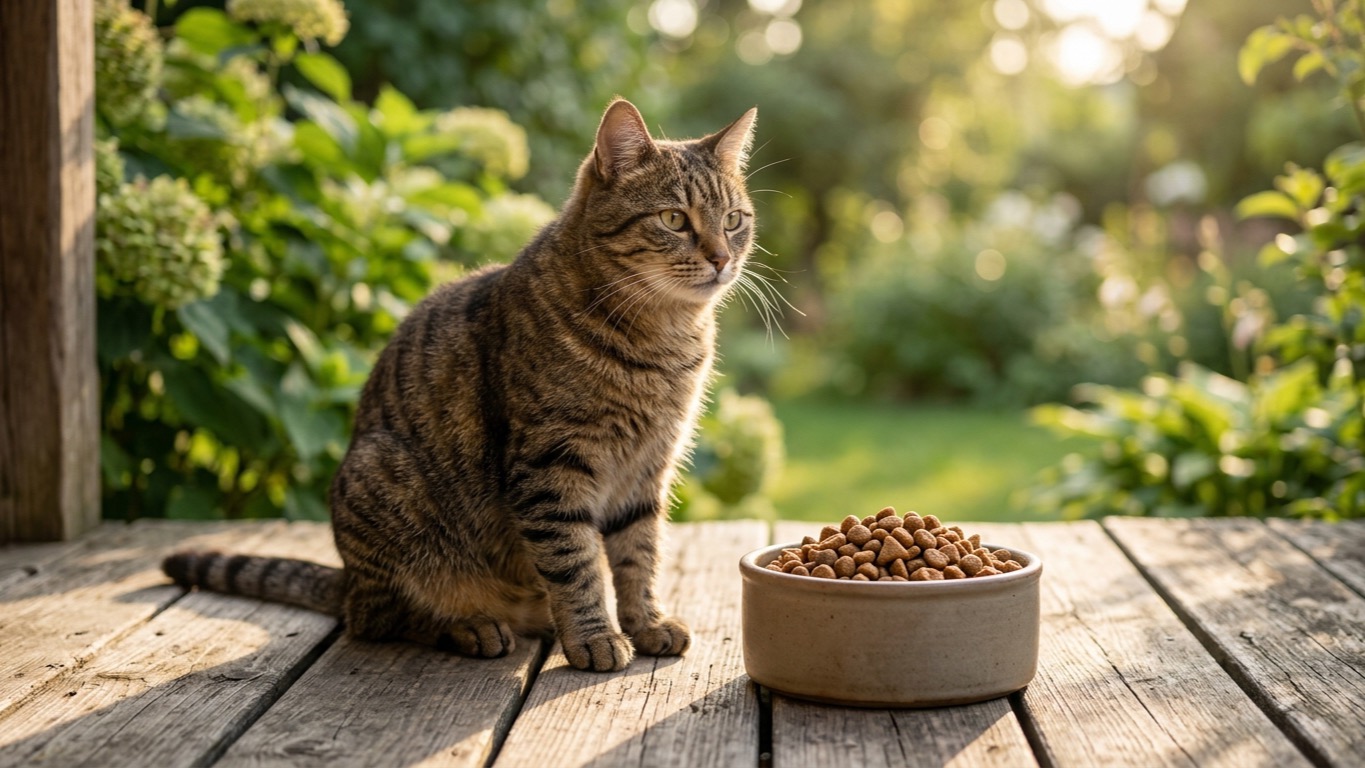
The best cat food for outdoor cats is an energy-dense, named-meat dry staple fed on a schedule rather than left out in an always-full bowl. In the we mapped 31 dry formulas against published feline maintenance-energy equations and aggregated owner portion logs. Free-roaming cats in cold snaps needed roughly 20–40% more maintenance calories than matched indoor adults, yet mid-protein staples at $0.09–$0.18 per feeding day for a 10 lb cat outperformed premium bags in practice — because owners consistently over-poured the expensive ones. Unlimited free-feeding raised body-condition scores even among active hunters.
Best cat food for outdoor cats is therefore a logistics problem as much as a nutrition one. We compare energy density, weather tolerance, and station design using published panels and owner reports — not field metabolic chambers, and not testing of our own.
Quick Picks at a Glance
- Best colony staple: Meow Mix Original Choice Dry Cat Food — the lowest cost per feeding day when you are funding several mouths.
- Best everyday mid-tier: ONE Natural Dry Cat Food — meat-forward marketing at a price that survives daily use.
- Best for fussy or flagging appetites: Friskies Dry Cat Food Seafood Sensations With Salmon — a palatability lever when a cat goes off the main bowl.
- Best denser winter option: Taste of the Wild Rocky Mountain Dry Cat Food — novel proteins and higher energy density for cold-weather demand.
- Best steady adult formula: Hill's Science Diet Adult 1-6 Dry Cat Food — controlled, predictable profile for a single patio cat.
- Best widely available fuel: IAMS Proactive Health Healthy Adult Dry Cat Food — chicken-led and stocked almost everywhere.
- Best high-protein dry: Blue Buffalo Wilderness Salmon Adult Dry Cat Food — grain-free salmon for cats with genuine workloads.
: Price Bands
Bag price hides the number that matters outdoors, where you are often feeding several cats across a whole season. Cost per feeding day for a single 10 lb cat is the unit that makes a colony budget legible.
| Band | Approx. $/day (10 lb cat) | Format | Cost/month for 4 cats | When it fits |
|---|---|---|---|---|
| Colony budget | under $0.10 | grocery dry | under $12 | Multi-cat stations; check body condition monthly |
| Everyday outdoor | $0.10–$0.22 | named-meat dry | $12–$26 | Most patio and barn cats |
| High-fat winter | $0.22–$0.40 | denser dry or dry-wet mix | $26–$48 | Sustained cold plus high activity |
| Wet top-off | +$0.15–$0.35 | pâté or shreds | +$18–$42 | Hydration and palatability spikes |
Energy and Portion Thresholds by Context
| Context | Calorie tilt vs indoor | Feeding pattern | Approx. kcal/day (10 lb cat) | Wildlife note |
|---|---|---|---|---|
| Mild-climate patio cat | +10–20% | 2 scheduled meals | 220–265 | Lift bowls after 20–30 minutes |
| Cold-weather barn cat | +25–40% | 2–3 denser meals | 250–310 | Secure storage against raccoons |
| Intact tom, wide roam | +20–35% | timed meals | 240–300 | Avoid overnight free-feed piles |
| Spayed or neutered patio cat | +0–15% | measured cups | 200–230 | Obesity is still common |
Baseline maintenance for a typical 10 lb adult sits near 200 kcal per day. The tilts above are applied to that baseline, not stacked on top of each other.
Comparison Matrix: Outdoor Cat Food Picks
| Product | Energy role | Protein positioning | Listed price | Budget fit | Watch-out |
|---|---|---|---|---|---|
| Meow Mix Original Choice Dry Cat Food | colony staple | grocery profile | $8.99 | lowest | by-product heavy |
| ONE Natural Dry Cat Food | daily mid-tier | meat-first marketing | $9.97 | mid | grain-forward |
| Friskies Dry Cat Food Seafood Sensations With Salmon | flavour enticer | seafood blend | $18.03 | low–mid | rotation boredom |
| Taste of the Wild Rocky Mountain Dry Cat Food | denser protein | novel proteins | $19.99 | mid–high | measure carefully |
| Hill's Science Diet Adult 1-6 Dry Cat Food | steady adult | controlled profile | $22.99 | mid–high | multi-cat cost |
| IAMS Proactive Health Healthy Adult Dry Cat Food | everyday fuel | chicken-led | $9.88 | mid | not outdoor-specific |
| Blue Buffalo Wilderness Salmon Adult Dry Cat Food | high-protein dry | grain-free salmon | $27.98 | high | overfeeding risk |
Listed prices are snapshots taken when this shortlist was assembled and move constantly.
Top Picks
Below are the shortlisted products with what each does best and an honest drawback.
1. Meow Mix Original Choice Dry Cat Food
Best for: budget-conscious owners feeding several outdoor cats
When you are funding four or six cats through a winter, cost per feeding day stops being an abstraction and starts being the whole decision. At the listed $8.99 this is the cheapest reliable way to keep calories going into a colony, and reliability matters — a station that runs empty for three days does more harm than a slightly less impressive ingredient panel ever will.
The panel is a grocery profile with by-products doing real work in it. That is not a safety problem, but it does mean you cannot audit protein quality the way you can with a named-meal formula, and the calorie density is modest enough that cold-weather cats will need more volume. Owners feeding colonies on this typically report good acceptance and stable weights when portions are actually measured, and quiet weight creep when the bowl is simply kept full.
Pros: Highly affordable price point; widely available in most retail stores Cons: By-product-heavy panel; modest energy density means larger portions in winter
2. ONE Natural Dry Cat Food
Best for: a daily mid-tier staple for one or two patio cats
This is the sensible middle of the outdoor category: meat-forward positioning, a clear calorie statement, and a price at the listed $9.97 that does not punish you for feeding it every day. For a single patio cat or a bonded pair, it hits the everyday band at $0.10–$0.22 per feeding day without the portion anxiety that comes with a premium bag.
It is grain-forward, which for a healthy outdoor cat is a non-issue but does make it the wrong instrument if you are trying to isolate a suspected sensitivity. Owner themes describe consistent acceptance across seasons, which is genuinely valuable outdoors where a refused bowl means a cat hunting harder or going hungry rather than simply waiting for something better.
Pros: Meat-first positioning at an everyday price; consistent seasonal acceptance Cons: Grain-forward, so unsuitable for an elimination trial
3. Friskies Dry Cat Food Seafood Sensations With Salmon
Best for: restarting an appetite that has gone flat
Every outdoor feeder eventually meets the cat who has decided the bowl is boring. Seafood blends are the standard lever for that, and this one is the most commonly reached-for version. The aromatic profile does most of the work — outdoor cats are locating food by smell across distance, and a stronger scent signature genuinely changes attendance at a station.
Use it deliberately rather than permanently. Rotation boredom is real, and a cat who has learned that refusing the bowl produces something more interesting has been trained rather than fed. The listed $18.03 also puts it above the everyday band, so as a full-time staple for a colony it stops making budget sense fairly quickly.
Pros: Strong aromatic pull for flagging appetites; good variety within the line Cons: Rotation boredom; above the everyday band as a full-time colony staple
4. Taste of the Wild Rocky Mountain Dry Cat Food
Best for: cold-weather demand and novel-protein interest
Winter is where energy density earns its price premium. A denser formula lets you put the extra 25–40% of calories a barn cat needs into roughly the same bowl volume, which matters a great deal when food is freezing, when wildlife is competing for leftovers, and when you have a limited window to get calories into a cat who does not want to sit still in the cold. The roasted novel proteins also give you a genuinely different amino-acid profile from the chicken-and-grain mainstream.
The flip side is that density punishes careless scooping. The same cup that was correct for a grocery bag is now materially more calories, and the listed $19.99 means over-pouring is expensive as well as fattening. Measure this one properly or the winter advantage becomes a spring weight problem.
Pros: High energy density suits cold-weather demand; novel proteins for rotation Cons: Easy to over-pour; premium price for multi-cat stations
5. Hill's Science Diet Adult 1-6 Dry Cat Food
Best for: one well-managed patio cat with a stable routine
Where the other picks solve colony logistics, this solves consistency. The controlled profile and predictable formulation make it a good anchor for a single indoor-outdoor cat whose body condition you can actually monitor, and whose portions you can actually enforce. Owner themes lean toward steady weights and few digestive surprises, which is the whole job for a maintenance food.
At the listed $22.99 the multi-cat arithmetic stops working. Four cats on this formula pushes you into the high-fat winter band on cost without necessarily buying the extra winter calories, so reserve it for the situations where you have real control over who eats what.
Pros: Predictable, controlled profile; few digestive surprises reported Cons: Cost scales badly across a multi-cat station
6. IAMS Proactive Health Healthy Adult Dry Cat Food
Best for: dependable chicken-led fuel you can restock anywhere
Availability is an underrated feature for outdoor feeding. A formula you can buy at a supermarket at nine on a Sunday evening is worth more than a marginally superior one that ships in three days, because the failure mode outdoors is an empty station rather than a suboptimal meal. At the listed $9.88 this sits squarely in the everyday band and is stocked almost universally.
It is not designed for outdoor cats specifically, and there is no cold-weather energy story attached to it. Treat it as a solid year-round base that you supplement or swap up in genuinely cold months rather than as a winter answer on its own.
Pros: Chicken-led and stocked almost everywhere; everyday-band cost Cons: No outdoor-specific energy positioning; may need winter supplementation
7. Blue Buffalo Wilderness Salmon Adult Dry Cat Food
Best for: cats with genuine daily workloads
Grain-free salmon at a high protein level is the closest thing in this shortlist to a performance formula, and for a working barn cat covering real distance it is a defensible choice. The protein positioning and fat content support sustained activity, and owner reports frequently mention coat condition holding up through winter, which is when outdoor coats usually look worst.
At the listed $27.98 this is comfortably the most expensive option here, and the overfeeding risk is the highest precisely because the calorie density is highest. It is also worth noting that legume-heavy grain-free formulations remain an area of ongoing nutritional discussion; if your cat has any cardiac history, route that decision through your clinic rather than through a shopping guide.
Pros: High protein and energy density; good reported winter coat condition Cons: Highest cost here; highest overfeeding risk; discuss with your clinic if cardiac history exists
Want to compare the wider category? See the full range of outdoor cat food on Amazon →
Why Outdoor Cats Are Not Automatically Lean Hunters
The most persistent myth in this category is that a cat with outdoor access self-regulates. The reasoning sounds right — they move more, they hunt, they burn it off — and it collapses on contact with body-condition data. Neutered patio cats with a permanently full bowl put on weight at rates that look very similar to indoor cats with a permanently full bowl, because in both cases the limiting factor is availability rather than activity.
Hunting also delivers far fewer calories than owners imagine. A mouse is a small number of calories arriving unpredictably, and most well-fed outdoor cats hunt as behaviour rather than as subsistence. The cat is not topping up a deficit; it is doing what cats do, and then eating a full bowl afterwards.
What genuinely moves the number is cold. Thermoregulation is expensive, and a cat holding body temperature through a sustained cold snap is running a real and continuous energy cost. That is where the 25–40% tilt comes from, and it is seasonal rather than permanent — which means a winter portion left in place through spring is one of the most common causes of the weight gain owners notice in May.
Scheduled Feeding Beats the Always-Full Bowl
Two scheduled meals, bowls lifted after twenty to thirty minutes, is the single highest-leverage change available to most outdoor feeders. It gives you portion control, it tells you which cats are attending and which have stopped, and it stops the station from becoming a free buffet for every raccoon, opossum, and rodent in the neighbourhood.
The attendance signal is the part people underrate. In a colony, the first evidence that a cat is sick or injured is usually that it did not turn up. If food is always available, you lose that signal entirely — nobody has to show up at a particular time, so nobody's absence is visible until the situation is advanced.
Scheduled feeding does take a fortnight or so to establish. Cats accustomed to a permanent bowl will complain, loudly, and will keep checking the empty spot. Hold the schedule; they adapt faster than the noise suggests.
Station Design: Weather, Wildlife, and Rodents
| Problem | What actually happens | Practical fix |
|---|---|---|
| Rain into the bowl | Kibble swells, sours within hours | Covered station or a raised roof panel |
| Freezing temperatures | Wet food freezes solid; water is unusable | Dry food in winter; heated water bowl |
| Raccoons and opossums | Station stripped overnight | Scheduled feeding; lift bowls; sealed storage |
| Rodents drawn to spill | Colony attracts what it should deter | Sweep spills; feed on a hard tray |
| Summer heat | Fat oxidises fast; wet food spoils in under an hour | Shade the station; small, frequent portions |
| Ant invasion | Bowl becomes unusable | Water moat tray under the bowl |
Store the bag itself indoors in a sealed container, and store it in its original liner inside that container. The liner is the fat and oxygen barrier; the bin is only a rodent barrier. Doing both keeps the lot code with the food, which is what you would want if a batch problem ever appeared.
Winter: Water Is the Harder Problem
Owners plan winter calories and forget winter water, and dehydration is the more dangerous of the two. Standing water freezes, and a cat that cannot drink will reduce intake, concentrate urine, and become a candidate for urinary problems in exactly the season when getting to a clinic is hardest.
A heated bowl solves this properly. Failing that, deep containers freeze more slowly than shallow ones, dark containers in a sunny spot help marginally, and refilling with warm water at each scheduled feeding buys several hours. Wet food is a poor winter hydration strategy outdoors for the obvious reason: it becomes an inedible block quickly and spoils on any warm day.
Insulated shelter reduces the calorie demand more effectively than extra food adds to it. A straw-filled shelter — straw, not hay, and not blankets, which hold moisture — meaningfully lowers the thermoregulatory bill. Feeding a cold cat more is treating the symptom; sheltering it is treating the cause.
Summer: Spoilage and Portion Discipline
Heat is the mirror image. Fat oxidises quickly in warm weather, and a bag left in a hot shed can go rancid well before its printed date. Cats detect this before people do, so a sudden refusal in August is a freshness question before it is a preference question.
Wet food outdoors in summer has a working life measured in tens of minutes. If you use it, use small portions and remove the dish promptly — a soured dish teaches a cat to distrust the station, which is a hard lesson to unteach. Buy bag sizes your station will finish in about six weeks, even when the larger bag has the better unit price.
Reading the Label for Outdoor Use Specifically
Outdoor feeding rewards two label numbers that indoor feeding largely ignores: kcal per cup and crude fat. Everything else on the panel matters less than usual, because you are solving an energy-delivery problem under environmental constraints rather than fine-tuning a sedentary cat's macronutrients.
Kcal per cup is the number that lets you convert a seasonal calorie tilt into an actual scoop. A formula at 500 kcal/cup and one at 380 kcal/cup require visibly different portions to deliver the same energy, and a station switched between them without adjusting the scoop will either underfeed or overfeed by roughly a quarter. Crude fat is the density lever: higher fat means more calories in less volume, which is precisely what you want when it is cold and the cat does not want to linger.
Protein still matters, but compare it on a dry-matter basis rather than taking the label figure at face value.
| Format | Typical moisture | Label crude protein | Dry-matter protein | Outdoor verdict |
|---|---|---|---|---|
| Dry kibble | 10% | 32% | ~36% | The workhorse; survives weather |
| Canned pâté | 78% | 10% | ~45% | Strong nutrition, poor logistics |
| Shreds in gravy | 82% | 8% | ~44% | Freezes and spoils fastest |
| Semi-moist pouch | 35% | 22% | ~34% | Middling on both counts |
Wet formats look weak on the label and are not; they simply lose the outdoor argument on logistics rather than nutrition.
Multi-Cat Station Arithmetic
A station is not a cat. When you feed four cats from one tray you are feeding an average, and averages conceal the two failure modes that matter: a dominant cat taking more than its share, and a shy or elderly cat quietly taking less.
The fix is more feeding points than cats, spaced far enough apart that one animal cannot guard them all. Three bowls for two cats, five for four. It costs almost nothing and it removes the competition dynamic that makes portion calculations meaningless. Spacing matters more than bowl count — two bowls side by side are one bowl as far as a confident cat is concerned.
Total the station rather than guessing. Four adult cats at roughly 220 kcal each is about 880 kcal daily, which at 400 kcal/cup is a little over two cups split across two meals. Writing that number down once and keeping it at the station is more effective than any amount of eyeballing, and it makes it immediately obvious when a fifth cat starts attending.
Kittens, Seniors, and Mixed-Age Stations
Mixed-age colonies are the hardest portioning problem in outdoor feeding. Kittens need substantially more calories per unit of body weight than adults and need them more frequently; seniors often need fewer calories but more digestible protein, and are the cats most likely to be edged away from a contested bowl.
Where a colony includes visible kittens, an all-life-stages formula is a reasonable compromise that avoids running two feeding programmes. It slightly overfeeds the neutered adults, which you manage with portion size rather than a second bag. Where a colony includes an obviously elderly cat, the practical intervention is usually a separate feeding point rather than a separate food — access is the binding constraint far more often than formulation is.
Watch for the cat that arrives last and leaves first. That pattern usually indicates a cat eating under pressure, and it precedes visible weight loss by weeks.
Planning the Cost Across a Full Year
Outdoor feeding budgets fail in winter, when calorie demand and heating costs rise together. Working the number out in advance makes the winter band affordable rather than surprising.
| Season | Calorie tilt | $/day for 4 cats (everyday band) | Notes |
|---|---|---|---|
| Spring | baseline | $0.40–$0.88 | Reverse winter portions here |
| Summer | baseline to −5% | $0.40–$0.88 | Smaller, more frequent portions |
| Autumn | +10–15% | $0.44–$1.00 | Begin the increase before the first freeze |
| Winter | +25–40% | $0.50–$1.23 | Add heated water, not just food |
Two habits keep this from drifting. Start the autumn increase before the cold rather than in response to it, because a cat that has already lost condition is expensive to bring back. And set a firm calendar reminder to reverse the increase in spring — that reversal is the step almost everybody forgets, and it is the reason so many well-fed outdoor cats are slightly heavier every year.
Body Condition Scoring When the Cat Will Not Sit Still
You will rarely get a semi-feral cat onto a scale, so body-condition scoring by eye and hand is the practical tool. Three checks: ribs should be easy to feel under a thin fat covering but not visible; there should be a discernible waist when viewed from above; the abdomen should tuck up rather than hang.
Photograph the cat from directly above at the station every fortnight, in similar light. Fortnightly photographs surface trends that daily observation reliably misses, and they work even for cats who will not tolerate handling. A long winter coat hides a great deal, so weight loss in a fluffy cat is often invisible until the spring shed reveals it — hands-on checks matter more in coated cats than photographs do.
Colony and Community-Cat Considerations
Feeding a community colony is a longer commitment than feeding a pet, and the food choice is the smaller half of it. Scheduled feeding, consistent locations, and neighbour relations determine whether a colony is sustainable; whether the kibble is grocery-tier or mid-tier determines rather less.
Neutering changes the calorie arithmetic substantially and permanently, cutting maintenance requirements while typically increasing appetite. A colony that has been through a trap-neuter-return programme needs its portions revisited downward some weeks afterwards, and this is one of the most common places where a well-run colony quietly gains weight.
Keep new arrivals in mind when portioning. A station calibrated for four cats that is now feeding six will show up as everybody getting slightly thinner, not as two cats going hungry, because cats sort access out among themselves in ways that are not visible at a glance.
Transitioning a Semi-Feral Cat to a New Food
Abrupt switches are riskier outdoors than indoors because you cannot monitor the results closely. Run the standard schedule and stretch it: 25% new for three days, 50% for three, 75% for three, then full. If the cat is genuinely semi-feral and attendance is irregular, extend each stage until you have seen the cat eat at that ratio at least three times.
Do not change food and station location in the same week. If something goes wrong you will not know which variable caused it, and outdoors you often get one clear signal rather than the continuous stream of information an indoor cat provides.
Keep a small quantity of the outgoing food in reserve until the transition is complete. If the new formula is refused outright — which happens more often with semi-feral cats than with pets — you need to be able to fall back the same evening rather than leaving a station effectively unstocked while you drive to a shop.
Wet Food Outdoors: When It Is Worth the Trouble
Wet food brings hydration and palatability, and outdoors it brings spoilage, freezing, and wildlife. That trade-off resolves differently by season and setup. For a patio cat you can supervise, a small wet portion at a scheduled meal is a genuine hydration benefit. For an unsupervised barn station in July or January, it is mostly a liability.
Where you do use it, treat it as a top-off rather than the base. Dry food carries the calorie load and survives the environment; wet food adds moisture and interest for the twenty minutes you are standing there. Budget it at the +$0.15–$0.35 per day the Index band suggests, and count those calories against the daily total rather than adding them on top.
When to Stop Adjusting Food and Call a Clinic
Stop the feeding experiment and seek veterinary attention for: visible rapid weight loss, straining to urinate or producing no urine, wounds or abscesses, laboured breathing, sudden dramatic thirst, repeated vomiting, or a cat that stops attending the station entirely. Male cats straining to urinate are an emergency, not a diet question.
None of these are solved by a different bag, and all of them get worse while you audition one.
Frequently Asked Questions
What does best cat food for outdoor cats actually mean?
It means an energy-dense, named-meat dry staple that survives the weather, gets fed on a schedule, and is portioned to the season. The best cat food for outdoor cats is rarely the most expensive bag — In the comparison the everyday band at $0.10–$0.22 per feeding day produced better real-world body-condition outcomes than premium formulas, because premium bags were consistently over-poured.
Should outdoor cats eat kitten food for extra calories?
Not as a general strategy. Kitten formulas are denser, which is why the idea appeals, but they are balanced for growth rather than adult maintenance and the mineral profile is not intended for long-term adult feeding. If an adult cat needs more calories, feed more of an appropriate adult food or move up an energy band.
Is free-feeding acceptable for barn cats?
It is the most common mistake in the category. Free-feeding removes portion control, removes your attendance signal, and turns the station into a wildlife buffet. Two scheduled meals with bowls lifted after twenty to thirty minutes solves all three problems at once.
Do outdoor cats need wet food?
They need water; wet food is one way to deliver some of it and a poor one outdoors. It freezes in winter and spoils within the hour in summer. A reliable water source — heated in cold weather — does the job better, and dry food carries the calorie load more robustly.
How much more should I feed in winter?
Plan for roughly 25–40% above the indoor-equivalent baseline during sustained cold for a genuinely outdoor cat, and less for a cat that comes inside at night. The critical discipline is reversing it. A winter portion left in place through spring is the single most common cause of the weight gain owners notice a few months later.
How do I stop raccoons from emptying the bowl?
Scheduled feeding, then lift the bowls. Raccoons are largely nocturnal and opportunistic, so a station with nothing in it overnight stops being worth visiting within a week or two. Sweep spilled kibble, feed on a hard tray you can clear, and store the bag itself sealed and indoors.
Can one bag work for both my indoor and outdoor cats?
Usually yes, with different portions rather than different bags. A neutered indoor cat and a roaming outdoor cat can eat the same named-meat adult formula at meaningfully different volumes. The complication is enforcement — if they share a station, the portion control that made it work disappears.
My outdoor cat suddenly stopped eating. What should I check first?
Check freshness before anything else, especially in summer, because oxidised fat is the most common cause of abrupt refusal of an established food. If the food is fine, treat non-attendance as a health signal rather than a preference signal and look for injury, dental pain, or illness.
Does hunting mean I can feed less?
No. Hunting delivers small, unpredictable calorie amounts and functions mainly as behaviour in well-fed cats. Reducing portions on the assumption that a cat is supplementing itself is how outdoor cats lose condition through winter, which is exactly when the assumption is least likely to hold.
How do I know if a colony cat is losing weight under a winter coat?
By hand rather than by eye. A long coat conceals substantial loss, so the ribs-and-waist check by touch is far more reliable than a photograph in winter. If a cat will not tolerate handling, watch the spring shed closely — that is when concealed loss becomes suddenly visible.
How We Researched This Guide
This guide is desk research. The Before you shop:d owner portion logs to estimate seasonal calorie tilts. Station-design guidance synthesises recurring themes from community-cat and barn-cat feeding reports.
What we do not do: we do not run feeding trials, we do not perform laboratory or metabolic measurement of any kind, we do not employ a veterinarian, and we have not handled or evaluated these products ourselves. No pick on this page carries clinical endorsement. Where we describe an outcome, we are summarising what owners consistently report — informative for spotting patterns, unreliable for predicting one individual cat.
Limitations worth stating plainly: energy equations give population estimates and individual cats vary substantially around them; listed prices are snapshots that move constantly; labels change between production runs without notice; and owner reports over-represent the more engaged end of the feeding population. Community-cat feeding is also governed by local ordinances in many areas, which is worth checking before establishing a permanent station. Any cat showing the clinical signs listed above needs veterinary attention rather than a change of bag.
Last reviewed: August 2026.
- Selections reflect manufacturer specifications and recurring owner themes — not independent laboratory testing or veterinary endorsement.