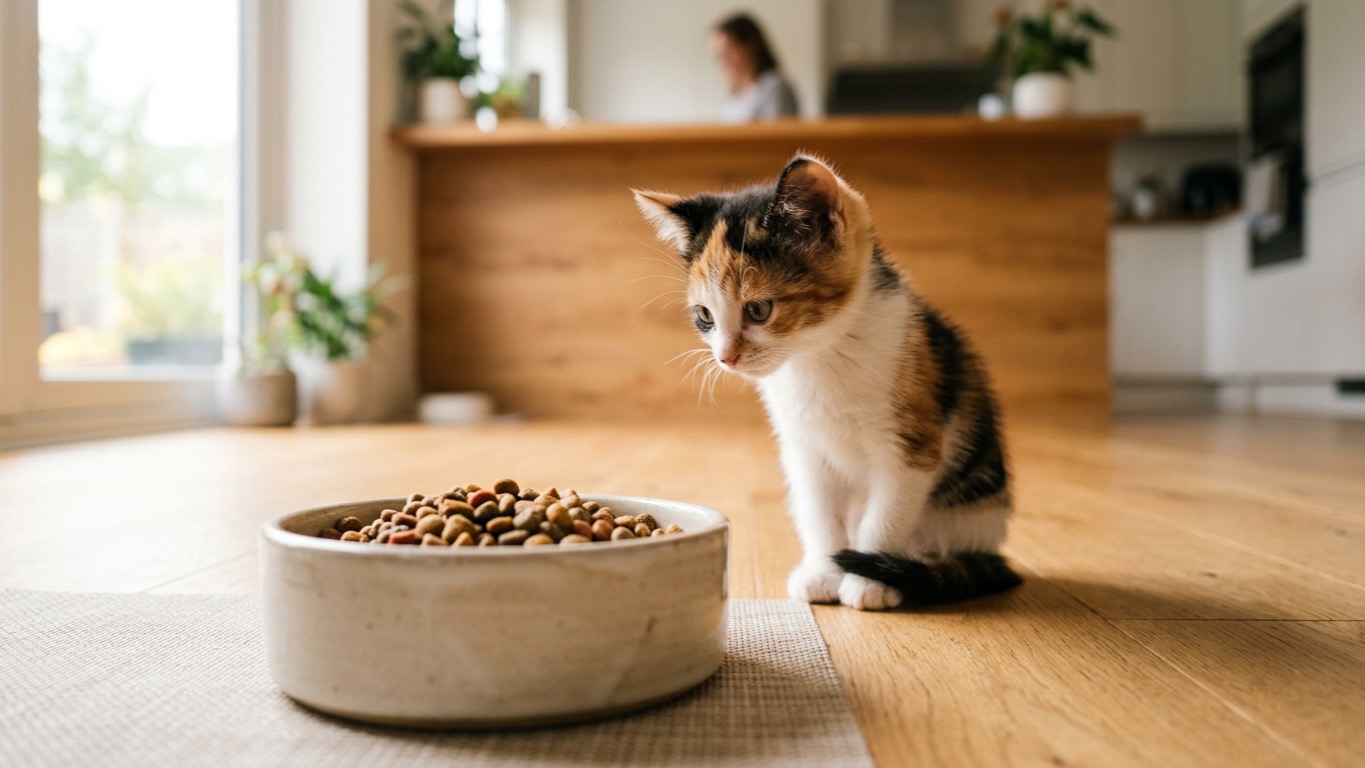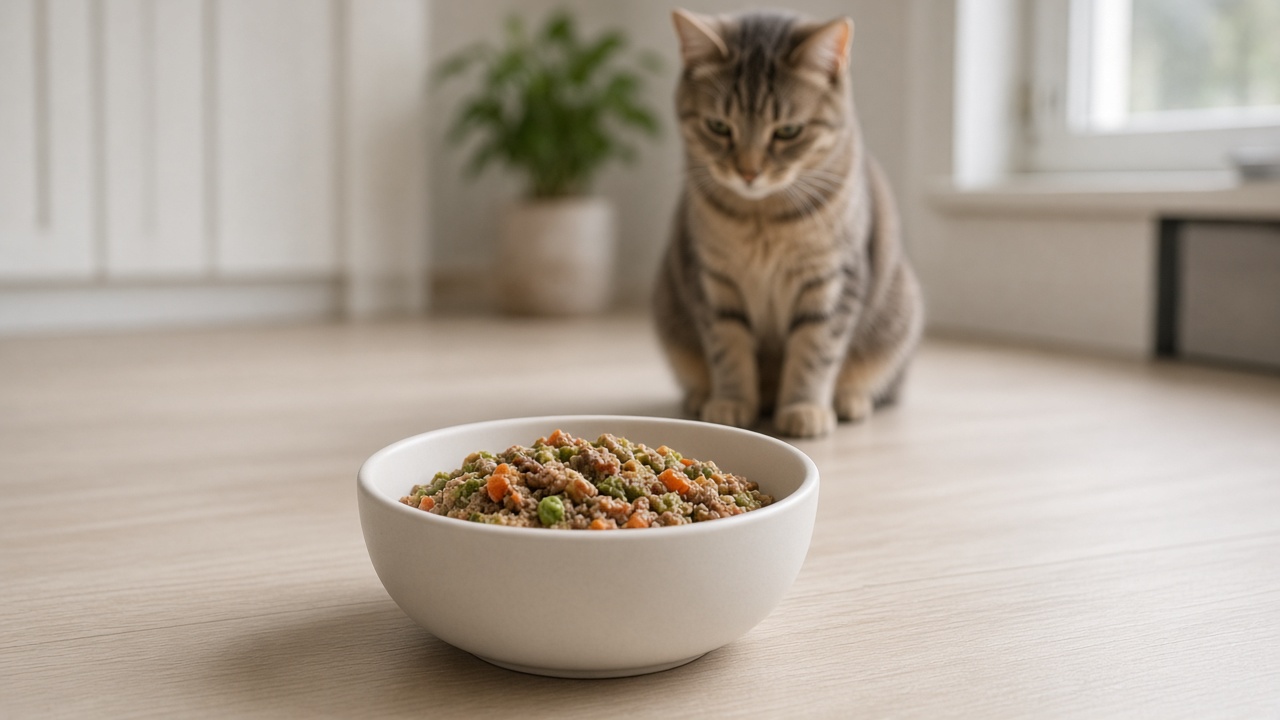
Quick answer: One stolen bite of dog food is not a poison event. One emergency meal is not a poison event for a healthy adult cat. Feed labeled cat food, not dog food, as the daily diet.
Dog food labeled only for dogs is not a complete daily diet for cats. This page is a desk comparison of AAFCO nutrient tables and FDA label rules; our research team analyzed published specs and ran no feeding trials, blood panels, or clinic exams.
Our selection rule is the Mixed-Home Adult Bowl Rule. We cover commercial dry or wet dog food eaten by an otherwise healthy adult cat in a two-species home. We leave out homemade recipes, raw diets, kitten growth feeding, and medical cases.
The first number that matters is protein. AAFCO’s adult dog floor is 18.0% crude protein on dry matter. AAFCO’s adult cat floor is 26.0% on the same basis.
What “complete and balanced” means on a US label
The FDA’s complete-and-balanced page tells owners to read the nutritional adequacy statement. If that statement uses “complete and balanced,” the product is meant as a sole diet for the named species.
The FDA’s page states two ways a dog or cat food may carry that phrase:
- The formula meets an AAFCO Dog or Cat Food Nutrient Profile.
- The formula passes a feeding trial that uses AAFCO procedures.
The FDA’s page is plain on the first path. The food must contain every nutrient listed in the relevant profile at the recommended level.
A bag that is complete for dogs is complete against the dog profile. It is not complete against the cat profile.
AAFCO’s Understanding Pet Food page says AAFCO does not regulate, test, approve, or certify pet food. AAFCO writes model language that states may adopt. The FDA and the states enforce labels.
The FDA’s page dates the first AAFCO Dog Food Nutrient Profiles to 1991. The first Cat Food Nutrient Profiles followed in 1992. The same page says AAFCO most recently updated both profiles in 2016.
Treats and snacks sit outside this rule. The FDA’s page notes that treats are often not complete and balanced. A dog biscuit is not a cat meal.
The species word on the bag is the rule. “Dog” does not mean “pet.”
The Pet Bench AAFCO Gap Check
Our research team analyzed the published AAFCO adult-maintenance tables on a dry-matter basis. We compared the dog minima with the cat minima line by line. We did not assay bags in a lab.
The Pet Bench AAFCO Gap Check counts five cat-profile line items that have no dog-profile minimum:
- Extruded taurine
- Canned taurine
- Arachidonic acid
- Vitamin K
- Biotin
A dog food can meet every dog minimum and still omit all five.
Protein is the largest bulk gap. AAFCO’s adult dog minimum is 18.0% crude protein on a dry-matter basis. AAFCO’s adult cat minimum is 26.0% crude protein on the same basis.
That is an 8.0 percentage-point shortfall if a food is built to the dog floor. On AAFCO’s calorie table the dog floor is 45.0 grams of protein per 1,000 kcal. The cat floor is 65 grams per 1,000 kcal.
Fat has a floor gap too. AAFCO’s adult dog fat minimum is 5.5% dry matter. AAFCO’s cat fat minimum is 9.0% dry matter for both adult maintenance and growth.
Arginine is a concrete amino-acid gap. AAFCO lists 0.51% arginine for adult dogs and 1.04% for adult cats, both on dry matter. The cat floor is twice the dog floor.
Two vitamin rows widen the same split:
- Niacin: AAFCO lists 13.6 mg/kg for dogs and 60 mg/kg for cats.
- Pyridoxine: AAFCO lists 1.5 mg/kg for dogs and 4.0 mg/kg for cats.
The Merck Veterinary Manual explains the niacin biology. Cats cannot make enough niacin from tryptophan. The diet must supply it.
AAFCO’s tables presume 4,000 kcal of metabolizable energy per kilogram of dry matter. AAFCO also warns that processing may destroy up to 90% of thiamine.
Cat food premixes are built for that loss. Dog food premixes are not built for the cat niacin or taurine floors.
| Nutrient, adult maintenance, dry matter | AAFCO dog minimum | AAFCO cat minimum |
|---|---|---|
| Crude protein | 18.0% | 26.0% |
| Crude fat | 5.5% | 9.0% |
| Arginine | 0.51% | 1.04% |
| Arachidonic acid | no minimum | 0.02% |
| Taurine, extruded | no minimum | 0.10% |
| Niacin | 13.6 mg/kg | 60 mg/kg |
Growth widens the protein gap. AAFCO’s growth-and-reproduction dog minimum is 22.5% crude protein. The matching cat minimum is 30.0%.
That is why this article does not treat kittens as a “one meal is fine” case.
Why taurine, arachidonic acid, and vitamin A matter
The Merck Veterinary Manual states that cats require dietary taurine, arachidonic acid, and vitamin A. Dogs do not have the same dietary mandate for those three. That is the species split behind most “can cats eat dog food” answers.
AAFCO’s cat profiles set taurine at 0.10% of dry matter for extruded food. The canned minimum is 0.20% of dry matter. The dog profiles list no taurine minimum at either life stage.
The Merck Veterinary Manual names the two classic taurine-deficiency outcomes in cats:
- Dilated cardiomyopathy
- Central retinal degeneration
Both take time. A single stolen meal does not create them.
Arachidonic acid is the fatty-acid twin of that story. AAFCO’s cat profiles set 0.02% arachidonic acid on dry matter. The dog profiles set no arachidonic acid minimum.
The Merck Veterinary Manual says cats cannot readily convert linoleic acid into arachidonic acid. Dogs can.
Vitamin A is the third split. The Merck Veterinary Manual says cats lack the intestinal dioxygenase enzyme that cleaves beta-carotene.
Cats need preformed vitamin A from animal tissue or a premix. Dogs can use plant carotenoids.
AAFCO’s adult cat vitamin A minimum is 3,332 IU/kg of dry matter. The dog minimum is 5,000 IU/kg. The number on the dog table can look higher.
The form still matters. A dog premix may lean on carotenoids that a cat cannot use.
Protein quality on a dog bag does not close these gaps. A food that leads with meat meal can still miss taurine, arachidonic acid, and preformed vitamin A.
Our explainer on meat meal versus meat in dog food covers those dog-label names. It does not turn a dog formula into a cat formula.
One stolen meal versus a week of meals
Dog food is not a listed toxin for cats. The acute problem is usually the stolen volume, not a poison molecule.
A large dry meal can cause vomiting or loose stool. That is a GI upset, not a complete-diet claim.
The chronic problem is the profile gap. Weeks of dog-only feeding leave taurine, arachidonic acid, and protein below the cat floors.
The Merck Veterinary Manual says cats stay in continuous gluconeogenesis. They burn amino acids for glucose even when they rest.
The Merck Veterinary Manual also notes that cats may graze as many as 18 small meals a day. A free-choice dog bowl is an easy 18-hit buffet. The risk is the pattern, not the first nibble.
Use this split when you decide what to do next:
- One stolen handful: watch stool and appetite. Return to cat food at the next meal.
- One planned emergency meal: acceptable for a healthy adult. Buy cat food the next day.
- Days or weeks of dog-only bowls: the AAFCO cat floors are no longer being met.
The FDA’s moisture math explains a common label trick. The FDA’s page says canned pet food is typically 75 to 78 percent moisture. Dry food is typically 10 to 12 percent moisture.
The FDA example converts canned 12% protein at 78% moisture to 54.5% dry-matter protein. A dry 37% guarantee at 12% moisture becomes 42% protein on dry matter.
Compare dry matter, not the raw panel, when a cat steals wet dog food.
If the cat food bag is empty tonight, one dog-food meal is a stopgap. Buy cat food the next day. Do not stretch the stopgap into a feeding plan.
Why high-protein and kidney dog foods still fail cats
A high-protein dog food can clear the 26.0% cat protein floor and still fail the cat profile. Protein is one row. Taurine, arachidonic acid, vitamin A form, arginine, and niacin are separate rows.
Comparing published specs does not show a dog “high protein” claim that also guarantees AAFCO cat taurine. Our guide to high-protein dog food benefits is written for dogs. It is not a cat-feeding license.
Prescription kidney diets for dogs move the other way. They often restrict protein on purpose.
The Hill’s manufacturer page for k/d with Chicken dry calls it clinical nutrition for dogs with kidney disease. The same page lists bag sizes of 8.5 lb, 17.6 lb, and 27.5 lb.
That product is built for a dog kidney problem. It is not built for a cat’s taurine or arginine floors. If a cat shares that bowl, the protein gap and the cat-only nutrient gap both apply.
Retail availability of k/d does not change the species rule. Our where-to-buy note on k/d dog food is a shopping page for dog households. It is not a feeding page for cats.
A richer dog bag is still a dog bag. Taste is not a nutrient profile.
How to stop bowl sharing in a mixed home
Feed the cat first, in a closed room, with the door shut until the bowl is empty. Pick up uneaten cat food before the dog patrols. Then feed the dog.
Simple hardware cuts the raid window:
- Raise the cat bowl if the dog cannot jump and the cat can.
- Use a baby gate with a cat door in a hallway.
- Use a timed feeder so the bowl is not open all day.
- Store dog kibble in a lidded bin.
Do not free-feed a high-value dog food in a house with a bored cat. The Merck Veterinary Manual’s 18-meal grazing note is the reason.
If the cat prefers the dog’s food for taste, change the cat food form first. Many cats prefer wet food. That is a palatability fix, not a nutrient fix from the dog bowl.
Watch body weight and stool for a few days after a raid. Seek hands-on care if vomiting lasts or the cat stops eating. This desk does not diagnose those cases.
FAQ
Can cats eat dog food in an emergency?
Yes, one meal is a stopgap when the cat bag is empty. The FDA’s complete-and-balanced rule still names the species on the label. Buy cat food the next calendar day.
Can cats eat wet dog food?
Wet dog food is still dog food. The FDA’s page puts typical canned moisture at 75 to 78 percent. Moisture does not add taurine or arachidonic acid at AAFCO cat minima.
What if my kitten ate dog food?
This article’s selection rule excludes kittens. AAFCO’s growth cat protein minimum is 30.0% dry matter, versus 22.5% for growing dogs. Call a clinic if a kitten’s main meals were dog food.
Can dogs eat cat food?
A few stolen cat kibbles are a calorie event for most dogs, not a poison event. Cat food is richer in protein and fat against AAFCO’s cat floors. Daily cat food for a dog is a different article.
How long can a cat eat dog food before it is a problem?
There is no safe multi-week window in the AAFCO cat profiles. The Merck Veterinary Manual lists taurine heart and eye injury as a delayed deficiency, not a same-day event. Switch back to cat food as soon as you can.
Does adding taurine powder fix dog food for cats?
A taurine sprinkle does not add arachidonic acid, preformed vitamin A, arginine, or niacin to the cat floors. AAFCO’s cat profile is a full table, not one amino acid. Do not homemade a cat diet from a dog bag plus a jar.
Is “complete and balanced” on a dog bag enough?
No. The FDA’s page says the claim is valid for the AAFCO profile or feeding trial named on that label. A dog statement does not satisfy the cat profile.