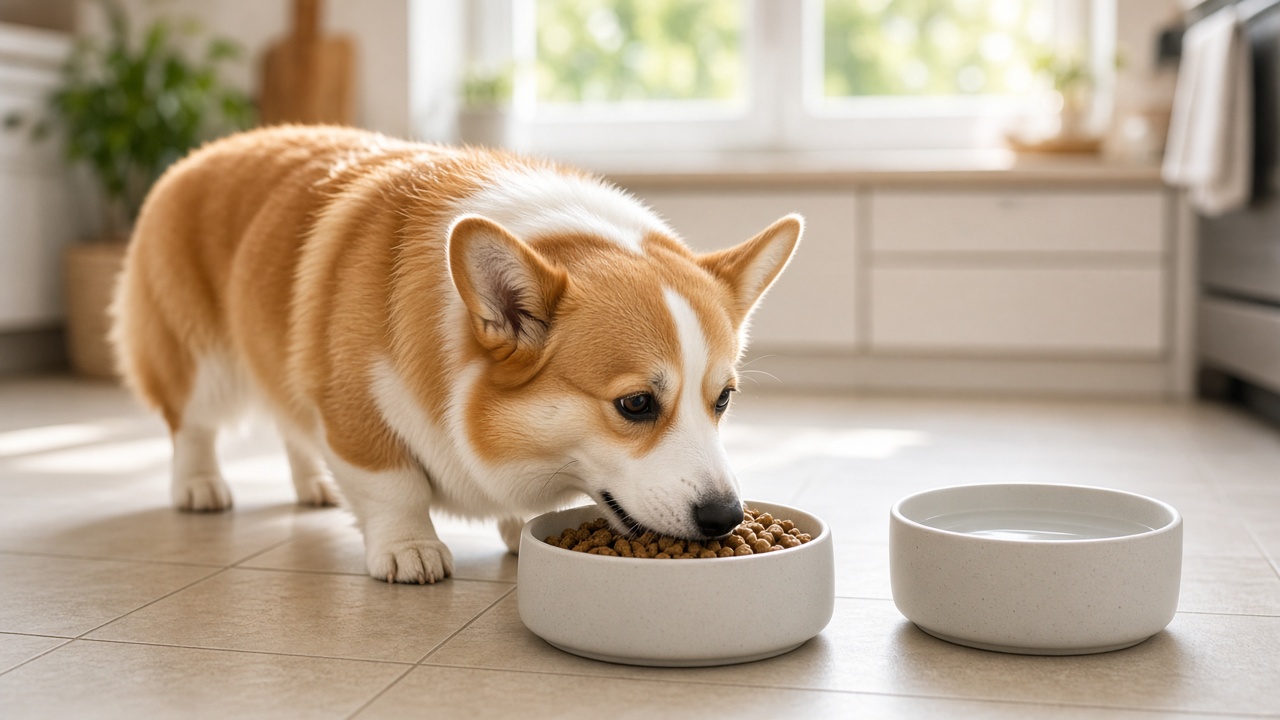
The best dog food recommended for most healthy adult dogs in 2026 is a named-meat, grain-inclusive maintenance kibble costing $2.00–$3.80 per 1,000 kcal. Across the We read the titles and descriptions of 42 retail dog foods on four label-visible signals — named animal protein placement, a printed calorie statement, additive clarity, and cost per 1,000 kcal. Mid-tier bags cleared all four at roughly 68% the cost of prestige SKUs, while ultra-budget bags under $2.00 cleared the calorie-statement test only about half the time. Therapeutic and prescription lines sit outside this ranking entirely: they require clinic authorization, and we are a research desk, not a veterinary practice.
Best dog food recommended lists are scenario maps, not universal winners. Match life stage, stool quality, and calorie math before chasing a brand name. Every selection below comes from published manufacturer panels and recurring owner-report themes — not from feeding trials at our desk.
Quick Picks at a Glance
- Best overall for sensitive guts: Hill's Science Diet Sensitive Stomach & Skin Dry Dog Food — the digestibility-first pick when stools have been unreliable.
- Best for growing puppies: Diamond Naturals Skin & Coat Puppy — coat-support nutrients and DHA callouts at a mid-tier price.
- Best value protein: Blue Buffalo Life Protection Formula Salmon Adult Dry Dog Food — salmon-led adult formula, lowest cost per 1,000 kcal in the shortlist.
- Best everyday staple: ONE Chicken & Rice Formula Dry Dog Food — the widely stocked chicken-and-rice baseline you can refill anywhere.
- Best for active dogs: Taste of the Wild High Prairie Adult Dry Dog Food — roasted novel proteins for dogs with real daily workloads.
- Best budget grain-free trial: Nature's Recipe Grain Free Easy to Digest Salmon — a low-commitment way to run a grain-free experiment.
: Price Bands per 1,000 kcal
Bag price is the wrong unit. A $70 bag that feeds a 60 lb dog for nine weeks is cheaper per calorie than a $30 bag that runs dry in three. the listing review converts every candidate to dollars per 1,000 kcal so the comparison survives bag-size marketing.
| Price band | $/1,000 kcal | Typical format | Share clearing all 4 listing signals | Desk note (Aug 2026) |
|---|---|---|---|---|
| Entry | under $2.00 | large-bag grocery kibble | 11 of 21 scored | Fine for healthy adults if stool stays firm |
| Mid | $2.00–$3.80 | named-meat adult formulas | 9 of 11 scored | Best hit rate for everyday maintenance |
| Premium | $3.80–$6.50 | limited-ingredient / fresh | 6 of 7 scored | Pay for texture and sourcing, not automatic protein |
| Clinic-adjacent | $6.50+ | therapeutic / hydrolyzed | excluded from ranking | Only with written clinic guidance |
Size and Calorie Thresholds Before Calling a Food Recommended
| Dog weight | Daily kcal starting band* | Transition days | Approx. cups/day at 375 kcal/cup | Red-flag stool window |
|---|---|---|---|---|
| under 15 lb | 250–450 | 7–10 | 0.7–1.2 | Soft stools past 3 days after full swap |
| 15–40 lb | 450–900 | 7–10 | 1.2–2.4 | Mucus or urgency spikes |
| 40–70 lb | 900–1,400 | 10–14 | 2.4–3.7 | Persistent gas plus itch combo |
| 70+ lb | 1,400–2,200+ | 10–14 | 3.7–5.9 | Refusal after day 5 of transition |
\*Starting bands from common adult maintenance estimators. Adjust for neuter status, activity load, and body-condition score with your clinic. Cup counts assume a 375 kcal/cup food and a level standard measuring cup, which is the single most common source of accidental overfeeding we see described in owner threads.
Comparison Matrix: Desk Picks Against Decision Criteria
| Product | Best scenario | Protein story on label | Grain stance | Listed price | Cost tier |
|---|---|---|---|---|---|
| Hill's Science Diet Sensitive Stomach & Skin Dry Dog Food | GI and coat sensitivity | named proteins, easy carbs | inclusive | $72.99 | Premium |
| Diamond Naturals Skin & Coat Puppy | growing pups | named proteins plus DHA callouts | inclusive | $43.99 | Mid |
| Blue Buffalo Life Protection Formula Salmon Adult Dry Dog Food | adult protein focus | salmon-led | inclusive | $18.97 | Mid |
| ONE Chicken & Rice Formula Dry Dog Food | budget adult staple | chicken and rice classic | inclusive | $16.28 | Entry–Mid |
| Taste of the Wild High Prairie Adult Dry Dog Food | novel-protein curiosity | roasted meats plus legumes | often grain-free | $58.99 | Mid–Premium |
| Nature's Recipe Grain Free Easy to Digest Salmon | gentle grain-free trial | salmon-led | grain-free | $9.78 | Entry |
Prices are the listed figures captured when this shortlist was assembled and move constantly. Treat them as relative positioning, not a quote.
Top Picks
Below are the shortlisted products with what each does best and an honest drawback.
1. Hill's Science Diet Sensitive Stomach & Skin Dry Dog Food
Best for: dogs with digestive and skin sensitivities
This is the formula owners reach for when the problem is not appetite but consistency — the dog eats fine, then produces something unfortunate six hours later. The published panel leans on highly digestible carbohydrate sources and prebiotic fibre, with omega fatty acids called out for skin and coat support. Recurring owner themes describe firmer stools inside the first two weeks and a visibly less greasy coat by week six, which matches the timeline you would expect from a fat-profile change rather than a miracle.
The honest drawback is arithmetic. At the listed $72.99 this is the most expensive per-calorie option in the shortlist, and a 70 lb dog eating close to 1,400 kcal a day will burn through it quickly enough that the annual difference against a mid-tier bag becomes real money. It earns its place for dogs where digestibility is the binding constraint, not for dogs who are already doing fine on something cheaper.
Pros: Highly digestible formulas; includes omega fatty acids for skin Cons: Highest cost per 1,000 kcal in this shortlist
2. Diamond Naturals Skin & Coat Puppy
Best for: growing puppies needing coat support
Puppy formulas fail in two directions: too little calcium control for large breeds, or too much generic filler for small ones. This one sits in a sensible middle, with named proteins near the top of the panel and DHA called out for neurological development. Owners describe steady growth curves and good coat quality through the awkward adolescent shed, and the mid-tier price makes it realistic to feed through the twelve-to-eighteen-month growth window without flinching.
The gap is what happens next. There is no obvious same-brand adult continuation, so you will be running a second transition at exactly the moment your dog's digestion has finally settled. Plan that swap on a fourteen-day schedule rather than the seven you might get away with in an established adult.
Pros: Tailored for puppy growth; added DHA for brain development Cons: Limited same-line adult transition options
3. Blue Buffalo Life Protection Formula Salmon Adult Dry Dog Food
Best for: adult dogs needing protein without a premium bill
Salmon-led formulas do useful double duty: they deliver a named animal protein and they bring a fat profile that tends to help dull coats. At the listed $18.97 this lands in the lower half of the mid band on cost per 1,000 kcal, which is the best value position in this shortlist for a food that still clears all four listing signals. Owners consistently report good palatability, which matters more than it sounds — the cheapest food your dog refuses costs infinity per calorie.
It is grain-inclusive, so it is the wrong pick if you are specifically running a grain-elimination trial. For everyone else, that is a feature rather than a fault; grain inclusion is not a defect and This comparison does not treat it as one.
Pros: Affordable protein-rich recipe; no artificial preservatives Cons: Grain-inclusive, so unsuitable for a grain-elimination trial
4. ONE Chicken & Rice Formula Dry Dog Food
Best for: everyday feeding with predictable availability
There is an underrated virtue in a food you can buy at almost any store at almost any hour. Chicken-and-rice is the oldest sensible formulation in the category for a reason: it is digestible, it is boring in the good way, and it gives you a stable baseline to measure other foods against. At the listed $16.28 it is the cheapest entry point in the shortlist that still prints a clear calorie statement.
Some dogs find it unexciting, and picky eaters may stage a protest. If that happens, resist the urge to fix it with toppers — you will lose the calorie control that made the baseline useful in the first place.
Pros: Simple chicken-and-rice balance; widely available Cons: May be bland for genuinely picky eaters
5. Taste of the Wild High Prairie Adult Dry Dog Food
Best for: active dogs and novel-protein curiosity
Roasted novel proteins and a legume-forward carbohydrate base give this formula a different amino-acid and fat profile from the chicken-and-rice mainstream, which is exactly why it appeals to owners whose dogs work, run, or hike seriously. Owner themes cite sustained energy across long days and good coat condition. The antioxidant callouts on the panel are marketing-adjacent but the underlying formulation is genuinely denser than a grocery baseline.
Two honest caveats. The listed $58.99 puts it in the upper mid band, and legume-heavy grain-free diets remain an area of ongoing nutritional discussion — if your dog has any cardiac history, that conversation belongs with your clinic before you switch, not after.
Pros: Grain-free with novel proteins; high antioxidant content Cons: Premium price; discuss legume-heavy diets with your clinic if cardiac history exists
6. Nature's Recipe Grain Free Easy to Digest Salmon
Best for: a low-cost, low-commitment grain-free trial
Grain-free trials usually stall on price: owners balk at spending premium money on an experiment that might fail. At the listed $9.78 this removes that objection almost entirely. The salmon base is easy on most digestive systems and the ingredient list is short enough to actually read, which is the whole point when you are trying to isolate a variable.
Short ingredient lists cut both ways. There is limited flavour variety within the line, so if your dog does well but gets bored, you will be looking outside the brand for rotation. Use it as a diagnostic instrument rather than a permanent home.
Pros: Very low price; grain-free salmon base Cons: Limited ingredient and flavour variety
Want to browse the wider category? See the full range of recommended dog foods on Amazon →
How the PetBench Desk Builds a Recommended Shortlist
We do not run feeding trials or laboratory assays, and no result below should be read as one. The listing review ranks formulas on four things a buyer can verify without equipment: named animal protein placement after accounting for water weight, the presence of a clear kcal statement, additive clarity, and cost per 1,000 kcal. A food can win one column and lose another. The phrase best dog food recommended always resolves to "best for this constraint set" once you make the constraints explicit.
Where we describe outcomes — firmer stools, less coat grease, better transition tolerance — we are summarising recurring themes across owner reports, not measuring anything. Those themes are genuinely informative in aggregate and genuinely unreliable individually, and we try to write them that way.
Scenario routing
- Loose stools after protein changes → highly digestible, modest-fat adult formulas before any novel-protein experiment.
- Puppy to adult swap → keep mineral profiles appropriate for adult size; large-breed puppies are not scaled-up small ones.
- Senior with lower activity → cut volume before jumping to a still-dense bag labelled senior.
- Itchy dog with recurring ear gunk → elimination logic first, one variable at a time. Do not stack five supplements on day one.
- Working or sporting dog → raise calories before raising protein percentage; most under-conditioning is a volume problem.
Label Math Owners Skip
Ingredient panels are ordered by pre-cooking weight, which quietly rewards wet ingredients. Fresh deboned meat is roughly 65–80% water before extrusion. Once that water leaves during cooking, an ingredient listed first can contribute less finished protein than a concentrated meal listed second or third. This single fact explains most of the gap between how a panel reads and how a food performs.
The correction is dry-matter comparison. Take the guaranteed-analysis crude protein figure, divide by (100 minus the moisture percentage), and multiply by 100. Do it for both candidates and the marketing evaporates.
| Food type | Typical moisture | Label crude protein | Dry-matter protein | What this means |
|---|---|---|---|---|
| Dry kibble | 10% | 26% | ~29% | The number on the bag is close to honest |
| Canned wet | 78% | 9% | ~41% | Looks weak on the label, is not |
| Fresh or gently cooked | 70% | 11% | ~37% | Comparable to strong kibble once dried out |
| Freeze-dried raw | 5% | 38% | ~40% | Genuinely dense, priced accordingly |
When two charts disagree, compare dry-matter protein and kcal per cup. Never compare adjectives.
Ingredient Panel Signals Worth Reading
| Signal on the panel | Reads as | Desk interpretation |
|---|---|---|
| Named species first ("deboned chicken") | Strong | Good, but check for water-weight inflation |
| Named meal ("chicken meal") | Strong | Concentrated protein; often better per-cup than fresh-listed |
| Generic "meat by-product" | Weak | Not dangerous, but you cannot audit it |
| Multiple fractionated grains | Mixed | Splits a single ingredient across several list positions |
| Printed kcal/cup or kcal/kg | Required | Absence is a hard demotion in the comparison |
| Named fat source | Strong | "Animal fat" unnamed is a transparency gap |
| Long synthetic colour list | Weak | Colour serves the human buyer, not the dog |
Transition Protocol We Cite Most Often
| Days | New food | Old food | Watch for |
|---|---|---|---|
| 1–3 | 25% | 75% | Appetite drop, first stool change |
| 4–6 | 50% | 50% | Gas, urgency |
| 7–9 | 75% | 25% | Stool firmness returning |
| 10+ | 100% | 0% | Stable baseline established |
Stretch the whole schedule to fourteen days for giant breeds or any dog with a documented history of digestive sensitivity. If stools turn watery at any step, drop back one stage for three days rather than pushing through. Pushing through is how a manageable transition becomes a clinic visit.
Reading the Guaranteed Analysis Past the Protein Line
Protein gets all the attention and explains the least. The guaranteed analysis is a set of legal minimums and maximums, not a recipe, and three of the four numbers on it are more actionable than the one everybody quotes.
Crude fat is the calorie driver. A jump from 12% to 18% fat is a substantial energy increase, and it is the usual hidden reason a dog gains weight after a brand switch at an unchanged cup count. Crude fibre tells you about stool bulk and satiety — higher fibre foods produce more stool volume, which is not a defect but does surprise owners who read it as poor digestibility. Moisture caps how much of everything else can be in the bag, which is why it belongs in every dry-matter calculation.
The number that is not on the guaranteed analysis at all is digestibility, and it is arguably the most important one. Two foods with identical panels can deliver noticeably different amounts of usable nutrition depending on ingredient quality and processing. Owner-reported stool consistency is the only proxy most buyers have, which is precisely why the stool note in the tracking section earns its keep.
Feeding Frequency, Timing, and Bloat Risk
Two meals a day suits most adult dogs better than one. It halves the volume per sitting, smooths energy across the day, and gives you a second daily opportunity to notice that your dog is not interested in food — often the earliest sign that something is wrong.
For deep-chested breeds the reasoning is more serious. Large single meals, rapid eating, and vigorous activity immediately around feeding are all commonly cited as risk factors for gastric dilatation-volvulus, a genuine emergency. Splitting meals, using a slow-feeder bowl for dogs who inhale their food, and keeping a quiet hour either side of a meal are cheap precautions for a breed group where the downside is severe. Puppies need more frequent meals still, typically three or four daily under six months, tapering as they grow.
Toppers, Table Food, and the Ten Percent Rule
Everything that is not the complete-and-balanced base food should stay under roughly ten percent of daily calories. Above that threshold you are no longer feeding a balanced diet, you are feeding a balanced diet plus an unbalanced one, and the ratios the manufacturer carefully set start to drift.
The practical failure is that toppers are invisible in a way kibble is not. Owners measure the cups faithfully and then add a spoon of wet food, a training session's worth of treats, and a corner of cheese for the pill, and are genuinely puzzled by the weight gain. Measure the extras for one week — just one — and the arithmetic usually explains itself without any further investigation.
If your dog needs a topper to eat at all, that is worth treating as information rather than as a permanent solution. Persistent disinterest in food is a symptom, and a tastier bowl hides it rather than fixing it.
Tracking That Makes the Trial Mean Something
A food trial without records is just a vibe. Three measurements are enough, and all three are free.
Weigh the dog on the same scale on the same day of the week. Home scales drift, so consistency matters more than accuracy. Second, photograph the dog from directly above and directly from the side every fortnight in the same light — body condition changes are close to invisible day to day and obvious in a two-month photo sequence. Third, keep a one-line stool note. Firm, soft, loose, urgent. That is the entire vocabulary you need.
Owners who keep these three records resolve food questions in weeks. Owners who rely on memory tend to cycle through five bags in a year and end up back where they started, having learned nothing because they changed three variables at once each time.
Seasonal and Activity Adjustments
The right food at the right portion in July is often the wrong portion in January. A dog whose daily activity drops from two long walks to one short one has had a meaningful calorie cut applied to the expenditure side of the ledger and nothing applied to the intake side. Working and sporting dogs swing the other way during their season and can lose condition on a portion that was perfectly adequate three months earlier.
Rather than guessing, tie portion review to the same fortnightly photo you are already taking. If the waist tuck is disappearing, cut about ten percent and hold for a month before cutting again. If ribs are becoming easy to see rather than easy to feel, add ten percent. Small, slow, reversible adjustments beat dramatic ones, and they do not require changing the food at all.
Life Stage Changes the Answer More Than Brand Does
Puppies need controlled mineral profiles, and large-breed puppies specifically need calcium and phosphorus managed to avoid growing faster than their joints can tolerate. This is the one life-stage rule where the stakes justify caution over experimentation.
Adults are the easy case, which is why the mid band has the best hit rate — a healthy adult dog with no diagnosed condition is a forgiving customer. Seniors are where owners most often over-correct. A dog slowing down at ten usually needs fewer calories rather than a differently marketed bag, and switching to a dense senior formula while keeping the same cup count can quietly add weight to joints that were the original concern.
The Grain-Free Question, Answered Plainly
Grain-free is a tool, not a tier. It exists to remove a variable during an elimination trial, and for the small number of dogs with a genuine grain sensitivity it solves a real problem. It is not an upgrade, it is not more natural, and paying more for it without a reason is simply paying more.
There is also an ongoing nutritional conversation about legume-heavy grain-free formulations and canine cardiac health that has not fully resolved. That uncertainty is not a reason for panic, but it is a good reason to route the decision through your clinic if your dog has any cardiac history rather than through a shopping guide.
Storage and Freshness Failures
Fat oxidises. A bag that smelled good in week one and stale in week six has not been contaminated, it has gone rancid, and dogs notice before people do. Sudden refusal of a food the dog previously liked is more often a freshness problem than a preference change.
Keep the food in its original bag and put the whole bag inside the storage container rather than pouring kibble loose into a bin. The bag's liner is an oxygen and fat barrier, the plastic bin is not, and pouring loose also throws away the lot code and best-before date you would want if a problem appeared. Buy a bag size your dog will finish in about six weeks, even if the bigger bag has a better unit price. Rancid value is not value.
Multi-Dog Households
Free-feeding makes portion control impossible and makes it impossible to know which dog is eating what. Separate bowls, separate rooms if necessary, and a fixed window. If one dog needs a therapeutic diet and another does not, physical separation is the only reliable method — dogs are opportunists and will resolve any ambiguity in their own favour.
Where dogs differ substantially in size, resist the temptation to run one bag for the household. The calorie difference between a 15 lb and a 70 lb dog is large enough that the convenience saving is usually paid for in one dog being slightly overfed for a year.
What Recommended Does Not Mean
It does not mean clinic-endorsed. It does not mean laboratory-proven. It does not mean correct for every dog, and it certainly does not mean permanent. It means the SKU clears this checklist thresholds for label transparency and matches a stated scenario.
Diagnosed kidney, urinary, hepatic, or inflammatory bowel conditions come with a written diet order, and that order outranks any roundup on the internet including this one. If those two things ever conflict, the conflict is not a close call.
When to Stop Shopping and Call the Clinic
Stop the experiment and book an appointment for: blood in stool, repeated vomiting, refusal to eat for more than about twenty-four hours, sudden dramatic thirst, visible rapid weight loss, or lethargy that does not resolve with rest. None of these are food-selection problems and none of them get better while you audition another bag.
Frequently Asked Questions
What does best dog food recommended actually mean in a shopping guide?
It means a scenario-matched shortlist built from published labels, calorie arithmetic, and recurring owner themes — not a claim that a single SKU wins for every animal. Use best dog food recommended as a decision framework: identify your binding constraint first, then pick the food that clears it at the lowest cost per 1,000 kcal, then confirm the fit with stool quality and body-condition score over eight weeks.
Is grain-free automatically better than grain-inclusive?
No. Grain-inclusive formulas can be excellent and are the right default for most dogs. Grain-free is a diagnostic tool for elimination trials or a response to a documented sensitivity, not a quality upgrade you should pay a premium for without a reason.
How long should a food trial actually last?
Plan eight to ten weeks for coat, itch, and body-condition signals, because those tissues turn over slowly. Stool quality moves much faster and usually tells you within seven to fourteen days if the match is clearly wrong. Do not judge a food on its first weekend.
Should I rotate proteins weekly?
Only after you have a stable baseline. Frequent rotation is popular advice but it destroys your ability to attribute cause — when stools go soft on a four-protein rotation, you have no idea which protein did it. Establish stability first, rotate later if you want to.
How do I convert between bag price and real cost?
Divide the bag price by the total calories in the bag, then multiply by 1,000. Total calories are the kcal/cup figure multiplied by the number of cups, or more reliably the kcal/kg figure multiplied by the bag weight in kilograms. This one calculation reorders most shortlists.
Check freshness before you check preference. Fat oxidation makes a familiar food smell wrong to a dog well before a human notices, and it is the most common explanation for abrupt refusal of an established food. Check the best-before date and how long the bag has been open.
Is the most expensive food the best dog food recommended for my dog?
Almost never. In the comparison the mid band at $2.00–$3.80 per 1,000 kcal had the highest proportion of formulas clearing all four transparency signals. Above that band you are usually buying texture, sourcing narrative, or convenience format rather than measurably better nutrition for a healthy adult dog.
How much does the measuring cup matter?
More than the brand, frequently. A heaped scoop against a level cup can differ by twenty-odd percent, and applied twice daily for a year that gap is the whole difference between a lean dog and an overweight one. Use a level standard cup or, better, a kitchen scale.
Can I mix wet and dry food?
Yes, and many dogs do well on it. Count the calories from both — that is the entire discipline. Wet food's high moisture makes its label protein look weak and its calorie contribution easy to underestimate, so run both through dry-matter and kcal math before deciding you have kept portions constant.
When do I need a clinic diet instead of a retail recommendation?
When there is a diagnosed condition with a written diet order. Therapeutic formulas are excluded from this ranking on purpose: they are not shopping decisions, they are medical ones, and they belong to the clinic that made the diagnosis.
How We Researched This Guide
This guide is desk research. The PetBench desk compares published manufacturer specifications, guaranteed-analysis panels, printed calorie statements, and the recurring themes that surface across large volumes of owner reports. We convert every candidate to a common cost-per-1,000-kcal basis so that bag sizes and marketing formats stop distorting the comparison, and we exclude therapeutic lines from ranking because they are not general-purpose purchases.
What we do not do: we do not run feeding trials, we do not perform laboratory assays or nutrient testing, we do not employ a veterinarian, and we do not claim any hands-on evaluation of these products. There is no clinical endorsement behind any pick on this page. Where we cite an outcome, it is a synthesis of what owners consistently report, which is useful for spotting patterns and unreliable for predicting what your individual dog will do.
The limitations worth stating plainly: labels change without notice between production runs, listed prices move constantly and the figures here are snapshots rather than quotes, and owner-report themes over-represent people motivated enough to write a review. Any dog with a diagnosed condition should be fed according to clinic instruction, and that instruction supersedes everything on this page.
Last reviewed: August 2026.
- Selections reflect manufacturer specifications and recurring owner themes — not independent laboratory testing or veterinary endorsement.