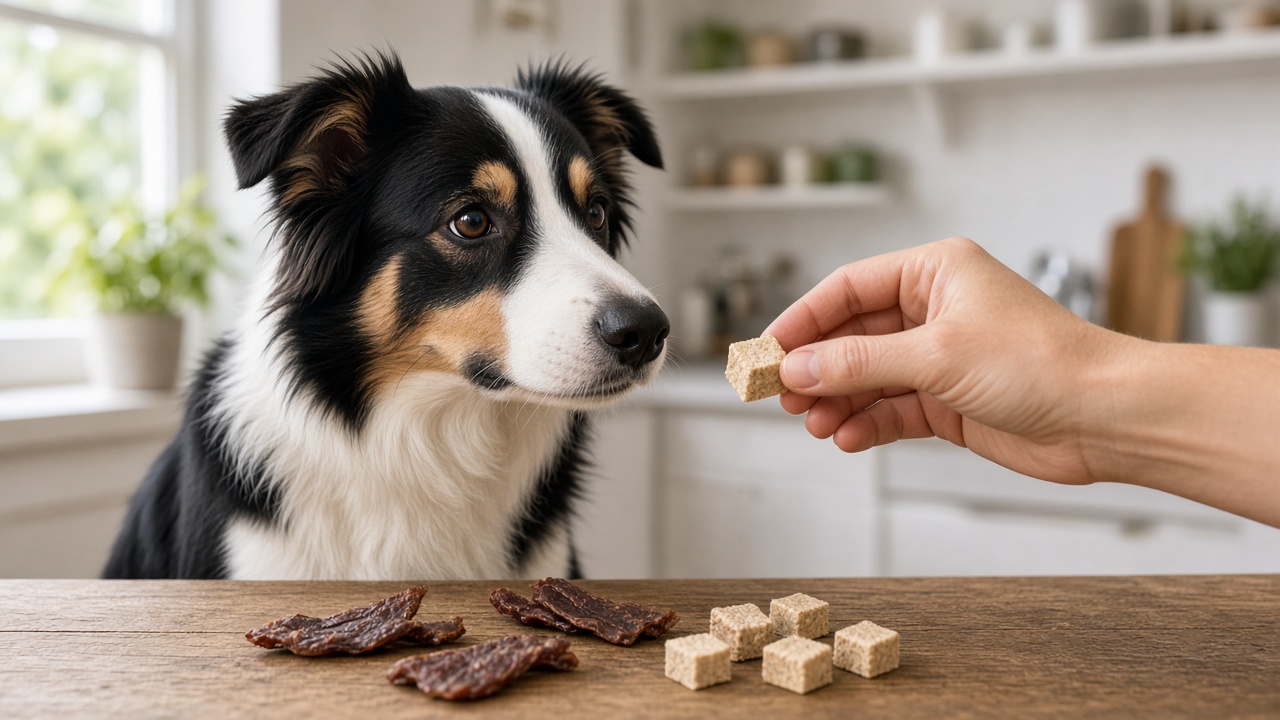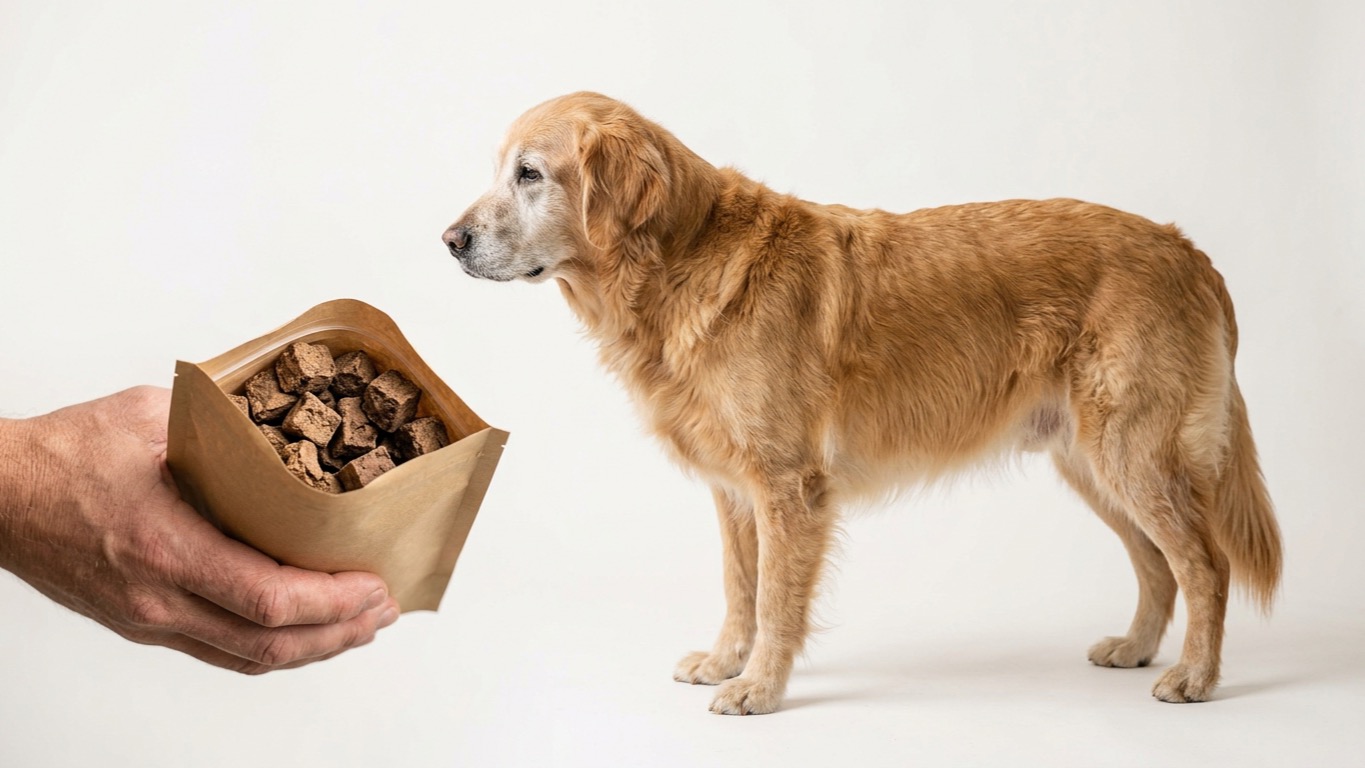
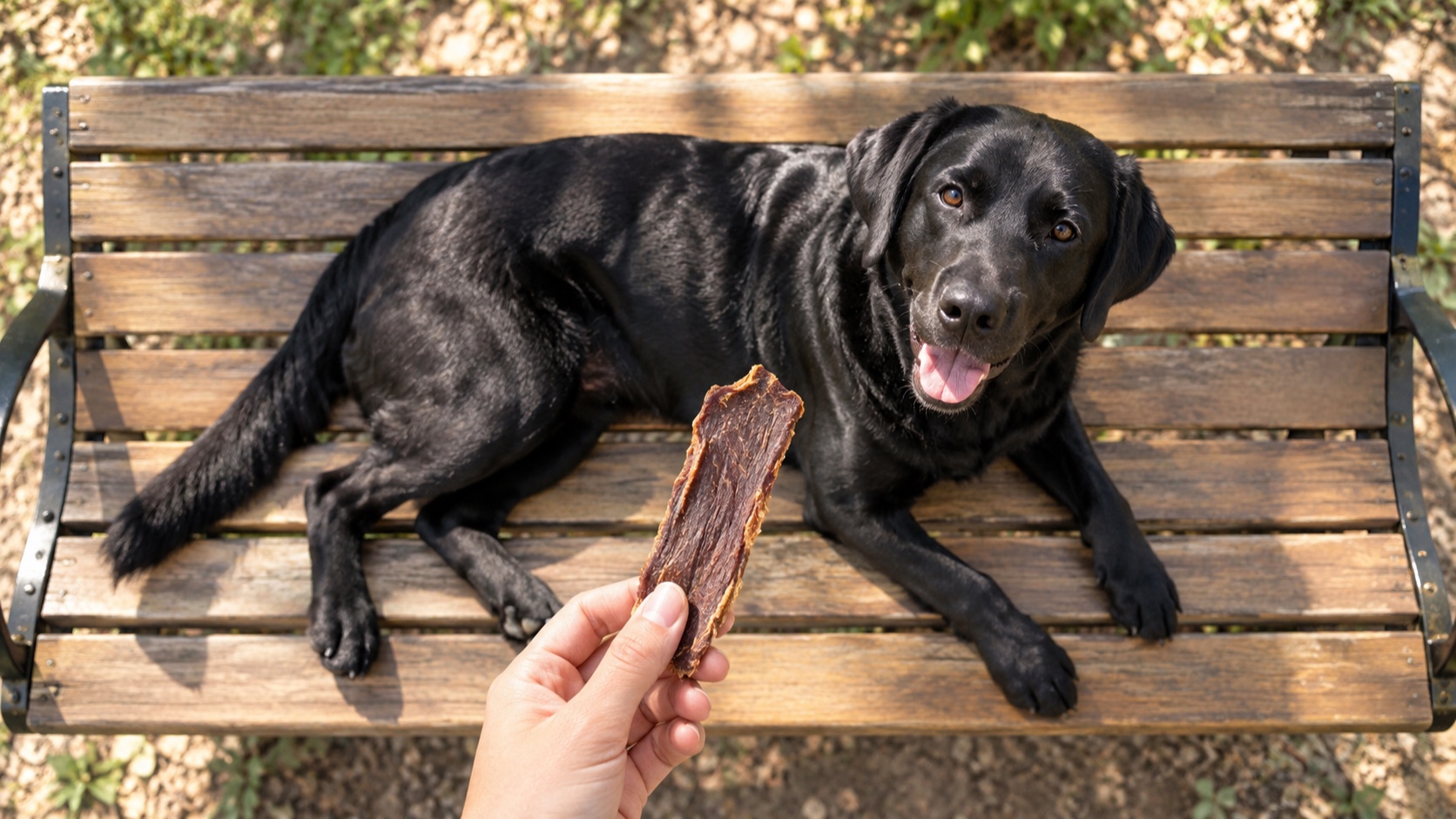
Quick answer: For everyday dog jerky treats, pick a U.S.-made strip that names one animal as the only meat. Tear pieces for training. Treat the bag as a snack, not a meal.
Dog jerky treats worth buying in 2026 list one meat species and a U.S. plant on the maker’s page.
This page is a label-comparison brief from a pet research desk.
Our research team compared published specs on four currently sold bags that cleared that bar. Listed crude protein on the three chicken labels ran from 25.0% to 54.0%.
The U.S. Food and Drug Administration still posts the jerky illness file dated December 31, 2015. That file counts about 5,200 complaints and more than 1,140 canine deaths, many tied to imported poultry jerky.
Country of origin for each ingredient is still optional on a U.S. label. That gap is why we used the maker’s own manufacture claim, not a store filter.
The One-Meat, U.S.-Plant rule
A bag entered this article only if two facts sat on the maker’s own site. The recipe had to list one animal species as the only meat. The company also had to state U.S. manufacture, not just U.S. branding.
We left out freeze-dried cubes, multi-meat blends, imported poultry jerky, and biscuits. A warehouse sticker is not a manufacture claim.
That rule is stricter than a “limited ingredient” badge. Spot Farms Chicken Jerky with Flaxseed & Vitamin E still lists flaxseed, sunflower oil, and cane sugar. It stays in because chicken is the only meat.
Rocco & Roxie Jerky Sticks list brown rice flour, glycerin, and sugar. They stay in because the meat line is one species. The company also states a U.S. plant.
The rule is narrower than “human grade.” That phrase describes a facility standard. It does not prove a single meat or a U.S. cook step.
Spot Farms states its treats are made in the United States and cooked in U.S. kitchens. Full Moon titles its chicken jerky as made in the USA. Rocco & Roxie says the sticks are made in the USA with 100% USA ingredients.
What the FDA jerky file still records
The FDA jerky investigation is not a closed case with a named toxin. The agency’s public update still says its testing did not find a root cause.
As of December 31, 2015, the FDA had about 5,200 complaints. Those reports covered more than 6,200 dogs, 26 cats, and three people.
The same file lists more than 1,140 canine deaths. The FDA says illness was most often, but not always, linked to jerky sourced from China.
About 60 percent of the reports described gastrointestinal illness. About 30 percent described kidney or urinary signs. The remaining 10 percent covered other signs, including tremors and skin irritation.
The FDA also logged more than 360 dogs with glycosuria plus normal blood glucose. The agency collected about 530 jerky samples tied to more than 290 complaints, plus more than 450 unopened retail bags.
The FDA still notes a labeling hole. Manufacturers are not required to list the country of origin for each ingredient.
That is why a maker-page plant claim matters. “Made in the USA” on the company site is a checkable sentence. An aisle sticker is not.
AAFCO treats jerky as pet food, not as a chew exemption. Poultry-flesh jerky must be fully labeled. The front panel must show the word “snack” or “treat.”
AAFCO does not require treats to be complete and balanced. The organization tells owners to give those products sparingly so they do not crowd out the main diet.
How the four bags differ on the label
Full Moon Chicken Jerky lists four ingredients. They are chicken, organic cane sugar, vinegar, and rosemary extract. The company titles the product as made in the USA and glycerine-free.
Full Moon publishes 54.0% crude protein and 3.0% crude fat. It lists 0.7% crude fiber and 22.0% moisture. Calorie content is 2,890 kcal/kg, or 43 kcal per treat.
The same Full Moon page posts a daily chart. Dogs 5 to 15 pounds get one-half to one and one-half treats. Dogs 50 to 75 pounds and up get four to five treats.
Spot Farms Chicken Jerky with Flaxseed & Vitamin E starts with chicken. Later lines include cane sugar, vinegar, sunflower oil, flaxseed, alpha tocopherol, and rosemary extract.
That Spot Farms label lists 50.0% crude protein and 2.0% crude fat. It lists 0.5% crude fiber and 28.0% moisture. Calories are 3,237 kcal/kg, or 49 kcal per treat.
The same page lists vitamin E at 100 IU/kg. It also lists omega-3 fatty acids at 0.5% and omega-6 fatty acids at 3.0%.
Spot Farms names Kentucky family farms for its USDA-inspected, cage-free chicken. That is a source claim, not a flavor line.
Spot Farms Basics Chicken Jerky Tenders use a different recipe. The ingredients are chicken, cassava root, organic cane sugar, salt, vinegar, smoke flavor, and rosemary extract.
Basics lists 25.0% crude protein and 12.0% crude fat. It lists 2.0% crude fiber and 25.0% moisture. Calories are 3,700 kcal/kg, or 37 kcal per treat.
That is the lowest per-treat calorie line in this set. It is also the lowest published protein minimum among the chicken bags.
Rocco & Roxie Jerky Sticks in beef list beef first. Later lines include brown rice flour, glycerin, sugar, salt, smoke flavoring, potassium sorbate, and garlic powder.
Rocco & Roxie does not publish a guaranteed analysis on that product page. It does publish two numbers we can check: about 55 kcal per stick, and an 18-month shelf life.
The same page says the texture comes from 10 hours of slow smoking in small batches. The feeding line is intermittent or supplemental feeding only.
Comparison of listed attributes
The table uses only attributes the makers publish. “Not listed” means the maker page did not show that figure.
| Product | Sole meat | Crude protein (min) | kcal per listed treat | Moisture (max) | Process note on the maker page |
|---|---|---|---|---|---|
| Full Moon Chicken Jerky | Chicken | 54.0% | 43 | 22.0% | Glycerine-free; USDA-inspected meat |
| Spot Farms Chicken Jerky with Flaxseed & Vitamin E | Chicken | 50.0% | 49 | 28.0% | Small-batch cook; Kentucky chicken |
| Spot Farms Basics Chicken Jerky Tenders | Chicken | 25.0% | 37 | 25.0% | Grain- and glycerin-free, per maker |
| Rocco & Roxie Jerky Sticks, Beef | Beef | Not listed | 55 | Not listed | 10-hour slow smoke; 18-month shelf life |
All four bags publish a per-treat calorie line. Those four span 37 to 55 kcal.
That spread matters more than a flavor name. One 55 kcal stick is not the same snack as one 37 kcal piece.
The three chicken bags that publish protein sit far apart. Full Moon lists 54.0%. The flaxseed Spot Farms bag lists 50.0%. Basics lists 25.0%.
Moisture also splits the chicken set. Full Moon lists 22.0% maximum. The flaxseed Spot Farms bag lists 28.0%. A higher moisture cap often tracks a softer strip.
Glycerin is not a code for “imported.” Rocco & Roxie lists glycerin and still claims a U.S. plant. Full Moon and both Spot Farms recipes in this table do not list glycerin.
Portioning jerky around the daily bowl
Jerky is dense. The calorie line on the bag is the useful number, not the strip count in your hand.
AAFCO’s treat page does not set a numeric daily cap. It does say a product marked “treat” or “snack” should be given sparingly.
Use the maker’s own kcal figure before you tear a strip. Full Moon’s 43 kcal treat is already a large share of a small dog’s spare calories.
Spot Farms posts a piece-count chart on the flaxseed jerky. Dogs 15 to 30 pounds get one and one-half to three pieces. That is a maker chart, not a research-desk dose.
Rocco & Roxie tells owners to feed the sticks as a treat. If you break a stick into ten bits, the 55 kcal do not vanish.
Write the daily food amount down first. Then subtract the jerky calories you plan to hand out. That is label math, not a clinic protocol.
Watch stool, itch, and water intake after a new protein. A single-source bag makes that check simpler. You changed one meat, not three.
Stop the bag and call your clinic if vomiting, collapse, or a sudden thirst spike shows up. The FDA file is why that caution still belongs here.
Do not replace a meal with a strip. None of these four pages claim a complete-and-balanced statement in the copy we read.
Training bits, pouches, and when jerky is the wrong tool
A dried strip is a high-value jackpot. It is a poor clicker treat if you need forty reps in five minutes.
Tear Full Moon or Spot Farms strips into pea-size bits for short sessions. Save a whole piece for a recall or a crate send-away.
If you need a tiny, repeatable reward, switch to a purpose-built training treat. Our guide to the best dog treats for training covers that use case.
Jerky also sheds crumbs and oil. A sealed pouch keeps pockets clean. It also keeps the bag from sitting open in a hot car.
Our dog treat pouch guide is the gear page for that problem. Soft bits still need a washable liner.
Skip jerky when the goal is settling, not paying a behavior. A meat strip is a reward. It is not a calming formula.
If you want a chew built around settling ingredients, use our calming treats page instead.
Skip jerky for dogs that gulp slabs whole. A dry strip can be a choke risk in a gulper. Supervise, or pick a smaller form.
Puppies can share a torn bit if the main diet already covers growth. The maker pages still mark these products as treats, not as puppy food.
Seniors with worn teeth may prefer the softer 10-hour smoke on a Rocco & Roxie stick. Open one flavor first. Wait a few days before you add a second protein.
FAQ
Are U.S.-made dog jerky treats automatically safe?
No. A U.S. plant claim reduces one historic risk class in the FDA file. It does not erase ordinary food hazards.
The FDA never named a single contaminant that explained every jerky complaint. Read the current label and stop feeding if the dog gets sick.
What does “single-source” mean on this page?
It means one animal species is the only meat on the ingredient list. Seasonings or glycerin can still appear.
It does not mean “one ingredient.” Full Moon is four items. Rocco & Roxie is longer and still single-source under this rule.
How many pieces can I feed in a day?
Start from the kcal line, not from a guess. Spot Farms Basics lists 37 kcal per treat. Rocco & Roxie lists about 55 kcal per stick.
AAFCO says treats should stay sparse so they do not displace a complete diet. Full Moon and Spot Farms both print weight bands on those chicken pages.
Is chicken jerky better than beef jerky?
Not as a universal rule. Chicken dominates the FDA complaint history because chicken jerky dominated the import market.
A dog that already itches on chicken needs a different meat. That is why beef sits in this set. Match the meat to the dog, then check the plant claim.
Why do some jerky bags skip protein numbers on the website?
AAFCO requires fuller labeling on poultry-flesh jerky than on some hide chews. Companies still vary in what they put on a web page.
Rocco & Roxie publishes calories and shelf life, not a guaranteed analysis, on the page we read. We treated missing numbers as missing, not as zeros.
Does glycerin mean the jerky came from overseas?
No. Glycerin is a humectant. It keeps a strip soft.
Rocco & Roxie lists glycerin and states a U.S. cook with U.S. ingredients. Full Moon’s chicken jerky page presents the product as glycerine-free. Read the line.
Can I use jerky as the only training treat?
You can, if you tear it small and count the calories. You will run out of spare calories fast on a 43 to 55 kcal piece. For high-rep work, keep jerky for the hard reps only.