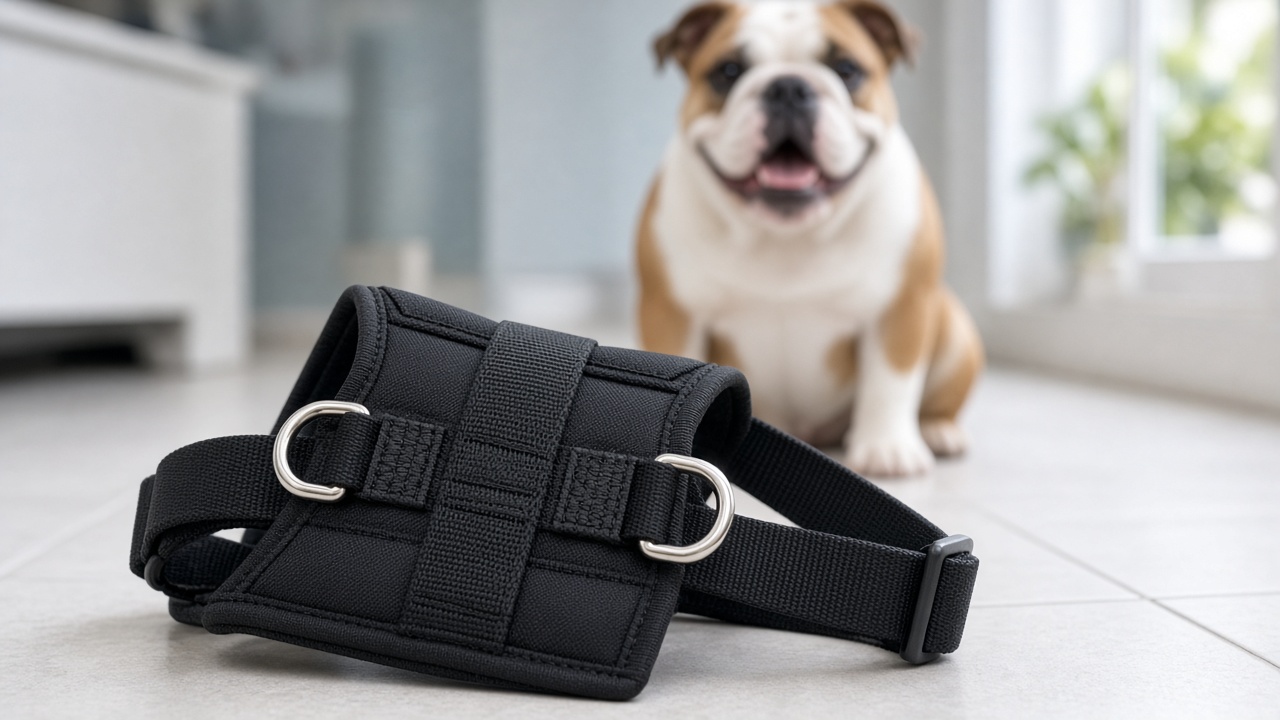

Quick answer: Choose a Y-front harness with a front clip and a maker girth chart that covers 24–34 inches. Size to the ribcage, not the thick neck. For a typical 40–50 pound English Bulldog, start in the band that includes 27–32 inches.
English Bulldogs need a Y-front harness fitted to chest girth so leash load stays off the throat.
This page is a 2026 spec comparison of currently sold walking harnesses, not a walk trial, pull test, or clinic case series.
Our research team compared published size charts with the American Kennel Club breed standard.
The 24–34 Clear-Throat Rule
This is the selection rule. We included only currently sold harnesses whose maker publishes a chest or ribcage method. The listed geometry also had to keep leash load off the trachea.
That meant a Y-front, a lowered chest plate, or a front clip. We excluded step-in vest harnesses that sit on the neck. We also excluded head-halter-only tools and models with no maker size method.
A ranked list is not the job. Across the five maker charts that list inch bands, every product line covers 24–32 inches.
That span is the working window we used for this breed. A 28 inch chest sits on or next to a size split on four of those five charts.
Top 7 English bulldog harness
The picks below are the 7 english bulldog harness on sale right now, listed with what each suits best and an honest drawback. Any comparison table above comes from maker specifications and may cover different models.
1. BULLHUG Adjustable Dog Harness
Best for: Barrel-chested adults needing breed-shaped straps
Maker pages sell this adjustable harness for broad-chested breeds, including English Bulldogs. Owners report the chest wrap fits a barrel body better than a generic vest once they lock the straps. You pay mid-list money for that cut, not for extra clips.
Pros: Breed-shaped adjustable cut; Mid-list dedicated brand Cons: Goes on over the head
2. Bulldog Grade Custom Fit No-Choke Bulldog Harness (Brave Black Camo
Best for: Owners wanting a bulldog-only no-choke vest
This listing is a custom-fit, no-choke harness aimed at bulldog bodies. Maker pages stress a wide-chest vest and a handle for short, strong dogs. Owners still say you must measure, and it is the priciest pick here.
Pros: Breed-specific no-choke vest; Custom-fit handle control Cons: Highest price on list
3. Annchwool No Pull Dog Harness with Soft Padded Handle
Best for: Helpers who lift stocky dogs by handle
The name is a no-pull harness with a soft padded handle, which is what owners grab when they lift a stocky dog into a car. Maker listings treat it as a general small-to-large vest, not a bulldog last. The price is everyday-walker money.
Pros: Soft padded lift handle; Everyday walker price Cons: Not a breed-specific cut
4. PHOEPET No Pull Dog Harness Medium Reflective Front Clip Vest with
Best for: Evening walkers using a front-clip vest
This budget vest names a medium size, a front clip, and reflective trim. Maker pages sell the chest ring for dogs that pull on evening walks. Owners of wide English Bulldogs still have to check the medium chart, because a generic vest can sit tight across the ribs.
Pros: Front-clip reflective vest; Budget vest price Cons: Generic medium may run narrow
5. Beebiepet Tactical No Pull Dog Harness with Leash
Best for: Owners wanting a harness-plus-leash kit
The listing bundles a tactical no-pull harness with a leash, so you buy a kit. Maker pages describe a heavier vest with extra webbing, which is the usual trade for this form. Owners report the extra bulk is the cost of the included leash.
Pros: Harness and leash kit; Tactical no-pull vest Cons: Bulkier than slim vests
6. Voyager Step-in Air Dog Vest Harness
Best for: Heat-sensitive smaller English Bulldogs
This is a step-in air vest at the lowest price on the list. Maker pages describe a light vest you step into, not a heavy no-pull frame. Owners report it stays cooler, but a full-size English Bulldog can outgrow the chest range.
Pros: Step-in air vest; Lowest price on list Cons: Light build for strong pullers
7. WINGOIN Tactical Dog Harness for Large Dogs
Best for: Heavier English Bulldogs needing large tactical gear
The name targets large dogs and a tactical vest, which is why heavier English Bulldogs show up in the reviews. Maker pages size it like a generic large-breed harness, with a handle for control. Owners still need to measure a short, wide chest, because ‘large’ here is not a bulldog last.
Pros: Large-dog tactical vest; Handle for heavier dogs Cons: Cut for generic large breeds
Comparison: English bulldog harness at a Glance
Want to browse every option? See the full range of english bulldog harness on Amazon →
Why this breed breaks generic harness charts
The Official Standard of the Bulldog from the American Kennel Club sets mature dogs at about 50 pounds. Mature bitches sit at about 40 pounds. Those are show-standard figures, not a promise about your dog.
The same standard asks for a short, very thick, deep neck. It also asks for a very broad, deep, full chest and wide shoulders. Neck-first size charts miss that barrel.
VCA Animal Hospitals lists English Bulldogs among brachycephalic breeds. Those dogs have shortened skull bones and a pushed-in face. VCA describes brachycephalic obstructive airway syndrome as a set of upper-airway faults that raise the work of breathing.
VCA’s published advice is plain. Dogs with that syndrome should wear a harness that does not tug at the neck. A regular neck collar can put undue pressure on the neck.
VCA also states that most dogs receive that diagnosis between one and four years of age, and that signs often worsen in heat. Excess weight adds more strain on breathing.
A 2025 paper in Veterinary Medicine and Science measured 24 dogs. Bailey, Packer, and Wills found that a stationary collar raised intraocular pressure in brachycephalic dogs. Exercise in a harness did not raise intraocular pressure in either head-shape group.
That paper cites a 2021 owner survey by Townsend and colleagues. In that survey, 82.7 percent of owners said their dogs pull on leash. A collar concentrates that common load on the throat.
The same collar-versus-harness choice we outline for puppies is sharper here. A young Bulldog already carries the short muzzle. The neck is not a safe tow point.
The measurement that actually matters
Measure the widest ribcage, just behind the front legs. That is the girth line most of these makers use. Our dog harness size guide walks through the tape position.
Do not use neck circumference as the primary number. The American Kennel Club standard calls the neck short and very thick. A neck band that fits another 50 pound breed can sit high on a Bulldog.
Ruffwear tells buyers to measure the widest part of the rib cage and to choose the larger Front Range size when between bands. That chart runs from 13–17 inches in XXS to 32–42 inches in L/XL.
2 Hounds Design says to choose the smallest size that still fits. At exactly 28 inches, 2 Hounds still recommends Medium so the front straps sit better.
PetSafe asks for two Easy Walk numbers: girth and chest width. Chest width is a horizontal line across the front, ending about 1 inch past each front leg. A broad Bulldog chest can force a size-up on width alone.
Wild One’s Large spec lists a 17–22 inch neck and a 26–38 inch chest. A thick Bulldog neck can hit that 22 inch neck max before the chest max is close.
Six current harnesses, compared by published attributes
The table uses maker-listed attributes only. There is no rank column and no price column.
| Model | Maker girth or chest range | Leash clips | Adjustment points | How it goes on | Published standout |
|---|---|---|---|---|---|
| Ruffwear Front Range | 13–42 in across 5 sizes | Front webbing + back V-ring | 4 | Over head; side-release buckles | Padded; 300D recycled ripstop shell |
| 2 Hounds Freedom No-Pull | 13–44 in across listed sizes | Front ring + back martingale | Not given as a count | Chest strap behind the front legs | 3800 lb test webbing; Swiss velvet lining |
| Julius-K9 IDC Powerharness | Size 0: 23–30 in, 31–55 lb; Size 1: 26–33.5 in, 50.5–66 lb | Chest-plate urban harness | Chest strap + belly strap | Maker copy: fit in one move | Frontal chest strap lowered about 30° |
| PetSafe Easy Walk | 8 sizes; Medium 22–32 in; Medium/Large 24–34 in | Front chest only | 4 | Snap shoulder and belly straps | Martingale loop on the chest; sold since 2004 |
| Wild One Cushioned Dog Harness | Large chest 26–38 in; Large neck 17–22 in | 1 front + 2 back | Neck, chest, and back straps | Quick-snap buckles at neck and chest | Double-layer neoprene body |
| Blue-9 Balance Harness | Maker sizes XS–L; measure ribcage | Front and back rings | 6 | Buckle-on neck loop | Y-shaped chest plate |
A strap that sits on the windpipe fails the same throat-clear test we use in our safest cat harness article.
Ruffwear Front Range
Ruffwear describes the Front Range as a padded everyday harness. It lists two leash points: an aluminum V-ring on the back and reinforced webbing on the chest. Four adjustment points are on the spec sheet.
The Medium band is 27–32 inches. The L/XL band is 32–42 inches. A barrel-chested adult often lands in one of those two.
Ruffwear lists an ID pocket, so tags need not hang on the throat.
2 Hounds Design Freedom No-Pull
2 Hounds Design publishes a dual-connection layout. A front ring redirects the chest. A back martingale loop tightens around the torso when the dog leans.
The maker lists 3800 lb test webbing and Swiss velvet lining behind the front legs. Weight splits the Medium band at the same 24–28 inch chest: 5/8 inch webbing for about 32–40 pounds, and 1 inch webbing for about 40–60 pounds.
An American Kennel Club 50 pound dog with a 26 inch chest maps to the 1 inch Medium. A 30 inch chest maps to the 1 inch Large, even at 50 pounds. Girth wins on that chart.
Julius-K9 IDC Powerharness
Julius-K9 publishes both girth and weight. Size 0 covers 23–30 inches and 31–55 pounds. Size 1 covers 26–33.5 inches and 50.5–66 pounds.
Those two bands swallow the American Kennel Club 40 and 50 pound marks. A stocky male can still need Size 1 if the tape reads past 30 inches.
Julius-K9’s UK measuring page says the frontal chest strap is lowered about 30 degrees to follow the chest curve. That is a plate geometry, not a vest that rides the throat. The same page wants four fingers between the front legs and the belly strap on sizes 0 and up.
PetSafe Easy Walk
PetSafe’s page dates the Easy Walk to 2004. It lists four adjustment points and a single front chest attachment.
The martingale loop sits on the chest, not the neck. PetSafe says the harness rests across the chest instead of the throat. That claim is only as good as the fit.
The Medium girth band is 22–32 inches and about 25–50 pounds, with 12–15 inches of chest width. Medium/Large is 24–34 inches and about 40–65 pounds, with 14–18 inches of chest width. A very broad chest can force Medium/Large on width even when girth still fits Medium.
Wild One Cushioned Dog Harness
Wild One lists three leash points: one on the chest and two on the back. Quick-snap buckles sit at the neck and the chest. The body is a stretch poly with a double-layer neoprene feel.
The Large spec we used is a 17–22 inch neck and a 26–38 inch chest. Medium chest is 20–28 inches with a 15–18 inch neck. If the neck tape is already near 18 inches, do not force Medium.
Blue-9 Balance Harness
Blue-9 Pet Products lists six adjustment points on the Balance Harness. Front and back rings are both on the page. A buckle-on neck loop avoids an over-the-head fight.
The maker also describes a Y-shaped chest plate, which is the published reason the shoulders can still extend. Blue-9’s public size set is Extra Small through Large, sized by ribcage, then a two-finger fit check.
Fit checks before the first block walk
Put the harness on a standing dog. The chest strap should sit behind the front legs, not in the armpit. Julius-K9’s four-finger gap at the front legs is a useful clearance check on any wide chest.
You should slide two fingers under a strap. 2 Hounds Design and Blue-9 both publish that two-finger rule. Snug is the goal, not cinching wrinkles into a fold.
Watch the throat after you clip the leash. If a strap has crept onto the windpipe, reset girth first. Then shorten the neck loop only enough to stop a backup.
Use the front clip while you teach a loose leash. Use the back clip on a calm dog that already tracks with you. Dual-clip leashes are optional on the Freedom and the Balance.
Keep walks short in heat. VCA notes that airway signs get worse in hot or humid weather. If breathing noise jumps fast, stop the walk and call your clinic.
FAQ
What size harness does an English Bulldog wear?
There is no single letter size. Start with girth behind the front legs. Many adults land between 24 and 34 inches, which often maps to Julius-K9 Size 0 or Size 1, or to Ruffwear Medium or L/XL, so let the tape break a tie.
Is a front-clip harness better than a collar for this breed?
For leash walking, yes, on the published airway and eye-pressure evidence we cited. VCA tells owners of dogs with brachycephalic obstructive airway syndrome not to use a regular neck collar as the tow point.
Bailey, Packer, and Wills saw intraocular pressure rise when brachycephalic dogs stood in a collar. The harness-exercise condition did not raise that pressure.
Can I use a step-in vest harness?
Not under this article’s rule. A vest that sits on the neck puts load back on the trachea. If a vest is the only thing that stays on an escape artist, treat it as a stopgap, then move to a Y-front with more adjustment points, such as the Blue-9 Balance.
My Bulldog backs out of harnesses. What should I change?
First check belly-strap tension, because Julius-K9 says a loose belly strap lets a dog back out. Do not solve escape by cranking the neck loop onto the throat. Reset girth, then add only the neck tension needed to keep the Y in front of the shoulders.
Should a Bulldog puppy use a harness?
Yes for walks, if the harness is sized to today’s girth. Puppies change fast, and Ruffwear’s five-band Front Range chart assumes growth. Keep ID on a loose collar or in an ID pocket, and do not clip the leash to the neck.
How tight should the straps be?
Snug, with two fingers under a strap. 2 Hounds Design also says the chest strap should sit right behind the front legs. The dog should still swing the elbows freely.
If skin folds bunch under a strap, loosen and shift the line.
Do I still need a collar if I use a harness?
You may still want a loose ID collar or a harness ID pocket. Ruffwear lists an ID pocket on the Front Range. Do not use the ID collar as the walking attachment, because that returns load to the neck VCA tells you to unload.