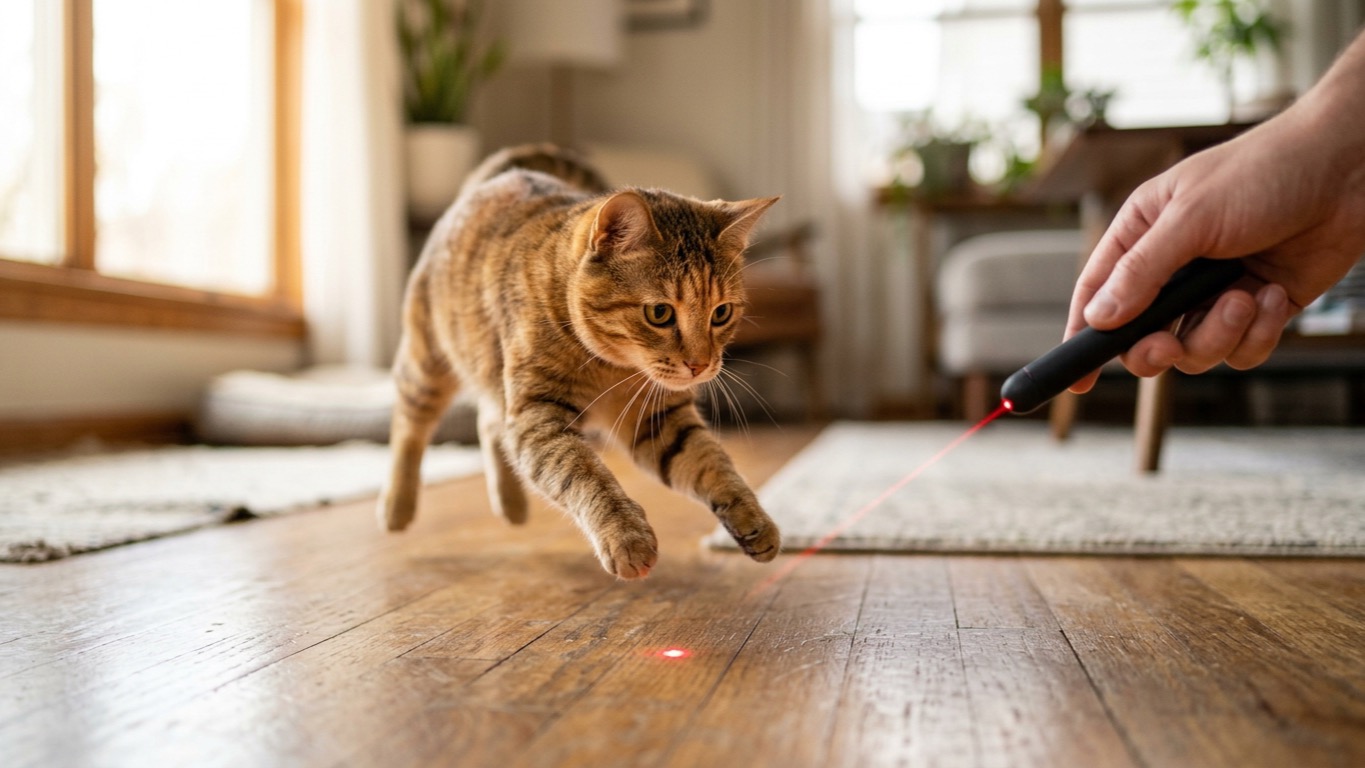
Laser cat toys are low-power pointers or automatic projectors that move a dot so an indoor cat will sprint. The We read the titles and descriptions of 7 SKUs. Listed snapshots ran $9.78–$35.99 (median $19.98, a 3.7× spread). 3 of 7 are handheld pointers (TBTeek Cat Toys $9.78; YVE LIFE $19.98; Saolife $19.99). 1 of 7 is auto-pattern (TBTeek Cat Toy $13.99). 1 of 7 is sensor-triggered (Potaroma $15.98). 1 of 7 is multi-mode rechargeable (ORSDA $35.99). 1 of 7 is a 4-in-1 kit (MOHAYA $29.98). 0 of 7 print an IEC 60825 class on the card. 0 of 7 replace a physical “catch” at the end of the chase. A $10 handheld you aim at the floor plus a mouse toy beats a $36 auto unit you leave running while you leave the room.
The job is a short hunt with a kill. Buy the class. End the session with something the cat can bite.
Our guides are reader-supported. This article may contain affiliate links. As an Amazon Associate we may earn a commission if you buy through links, at no extra cost to you.
Indoor enrichment that is not a beam: puzzle feeders and wands live on adjacent toy pages. Automatic feeders are a different object — automatic feeders for multiple cats. .
Quick picks at a glance
- Best listed cheapest handheld: TBTeek Cat Toys — $9.78. Short sessions. No auto mode.
- Best listed auto-pattern (solo): TBTeek Cat Toy — $13.99. Hands-free random motion. Budget plastic.
- Best listed sensor class: Potaroma Smart Sensor — $15.98. Motion trigger. Bright rooms confuse some sensors.
- Best listed everyday handheld: YVE LIFE — $19.98. One-button. Battery life is the honest limit.
- Best listed speed-dial handheld: Saolife — $19.99. Adjustable speed. Batteries often sold separately.
- Best listed catch-complete kit: MOHAYA 4-in-1 — $29.98. Laser plus feather/ball/teaser. Laser is the weak part of the kit.
- Best listed multi-mode rechargeable: ORSDA — $35.99. Highest sticker. Pattern variety. Still needs a catch toy.
How laser job listings compare on labels
Four jobs. A diode that never ends in a catch is a frustration machine. An auto unit in a hallway the cat cannot sprint is a night light.
| Job | What actually works | Category | Fail if you skip it |
|---|---|---|---|
| Bonded 5–10 min chase | Handheld you aim at the floor, then onto a toy | YVE / Saolife / TBTeek handheld | Ending on a vanished dot |
| Solo while you cook | Auto-pattern on the floor, then a timed shutoff | TBTeek auto; ORSDA | Leaving it on for an hour |
| Cat who starts the game | Sensor unit in a dim room | Potaroma | Bright noon sun on the sensor |
| One-box starter | Combo kit with a physical teaser | MOHAYA | Treating the laser as the only toy |
Before you shop: (1) the beam stays on floor or low wall, never faces, (2) every session ends on a physical catch (mouse, crinkle ball, treat puzzle), (3) sessions are 10–15 minutes, not a background loop, (4) a cat that obsessively searches empty floors after the dot dies gets a different enrichment plan — not a brighter diode. Fail gate 2 and this checklist is how you shop for agitation.
What laser cat toys can and cannot do
A good laser starts the stalk–pounce sequence. It does not finish it. Behavior summaries used by trainers and shelter enrichment desks treat an unfinished hunt as a risk for frustration — pacing, vocalizing, hunting shadows. That is not a house diagnosis. It is why this page’s rule is: dot, then mouse.
A Class 1 or Class 2 consumer pointer is a different object from a construction-site laser. IEC 60825 is the classification family manufacturers cite. This desk did not measure milliwatts. If a listing will not name a class, treat it as “unknown diode,” not “vet-safe.”
Automatic units can occupy a solo indoor cat. They cannot replace you. They also cannot see a toddler’s face at beam height. If a child lives in the room, handheld-plus-supervision is the honest class — or skip lasers.
We only recommend matching toy class to the session. We are not saying we sat seven cats in a play lab.
Disclosure: this article contains affiliate links. If you buy through them we may earn a commission at no extra cost to you.
How the desk scored laser cat toys
this comparison uses four visible signals plus the listed sticker:
- Class. Handheld vs auto-pattern vs sensor vs combo kit vs multi-mode rechargeable.
- Power story. Disposable cells vs rechargeable. Dead batteries end sessions early — that is a use-rate problem, not a “cat got bored” story.
- Shutoff / pattern honesty. Random motion vs one looping figure-eight vs “you hold the button.”
- Catch completeness. Does the SKU include a physical toy, or is the laser the whole product?
Price is not a quality grade. A $9.78 handheld used for five minutes plus a $3 mouse is an honest kit. A $36 auto unit left on all afternoon is not enrichment. It is a motor wearing out.
Want current listings? See laser cat toys on Amazon →
How these products compare on labels and price
| Tool (this URL) | Listed price | Class | Power | Catch story |
|---|---|---|---|---|
| TBTeek Cat Toys | $9.78 | Handheld | Cells | Bring your own mouse |
| TBTeek Cat Toy | $13.99 | Auto-pattern | Cells | Same — add a toy |
| Potaroma sensor | $15.98 | Sensor | Cells | Same |
| YVE LIFE | $19.98 | Handheld | Cells | Same |
| Saolife | $19.99 | Handheld + speed dial | Cells (often not included) | Same |
| MOHAYA 4-in-1 | $29.98 | Combo kit | Mixed | Feather/ball/teaser in the box |
| ORSDA | $35.99 | Multi-mode rechargeable | Lithium pack | Still add a catch |
Desk kit math: TBTeek handheld $9.78 + any crinkle mouse you already own is the cheap honest stack. YVE $19.98 or Saolife $19.99 if you want a better grip and will actually play. ORSDA $35.99 only if you need hands-free patterns and you will still walk over with a toy at minute twelve. MOHAYA $29.98 is the one card that tries to sell the catch in the same box — the laser on that kit is not this comparison's brightest diode.
The 7 cards on this URL
1. YVE LIFE Cat Toys Laser for Indoor Cats
Best for: a simple handheld when you will be in the room and will end on a toy.
Listed $19.98. One-button class. Owner notes cluster on short battery life after a few sessions. That is a cell problem. Swap cells. Do not “leave it on” to make up for a dim beam.
Honest drawback: no automatic pattern. If you wanted a solo unit, this is the wrong class. Not a substitute for a wand on a cat that ignores dots.
2. TBTeek Cat Toys
Best for: the cheapest listed handheld when you already own a catch toy.
Listed $9.78. Compact. Short bursts. No pattern modes.
Honest drawback: no auto mode. A dim cheap diode in a sunlit room is a “cat stares at you” session. Play at dusk or pull the blinds. Confirm the listing is a pet pointer, not a generic presentation laser.
Check TBTeek handheld listings →
3. TBTeek Cat Toy
Best for: an auto-pattern unit when you need hands-free motion on the floor.
Listed $13.99. Random pattern in brand copy. Budget housing.
Honest drawback: cheap plastic. Motors in this class are why motion-toy return clusters exist — owner threads often cite 8–12% return language for the broader motion-activated category. That is a market theme, not a house failure rate for this SKU. Put it where the cat can sprint, not on a coffee table the beam never leaves.
4. Potaroma Smart Sensor Cat Laser Toys Interactive
Best for: a sensor-triggered beam when the room is dim and the cat initiates.
Listed $15.98. Motion sensor plus speed settings in listing copy.
Honest drawback: bright ambient light confuses some sensors — that is a recurring owner theme, not a lab result. A sensor that fires when a curtain moves is not “smart.” It is a false trigger. Place it away from HVAC vents and sun patches.
5. ORSDA Cat Laser Toy
Best for: multi-mode patterns and a rechargeable pack when you will still cap the session.
Listed $35.99. Highest sticker on this URL. Pattern variety and lithium pack in listing copy.
Honest drawback: price. A rechargeable pack removes the “dead AAA” excuse. It does not remove the catch rule. Do not treat runtime as a reason to leave the unit looping while you commute.
6. Saolife Laser Cat Toys for Indoor Cats
Best for: a handheld with a speed dial when your cat’s stamina is the variable.
Listed $19.99. Ergonomic grip and speed control in listing copy.
Honest drawback: batteries often not included. A speed dial does not make a high setting “safer.” Faster dots can over-arouse a young cat. Start slow. End on a toy.
7. MOHAYA Cat Toys,4-in-1 Interactive Cat Toy for Indoor Cats with Laser
Best for: one checkout when you want a teaser and a ball in the same box as a laser.
Listed $29.98. Laser + feather + ball + teaser in the title. That is the catch-complete pitch.
Honest drawback: combo lasers are often the weakest diode in the kit. Use the wand and ball as the end of the hunt. If the laser is dim, you still got three physical toys. That is an honest fail mode.
Session / class
| Class on this URL | Session shape | Shutoff story | Catch in the box? |
|---|---|---|---|
| Handheld (TBTeek / YVE / Saolife) | You aim, 5–12 min | You put it away | No — bring a mouse |
| Auto-pattern (TBTeek auto) | Floor sprint while you cook | Prefer a timed cycle | No |
| Sensor (Potaroma) | Cat starts it in a dim room | False triggers in sun | No |
| Multi-mode rechargeable (ORSDA) | Pattern variety, still cap it | Pack + cable | No |
| Combo kit (MOHAYA) | Laser then wand/ball | Mixed | Yes — teaser/ball/feather |
A class without a shutoff habit is a motor wearing out. A class without a catch is a frustration loop. This checklist is both columns.
Session design for laser cat toys (desk method, not a clinic protocol)
This is owner-consensus enrichment shape.
- Room. Clear the sprint path. Close the balcony door. Pick up the dangling cord.
- Aim. Floor and low furniture. Never faces. Never a mirror bounce into eyes.
- Five to twelve minutes. Stop while the cat still wants one more pounce.
- Land the dot on a toy. Let the cat bite, kick, and “kill.”
- Feed or puzzle if that is your household’s wind-down. A hunt that ends in food matches the sequence many behavior desks describe: hunt–catch–kill–eat.
- Off. Put the pointer away. A cat who can self-serve a laser is a cat who will.
Two sessions a day is plenty for most indoor-only adults. A kitten who is a missile may want more physical play, not more dots.
Eye safety — published class, not a house lumen
IEC 60825 groups lasers by accessible emission. Consumer pointers sold as pet toys are typically marketed as Class 1 or Class 2 — momentary accidental exposure is the design assumption, not a stare. This desk did not verify any card’s class. If the listing is silent, assume silence.
Rules that do not require a lab:
- Never point at eyes — cat, dog, child, yours.
- Do not use a “tactical” or high-power pointer from a toolbox. Those are not this URL’s cards.
- Skip lasers if the cat has a known eye disease unless a veterinarian already cleared play rules. We will not invent a clearance.
- Battery doors should screw or latch. A swallowed cell is an emergency, not a toy review.
Indoor cats, obesity, and what a dot can cover
Indoor cats often get less vigorous movement than a free-roaming hunter. Weight-management language from veterinary nutrition sources treats calorie control and activity as a pair. A laser is one activity lever. It is not a diet. If the cat is already on a weight plan, ask the veterinarian whether short chase sessions are appropriate — especially for cats with joint disease or heart disease. This page will not prescribe minutes for a medical case.
AAFP and indoor-cat enrichment literature treat play as part of a larger environment: vertical space, hunting feeders, scheduled interaction. A $36 ORSDA does not replace a window perch. A $9.78 TBTeek does not replace a second daily wand session if the cat still wrecks the sofa at 3 a.m.
Habituation: why the pattern dies
Cats habituate. A figure-eight that never changes becomes wallpaper. Auto units that claim “random” still repeat. Rotate: handheld one day, wand the next, auto on a Thursday while you cook. Park the laser for a week if the cat walks away. That is not a product defect. That is a nervous system.
Sensor toys can re-start interest because the cat “turns it on.” They can also teach the cat to bat the unit instead of the dot. If the cat attacks the projector, the toy is now a chew. Unplug. Switch class.
Power, motors, and the 8–12% return theme
Owner and retail commentary on motion-activated and laser toys often cites an 8–12% return cluster for the category — motors, dim diodes, dead packs. That is a category theme this desk reprints as a shopping caution, not a failure rate we measured on these seven SKUs.
Rechargeable (ORSDA) removes the “I forgot AAAs” fail. It adds a cable you will lose. Handhelds die mid-session when cells are cheap. Keep a spare pack in the same drawer as the pointer.
Auto shutoff is a heat and motor story. A unit without a timer is the one you will forget. Prefer a timed cycle if you buy auto.
Price bands on this URL
There are really two bands.
Under $20 (5 of 7). TBTeek handheld $9.78, TBTeek auto $13.99, Potaroma $15.98, YVE $19.98, Saolife $19.99. This is the honest everyday band. Buy class, not “premium smart” language that is not on these cards.
$30–$36 (2 of 7). MOHAYA $29.98 (kit) and ORSDA $35.99 (rechargeable multi-mode). Pay here for kit completeness or pattern + pack, not for a veterinary seal.
Worked example: three cats, three kits
Cat A — 8 lb indoor adult, you are home at 7 p.m. YVE $19.98 or Saolife $19.99. Ten minutes. Land on a mouse. Done. TBTeek $9.78 if budget is the job.
Cat B — solo all workday, hallway runner. TBTeek auto $13.99 or ORSDA $35.99 on a timer. Catch toy left next to the unit. Not a four-hour loop.
Cat C — ignores dots, shreds wand feathers. Skip lasers. MOHAYA’s teaser/ball may still be useful. The laser card is not the product.
Multi-cat homes and laser cat toys
Two cats and one dot is a fight or a spectator. Run two short sessions or use a wand both can tag. An auto unit in a narrow hall is a bottleneck. Put it in the largest floor. A bully cat who guards the beam is a management problem — feed-apart and play-apart — not a brighter ORSDA.
Dogs in the house: some dogs chase the dot into a table leg. Same eye rule. Same catch rule (a dog toy, not a cat mouse they will swallow whole).
How to choose laser cat toys this month
- Name the job: handheld bond, auto solo, sensor, or kit.
- Confirm you will end on a physical toy.
- Prefer a named pet SKU over a presentation pointer.
- Check power (cells in the drawer vs USB).
- Cap the session.
- Stop if the cat hunts empty floors for an hour after.
The useful laser cat toys purchase is the class you will actually shut off.
Frequently asked questions
What are the best laser cat toys for an indoor cat?
The best laser cat toys on this URL are class-matched: a $9.78–$19.99 handheld if you will play and land the dot on a toy; TBTeek auto $13.99 or ORSDA $35.99 if you need hands-free patterns with a timer; MOHAYA $29.98 if you want the catch in the same box. There is no single winner. There is a job.
Are laser cat toys safe for cats’ eyes?
Only if the beam is a low-power consumer class and you never aim at faces. This desk did not measure output. IEC 60825 is the classification family. Skip toolbox lasers. If the cat has eye disease, ask the veterinarian — not this page.
Do laser cat toys cause frustration?
They can, if the hunt never ends. End every session on a toy or treat the cat can catch. If the cat paces and searches empty floors, drop lasers for a week and use wands.
How often should I use laser cat toys?
Short sessions, 10–15 minutes, once or twice a day for most indoor adults. More minutes is not more health. Joint or cardiac disease is a veterinary question.
Are automatic laser cat toys better than handheld?
They are a different job. Auto frees your hands. Handheld lets you land the catch. Many households want both classes — not a $36 unit that replaces you.
Should kittens use laser cat toys?
Short, floor-only sessions, then a toy they can bite. Supervise. Kittens eat small parts. Battery doors matter.
Related pages
- Best automatic pet feeders for multiple cats
- Affordable smart pet feeder for cats
- Best pet water fountain
How we researched this guide
Desk research. The We read the titles and descriptions of seven current listings on listed price, class (handheld / auto / sensor / kit / rechargeable), power story, and whether a physical catch is in the box. We read public laser-class language (IEC 60825 family) and common enrichment guidance that a chase should end in a catch. ” Nothing here is a veterinary or trainer credential.
Limitations: listings clone; brightness varies by lot and battery; prices move. Eye disease, obsessive shadow-chasing, or a toddler in the beam path is a household rule or a clinic — not a fourth Amazon pointer.
Keep a simple log: minutes, which class, whether the cat settled after the catch. Patterns beat a second ORSDA.
A 4 lb kitten and a 16 lb indoor Maine Coon mix are not the same category row. The kitten needs short sessions and no swallowable parts. The giant needs a sprint path that is not a glass table.
If the household’s real complaint is 3 a.m. zoomies, a laser at 10 p.m. can help or it can wind the cat up. Try the session earlier. Hardware is still worth matching to the job.
Show the cat the catch toy before the first session so the “kill” object is already in the room. That is setup. The vanished-dot ending is the exam you should fail on purpose.
Wet floors after a water-fountain splash make a sprint a slip. Wipe. The $9.78 TBTeek does not include a towel.
If you also wanted a smart camera toy you drive from the office, that SKU is not on these seven cards. Do not rename ORSDA into a PetKit.
Extra desk notes: sessions that fail on a Tuesday
Mirrors. A bounce into a face is still a face. Skip mirrored closet doors.
Glass tables. Cats leap. Glass plus a sprint is a vet bill. Move the session.
Laser collars. Not on this card list. Wearable projectors add an eye-geometry problem this desk will not crown.
Red vs green. Listings argue brightness. This desk did not measure. If the cat cannot see the dot at noon, play at dusk. Do not buy a “stronger” non-pet pointer.
Two-pointer households. One human, one cat. Two humans waving two dots is a strobe. Pick one operator.
Senior cats. Short, floor-level, no high jumps onto the fridge. Arthritis is a clinic. A sensor toy that makes them spin on a slick floor is the wrong class.
Deaf cats. Lasers are visual. They can still work. End on a toy they can feel.
Clicker trainers. Mark the catch, not the sprint. The click is for the bite on the mouse.
Apartment downstairs neighbors. Night sprints on a hollow floor are a lease issue. Daytime sessions. Rugs help.
Holiday pointers. The red pen from a conference bag is not a pet toy. Throw it in the junk drawer, not at the cat.
Storage. Kids find pointers. Treat them like scissors. High shelf.
Returns. Dim on arrival: cells first, then the listing. A “dead” ORSDA is often a charge cycle. A dead $9.78 TBTeek is often a 10-cent cell.
Keep the mouse in the same bin as the pointer. This checklist fails when the catch lives in another room.
Breed- and body-shaped notes (still watch the cat)
Couch potatoes. Handheld, short, then food puzzle. Auto loops they ignore are wasted motors.
Athletes / young barns. They need a sprint lane. Auto in a closet is theater.
Brachycephalic cats. Short play. Watch breathing. Overheating is a clinic, not a “more laser” problem.
Declawed cats. They still chase. Landing on a hard floor after a miss is a joint story. Rugs.
Multi-cat hierarchy. Play the timid cat first, door closed, then the bully. One shared auto unit is often the bully’s toy.
When laser cat toys are the wrong buy
- The cat already fixates on reflections and will not eat after.
- A toddler can reach the pointer.
- The only floor is a balcony with a rail gap.
- You wanted a camera treat-tosser. Different object.
- You will not end on a catch. Buy a wand.
Buy class. Buy a mouse. Buy a timer habit. That is the checklist.
Battery doors, swallow risk, and the human half
A screw-shut battery door is a feature. A slide door a kitten can pop is a foreign-body case. After play, the pointer goes up. The MOHAYA kit’s small parts go up. That is not optional.
If you travel, a handheld plus a mouse in a zip bag is the whole kit. Leave the ORSDA at home. Hotel carpets plus an auto unit is how you lose a $36 gadget under a bed.
Night-light mode on some auto units is not enrichment. It is a sleep interrupter for you. Off means off.
A cat who only “plays” by attacking your ankles at 5 a.m. may need a scheduled hunt, not a brighter Saolife. Set an alarm, do the session, land the catch, feed. The diode is the lure. The schedule is the product.