Quick answer: Start with a 2-ounce pet nurser if the pup latches. Pair it with a canine milk replacer, not cow’s milk. Add a syringe nipple only when the pup cannot empty the bottle.
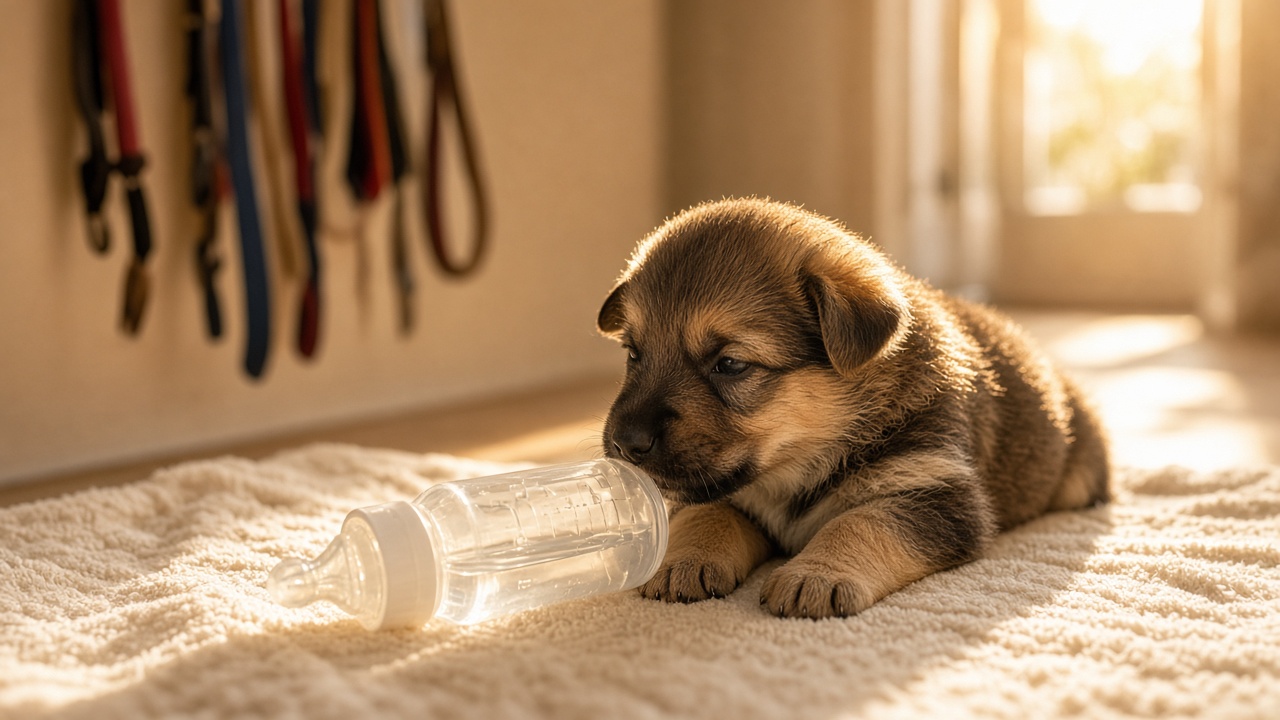
A 2-ounce pet nurser with a buyer-cut drip hole is the first bottle to buy for a latching newborn pup.
This page is a spec comparison of five currently sold nursing tools. We did not bottle-feed a litter, time a latch, or run a wash-cycle trial.
The Latch-First Rule, and what we left out
Our research team compared published specs. We used one rule.
A tool entered this guide only if the maker page listed a liquid capacity or a syringe volume. It also had to name puppies or dogs.
Human infant bottles did not enter. Stomach tubes did not enter. Wildlife-only kits that never name a puppy size did not enter.
That is the Latch-First Rule. Cover a bottle when the pup can suck and stop. Cover a syringe nipple when the pup cannot empty a bottle.
A puppy bottle is a small, marked vessel with a pet nipple. The pup must create suction. The caregiver must see the volume.
A latching pup can refuse the bottle when full. PetAg states that bottle feeding allows the animal to refuse formula when full. That is why a bottle sits first here.
We still included syringe nipples. Weak pups often cannot empty a 2-ounce bottle. Miracle Nipple sells four nipple sizes on syringes.
We left out tube-feeding catheters. Those are a clinic skill, not a drawer kit. We left out human baby bottles.
Top 7 Puppy bottles
The picks below are the 7 puppy bottles on sale right now, listed with what each suits best and an honest drawback. Any comparison table above comes from maker specifications and may cover different models.
1. Pet Feeding Bottle and Syringe Set for Puppies and Kittens
Best for: Owners who need a syringe backup
This listing is a bottle-and-syringe set, not a lone nurser. Kit pages pair a small bottle with syringes for pups that will not latch. Owners report they start on the syringe, then switch to the bottle once the pup sucks.
Pros: Bottle and syringe together; Low combo-kit price Cons: More parts to wash
2. Puppy Kitten Nursing Bottle 5oz
Best for: Pups that already take larger meals
The title names a 5-ounce nursing bottle, larger than the usual 2-ounce pet nurser. That fill line suits a pup that already drinks more than a first-day meal. Owners report fewer refills as the pup grows, and leftover formula if they fill it for a tiny newborn.
Pros: Named 5-ounce capacity; Budget single-bottle price Cons: Oversized for tiny newborns
3. Lixit® 2 Ounce Nursing Bottle for Kittens Small Puppies
Best for: Tiny newborns on 2-ounce meals
Lixit’s page lists this as a 2-ounce nursing bottle for small puppies and other small pets. The nipples ship unpunched, so the buyer sets the drip before the first feed. Owners report the small barrel fits a first-week pup, plus that extra cut step.
Pros: Named 2-ounce size; Known small-pet brand Cons: Buyer must cut nipples
4. Doggiema Puppy Milk Feeder Nipple Puppy Bottle Puppy's feeders
Best for: Litters that share one feeder
Doggiema sells this as a puppy milk feeder, not a single 2-ounce bottle. The $29.90 list price sits well above the other bottles here, which matches a feeder meant for more than one pup. Owners report some litters latch after guided tries, and that not every pup will take this form.
Pros: Multi-pup feeder form; Built for litter meals Cons: Costs more than bottles
5. Evenflo Feeding Classic Tinted Plastic Standard Neck Bottles for Baby
Best for: Fosters already using infant bottles
Evenflo lists these as tinted plastic standard-neck bottles for human babies, not as a pet nurser. Some foster write-ups still name infant bottles when a pup already latches on that nipple shape. Owners report a strong sucker can use the infant nipple, and a poor fit for a pup that needs a pet-sized teat.
Pros: Tinted plastic baby bottles; Familiar infant-bottle shape Cons: Not a pet nurser
6. NOVYQREN Pet Nursing Kit for Newborn Puppies
Best for: New owners buying a starter kit
NOVYQREN sells this as a pet nursing kit, a bundle of feeding tools rather than one branded bottle. At $9.99 it sits with other generic kits that mix a small bottle and spare tips. Owners report they like having extras on hand, and a lot of small pieces to wash.
Pros: Full starter-kit form; Low kit price Cons: Many small loose parts
7. PetAg Nurser Bottle
Best for: Households already using PetAg formula
PetAg’s nurser page lists 2-ounce and 4-ounce bottles for small animals, with nipples the buyer must open. That is the vessel the same brand already pairs with its milk-replacer directions. Owners report they like the familiar PetAg nipple on a latching pup, plus the higher price and the cut step before the first feed.
Pros: Established small-animal nurser; Brand-matched PetAg bottle Cons: Nipples need a first cut
Comparison: Puppy bottles at a Glance
Want to browse every option? See the full range of puppy bottles on Amazon →
Five nursing tools, compared by listed attributes
The table uses attributes the makers list. It has no rank column and no price column.
| Product | Listed capacity | Nipple or tip | Hole as sold | Maker cleaning note | Extra pieces listed |
|---|---|---|---|---|---|
| PetAg Nursing Kit, 2 oz | 2 oz | Latex-free silicon, elongated and balloon styles | No precut hole | Hot soapy water after each session | Cleaning brush sized to the bottle |
| PetAg Nursing Kit, 4 oz | 4 oz | Latex-free silicon, elongated and balloon styles | No precut hole | Hot soapy water after each session | Cleaning brush sized to the bottle |
| Four Paws Healthy Promise Pet Nurser Kit | 2 ounces | Pure rubber nipple, latex-free, BPA-free | Not stated | Top-rack dishwasher safe | Long-handled scrubbing brush |
| Miracle Nipple Mini Pkg/2 | 3 ml Oring syringe | Two Mini nipples | Not stated as a cut step | Not listed on the size page | One 3 ml Miracle Oring Syringe |
| Miracle Nipple Small Puppy set | Two 10 ml Oring syringes | Two Small Puppy nipples | Not stated as a cut step | Not listed on the size page | Two 10 ml Miracle Oring Syringes |
PetAg sells the same kit in 2 oz and 4 oz. The 2 oz kit is for small animals. The 4 oz kit is for larger animals.
Both PetAg kits include a brush. Both use silicon nipples that PetAg calls latex-free. Both ship without a precut hole.
Four Paws lists a 2-ounce bottle on its Healthy Promise Pet Nurser Kit page. The nipple is pure rubber. The bottle is BPA-free and latex-free.
A long-handled brush ships in that Four Paws kit. Four Paws says the bottle can go on the top rack of a dishwasher. The page does not say whether the nipple ships open.
Miracle Nipple lists four sizes on its own size page. Mini and Original packs ship with a 3 ml syringe. The Small Puppy set ships with two 10 ml syringes.
The Large Puppy set ships with one 10 ml syringe and one 20 ml syringe. The page cites U.S. Patent No. 9,510,562.
Miracle Nipple also prints USA suggested retail on that page. The Mini Pkg/2 is listed at $10.95. The Small Puppy set is listed at $22.95.
Those are maker list figures, not live checkout prices.
Across the five tools, three are bottles. Two are Miracle Nipple syringe packs.
Two of the three bottles, both PetAg kits, tell the buyer to cut the nipple. Four Paws does not state hole status.
Bottle or syringe nipple
Use the bottle first when the pup latches. The marked barrel shows intake. The pup can stop.
PetAg marks its bottles with graduations. The company says those marks help prevent over- or under-feeding.
Use a Miracle Nipple on a syringe when the pup cannot latch. The Mini pack is built around a 3 ml syringe. That volume is far smaller than 2 ounces.
It suits a pup that takes drops, not gulps. Keep the 2-ounce bottle if the pup latches and stops.
Miracle Nipple warns buyers about syringe tips. On 5 ml and 10 ml syringes, only the luer-lock tip fits.
The slip tip does not. The maker also says its Oring syringes are BPA-free and autoclavable.
Do not treat these tools as interchangeable with a stomach tube. PetAg tells caregivers to consult a veterinarian if the animal is too small or weak to nurse.
Hole size, flow, and cleaning
PetAg ships 2 oz and 4 oz nipples with no hole. The company says the caregiver must size the opening.
That is a stated design choice, not a defect. PetAg’s own FAQ repeats the same reason.
PetAg’s directions give two cut methods. Cross-cut the tip with a razor blade. Or use a strong needle or cuticle scissors to remove a tiny piece.
Then check flow with water. PetAg wants a steady drip or thin stream when slight pressure is applied.
That drip check is the test for hole size. If water streams with no pressure, the hole is too large.
If nothing moves with light pressure, the hole is too small. Recut only in tiny steps.
Four Paws does not publish a cut method on the nurser kit page. Do not invent one.
Miracle Nipple’s size page does not print a wash protocol. It does print a tip-fit rule and pack contents.
PetAg’s wash step is simple. Wash the bottle, cap, and nipple with hot soapy water after each session. Rinse thoroughly.
Four Paws adds a top-rack dishwasher option for its bottle kit. PetAg does not list a dishwasher step.
PetAg also says to use a different bottle if one animal is ill. Or feed that animal last.
How much formula the bottle should hold
The bottle is only a vessel. The milk-replacer label sets the volume. PetAg’s Esbilac liquid page is the example we read.
PetAg tells caregivers to feed 2 tablespoons per 4 ounces of body weight daily. It lists those amounts as 30 mL and 115 g.
Split that daily amount into equal feedings. PetAg says puppies should be fed every 3 to 4 hours.
An 8-ounce pup, on that same page, needs 4 tablespoons of formula over 24 hours. That is PetAg’s own example. It is not a breed chart.
Opened Esbilac liquid must be refrigerated. PetAg says to discard it after 72 hours.
Unopened product stays in a cool, dry place. After opening, PetAg allows freezing for up to 6 weeks.
Freeze it in an ice cube tray. Do not freeze it in the original container.
PetAg lists calorie content as 710 kcal/kg, or 10.96 kcal per tablespoon. Crude protein is listed at a 5.00% minimum.
Crude fat is listed at a 3.50% minimum. Moisture is listed at an 86.00% maximum.
PetAg states that Esbilac meets AAFCO Dog Food Nutrient Profiles for all life stages. That claim includes growth of large-breed dogs that will weigh 70 lb or more as adults.
The Association of American Feed Control Officials says it does not approve, certify, or otherwise endorse pet foods. There is no AAFCO-approved pet food.
AAFCO tells buyers to read the nutritional adequacy statement on the label. AAFCO also notes that its nutrient profiles have 37 nutritional parameters for dogs.
The U.S. Food and Drug Administration says a “complete and balanced” claim must rest on one of two paths. The food meets an AAFCO nutrient profile. Or it passes a feeding trial that uses AAFCO procedures.
FDA notes that AAFCO first published Dog Food Nutrient Profiles in 1991. The profiles were last updated in 2016.
The Journal of the American Veterinary Medical Association published a 2014 comparison of 15 milk replacers and 5 dog-milk samples. Calcium was lower than dog milk in 14 of 15 replacers.
Docosahexaenoic acid was undetectable in 12 of 15 replacers. Median energy was 1.56 kcal/mL in the milk samples and 0.96 kcal/mL in the replacers.
That JAVMA paper is why this guide refuses to treat a bottle as nutrition. The vessel does not correct a thin formula.
Read the label. Weigh the pup. Keep the bottle for delivery only.
PetAg’s Esbilac FAQ also says the liquid does not contain colostrum. If possible, puppies should nurse from the mother for a minimum of 2 days.
Cow’s milk is not a listed substitute on that page. Do not pour it into the bottle as a stand-in.
For the wider feeding picture after the bottle stage, use our puppy nutrition guide. It covers what a growing pup needs once milk replacer is no longer the whole diet.
When the pup starts chewing and weaning
A nursing nipple is a consumable. PetAg tells buyers to check flow before each use.
Miracle Nipple’s size page does not give a wear schedule. Replace any nipple that tears, splits, or streams.
Once pups gnaw, a bottle becomes a chew toy. Move worn nipples out of the whelping box.
Offer puppy teething toys that are sold as toys, not as feeders.
When the pup starts taking moist food, the bottle’s job shrinks. Keep the 2-ounce nurser for leftover milk-replacer meals.
Shift calories toward a complete wet diet. Our wet puppy food guide is the next comparison, not a bigger bottle.
A 4-ounce PetAg kit can help a large pup that still latches. It does not replace a growth diet.
PetAg’s own 4 oz note is about larger animals. It is not a license to skip solid food.
FAQ
Can I use a human baby bottle for a newborn puppy?
No. This guide excluded human infant bottles under the Latch-First Rule. Pet nursers list 2 oz or 4 oz capacities and pet-sized nipples.
How big should the hole in a puppy bottle nipple be?
PetAg says to check flow with water after you cut. You want a steady drip or thin stream when you apply slight pressure. If formula pours with no squeeze, the hole is too large.
How much formula goes in the bottle at each feeding?
Use the milk-replacer label, not a bottle size. PetAg sets 2 tablespoons (30 mL) per 4 ounces (115 g) of body weight per day. An 8-ounce pup, in PetAg’s example, needs 4 tablespoons across 24 hours.
Do I need a 4-ounce bottle for a large-breed newborn?
Not on day one. PetAg assigns 2 oz bottles to small animals and 4 oz bottles to larger animals. Esbilac’s 70 lb note is about the formula’s AAFCO statement, not bottle size.
When should I switch from a bottle to a syringe nipple?
Switch when the pup cannot latch or cannot empty the bottle. Miracle Nipple Mini packs ship with a 3 ml syringe. Keep the bottle if the pup latches and stops on its own.
How long can opened formula sit in or near the bottle?
PetAg says an opened Esbilac liquid container must be refrigerated and discarded after 72 hours. Do not freeze it in the original can. Wash the bottle after each session.
Can I put cow’s milk in a puppy bottle?
PetAg formulates Esbilac as a canine milk replacer. AAFCO tells buyers to match species and life stage on the label. Use a product whose label carries an AAFCO nutritional adequacy statement for dogs.