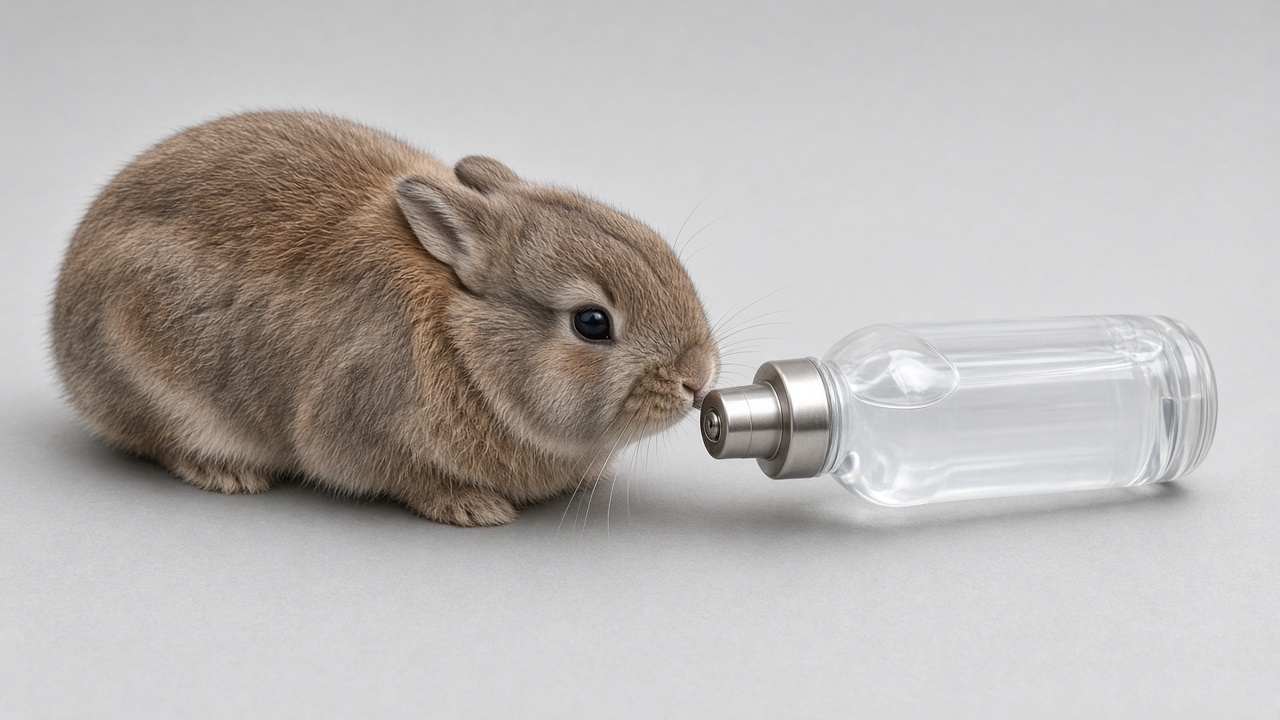
Quick answer: Use a 32-ounce no-drip bottle as backup, plus a heavy crock. Lixit’s Top Fill 32-ounce model refills on the cage. Skip hamster-size 10 mm bottles for adult rabbits.
Lixit’s 32-ounce Top Fill bottle, named for rabbits, exceeds Oxbow’s 12.7-ounce daily upper figure for a 5.51-pound rabbit. This page is a published-spec comparison of cage bottles, and we did not run leak trials, time wash cycles, or assign ranks.
A rabbit water bottle is a hanging reservoir with a metal sipper. It is not a bowl. It is not a circulating fountain.
Our research team analyzed maker pages for valve type, capacity, tube size, and mount. We then set those numbers next to intake figures published by Oxbow Animal Health.
The Rabbit-Named, Sixteen-or-Thirteen Rule
We used one inclusion rule for this guide.
A bottle appears here only if its maker page names rabbits, bunnies, or dwarf rabbits. It must also list 16 fluid ounces or more, or a nozzle of 13 mm or wider.
That rule dropped hamster-only 10 mm bottles. It also dropped travel sippers, circulating fountains, and crocks sold only as bowls.
Choco Nose lists its H125 with a 10 mm nozzle. The body measures 5.5 by 2 by 2 inches and weighs 1.9 ounces. The page names hamsters, hedgehogs, rats, and mice.
It does not name rabbits. The H125 stayed out.
Choco Nose lists the H528 at 11.2 fluid ounces, or 330 cc, with a 13 mm nozzle. The body measures 9 by 3 by 3 inches and weighs 4.0 ounces. The page names rabbits.
The H528 stayed in.
Top 7 Rabbit water bottle
The picks below are the 7 rabbit water bottles on sale right now, listed with what each suits best and an honest drawback. Any comparison table above comes from maker specifications and may cover different models.
1. Lixit Weather Resistant Cage Water Bottles for Rabbits
Best for: Budget outdoor cage setups
This is Lixit’s cheapest weather-resistant cage bottle, named for rabbits. Maker pages in this line describe hang-on outdoor use. Owners report these work when the cap is tight, and they report drips when it is not.
Pros: Lowest price on list; Weather-resistant cage bottle Cons: Cheap bottles often drip
2. Lixit® All-Weather Rabbit Water Bottle
Best for: All-weather hutch rabbit keepers
Lixit labels this an all-weather rabbit water bottle, at a mid-list price. It is the named outdoor rabbit SKU, not the bargain cage bottle. Owners report hanging it on hutches, and they also report leaks if the bottle is not filled full.
Pros: All-weather rabbit bottle; Mid-tier Lixit price Cons: Outdoor jugs still drip
3. 2Pack Rabbit Water Bottle for Cage
Best for: Two-cage spare-bottle homes
This listing is a two-pack of cage bottles, not one branded jug. The pair is about $19, so you are paying for a spare. Owners use the extra on a second cage, and they report leaks when the bottle tilts.
Pros: Two bottles in one; Spare for a second cage Cons: Generic pair, mixed quality
4. Choco Nose No-Drip Water Bottle Feeder for Guinea Pigs
Best for: Mixed rabbit-and-pig rooms
Choco Nose sells this as a no-drip feeder for guinea pigs. Owners report a dry cage on mixed setups. They also say the jug is small for an adult rabbit, so treat it as a drip-control pick, not a large rabbit jug.
Pros: Named no-drip feeder; Priced for small pets Cons: Sold for guinea pigs
5. Vannon Water Bottle for Small Animals
Best for: Crate-housed mixed small pets
Vannon’s generic small-animal bottle sits near $20 with no size in the title. Owners report these crate bottles clip to wire. They also report drips until the gasket seats.
Pros: Small-animal cage bottle; Higher-priced generic bottle Cons: Capacity not in the title
6. RentACoop 32oz Small Animal Drinking Bottle with Auto-Fill Metal Cup
Best for: Rabbits that refuse sipper tubes
RentACoop’s 32-ounce bottle feeds an auto-fill metal cup, not a sipper ball. Owners report rabbits that ignore tubes will drink from the cup. They also report bedding in the open cup.
Pros: Listed 32-ounce jug; Auto-fill metal cup Cons: Open cup collects debris
7. Vannon 30oz Small Pet Water Bottle for Cage with Top Fill Design
Best for: Owners who refill from above
Vannon lists this as a 30-ounce cage bottle with a top-fill lid. The lid means you can pour without pulling the jug. Owners like that refill path, and they report leaks until the gasket is pushed in.
Pros: Listed 30-ounce jug; Top-fill cage design Cons: Gasket must seat right
Comparison: Rabbit water bottle at a Glance
Want to browse every option? See the full range of rabbit water bottle on Amazon →
How much water a bottle must hold
Oxbow Animal Health cites the National Research Council’s 1995 laboratory-animal tables. Typical intake sits near 50 to 150 milliliters per kilogram of body weight.
Oxbow then applies that range to a 2.5 kilogram, or 5.51-pound, rabbit. That animal needs 125 to 375 milliliters a day. In fluid ounces, Oxbow writes 4.2 to 12.7.
A 32-ounce bottle holds about 946 milliliters. That is about 2.5 times Oxbow’s 375-milliliter upper figure.
A 16-ounce bottle holds about 473 milliliters. That covers one high-intake day with a little spare.
The Choco Nose H528 holds 330 milliliters. That sits 45 milliliters under Oxbow’s 375-milliliter upper figure. Treat it as a dwarf-size bottle or a backup.
Do not treat it as the only source on a hot day.
Lixit’s Wide Mouth 64 Ounce Rabbit Bottle holds 64 fluid ounces, about 1,893 milliliters. That is about five high-intake days for Oxbow’s 5.51-pound example.
Oxbow also notes that water makes up about 60 percent of body weight. Fresh greens are typically about 90 percent water.
Greens help. They do not replace a drinker.
Five bottles compared by valve, tube, and mount
The table uses attributes from each maker’s product page. It has no price column and no rank column.
| Model | Capacity | Valve or seal | Tube or nozzle | Body | Mount | Maker-stated animals |
|---|---|---|---|---|---|---|
| Lixit Top Fill Small Animal Water Bottle 32 Ounce | 32 fl oz | Patented no-drip ball valve | American-made stainless tube | Plastic, flat back | Heavy-duty spring | Rabbits, ferrets, small dogs |
| Lixit Wide Mouth Bottle 32 Ounce | 32 fl oz | Vacuum seal | 7/16-inch 304 stainless tube | BPA-free, weather-resistant plastic | Wire hangers | Rabbits, ferrets, guinea pigs |
| Lixit Quick Lock Flip Top 16 Ounce Water Bottle | 16 fl oz | Lever-style no-drip valve | Stainless lever tube | UV-resistant BPA-free plastic | Clamp, vertical or horizontal | Rabbits, chinchillas, ferrets, guinea pigs, adult rats |
| Lixit Wide Mouth 64 Ounce Rabbit Bottle | 64 fl oz | Vacuum plus ball-bearing tip | 7/16-inch or 3/8-inch tube | BPA-free all-weather plastic | Dual support wires | Larger rabbits (7/16); dwarf rabbits (3/8) |
| Choco Nose H528 No Drip Small Animal Water Bottle | 11.2 fl oz / 330 cc | Patented leak-proof nozzle | 13 mm nozzle | BPA-free, 9 × 3 × 3 in, 4.0 oz | Screw-on and nail-on brackets | Rabbit, chinchilla, toy-breed dog |
Comparing those five published capacities, the spread is 11.2 to 64 fluid ounces. That is a 5.7-fold range.
Three of the five bottles use a vacuum or ball-bearing seal. One uses a lever. One uses Choco Nose’s patented nozzle.
Only the Top Fill and the Quick Lock Flip Top refill from the top. You can leave those two on the cage while you pour.
Lixit SKU 30-0378-001 is the Top Fill 32-ounce bottle. Lixit SKU 30-0890-001 is the Wide Mouth 32-ounce bottle. Those codes are on Lixit’s own product pages.
Leak control: vacuum, ball, and lever
Lixit states that its wide-mouth bottles hold water by vacuum. Fill the bottle to the top and tighten the cap. Some drip at first flip is normal, per Lixit.
Lixit also states leaking may occur if a vacuum does not form. That sentence sits on the 64-ounce rabbit-bottle page.
A 64-ounce vacuum bottle is the hardest seal in this set. That is a spec-based caution, not a hang test.
The Top Fill 32-ounce model uses Lixit’s patented no-drip ball valve. Lixit names an American-made stainless tube on that page.
The Quick Lock Flip Top uses a lever valve. Lixit says the lever moves in any direction to release water. Lixit names rabbits for that valve.
It also says the valve is not for birds or cats.
Choco Nose tells owners to tap the metal ball after every refill. Air bubbles mean the nozzle is flowing.
House Rabbit Society’s care primer says to check the steel ball each time you hang a bottle. That is a daily mechanical check, not a monthly chore.
A bottle that empties overnight is often an air leak, not a thirsty rabbit. Look at the gasket first.
Lixit sells a 64-ounce gasket that does not fit its 8, 16, or 32-ounce wide-mouth bottles. The smaller sizes share a different gasket.
Lixit lists that 64-ounce-only gasket at $0.54 on its wide-mouth 64-ounce product family pages. The 7/16-inch replacement cap assembly for the same bottle is listed at $3.99.
Tube size is not a marketing extra
Lixit’s 32-ounce wide-mouth page specifies a 7/16-inch tube. The 64-ounce rabbit-bottle page splits the choice.
Use 7/16 inch for larger rabbits. Use 3/8 inch for dwarf rabbits, ferrets, and guinea pigs.
A 7/16-inch tube is about 11.1 mm. The Choco Nose H528 nozzle is 13 mm. The H528 opening is wider than Lixit’s 7/16-inch tube, even though the H528 jug is smaller.
Lixit’s 32-ounce wide-mouth tubes are 304-grade stainless steel. Lixit says that is the same grade used in food preparation. Each tube is hand-coned for a smooth tip.
Easy-clean design and a monthly wash
Easy-clean here means a mouth wide enough for a bottle brush, or a top that opens on the cage.
Lixit says its wide-mouth opening accepts a bottle brush. The 32-ounce and 64-ounce wide-mouth models follow that design.
Top-fill lids cut handling. You still need to scrub the tube. Biofilm lives in the sipper, not only in the jug.
House Rabbit Society’s pen-housing notes set a clear cadence. Check bottles daily. Change the water weekly.
Wash with soap monthly. Check sipper tubes daily for clogs. Keep bottles out of direct sun to slow algae.
Oxbow Animal Health tells owners to scrub plastic bottles, then rinse with a 50:50 mix of distilled white vinegar and warm water. Soak nozzles. Do not jam an object down the spout or blast faucet pressure through it.
A leaking bottle wets bedding and mats fur. Plan extra combing on those days.
Our rabbit grooming kit guide covers the tools. The step-by-step rabbit grooming walkthrough covers the order of work.
These bottles do not circulate water. They are not fountains. For how stainless drink surfaces are specced in another species, see our stainless steel cat water fountain comparison.
When a bottle is the wrong tool
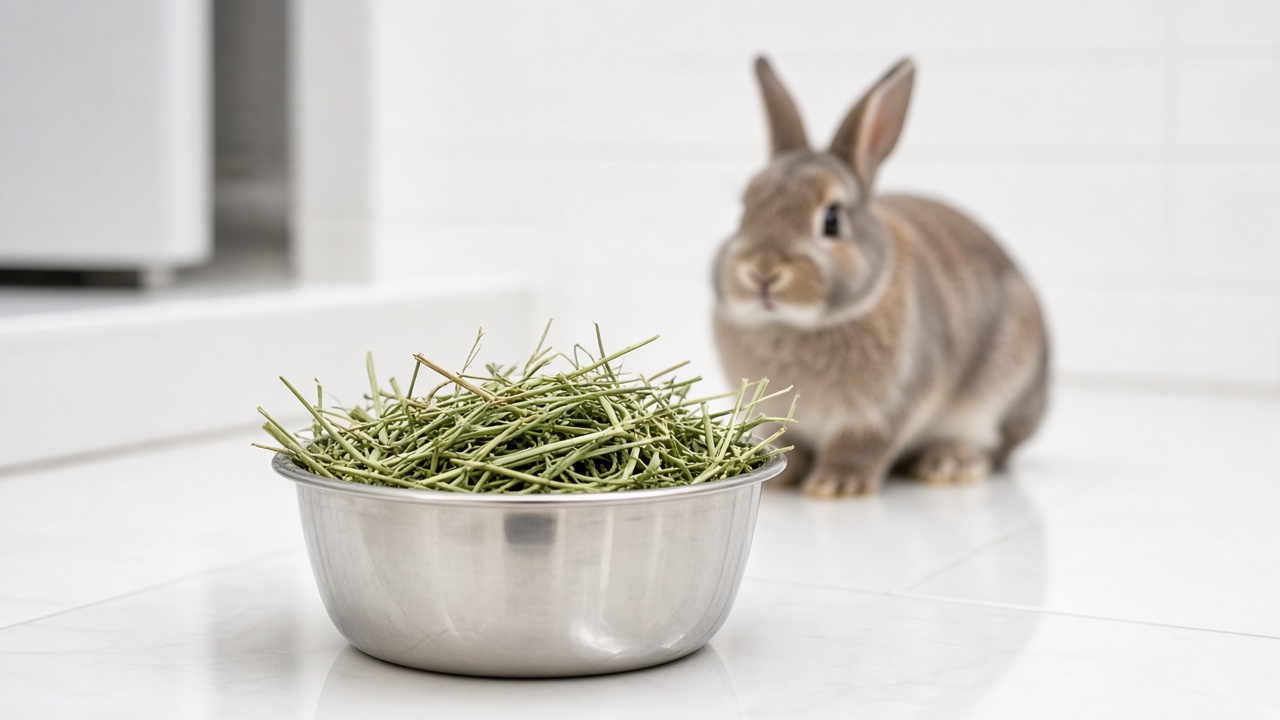
House Rabbit Society prefers a crock. Its primer says a bowl, changed daily, encourages more drinking. The bowl must be a heavy crock so it does not tip.
Oxbow Animal Health recommends two sources. Offer one bottle and one crock.
If the ball sticks, the crock still works. If the crock is soiled, the bottle still works.
Tschudin and colleagues reported 12 rabbits in the Journal of Animal Physiology and Animal Nutrition in 2011. With free access, drinker type did not change water intake. Fecal dry matter was higher on nipple drinkers, 60.0 percent versus 57.2 percent.
When those researchers limited water to part of the day, open dishes beat nipples. Intake was 54.9 versus 48.1 grams per kilogram to the 0.75 power per day.
A bottle-only setup fails rabbits that never learn the ball. It also fails if the tube freezes or clogs while you are out.
Use a bottle when the rabbit flips crocks, or when floor space is tight. Keep the crock anyway.
Chewers destroy plastic jugs. The stainless tube still helps. The jug does not.
Watch the barrel for tooth marks. Replace a scored bottle.
The Quick Lock Flip Top clamp can stay on the wire when the bottle comes off. That helps if you pull the jug daily. It does not stop a determined chewer.
FAQ
How large should a rabbit water bottle be?
Match listed capacity to Oxbow’s 4.2 to 12.7 fluid-ounce daily range for a 5.51-pound rabbit. A 16-ounce bottle covers one high day. A 32-ounce bottle covers more than two. The Choco Nose H528 at 11.2 fluid ounces sits under that upper figure.
Do “no-drip” bottles actually stay dry?
Makers claim no-drip valves. Lixit still says a first-flip drip is normal on vacuum bottles. Lixit also says leaks happen if the vacuum never forms. Check the gasket and fill to the brim.
Is a bottle better than a bowl?
House Rabbit Society prefers a crock. Oxbow Animal Health tells owners to offer both. A bottle stays cleaner and a bowl is easier to lap.
Use both.
How often should I clean the bottle?
House Rabbit Society says check daily, change weekly, and wash with soap monthly. Check the sipper daily for clogs. Oxbow adds a 50:50 vinegar rinse for plastic after a brush scrub.
Why is the bottle empty in the morning?
An overnight empty 32-ounce jug is rarely one rabbit’s drinking. Oxbow’s upper daily figure is 12.7 fluid ounces for a 5.51-pound rabbit. Look for a failed vacuum, a missing gasket, or a chewed cap.
Can two rabbits share one bottle?
A 32-ounce bottle can hold two high-intake days for one 5.51-pound rabbit. Two rabbits can empty it in one day. Give each rabbit a sipper they can reach. Keep a crock down low.
What bottle should I skip?
Skip any 10 mm hamster bottle. Choco Nose’s H125 uses that nozzle and names hamsters, not rabbits. Also skip a bottle you cannot brush or open from the top.