Quick answer: Plan for a dog-sized indoor rabbit that often tops 20 pounds. Give room-scale housing, unlimited grass hay, and measured timothy pellets rather than a hutch-only life.
The Flemish Giant is ARBA’s no-maximum-weight breed, and adults often exceed 20 pounds.
This research-desk brief compares published club standards and maker specs and records no housing trial, feeding trial, or show judging.
What this brief covers
Our selection rule is simple. We cover indoor adult pet care for one rabbit at or above senior show weight. We leave out breeding schedules, meat-pen rations, and outdoor-only hutch programs.
Our research team analyzed club pages and current maker labels. We compared published specs. We did not invent field weights or feeding results.
Size numbers from the breed clubs
The American Rabbit Breeders Association describes the Flemish Giant as a Flanders breed. ARBA says it was bred as early as the 16th century. ARBA also says the breed reached America in the early 1890s.
ARBA uses the nickname “Gentle Giant.” ARBA sets no maximum weight. ARBA states that these rabbits often tip the scales at over 20 pounds.
The National Federation of Flemish Giant Rabbit Breeders quotes the ARBA Standard of Perfection on class weights. NFFGRB lists junior bucks and does at a 6½-pound minimum. Juniors are under 6 months of age.
NFFGRB lists intermediates from 6 to 8 months. Seniors start the day the rabbit turns 8 months.
NFFGRB lists a 13-pound minimum for senior bucks. NFFGRB lists a 14-pound minimum for senior does. Those figures are show floors, not pet ceilings.
NFFGRB recognizes seven varieties listed in the ARBA standard. The colors are black, blue, fawn, light gray, sandy, steel gray, and white. Other colors need an ARBA Certificate of Development before that name applies.
Lafeber Company’s breed profile states the standard calls for a 20-inch minimum body. Lafeber also states a near-6-inch minimum ear. Lafeber lists a typical weight band of 10 to 20 pounds.
Lafeber says a Flemish Giant can grow up to 30 inches long. Lafeber dates ARBA recognition to 1910. A 20-inch body is already longer than many store cages are wide.
Housing that fits a stretched adult
Treat the home as a rabbit-proofed floor plan. A cage is a litter station and a retreat. It is not the whole habitat.
Lafeber’s breed profile says rabbits cannot endure temperatures much above 70 degrees Fahrenheit. Giant body mass holds heat. Keep the living area cool, dry, and shaded from sun through glass.
Compare one widely sold “large” hutch against those body numbers. Prevue Pet Products lists the Large Rabbit Breeding Hutch 461 at 46½ by 24 by 36¼ inches overall. Prevue lists interior space at 42½ by 20 by 20 inches.
That interior is 850 square inches, or about 5.9 square feet. The 20-inch width matches Lafeber’s minimum body length.
A 30-inch adult cannot fully stretch along the short axis. Prevue’s own copy frames the 461 as an agricultural breeding hutch. A breeding box is not an indoor exercise plan.
Give a single adult a full room or a large exercise pen. The rabbit should hop three body lengths without hitting a wall. It should stand with ears clear of the roof.
Use solid, washable flooring with rest mats. Wire floors cut hocks on a 20-pound frame.
Spot-clean litter daily. Wash the whole station each week. Do not leave a Flemish Giant in a 42-inch box as its only life.
Diet at Flemish Giant scale
House Rabbit Society’s diet guide puts hay at 85 percent of an adult ration. The same page puts vegetables at 10 percent. It puts pellets at 5 percent.
House Rabbit Society asks for an 18 percent minimum fiber pellet. It warns against mixes with nuts, seeds, or grains.
A second House Rabbit Society diet page gives volume math. Adults get at least 2 cups of chopped vegetables per 6 pounds of body weight. Adults get ¼ cup of pellets per 6 pounds of body weight.
Scale that to an 18-pound senior. Vegetables land at 6 cups a day. Pellets land at ¾ cup a day.
Scale it to a 12-pound young adult still filling out. Vegetables land at 4 cups. Pellets land at ½ cup.
House Rabbit Society prefers timothy-based pellets for adults. It keeps alfalfa pellets for young rabbits and nursing does.
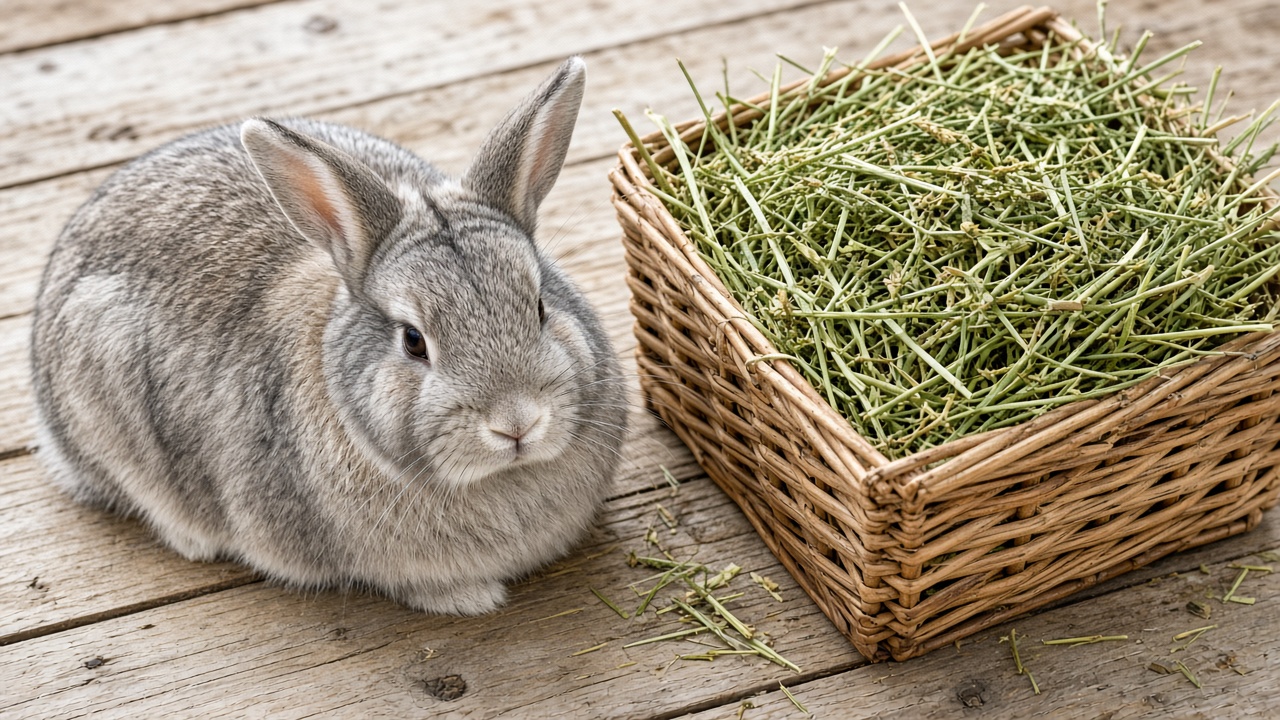
Offer grass hay all day. Timothy, orchard, and oat hay all fit that grass class. Water must be out at all times.
Use a heavy crock. A 20-pound rabbit knocks light bowls. Introduce one new green at a time.
Drop any green that loosens stool. House Rabbit Society also tells readers to wash produce for at least two minutes because of RHDV2 risk.
Fruit is a rare treat. House Rabbit Society’s volume page caps fruit near 1 teaspoon per 2 pounds of body weight per day.
For a wider pellet shortlist beyond giant-scale math, see our best rabbit pellets brief.
Pellet formulas compared by published specs
We compared four currently sold adult formulas on maker pages. We used first ingredient, fiber, protein, and the maker’s own feeding note. We did not rank them.
Oxbow Animal Health lists Timothy grass meal first in Essentials Adult Rabbit Food. Oxbow lists 14.00 percent minimum crude protein. Oxbow lists 25.00 to 29.00 percent crude fiber.
Oxbow’s feeding table assigns ¾ cup daily to rabbits over 10 pounds. Bags are listed at 5, 10, and 25 pounds.
Small Pet Select lists timothy hay first in its Rabbit Food Pellets. Small Pet Select lists 14 percent minimum crude protein. It lists 25 percent minimum and 29 percent maximum crude fiber.
For ages 1 through 5 years, Small Pet Select recommends ¼ to ½ cup per 6 pounds of body weight. Bags are listed at 5, 10, 20, and 40 pounds.
Supreme Petfoods lists alfalfa meal pellets first in Science Selective Adult Rabbit Food. Supreme lists 12.5 percent minimum crude protein. It lists 21.5 percent minimum and 28.5 percent maximum crude fiber.
Supreme’s feeding note is 60 to 70 grams, or 2 to 2.5 ounces, for a 5.5-pound rabbit. Packs are listed at 4 pounds and 8.8 pounds.
Kaytee lists sun-cured timothy grass hay first in Timothy Complete Rabbit Food. Kaytee lists 13.0 percent minimum crude protein. Kaytee lists 22.0 to 27.0 percent crude fiber.
Kaytee’s large-breed note is ⅔ to 1½ cups a day. Bags are listed at 4.5, 9.5, and 25 pounds.
| Product | First ingredient | Crude protein (min) | Crude fiber | Maker feeding note | Listed pack sizes |
|---|---|---|---|---|---|
| Oxbow Essentials Adult Rabbit Food | Timothy grass meal | 14.00% | 25.00–29.00% | ¾ cup daily for 10 lb+ | 5 lb, 10 lb, 25 lb |
| Small Pet Select Rabbit Food Pellets | Timothy hay | 14% | 25–29% | ¼–½ cup per 6 lb (ages 1–5) | 5 lb, 10 lb, 20 lb, 40 lb |
| Science Selective Adult Rabbit Food | Alfalfa meal pellets | 12.5% | 21.5–28.5% | 2–2.5 oz for a 5.5 lb rabbit | 4 lb, 8.8 lb |
| Kaytee Timothy Complete Rabbit Food | Sun-cured timothy grass hay | 13.0% | 22.0–27.0% | ⅔–1½ cups for a large breed | 4.5 lb, 9.5 lb, 25 lb |
Two gaps stand out next to an 18-pound rabbit. Oxbow’s table stops at 10 pounds and still prints ¾ cup. House Rabbit Society’s ¼ cup per 6 pounds also lands at ¾ cup for 18 pounds.
Supreme’s 5.5-pound example does not scale in print. Linear scaling to 18 pounds would be about 6.5 to 8.2 ounces. That is a different ration than Oxbow’s cup measure.
Kaytee’s large-breed band is wide. ⅔ cup and 1½ cups are not the same diet. Start at the low end if hay intake is strong.
Science Selective’s first ingredient is alfalfa meal. House Rabbit Society prefers timothy pellets for healthy adults. That label fact is why this formula sits in the table.
Oxbow lists calcium at 0.35 to 0.75 percent. Small Pet Select lists calcium at 0.4 to 0.6 percent. Kaytee lists calcium at 0.25 to 0.75 percent.
Supreme lists calcium at 0.3 to 1.2 percent. Supreme also states a 0.6 percent calcium and 0.4 percent phosphorus target.
Oxbow lists vitamin A at 10,000 IU per kilogram. Small Pet Select lists vitamin A at 8,650 IU per pound maximum.
Kaytee lists a Bacillus species minimum of 100,000 CFU per gram. That label claim is not a reason to skip hay.
Change foods over weeks, not days. Oxbow prints a four-week mix-in. Kaytee prints a 7-to-10-day mix-in.
Coat care and safe handling
Flemish Giants wear a rollback coat. Lafeber describes fur that returns slowly after a brush from tail to head. Weekly brushing is enough in a quiet coat month.
Shedding season needs more passes. A 20-pound molt puts a lot of fur into the gut. Hay fiber is the first defense.
A heavy rabbit has a real spine. Support the chest and the hindquarters together. Never dangle the rump.
Nails grow fast on soft indoor floors. Check them every few weeks. Long nails twist toes on a giant frame.
For tool choices that reach a long back, see our rabbit grooming kit review. For the stroke order and the calm hold, use our step-by-step rabbit grooming guide.
Skip full baths. Spot-clean soiled fur with a damp cloth. Dry the coat fully.
Lifespan and what usually shortens it
Lafeber’s breed profile lists a life span of about 8 to 10 years. That is shorter than many small house rabbits. Size is part of that gap.
Heat is the first daily risk. Lafeber flags 70 degrees Fahrenheit as a hard comfort ceiling. Watch for rapid breathing, red ears, and a stretched, still posture.
Sore hocks rise with weight. Soft mats and clean litter cut that risk.
Obesity hides on a large frame. You should feel ribs under a thin fat layer.
House Rabbit Society warns that free-choice pellets can drive obesity and gut disease. Hay must stay the main food. Pellets are the condiment.
Dental points follow low hay intake. A Flemish Giant that ignores hay needs a pellet cut, not a pellet increase. Dropped food and drool are urgent signs.
FAQ
How big do Flemish Giant rabbits get?
ARBA sets no maximum weight and says adults often exceed 20 pounds. NFFGRB’s senior show floors are 13 pounds for bucks and 14 pounds for does. Lafeber lists a typical 10-to-20-pound band and a length up to 30 inches.
How much space does one Flemish Giant need?
A store hutch is too small as a sole home. Prevue’s 461 lists only 42½ by 20 inches of interior floor. That is about 5.9 square feet.
Give a full room or a large pen. The rabbit should hop and stretch past 30 inches.
How much should an adult Flemish Giant eat?
House Rabbit Society puts hay at 85 percent of the diet. Its volume page uses ¼ cup of pellets and 2 cups of vegetables per 6 pounds of body weight. An 18-pound adult then gets ¾ cup of pellets and 6 cups of greens, plus unlimited grass hay.
What should I look for on a pellet bag?
House Rabbit Society wants at least 18 percent fiber and a timothy base for adults. Oxbow Essentials and Small Pet Select both list 25 to 29 percent fiber and a timothy first ingredient. Kaytee lists 22 to 27 percent fiber with timothy first.
How long do Flemish Giants live?
Lafeber lists about 8 to 10 years. Cool housing, a hay-first diet, and early care for teeth and hocks support the high end of that band. Heat, obesity, and a pellet-heavy bowl cut it.
Are Flemish Giants good family pets?
ARBA calls the breed a Gentle Giant and a universal rabbit for pet and show homes. Size still rules the house. Children need an adult who can lift 20 pounds without dropping the rabbit.
What colors are official Flemish Giants?
NFFGRB lists seven ARBA varieties: black, blue, fawn, light gray, sandy, steel gray, and white. Other shades are not Flemish Giants on the table unless ARBA grants a Certificate of Development. Color does not change housing or hay needs.