Quick answer: A calico kitten is a color-pattern kitten, not a breed, and almost all are female. Confirm sex at a clinic visit and feed a complete kitten diet through the first year. Coat patches do not change those basics.
Almost every calico kitten is female because the orange-and-black mosaic requires two X chromosomes.
This page is a research-desk briefing on coat genetics, sex, and first-year care. We did not karyotype a kitten, run a feeding trial, or sit through a clinic exam.
Our research team analyzed published genetics papers and maker labels. We used one selection rule for products.
We included only complete kitten diets whose U.S. maker pages publish a numeric guaranteed analysis and a growth-stage AAFCO statement. We left out adult bags, treats, and any “calico” merch.
A calico kitten is a color pattern, not a breed
Calico describes a coat, not a registry breed. The kitten can be a domestic shorthair, a Persian, or another breed that allows white plus two colors.
The Merck Veterinary Manual states that calico and tortoiseshell cats are usually female. The orange-versus-black switch sits on the X chromosome. White comes from a different gene.
A tortoiseshell coat mixes orange and black with little white. A calico coat adds large white patches that split those colors into blocks.
Dilute versions soften black to gray and orange to cream. The genetics stay the same.
Do not buy a kitten because a listing calls the pattern a breed. Ask for sex, age, and a written health history instead.
How orange, black, and white land on the same kitten
Orange in cats is sex-linked. Current Biology reported in 2025 that the orange allele is a 5-kb deletion on the X chromosome.
That deletion turns on Arhgap36 in pigment cells. The protein blocks protein kinase A and shifts pigment toward pheomelanin.
A companion Current Biology paper mapped a 5,076-nucleotide deletion inside ARHGAP36. Across 58 cats in that study, the deletion lined up with orange color in every case.
The eight calico cats in the sequencing set were heterozygous for the deletion. That matches a mosaic coat.
Mary Lyon described random X inactivation in Nature in 1961. Current Biology cites that work as the reason patches stay clonal.
In one skin clone the orange X stays on. In the next clone the non-orange X stays on.
White is separate. The Current Biology team found a KIT white-spotting allele in all 14 calico cats they genotyped.
None of the 33 cats without white carried that allele. Heavy white spotting is what turns a tortoiseshell mosaic into a calico.
The orange locus had been mapped earlier to a 9.7-Mb stretch of the X chromosome. The 2025 papers closed the gene gap. They did not change first-year care.
The Two-X Rule and why sex follows the coat
We use a simple rule at this desk. Call it the Two-X Rule. A visible orange-and-black mosaic needs two different X chromosomes in the same kitten.
A typical female is XX. She can carry orange on one X and non-orange on the other.
Random inactivation then paints the coat. A typical male is XY.
He has one X, so he is usually all orange or all non-orange, plus any white. The Merck Veterinary Manual treats calico and tortoiseshell color as sex-linked for that reason.
Shelter staff still check under the tail. The coat is a strong clue. It is not a substitute for a physical sex check.
If someone claims a “male calico kitten” as a selling point, slow down. Most of those kittens are female on exam.
When a calico kitten is male
Male calicos do exist. They are rare.
The Merck Veterinary Manual says they are born with two X chromosomes and one Y. The extra X allows the mosaic. It also causes sterility.
Centerwall and Benirschke reviewed 25 male tortoiseshell or calico cats in the American Journal of Veterinary Research in 1975. An XXY complement appeared in 16 of those 25 cats.
Almost all of the cats were sterile. Other routes exist.
Chimerism and mosaicism can also produce a male with two X lineages. Those paths are uncommon. They still do not make the kitten a breed.
Do not plan a breeding program around a male calico. The 1975 review found fertility was the exception.
A male calico still needs the same vaccines, diet, and safety setup as any other kitten.
The karyotype, if it is ever run, is a clinic decision. It is not a home test.
First-year care the patches do not change
Coat color does not set protein needs. The Merck Veterinary Manual, citing AAFCO, sets growth cat food at 30 percent protein on a dry-matter basis.
That equals 75 grams of protein per 1,000 kcal of metabolizable energy. Adult maintenance sits lower.
AAFCO’s adult cat minimum is 26 percent protein on a dry-matter basis, or 65 grams per 1,000 kcal. A bag labeled only for adult cats can miss growth targets.
The U.S. Food and Drug Administration explains how “complete and balanced” may appear on a label. The food must meet an AAFCO Cat Food Nutrient Profile.
Or it must pass a feeding trial that uses AAFCO procedures. The FDA notes that AAFCO issued the first Cat Food Nutrient Profiles in 1992.
Those profiles were last updated in 2016.
The FDA also warns that as-fed protein numbers mislead across textures. Canned food is typically 75 to 78 percent moisture.
Dry food is typically 10 to 12 percent moisture. Compare dry-matter figures before you call one formula “higher protein.”
Energy is a starting point, not a promise. The Merck Veterinary Manual lists healthy-kitten energy as 2.5 times resting energy requirement.
It also says any calorie formula may miss by as much as 30 percent for one animal. Weigh the kitten. Adjust the bowl.
Vaccines follow published schedules, not coat color. The American Veterinary Medical Association says most kittens start a series at 6 to 8 weeks of age.
The final dose is given at 16 weeks or older. The 2020 AAHA/AAFP Feline Vaccination Guidelines are more granular.
Core kitten shots for FPV, FHV-1, and FCV start no earlier than 6 weeks. They then repeat every 3 to 4 weeks until 16 to 20 weeks.
That Task Force also treats FeLV as core for cats younger than 1 year. Those same guidelines note a WSAVA finding.
Up to one-third of kittens may fail to respond to a final core vaccine at 16 weeks. That is why some protocols add a 6-month booster.
Kitten diets we compared under one label rule
The coat does not pick the bag. The label does.
Our Pet Bench Kitten Label Scan kept one rule. The diet had to be sold now as a kitten food.
The U.S. maker page had to publish numbers. The AAFCO statement had to cover growth.
We compared four products that met that rule. We did not rank them.
Royal Canin Kitten Dry Cat Food lists crude protein at 34.0 percent minimum. Crude fat is 16.0 percent minimum.
Royal Canin publishes 3,823 kcal of metabolizable energy per kilogram, or 367 kcal per cup. The page limits this kibble to ages 4 months to 1 year.
Hill’s Science Diet Kitten Chicken Recipe is aimed at weaning through 1 year. Hill’s Pet Nutrition publishes average dry-matter protein at 38.5 percent.
Fat is listed at 23.1 percent on a dry-matter basis. The same page lists 4,067 kcal per kilogram, or 407 kcal per cup.
Purina Pro Plan Kitten Complete Essentials Shredded Blend Chicken & Rice Formula lists crude protein at 42.0 percent minimum. Crude fat is 19.0 percent minimum.
Nestlé Purina PetCare publishes 3,980 kcal per kilogram, or 409 kcal per cup. Taurine is listed at 0.18 percent minimum. DHA is listed at 0.02 percent minimum.
Royal Canin Kitten Thin Slices in Gravy is the wet counterpart. The can lists crude protein at 10.5 percent minimum and moisture at 80.2 percent maximum.
Royal Canin publishes 76 kcal per 3-ounce can, or 893 kcal per kilogram. The AAFCO statement on that page is for growth.
Across those four labels, dry protein ran from 34.0 percent minimum to 42.0 percent minimum. Hill’s dry-matter figure sat at 38.5 percent.
Wet moisture sat at 80.2 percent maximum on the Royal Canin can. Per-serving calories ran from 76 kcal per can to 409 kcal per cup.
| Product | Form | Maker life-stage window | Protein (maker figure) | Fat or moisture (maker figure) | Calories (maker figure) |
|---|---|---|---|---|---|
| Royal Canin Kitten Dry Cat Food | Dry kibble | 4 months to 1 year | 34.0% min crude protein | 16.0% min crude fat | 367 kcal/cup |
| Hill’s Science Diet Kitten Chicken Recipe | Dry kibble | Weaning to 1 year | 38.5% protein, dry matter | 23.1% fat, dry matter | 407 kcal/cup |
| Purina Pro Plan Kitten Complete Essentials Shredded Blend Chicken & Rice | Dry kibble | Kitten growth; nibble from 3–4 weeks | 42.0% min crude protein | 19.0% min crude fat | 409 kcal/cup |
| Royal Canin Kitten Thin Slices in Gravy | Wet slices | Up to 12 months | 10.5% min crude protein | 80.2% max moisture | 76 kcal/can |
Read the AAFCO line on the bag in your hand. Formulas change. The page we compared is not a substitute for the current label.
Transition slowly if you switch. Purina’s shredded-blend notes allow 7 to 10 days to move foods.
Hill’s describes a 7-day mix. Fast swaps cause more GI upset than coat color ever will.
Home setup that still applies after the coat settles
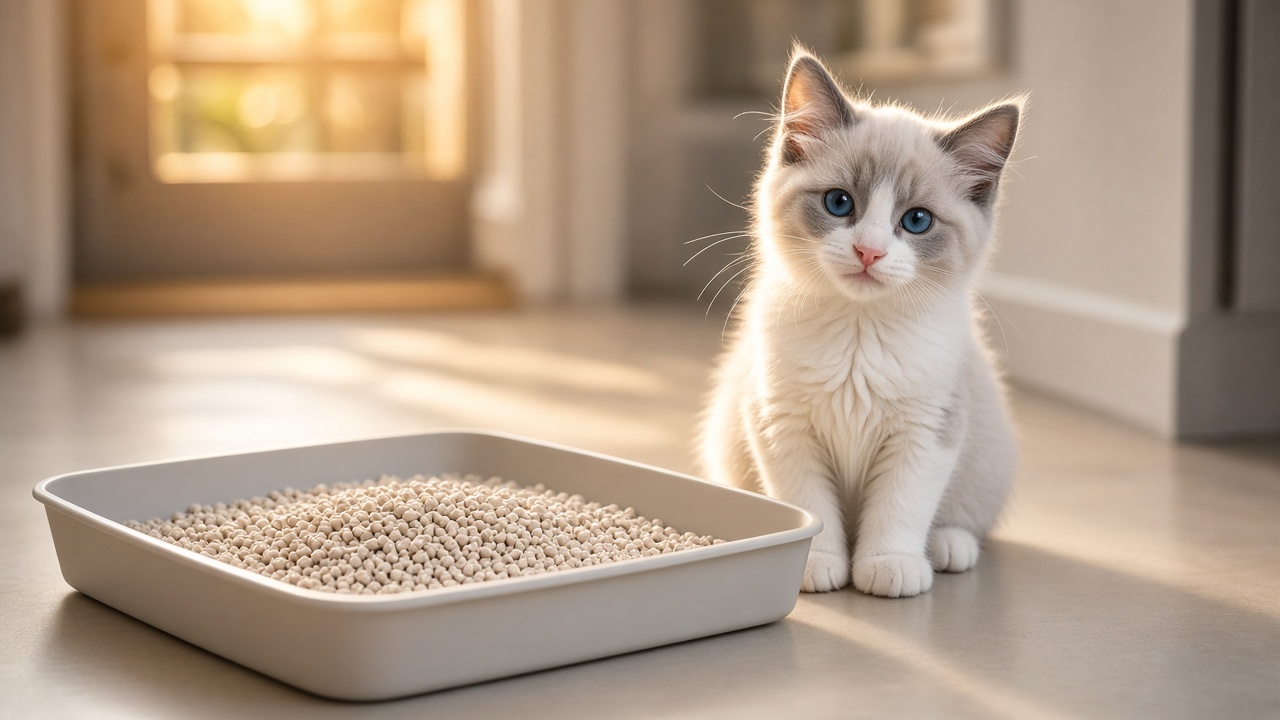
A calico kitten needs the same hardware as any other kitten. Use a low-entry litter box she can climb.
Keep food, water, and litter in three separate spots. Keep the core vaccine series on the published calendar.
The AVMA series and the AAHA/AAFP interval are about maternal antibodies, not patches. Plan a spay or neuter conversation at the kitten visits.
A female calico can become pregnant once she cycles. A rare male calico is usually sterile, but he can still spray.
Watch weight, not lore. “Tortitude” is a social nickname, not a feeding plan.
FAQ
Is a calico kitten a breed?
No. Calico is a color pattern. The Merck Veterinary Manual treats it as a sex-linked coat trait, not a breed standard.
The same orange-and-black-and-white layout can appear in many breeds and in random-bred kittens.
Are all calico kittens female?
Almost all are. The Two-X Rule requires two X chromosomes for a visible orange-and-black mosaic.
The Merck Veterinary Manual says male calicos are very rare and carry an extra X. Confirm sex on exam. Do not treat the coat as a karyotype.
What is the difference between calico and tortoiseshell?
Tortoiseshell is orange and black with little or no white. Calico adds large white patches that separate the colors.
Current Biology tied those white patches to a KIT white-spotting allele in every calico cat the 2025 team genotyped.
Do calico kittens need a special food for the coat?
No. They need a growth-stage complete diet.
AAFCO’s growth minimum, as summarized by the Merck Veterinary Manual, is 30 percent protein on a dry-matter basis. Adult-only bags can sit at the 26 percent adult minimum and miss growth needs.
When should vaccine visits start?
The American Veterinary Medical Association describes a series that starts at 6 to 8 weeks. The last kitten dose is at 16 weeks or older.
The 2020 AAHA/AAFP guidelines space those core doses every 3 to 4 weeks. The series runs until 16 to 20 weeks.
Can I breed for calico kittens on purpose?
You can raise the odds. You cannot lock the pattern.
Orange is X-linked. White spotting is a separate KIT trait. Littermates will still split into several color outcomes.
Why does my calico have more white than another calico?
White spotting varies in dose and in how pigment cells migrate. Current Biology found the KIT allele in all 14 calicos tested.
None of 33 cats without white carried it. The allele explains the presence of white, not the exact map on one kitten.