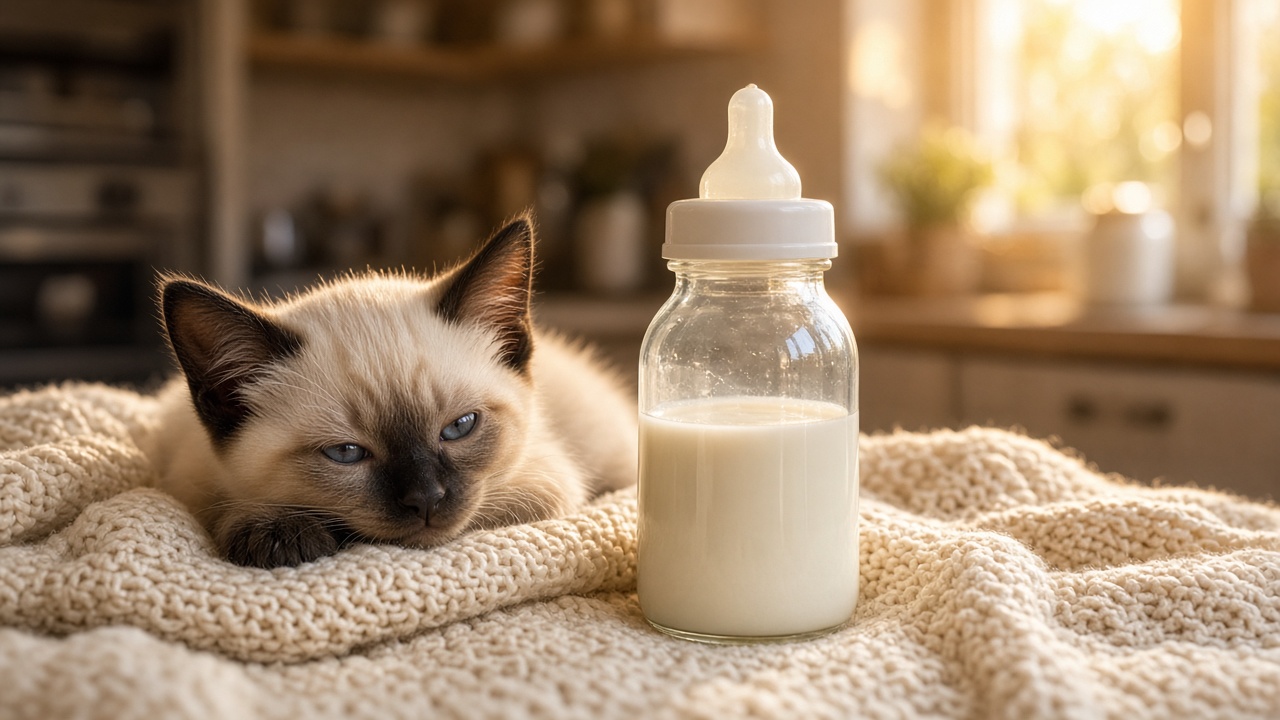
Quick answer: For orphan kittens, use a commercial kitten milk replacer, not cow’s milk. PetAg KMR Powder is the default complete diet through six weeks. Mix one part powder with two parts warm water. Feed two tablespoons of liquid per four ounces of body weight daily.
Kitten milk formula is a labeled milk replacer mixed to a drinkable liquid. It is not a saucer of grocery dairy.
PetAg KMR Powder lists a complete kitten diet to six weeks at 40.0% min protein and 28.0% min fat.
That line can stand alone. This page is a September 2026 label desk our research team compiled from published specs. We did not mix formula in our office, weigh live kittens, or open sealed cans.
The label-complete rule we used
We used one selection rule. A product entered only if the maker’s own US page named kittens and printed a feeding rate. The same page also had to print a complete-diet claim or an intermittent-or-supplemental statement.
We excluded puppy formulas, grocery cow’s milk, plain goat milk, and homemade recipes. We also dropped any brand whose maker page listed no feeding rate. That rule does not rank products.
Top 7 Kitten milk formula
The picks below are the 7 kitten milk formulas on sale right now, listed with what each suits best and an honest drawback. Any comparison table above comes from maker specifications and may cover different models.
1. PetAg KMR Kitten Milk Replacer Liquid
Best for: No-mix overnight orphan emergencies
PetAg’s KMR liquid is a ready-to-feed kitten milk replacer. You shake the carton, warm a serving, and skip mixing. Owners reach for it on sudden orphan nights; they also call out the high sticker and how fast an opened carton goes.
Pros: Ready-to-feed liquid carton; No mixing at night Cons: Premium price, short leftovers
2. Nutri-Vet Kitten Milk Replacer
Best for: Foster homes stretching powder
Nutri-Vet’s kitten milk is a mid-price mixing powder. You stir it with warm water before each feeding. Owners treat it as a pantry powder; the maker page also marks it for supplemental or intermittent feeding, so this is not the no-mix emergency carton.
Pros: Mid-price mixing powder; Powder stretches farther Cons: Must mix every feeding
3. Under the Weather Kitten Milk Replacement Powder + Colostrum for Cats
Best for: Colostrum-minded orphan caregivers
Under the Weather sells this as a kitten milk powder with added colostrum, which is why it costs more than the cheapest cans. You mix it with water. Owners buy the colostrum line on the label; leftover mixed liquid does not keep long.
Pros: Colostrum listed on label; Powder you mix yourself Cons: Costs more than basics
4. Pet-Ag PetLac Powder for Kittens
Best for: Cheapest PetAg powder backup
PetLac is PetAg’s cheaper kitten powder, not the KMR line. At this sticker it is the can you keep for a surprise litter. Owners report it as the budget PetAg option; you still mix every bottle.
Pros: Lowest-priced powder here; PetAg kitten powder can Cons: You mix every bottle
5. Tiki Cat Baby Milk Replacer
Best for: Pouch-fed travel and weaning
Tiki Cat’s Baby milk replacer is a ready-to-feed goat-milk formula in spout pouches. Owners like the pouch for travel and small litters. The pack price sits with the other premium liquids, and leftovers still need the fridge.
Pros: Ready-to-feed pouch format; Goat-milk liquid, no mixing Cons: Pricey for pouch volume
6. PetAg Goat’s Milk KMR Kitten Milk Replacer Powder
Best for: Sensitive-gut goat-milk powder
Goat’s Milk KMR is PetAg’s powdered KMR built on goat’s milk instead of the usual dairy base. The maker page aims it at kittens with sensitive guts. Owners pick this when they want the KMR name in powder form; it still needs mixing and costs more than PetLac.
Pros: Goat-milk KMR powder; Known KMR powder line Cons: Not a ready-to-feed
7. NOVYQREN Pet Nursing Kit for Newborn Puppies
Best for: First-time bottle-feeding kits
This is a feeding kit, not kitten milk. The listing is built for newborn puppies and also names kittens, so you still buy formula separately. Owners grab cheap bottle-and-nipple sets for the first night; at this price expect a generic kit, not a clinic nurser.
Pros: Low-cost nursing kit; Bottles for hand feeding Cons: Contains no milk formula
Comparison: Kitten milk formula at a Glance
Want to browse every option? See the full range of kitten milk formula on Amazon →
What kitten milk formula is, and is not
A kitten milk formula is a commercial milk replacer sold for kittens. Powder versions are mixed with water. Liquid versions are shaken and poured.
The Association of American Feed Control Officials does not write a separate nutrient profile for milk replacers. AAFCO’s Cat Food Nutrient Profiles still set a dry-matter minimum of 30.0% crude protein for growth. The adult-maintenance minimum is 26.0% crude protein.
AAFCO also says it does not approve, certify, or endorse pet food. State feed officials review labels. A “meets AAFCO” line on a can is a company claim, not a stamp from AAFCO.
Susan Little’s 2013 review in the Journal of Feline Medicine and Surgery compared queen’s milk with other milks. That paper states that cow’s milk is lower in protein and fat. It also calls cow’s milk a poor source of taurine.
The same paper says goat’s milk has no nutritional benefit compared with cow’s milk.
Little’s review sets an energy band of 15 to 25 kcal per 100 grams of body weight each day. It lists a stomach capacity of 4 to 5 ml per 100 grams. Homemade mixes belong only to short emergencies in that paper.
How five current labels compare
Powder numbers and liquid numbers are not the same kind of number. PetAg states this on its own pages. Powder guarantees describe the dry product before water is added.
Liquid guarantees describe the ready drink, which is mostly water. PetAg KMR Liquid lists a maximum moisture of 85.00%. PetAg KMR Powder lists a maximum moisture of 5.0%.
After a 1:2 mix, PetAg says the powder’s protein and fat should land near the liquid can. Our research team lined up the five maker pages on September 8, 2026. The dry-powder protein spread was 7.0 points.
PetAg KMR Powder and Goat’s Milk KMR list 40.0% min protein. PetAg PetLac lists 33.0% min protein. Nutri-Vet’s page lists a feeding rate but no protein or fat guarantee.
| Product | Form | Min crude protein | Min crude fat | Mix on maker page | Maker feeding rate | Label role on maker page |
|---|---|---|---|---|---|---|
| PetAg KMR Powder | Powder | 40.0% | 28.0% | 1 part powder to 2 parts warm water | 2 tbsp (30 mL) liquid per 4 oz (115 g) daily | Complete diet to 6 weeks |
| PetAg KMR Liquid | Ready liquid | 7.00% | 4.50% | Shake; no mixing | 2 tbsp (30 mL) per 4 oz (115 g) daily | Complete diet; discard 72 hours after opening |
| PetAg Goat’s Milk KMR Powder | Powder | 40.0% | 28.0% | 1 part powder to 2 parts warm water | 2 tbsp (30 mL) liquid per 4 oz (115 g) daily | Complete diet to 6 weeks |
| PetAg PetLac Powder for Kittens | Powder | 33.0% | 18.0% | 1 tbsp powder with 2 tbsp warm water | 1 tsp (5 mL) liquid per 4 oz every 3–4 hours | Intermittent or supplemental feeding only |
| Nutri-Vet Milk Replacer with Opti-Gut | Powder | Not listed on Nutri-Vet page | Not listed on Nutri-Vet page | 1 tbsp powder to 2 tbsp water | 2 tbsp (1 oz) solution per 4 oz body weight per day | Supplemental or intermittent feeding only |
PetAg KMR Powder is the default complete-diet pick when you need a published protein and fat pair. Goat’s Milk KMR carries the same 40.0% and 28.0% pair.
PetLac is the odd can in that set. PetAg’s page recommends it as a supplement for nursing or weaning kittens. The same page says the product is intended for intermittent or supplemental feeding only.
Nutri-Vet’s page calls the powder a full meal replacement in its marketing block. The directions on that same page say the product is intended for supplemental or intermittent feeding only. We report both lines and do not collapse them.
Mix ratios and daily volumes from the makers
PetAg’s KMR Powder page says to whisk or shake 1 part powder into 2 parts warm water. It says not to mix more than can be consumed in 24 hours. It says not to use a blender.
The daily volume is 2 tablespoons (30 mL) of reconstituted KMR per 4 ounces (115 grams) of body weight. That total is split into equal feedings. PetAg says kittens should be fed every 3 to 4 hours.
An 8-ounce kitten, on PetAg’s own example math, needs 4 tablespoons of liquid across 24 hours. The company uses the same daily rule for KMR Liquid and for Goat’s Milk KMR.
PetAg lists 4494 kcal per kilogram for KMR Powder, or 29.6 kcal per tablespoon of dry powder. After the 1:2 mix, PetAg lists 12.4 kcal per tablespoon of liquid. Goat’s Milk KMR prints those same two calorie lines.
PetAg KMR Liquid lists 836 kcal per kilogram, or 13.04 kcal per tablespoon.
PetLac’s mix is narrower. One tablespoon of powder plus two tablespoons of warm water makes about 35 ml of liquid. PetAg says that amount feeds a 4-ounce kitten for about one day.
Bottle-fed kittens then get 1 teaspoon (5 mL) per 4 ounces every 3 to 4 hours. Nutri-Vet mixes 1 tablespoon of powder with 2 tablespoons of water at 100 to 105 degrees Fahrenheit. The daily rate is 2 tablespoons of solution per 4 ounces of body weight.
Unused Nutri-Vet solution is refrigerated and discarded after 24 hours. Little’s review says milk replacer left at room temperature should be discarded after 1 hour. Follow the can for the product you bought.
What the powder should not be asked to do
PetAg states that KMR does not contain colostrum. The company says kittens should nurse for a minimum of 2 days when that is possible. Nutri-Vet’s page makes the same two-day nursing request.
Little’s review states that kittens take in almost all passive immunity in the first 12 to 18 hours. The same paper says milk replacers advertised with colostrum have no evidence that the ingredient provides immunity.
Formula replaces milk. It does not replace that early window.
Why cow’s milk fails as formula
Cow’s milk is not a kitten milk formula. It lacks a kitten complete-diet label. It also fails the nutrient comparison Little published.
Queen’s milk is higher in protein and fat. Cow’s milk is higher in lactose relative to what a kitten can use well. Diarrhea and dehydration are the usual result when grocery milk is used as a sole diet.
Plain goat milk from a carton is the same kind of miss. Little’s review gives it no nutritional edge over cow’s milk. PetAg’s Goat’s Milk KMR is a fortified replacer, not grocery goat milk.
Adult cats are a different question. Some adult cats tolerate small amounts of dairy. Many do not.
We cover that separate problem in Can cats drink milk?. Orphan neonates are not that case.
AAFCO requires every pet-food label to carry a guaranteed analysis. The required lines are minimum crude protein, minimum crude fat, maximum crude fiber, and maximum moisture. Grocery milk jugs do not carry those four kitten guarantees.
Storage windows printed on the cans
PetAg’s KMR Powder page says an unopened container stays in a cool, dry place. After opening, the powder may sit at room temperature for up to 2 months. It may then be refrigerated for 1 additional month.
Opened powder may be frozen for up to 6 months. Reconstituted liquid must be refrigerated and used within 24 hours.
PetAg KMR Liquid is stricter after opening. The opened container must be refrigerated and discarded after 72 hours. PetAg says not to freeze the liquid in its original container.
After opening, the liquid may be frozen for up to 6 weeks in an ice cube tray. PetLac’s page says reconstituted liquid lasts up to 24 hours in the refrigerator.
PetAg lists 130,000 colony-forming units per gram of powder on KMR Powder, Goat’s Milk KMR, and PetLac. Those counts are live-microbe guarantees on dry powder. They are not a reason to leave mixed formula on a counter.
Weaning off formula
PetAg’s KMR Powder page treats the product as a complete diet through 6 weeks. At week 6, PetAg points caregivers toward mixing reconstituted KMR with the company’s own weaning food.
Little’s review starts saucer training at 3 to 4 weeks. By 5 to 6 weeks, kittens should take 30% or more of daily calories from solid food. Weaning is usually complete by 6 to 9 weeks.
PetLac’s page says you may offer reconstituted PetLac in a shallow bowl at 4 to 6 weeks. It says not to stop bottle feeding until the kittens eat well on their own.
Weight is the check, not the calendar. Little’s review targets a gain of 10 to 15 grams per day until weaning. PetAg tells caregivers to weigh kittens daily on KMR.
PetLac tells caregivers to weigh at the start and every 3 days. A nest that is too cold will wreck a perfect mix.
Little lists 32 to 34 degrees Celsius (89.5 to 93 degrees Fahrenheit) for the first week. The target falls to 24 degrees Celsius (75 degrees Fahrenheit) by weeks 4 to 12.
Formula left in a warm room grows bacteria. Little says to prepare no more than a 24-hour supply. PetAg’s powder pages say the same 24-hour mix cap.
FAQ
Can I feed cow’s milk as kitten milk formula?
No. Cow’s milk is not a labeled kitten replacer. Little’s review states that cow’s milk is lower in protein and fat than queen’s milk.
How much formula does a newborn kitten need each day?
PetAg’s KMR pages set 2 tablespoons (30 mL) of liquid per 4 ounces of body weight per day. Split that total into feedings every 3 to 4 hours. Little’s review uses a wider energy band of 15 to 25 kcal per 100 grams per day.
Is powder better than ready-to-feed liquid?
They are different packages of the same job. PetAg KMR Powder lists 40.0% min protein before water is added. KMR Liquid lists 7.00% min protein because the can is already 85.00% moisture.
Can I use puppy milk replacer on a kitten?
PetAg says no. The company states that its kitten and puppy formulas are species-specific and are not interchangeable. Buy a kitten-labeled replacer.
How long does mixed powder last?
PetAg’s KMR Powder, Goat’s Milk KMR, and PetLac pages cap reconstituted liquid at 24 hours in the refrigerator. Nutri-Vet prints the same 24-hour discard line. Little’s review says room-temperature leftover formula should be thrown out after 1 hour.
When should I stop kitten milk formula?
PetAg treats KMR as a complete diet through 6 weeks, then points to a weaning food. Little’s review expects 30% or more of calories from solid food by 5 to 6 weeks. Weaning is usually done by 6 to 9 weeks.
Why do some labels say “supplemental only”?
AAFCO treats “intermittent or supplemental feeding only” as its own category. That line means the product is not being offered as a complete diet. PetAg prints that line on PetLac, and Nutri-Vet prints it in the directions.