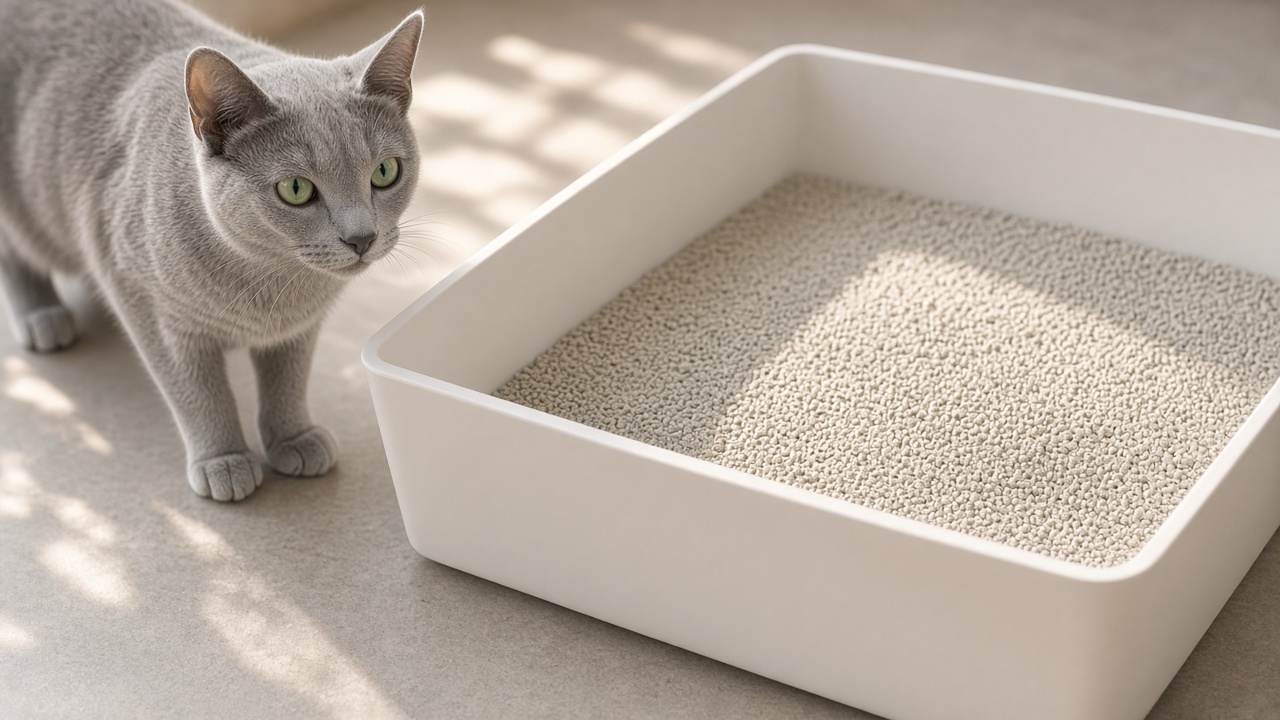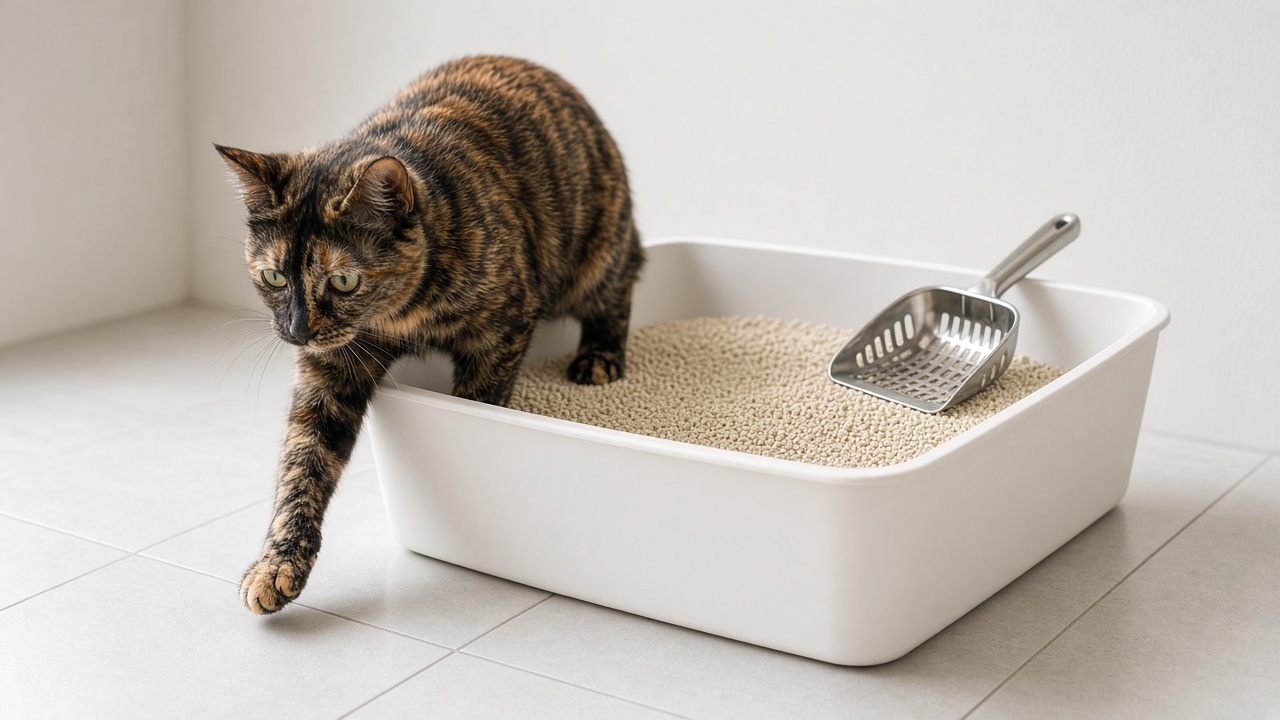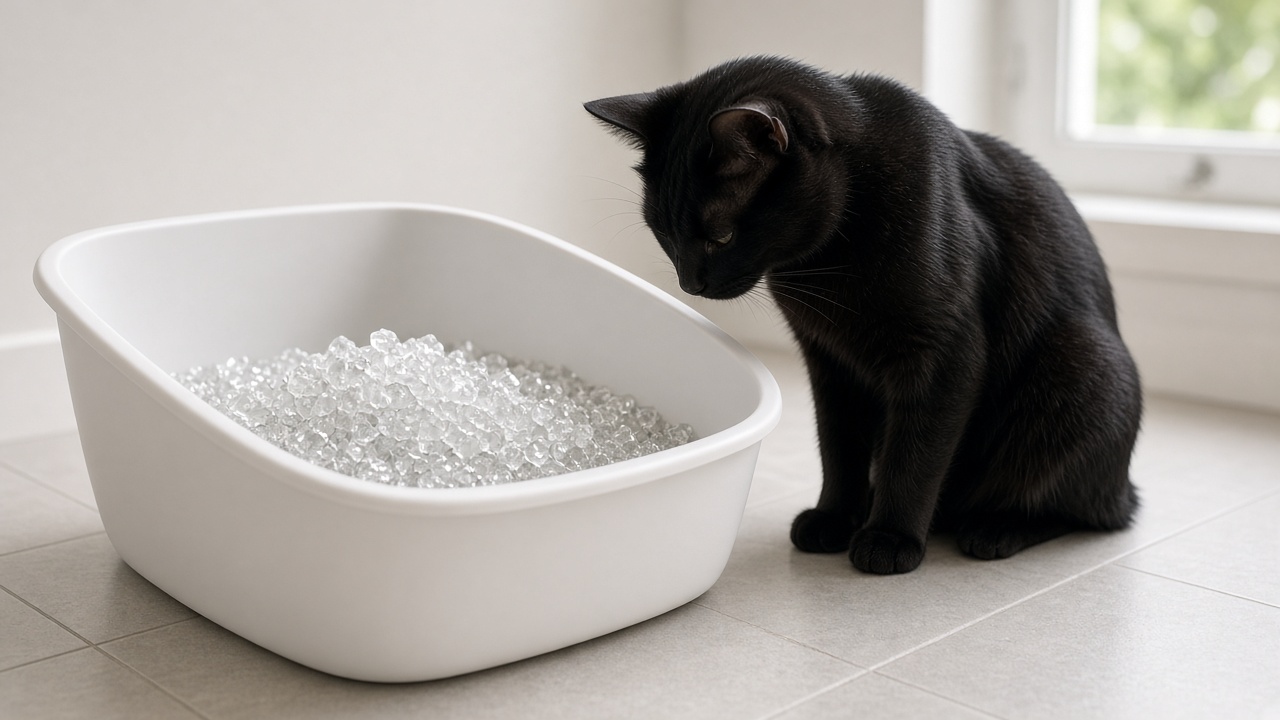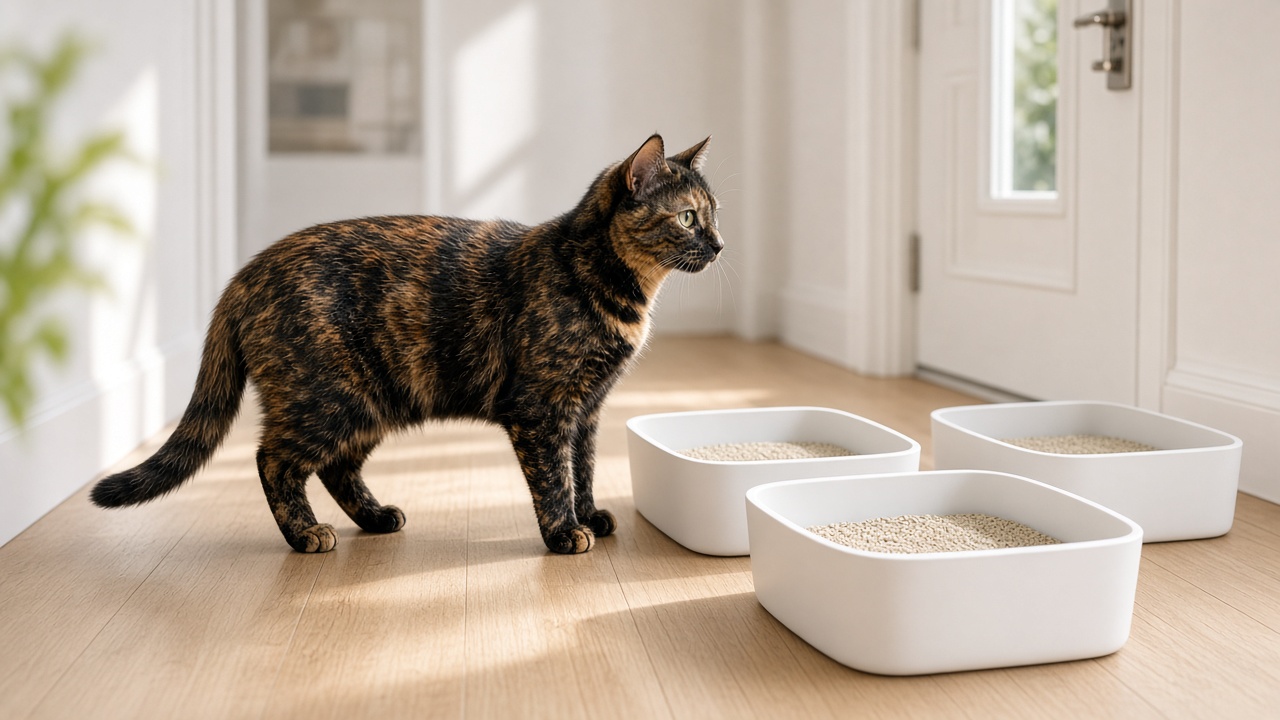
Quick answer: Keep one litter box per cat, plus one extra. Two cats need three boxes. Place each box in a different quiet room, not in a single row.
Keep one litter box per cat plus one extra.
This page is a household count-and-placement brief. Our research team compared published guidelines. We did not film home setups, did not time scooping, and did not score boxes.
The American Veterinary Medical Association’s 2025 pet ownership statistics list 1.8 cats per cat-owning household. N+1 on that average is three boxes.
What this brief covers
We used one selection rule. A scenario entered only if a named organization published a home count, size, depth, or cleaning interval.
We included one-cat homes, multi-cat homes, and multi-level homes. We included open boxes, covered boxes, and top-entry boxes as placement and access problems.
We left out product rankings. We left out price tiers. We left out shelter colony rooms, which stock boxes on a denser floor than a home.
We also left out outdoor-only toileting plans. International Cat Care still asks for indoor trays even when a cat is free to roam.
A row of boxes in one closet does not meet our rule. We count that cluster as one resource, not as N+1.
How to apply N+1 by household size
AAHA’s 2021 feline life-stage litter-box page states a simple rule of thumb. Use one box for each cat plus one additional box.
The same page adds a second version. If you know the social groups, use one box per group plus one.
The ASPCA’s litter-box problems page uses the same household math. It gives a worked example. Three cats need a minimum of four boxes.
Cornell’s Feline Health Center house-soiling page says the same count. Provide as many boxes as there are cats, plus one.
International Cat Care’s choosing-tray page uses the same plus-one formula. One tray per cat, plus at least one extra.
| Cats in the home | Boxes under N+1 |
|---|---|
| 1 | 2 |
| 2 | 3 |
| 3 | 4 |
| 4 | 5 |
That table is a count formula, not a ranking. Add a box if a cat cannot reach the set without crossing a rival.
AAHA’s page treats a bonded pair as one social group when you know the grouping. That can drop the raw head-count. It does not let you park every box in one room.
Why the extra box exists
The spare box is a buffer, not a decoration. Cats compete for a clean, unguarded place to eliminate.
The ASPCA’s litter-box problems page states that at least 10% of all cats develop elimination problems. Not enough boxes is one listed cause.
AAHA’s page says some cats seem quite sensitive to dirty litter boxes. A spare box gives a clean option when the first one is occupied or soiled.
It also gives a second door if one cat blocks the first. That matters in multi-cat homes more than the raw count.
Cornell’s house-soiling page reports that 10% of neutered males spray. It reports that 5% of neutered females spray. In homes with more than seven cats, it says one or more cats will likely spray.
Spraying is marking, not a simple box shortage. Extra boxes still reduce competition that can raise that stress.
The spare box does not treat pain. The ASPCA’s page tells readers to have a veterinarian check medical causes before treating the setup as a habit.
Put boxes in different rooms
Count without placement is an incomplete answer. Lined-up boxes act like one toilet.
AAHA’s litter-box page asks for different locations that stay easy to reach. It asks for quiet spots with an escape route.
The ASPCA’s litter-box problems page says boxes should sit in accessible spots, away from high traffic. In a multistory home, it says you may need a box on each level.
Keep boxes away from washers, dryers, and dog bowls. The ASPCA lists those as loud or intimidating neighbors.
International Cat Care’s choosing-tray page says trays should sit somewhere quiet, away from food and water. It also warns against trays by cat flaps or full-length glass. Cats may see outdoor rivals there.
Do not treat a laundry-room pair as two resources. If one cat can stand in the doorway, that cat can guard both pans.
A one-cat studio still benefits from two sites. One box by the sleeping spot and one by the living area shortens the walk.
Move a box only if you must. Cornell’s house-soiling page says to shift it a few inches a day when you relocate it.
Food stays elsewhere. Cats prefer not to eat beside waste. The ASPCA’s problems page says to put food bowls somewhere other than right next to the box.
Size: 1.5 times the cat
N+1 fails if every pan is too small. A large cat in a small pan will perch on the rim or leave.
AAHA’s litter-box page sets a size floor. The box should be at least one and a half times the cat from nose to tail tip.
It says most manufactured boxes are not large enough. It points to larger storage containers.
International Cat Care’s choosing-tray page uses a shorter yardstick. It wants the tray 1.5 times the cat from nose to the base of the tail. That endpoint excludes the tail.
Those two published rules do not match. Nose-to-tail-tip is the longer target. If you measure only to the tail base, the pan can still be short for a long-tailed cat.
Our research team compared those two published endpoints. We did not measure live cats. We treated AAHA’s longer span as the stricter home rule.
Petmate’s product page for the Giant Litter Box lists 25.560 by 18.300 by 10.020 inches. It states the pan can hold over 30 lbs of litter. It lists a $29.99 price on that page.
That length is one of the larger published open pans. It still may fall short of AAHA’s 1.5-times-to-the-tail-tip rule for a long adult.
Petmate’s same page tells owners to replace the plastic box at least once every 12 months. It says odor can penetrate plastic and resin.
Covered boxes trap odor. Cornell’s house-soiling page says covers hold odors in, even when people like them.
Top-entry boxes can block older cats. The ASPCA’s problems page says older cats may struggle with top-entry boxes or high sides.
If you want a durable open pan, stainless-steel top-entry litter boxes are one material path. Keep a low-entry option for kittens and seniors.
AAHA’s page says box edges should not be too high for a kitten or a senior cat.
Litter depth and substrate
A correct count cannot save a box the cat hates to stand in.
The ASPCA’s litter-box problems page says cats usually prefer one to two inches of litter. It warns against three to four inches.
International Cat Care’s choosing-tray page cites research that cats prefer a depth of approximately 3 cm. That is close to the shallow end of the ASPCA range.
Most cats prefer unscented, clumping litter with a medium to fine texture. The ASPCA’s problems page states that preference.
International Cat Care’s choosing-tray page says a fine, sand-like litter is the closest instinctive match. Many cats also prefer clumping litter, that page says, because clumps are easier to remove.
If you want wood or paper pellets, read our pellet cat litter brief before you swap the whole house. Change type slowly.
The ASPCA’s problems page says to offer different litters in boxes placed side by side. Let the cat show the preference.
AAHA’s litter-box page says individual litter preferences have been documented. For cats with a history of urinary problems, it notes that unscented clumping litter may be preferred.
Skip liners if claws catch. Both the ASPCA and International Cat Care flag liners as a common turn-off.
Skip scented cleaners. The ASPCA’s problems page says a cat can develop an aversion to that scent.
Cleaning so the extra box still matters
N+1 assumes each box is usable. A dirty spare is not a spare.
AAHA’s litter-box page says boxes should be scooped daily. It says to clean with hot water. It says to avoid soap or strong chemicals.
The ASPCA’s problems page says to scoop and change litter at least once a day. It says to rinse the box once a week with baking soda or unscented soap.
International Cat Care’s choosing-tray page is stricter on scooping. Scoop at least twice a day.
That page also sets a full wash interval. Wash and refill every 2 to 4 weeks with clumping litter. Wash weekly with non-clumping litter.
For the interval between full changes, use our how often to change cat litter guide. Match the interval to litter type and cat count.
A self-cleaning box can keep the bed cleaner. International Cat Care’s choosing-tray page says those units can startle cats with noise or motion. Many are also small.
If a cat stops using a self-cleaning pan, the ASPCA’s problems page says to try a traditional box.
Do not punish misses. AAHA’s page says cats should never be reprimanded for toileting in the wrong place. They should never be taken to a box as punishment.
Clean accidents with an enzymatic cleaner. The ASPCA’s problems page says ammonia-based cleaners can draw the cat back to the same spot.
The AVMA’s 2025 statistics page reports 43.1 million U.S. households with cats. It reports 76.3 million owned cats. It reports that 32.6% of U.S. households own a cat.
That page also notes the 2025 figures come from an opt-in online survey of 7,519 people.
The average 1.8 cats per cat home is why three boxes is the typical N+1 target, not two.
FAQ
Do two cats need three litter boxes?
Yes, two cats need three boxes under N+1. The ASPCA, AAHA, Cornell, and International Cat Care all publish that plus-one count. Place the three boxes in different rooms, not in one closet.
Can I keep one box if I scoop twice a day?
You can try it in a one-cat home with a large open pan. The published rule is still two boxes for one cat. The second box is the backup when you are late to scoop.
Does a studio apartment change the math?
The count does not drop because the floor plan is small. Put one box at each end of the unit. A storage tote that meets AAHA’s 1.5-times length rule can replace a short retail pan.
Should every box be the same style?
No, offer at least one large open box. Cornell’s page says covers hold odor, and the ASPCA’s page says many cats dislike lids and liners. Keep a low-sided box for seniors.
Do outdoor cats still need N+1 indoor boxes?
Yes, if they live in the home. International Cat Care’s choosing-tray page says trays are highly recommended even for cats that roam. Indoor-only cats have no other toilet, so their count is not optional.
When should I add a box beyond N+1?
Add one after any miss, after a new cat arrives, or when a cat starts guarding a doorway. Cornell’s page says spraying becomes likely in homes with more than seven cats. Seek a veterinarian if straining, blood, or crying appears.
How deep should the litter be?
The ASPCA’s litter-box problems page says one to two inches, not three to four. International Cat Care’s choosing-tray page states a preference of about 3 cm. Start near one inch, then add depth only if waste stays uncovered.