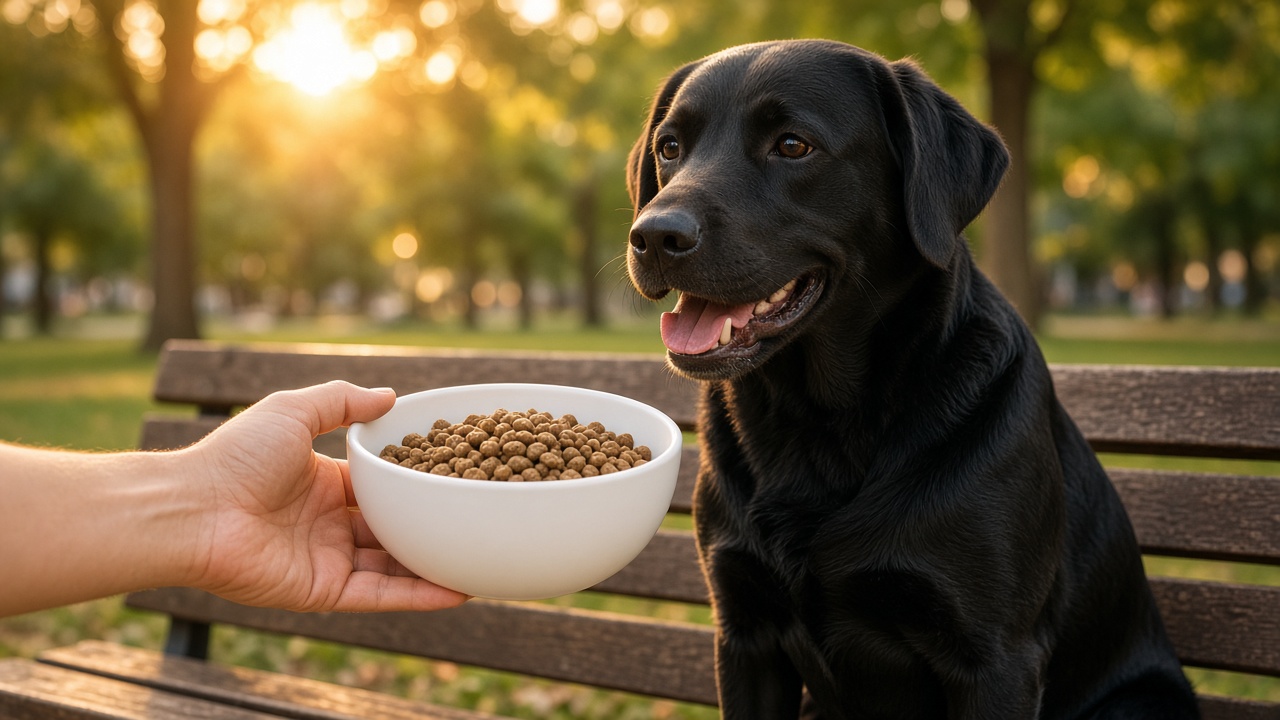
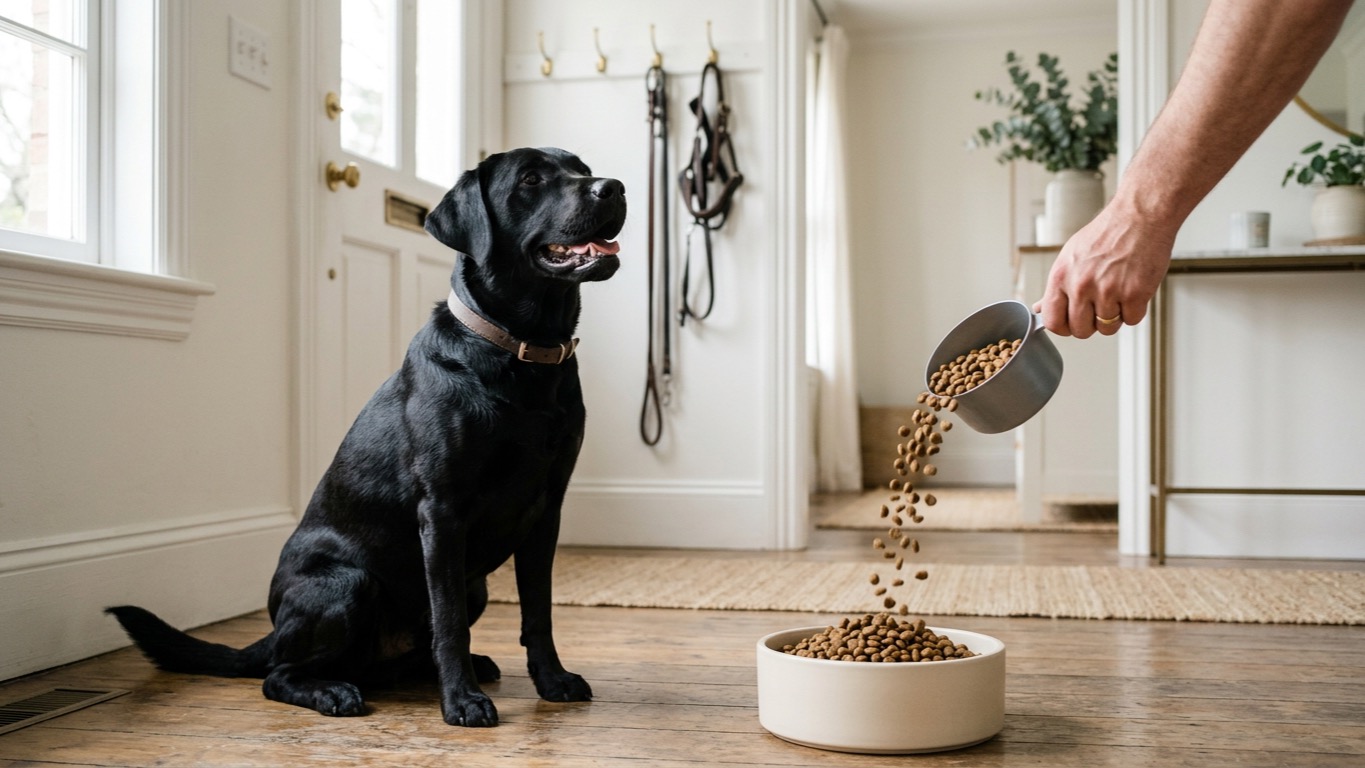
Quick answer: Use your food’s printed calories and the bag chart for your dog’s ideal weight. Split that daily amount into two meals for most adults, and three or four for puppies. Recheck the waist and rib feel every two weeks, then change the portion by about one-quarter cup.
A 50-pound inactive adult dog needs about 990 calories a day, not a fixed cup count.
This page is a feeding-desk explainer. It converts published calorie formulas and maker charts into portions by weight and age.
The Cup-to-Calorie Rule we used
A scenario enters this guide only if you can turn it into daily kilocalories from a labeled complete food. That is the Cup-to-Calorie Rule.
We cover healthy puppies, adults, and seniors on commercial dry or wet food. We use the bag’s calorie line, then a published energy formula as a check.
We leave out homemade recipes, raw diets, and disease-specific clinic plans. Those need a formula written for one dog.
We also skip breed-by-breed cup lists. Two 50-pound dogs can need different cups if calorie density differs.
Our research team analyzed published specs from maker pages and model-feed rules. We compared those numbers.
The working method has three numbers. Write down ideal body weight. Write down a daily calorie target.
Then write down the label’s kilocalories per cup or can. Divide target calories by calories per cup. Split that daily portion across meals.
Convert weight into a daily calorie target
Cups are a serving tool. Calories are the dose.
A 2025 Animals review from the University of São Paulo restates the National Research Council’s 2006 equations. Inactive adult dogs: 95 × kilograms^0.75. Active adult dogs: 130 × kilograms^0.75.
A 50-pound dog weighs about 22.7 kilograms. That metabolic weight is about 10.4. Times 95 equals about 990 calories a day.
Times 130 equals about 1,350 calories a day. The same review restates resting energy as 70 × kilograms^0.75. That rest figure is about 730 calories for the same dog.
Use ideal weight, not a high scale reading, if the waist is already gone. Extra fat is not extra muscle that needs more food.
The São Paulo series reviewed 438 adult records from 2013 to 2025. Neutered dogs had lower energy factors than intact dogs. Overweight dogs needed fewer calories per kilogram than dogs at an ideal score.
That matches a household pattern. Many family dogs are both neutered and fairly still. The 95-factor is the safer first guess for them.
AAFCO’s Dog Food Nutrient Profiles presume 4,000 kilocalories per kilogram of dry matter. Adult maintenance minimums are 18.0% crude protein and 5.5% crude fat.
Growth and reproduction minimums are 22.5% crude protein and 8.5% crude fat. Those percentages mark life stage. They do not set the cup count.
If you want more protein at the same calorie budget, read our note on high-protein dog food benefits. Protein density and portion size are different levers.
Age changes the multiplier
Puppies are not small adults. They need more calories per pound while they grow.
Match a puppy to AAFCO’s growth-and-reproduction profile. Adult-maintenance food can sit at the lower 18.0% protein floor. Read the adequacy line, not the front-panel cartoon.
Young puppies do better with three or four meals. VCA Animal Hospitals’ feeding explainer says a filled stomach empties within a few hours.
After 8 to 10 hours empty, hunger signals rise. That is why two meals fit most adults.
The same VCA explainer says puppies often need to eliminate within 10 to 15 minutes of a meal. Smaller, timed meals help house training.
Large-breed puppies should stay on a growth food labeled for large-size growth until a clinician says otherwise. Fast, heavy growth is the risk.
Most dogs reach adult portions between 9 and 18 months. Giant breeds run later. When you switch, keep calories steady for a week, then watch the waist.
Seniors often need fewer calories if walks shorten. Some seniors lose muscle and need the same calories in a more protein-dense food. Reweigh before you cut the scoop.
Pregnancy and nursing sit outside this guide. Purina’s Pro Plan Adult Complete Essentials page says intake may double or quadruple during lactation.
What manufacturer charts actually print
AAFCO’s consumer label guide says complete-and-balanced foods must include feeding directions. Those directions must state food weight per animal weight per unit of time.
The same AAFCO page requires a “Calorie Content” heading. It must show kilocalories per kilogram and per familiar unit, such as a cup.
Nestlé PetCare’s feeding-chart article says package charts assume an average adult with normal activity. Charts list a daily total. Split that total if you feed twice a day.
Purina’s sample adult dry chart lists 2 to 2⅔ cups a day for the 26-to-50-pound band. The 51-to-75-pound band lists 2⅔ to 3⅓ cups.
Purina’s Pro Plan Adult Complete Essentials page states 369 kilocalories per cup. It also states 3,790 kilocalories per kilogram.
For 36 to 50 pounds it prints 2½ to 3 cups a day, or 224 to 292 grams. The same page says an 8-ounce, 250-milliliter cup holds about 97 grams of that kibble.
The manufacturer’s page for Hill’s Science Diet Adult Light Chicken Meal & Barley Recipe states 243 kilocalories per cup. It also states 2,961 kilocalories per kilogram.
For a 50-pound dog it prints 3 cups a day for weight loss. It prints 4¼ cups for weight management.
AAFCO’s label rules cap a “lite” dry dog food at 3,100 kilocalories per kilogram. Hill’s printed 2,961 sits under that cap. Purina’s 3,790 does not use that claim.
Our research team compared those two published charts at 50 pounds. Three cups of the recipe supply about 1,110 calories. Four and one-quarter cups of the Hill’s light recipe supply about 1,030 calories.
The lighter kibble needs more cups to deliver a similar calorie load. Keep the old scoop after a switch, and the dose changes.
| Food, from the maker’s page | kcal per cup | Printed daily cups near 50 lb |
|---|---|---|
| Pro Plan Adult Complete Essentials Shredded Blend Chicken & Rice | 369 | 2½ to 3 |
| Hill’s Science Diet Adult Light Chicken Meal & Barley Recipe | 243 | 4¼ (weight management) |
That table is an attribute check, not a ranking. Use the food your dog already eats. Then do the division.
The FDA’s pet-food page says federal rules require ingredients listed from most to least by weight. The agency also states it does not recommend one product over another.
A first ingredient of fresh meat is not the same as a named meat meal later on the panel. We unpack that math in meat meal versus meat in dog food.
Purina’s product page lists a 7-to-10-day switch. Hill’s product page lists a 7-day mix-up. Recalculate cups on day one of the new bag.
Meal timing, treats, and the 10% cap
Purina’s feeding-chart article says two meals a day, morning and evening, fit most dogs. VCA’s explainer agrees that at least two meals are the usual plan.
One meal can work for some easy keepers. It is a poor default for puppies and dogs that gulp.
Free-choice bowls hide the daily total. If a dog grazes, still measure the day’s food in the morning. Lift what remains at night.
The World Small Animal Veterinary Association published 2011 nutrition-assessment guidelines. Those guidelines set a goal score of 4 to 5 on a 9-point scale.
The same guidelines flag treats and table food above 10% of calories as a risk.
WSAVA’s later dog-treats flyer repeats that cap. Treats stay under 10% of daily calories. The rest belong in the complete food.
On a 990-calorie plan, treats stop at about 99 calories. That is often one commercial chew, not a handful.
The Association for Pet Obesity Prevention’s 2025 opinion survey enrolled 265 screened respondents across 45 states. The owner group was 174 people. Only 16% of dog owners said they weigh food.
That gap is large. A packed cup can add 10% to 20% more kibble than a level 8-ounce cup. Weigh grams when you can.
APOP’s 2025 owners described 37% of dogs as above ideal weight, up from 35% in 2024. Among owners trying to reduce weight, 56% of dog owners said they were working on it. Only 28% of those dogs were reported to have reached a healthy target.
Imprecise scoops help explain the stall. So do uncounted treats.
How to tell the portion is working
WSAVA’s 9-point chart calls 4 and 5 ideal. At those scores you can feel ribs under a thin fat cover.
You can see a waist from above. You can see an abdominal tuck from the side.
A 6 shows extra fat over the ribs. A 7 hides the waist. Eights and nines are obese on that scale.
Reweigh every two weeks after a portion change. Move the daily total by about 10%, or about one-quarter cup on many dry foods. Then wait another two weeks.
If the waist fades while the cup stays fixed, the chart was high for that dog. Cut calories. Do not switch brands first unless the life stage is wrong.
If ribs feel sharp and energy drops, add food in the same small step. Growing puppies should gain. They should not lose the waist.
AAFCO’s label guide notes that feeding directions are guidelines. Activity, genetics, and housing differ. The chart is a start line.
The FDA’s pet-food page tells owners to take individual health questions to their own clinic. This desk is not a clinic.
Clinic-only foods sit outside the Cup-to-Calorie Rule. If a clinician already prescribed a renal diet, use that plan. Our locator for where to buy k/d dog food is for that case, not for a healthy housemate.
FAQ
How much food should I feed my dog each day?
Start with the bag’s daily amount for your dog’s ideal weight. Convert it using the label’s kilocalories per cup. For an inactive adult, check that total against about 95 × kilograms^0.75, then split it into two meals.
Do I use current weight or ideal weight?
Use ideal weight when the dog is already heavy. The National Research Council formulas, as cited in the 2025 Animals review, scale to body weight. Extra fat should not raise the target.
How many times a day should I feed a puppy?
Use three or four meals until the belly can hold two. VCA’s explainer warns against free-choice puppy feeding. It can drive juvenile obesity and binge eating.
Can I follow the bag chart without doing calorie math?
You can start there. Purina’s feeding-chart article says you still may need to change the amount. Our comparison at 50 pounds showed 3 cups versus 4¼ cups for a similar calorie load.
How many treats can my dog have?
Keep treats under 10% of daily calories. That is the cap in WSAVA’s assessment guidelines and treats flyer. On a 990-calorie day that is about 99 treat calories.
Why did my dog gain weight on the same cup amount?
The new bag may pack more calories per cup. The cup may be heaped. Treats may have crept up.
APOP’s 2025 survey found that only 16% of dog owners weigh food.
When is this guide the wrong tool?
Skip it for homemade diets, raw plans, and disease-specific clinic foods. Skip it for bitches in heavy lactation. Purina’s own page says intake can double or quadruple then.