
Quick answer: House a same-sex pair in a deep solid-floor tank with sand and a solid wheel. Feed a uniform pellet, not a seed-only mix. Scoop from below and never lift by the tail tip.
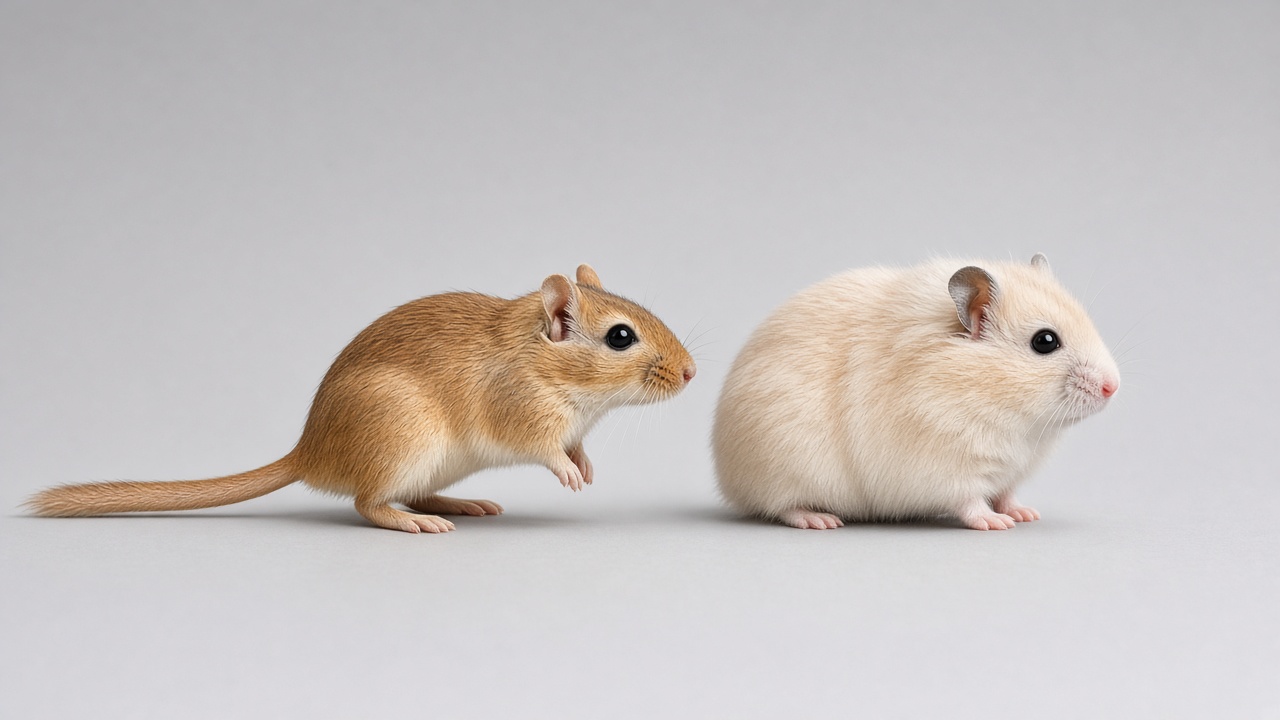
The Mongolian gerbil is Meriones unguiculatus, a 70–130 g jird Merck lists as living 2–3 years.
This page is a research-desk comparison of published husbandry figures and current maker specs. We did not house a colony, run feeding trials, or sit in on clinic exams.
The Four-Spec Screen we used
A product entered this guide only if it passed our Four-Spec Screen. The maker page had to be live. It had to name gerbils, or it had to be a solid-surface wheel with a printed diameter.
It also had to print at least one number we could quote. We dropped discontinued cages, mesh-only wheels, hamster-only treats, and any bag whose label we could not open.
That rule is why Kaytee Comfort Exercise Wheel is here. Kaytee’s page names hamsters and rats, not gerbils. It still lists a solid 8.5-inch running surface.
Our research team analyzed those maker pages against the Merck Veterinary Manual and the National Research Council gerbil chapter. We compared printed specs. We did not weigh animals or time a wheel.
What a Mongolian gerbil actually is
The pet gerbil is one species. Merck names it Meriones unguiculatus. The genus Meriones holds 14 species.
Merck’s adult weights split by sex. Females average 70–100 g. Males average 80–130 g.
The National Research Council’s 1995 gerbil chapter gives a combined adult range of 70 to 135 g. Newborn pups weigh about 2.5 g. Weanlings sit at 14 to 18 g.
Merck lists a captive lifespan of 2–3 years. Plan the pair for a few years, not a decade.
Males reach sexual maturity at 70–84 days, per Merck. Nonlactating gestation is 24–26 days. Litters run 3 to 7 pups.
Pups start solid food at about 16 days. Merck treats day 25 as a typical weaning point.
Merck notes that gerbils tend to pair-bond. An older female that loses a mate often will not accept another. Buy an already bonded same-sex pair when you can.
Wild Mongolian gerbils live in clay and sandy deserts and arid steppes. Merck says they build simple burrows 2–3 feet long. They spend most of their time inside those burrows.
They also stand erect on their hindlimbs. Merck says a cage needs a solid bottom. Floor-to-lid height must allow that stance.
The Association of American Feed Control Officials treats household rodents as specialty pets. In AAFCO’s model language, “pet” means dog or cat.
Housing that can hold a burrow
A starter wire cage can sell as a gerbil home and still miss the burrow. Compare two currently listed habitats.
Kaytee’s My First Home Hamster & Gerbil Starter Kit lists a 13.5 by 11 by 14.5 inch habitat. Bar spacing is 1/2 inch. The kit weighs 3.73 pounds.
Kaytee includes a deep plastic base, a wheel, a bottle, a dish, and bedding. From the listed floor, our research team calculated about 149 square inches. That is a beginner box, not a 2–3 foot burrow.
Prevue Pet Products Hamster Playhouse 2006 lists 18-3/8 by 11-3/4 by 27-1/2 inches. Wire spacing is 3/8 inch. With the exterior tunnels, length becomes 24-3/4 inches.
From Prevue’s footprint, our calculation is about 216 square inches. The extra height is climb space, not dig depth. Merck’s wild burrow is still longer than either floor.
Neither maker page lists a substrate depth. A glass tank with a tight mesh lid holds deep bedding better than a wire cube. Merck’s rule is a solid floor and standing room.
Keep humidity in mind when you pick a room. Merck links nasal dermatitis to relative humidity above 50 percent. The same manual says prevention means humidity below 40 percent.
Gerbils make little urine. Fecal pellets are hard and dry. Merck says their cages need less frequent cleaning than other pet rodents.
That is not a pass to skip a deep-bedding change. Avoid painted or alloy cages with lead. Merck warns that gnawing plus concentrated urine raises lead risk.
Prevue lists powder-coated steel mesh and a plastic tray on the Playhouse. Kaytee lists chew-proof latches on the starter kit. Those are label claims, not our lab results.
Diet labels versus published protein figures
Merck says gerbils thrive on pelleted rodent diets with 18–20 percent protein. The same chapter recommends 5–8 g of pelleted chow per day.
The National Research Council puts growing intake at about 5 to 6 g of dry diet per day. It also puts the growing protein need near 16 percent. That figure assumes dietary fat of 2 to 5 percent.
Here is the gap our spec comparison found. None of the three gerbil-named bags below print an 18 percent protein minimum.
Oxbow Essentials Hamster & Gerbil Food lists crude protein at 15.00 percent minimum. Crude fat is 4.50 percent minimum. Moisture is 10.00 percent maximum.
Oxbow’s fiber range is 10.00 to 15.00 percent. The adult gerbil serving is 1/3 cup. Animals under six months, or pregnant or nursing, are listed as unlimited.
Kaytee Forti-Diet Pro Health Nourish+Protect Hamster and Gerbil Food lists crude protein at 12.0 percent minimum. Crude fat is 6.0 percent minimum. Fiber and moisture both max at 12.0 percent.
Kaytee’s serving for that bag is 2 tablespoons, listed as about 20 g. That printed serving is more than twice Merck’s 5–8 g pellet figure.
Kaytee Fiesta Hamster & Gerbil Food lists crude protein at 13.5 percent minimum. Crude fat is 6.0 percent minimum. The serving is 2 tablespoons.
Fiesta fiber maxes at 10.0 percent. Moisture maxes at 12.0 percent. The bag is an open fruit, seed, and grain blend.
Merck flags diets above 4 percent fat for high blood cholesterol. The lipemia signal is stronger in males.
Oxbow sits at 4.50 percent fat. Both Kaytee bags sit at 6.0 percent.
Oxbow prints calcium at 0.60 to 1.00 percent. Phosphorus is 0.40 percent minimum. Vitamin A is 10,000 IU/kg minimum.
Kaytee Forti-Diet prints omega-3 fatty acids at 0.6 percent minimum. It also lists 80,000 CFU/g of Bacillus species. Fiesta prints 0.2 percent omega-3 and 50,000 CFU/g.
The National Research Council recommends 1.5 g of magnesium per kilogram of diet. The consumer bags we opened do not print a magnesium guarantee we could quote.
AAFCO’s specialty-pet path is not a dog or cat “complete and balanced” profile. AAFCO names the National Research Council as one recognized nutritional authority.
Merck says sunflower-seed-heavy or homemade diets can miss nutrients. Sunflower seeds are high in fat and low in calcium. Gerbils also hoard, so a seed mix invites sorting.
Oxbow states its food is 100 percent uniform to block selective eating. Forti-Diet says its pellets make bites nutritionally equal.
If you change bags, both Kaytee pages use a 7 to 10 day mix-in. Oxbow uses a four-week ramp from one-quarter new food to a full bowl.
Offer water even in a dry-adapted species. The National Research Council cites high mortality when dry diets ran without water or succulent feeds. Voluntary intake was 4 to 10 mL of water per 100 g of body weight per day.
| Product | Maker-listed use | Form | Protein min. | Fat min. | Maker-listed amount or size |
|---|---|---|---|---|---|
| Oxbow Essentials Hamster & Gerbil Food | Gerbils and hamsters | Uniform pellet | 15.00% | 4.50% | Adult gerbil: 1/3 cup |
| Kaytee Forti-Diet Pro Health Nourish+Protect Hamster and Gerbil Food | Hamster or gerbil | Fortified blend with pellets | 12.0% | 6.0% | 2 Tbsp (about 20 g) |
| Kaytee Fiesta Hamster & Gerbil Food | Hamster or gerbil | Fruit, seed, and grain blend | 13.5% | 6.0% | 2 Tbsp |
| Kaytee Comfort Exercise Wheel | Hamsters and rats on the maker page | Solid running surface | — | — | 8.5 in diameter; 8.5 × 5 × 9.5 in |
| Kaytee My First Home Hamster & Gerbil Starter Kit | Hamster or gerbil | Wire top, plastic base | — | — | 13.5 × 11 × 14.5 in; 1/2 in bars |
| Prevue Pet Products Hamster Playhouse 2006 | Hamsters or gerbils | Four-level wire habitat | — | — | 18-3/8 × 11-3/4 × 27-1/2 in; 3/8 in wire |
Handling without a tail injury
Gerbil tails are fragile. Merck is blunt: grasp only the base of the tail. A tip grab can deglove skin.
Work over a lap or a low sofa. Let the animal step onto both palms. Cup the hindquarters.
Keep one hand as a roof, not a clamp. Do not chase a gerbil around a wire cube. That spikes stress.
Merck ties extra Harderian secretion to stress. Humidity above 50 percent is the other trigger. A new pair needs a quiet first week.
Merck says gerbils often isolate when sick. Watch for hunched posture, rough fur, and a drop in exploration.
Normal body temperature in Merck is 37–39°C, or 98–102°F. We did not take temperatures. Use that range only as a published reference for a clinic visit.
Children can enjoy gerbils. They still need a two-hand lift and a no-tail-tip rule.
Sand, humidity, and a solid wheel
Merck says gerbils need sand bathing to keep the coat from going oily. Lipids come from Harderian nasal excretions and from skin. A sand roll strips those lipids and leaves scent on the substrate.
A typical sand bath finishes within 5 minutes, per Merck. Block the bath and the fur mats. Animals then increase “sand rolls” and mark more, especially males.
Use a heavy dish of plain sand. Do not pile dusty powder on bedding. Pull the dish after the bout if the tank is small.
Damp sand defeats the point. Humidity stays the other lever. Merck’s dermatitis risk starts above 50 percent relative humidity.
The prevention line is below 40 percent. A steamy bathroom is a poor room. Use a cheap hygrometer.
Kaytee Comfort Exercise Wheel lists a solid running surface and a “tail-safe” design. The 8.5-inch listing measures 8.5 by 5 by 9.5 inches. It weighs 0.7 pounds.
It can stand free or clip to wire. That solid deck is why the wheel cleared our screen. A mesh wheel can still catch a tufted tail.
Give chew blocks and cardboard. Incisors grow continuously. Merck’s exam list includes a check for overgrown teeth.
That check is a clinic task, not a home diagnosis. Place the tank out of drafts and hard sun. Humidity and lead paint are the sharper housing faults.
FAQ
How long does a Mongolian gerbil live?
Merck lists a normal lifespan of 2–3 years. That is the figure we use on this desk. Plan the pair’s housing around that window.
Can one Mongolian gerbil live alone?
Merck describes a pair-bond. An older widow often rejects a new mate. A lone adult can survive.
It is a poorer match for a social jird. Start with a same-sex pair or an already bonded pair.
How much should a Mongolian gerbil eat each day?
Merck recommends 5–8 g of pelleted chow per day. The National Research Council puts growing dry-diet intake at 5 to 6 g per day.
Kaytee Forti-Diet prints 2 tablespoons, about 20 g. Oxbow prints 1/3 cup for an adult gerbil. Those label scoops sit above the published gram figures.
Why does a gerbil need a sand bath?
Merck says sand bathing removes coat lipids and deposits scent. A bout usually ends within 5 minutes.
Skip the bath and the fur mats. Behavior shifts toward extra rolling and extra marking.
How should I pick up a Mongolian gerbil?
Use two hands from below. Merck says to grasp only the base of the tail if a tail hold is needed at all.
Never pinch the tail tip. Work over a soft surface. Stop if the animal struggles hard.
Do Mongolian gerbils need a water bottle?
Yes. They are arid-adapted. The National Research Council still reported high mortality on dry diets without water or succulent feeds.
Voluntary drinking was 4 to 10 mL per 100 g of body weight per day in that chapter. Keep a bottle filled.
What humidity keeps a gerbil’s nose clear?
Merck links nasal dermatitis to relative humidity above 50 percent. Prevention in that chapter means humidity below 40 percent.
Use a room hygrometer. Move the tank if the reading sits high.