Quick answer: Take a house-trained dog that starts peeing on the bed to a clinic before you change training. Do not punish. Keep the dog off the mattress and clean the wet spot with an enzymatic cleaner.
A wet sheet is a sorting problem, not proof that your dog is angry.
A dog pees on a bed for one of four reasons: illness, sleep leakage, marking, or unfinished house-training.
This page is a research brief, and
How we chose what this page covers
We kept a cause only if a named clinic paper or a drug label describes it.
Selection rule: A cause made this article only if a named clinic paper or an FDA-posted label describes it. It also had to be able to wet a bed a dog shares or can climb. We left out outdoor-only marking, cat boxes, and any ranked product list.
Our research team compared three published texts side by side. Those texts are the 2024 ACVIM consensus, a 2017 Journal of Veterinary Internal Medicine series of 163 dogs, and the DailyMed PROIN label. We used that pairing to build the Four-Cause Bed Rule below.
The Four-Cause Bed Rule
Sort the wet spot by when it happened, how much urine is there, and whether the dog was awake.
- Illness: The dog strains, pees often, drinks more, or a house-trained adult starts overnight.
- Sleep leakage: A wet patch sits under where the dog slept, and the dog did not squat.
- Marking: Small wet dots land on the duvet or pillows, and the act lasts a few seconds.
- Unfinished house-training: A puppy or new rescue empties a full bladder on a soft, scented surface.
The 2024 ACVIM consensus states that acquired urinary incontinence shows up in 3% to 20% of spayed female dogs.
Illness that can send a dog to the mattress
A sudden change in a house-trained dog is a medical problem until a clinic says it is not.
Urine on a bed can be the first thing you notice, so write these signs down before the visit:
- Peeing more often, or passing only a few drops
- Straining, crying, or licking the genital area
- Blood in the urine, or a new strong smell
- Extra thirst, extra hunger, or weight change
The 2024 ACVIM consensus says every dog presented for urinary incontinence should get a urinalysis and an aerobic bacterial urine culture. The 2017 Journal of Veterinary Internal Medicine series on 163 neutered female dogs found a urinalysis in 97% of the dogs with records. A urine culture was done in only 10.9%.
That gap matters, because a missed infection can look like bad manners on a mattress.
The same ACVIM paper gives a volume rule clinics use after a dog pees. A leftover bladder volume of 0.2 to 1.0 mL per kg can be normal.
A leftover volume over 3 mL per kg is abnormal and points to urine left behind. You cannot measure that at home, but you can tell the clinic whether the dog finished outside or only dribbled.
Do not start leftover chews from another dog. The DailyMed label for PROIN states that use in a dog with a urinary tract infection will mask symptoms. The same label says PROIN is not effective for neurologic leaks.
If the dog cannot stand, cannot pass urine, or seems collapsed, that is an emergency clinic trip, not a morning-slot problem.
Sleep leakage in spayed and older dogs
A wet ring under a sleeping dog is leakage, not a protest.
Clinics call the common form urethral sphincter mechanism incompetence, or USMI. The bladder still empties on purpose later, but the urethral seal is too weak when the dog lies down.
The 2024 ACVIM consensus says female dogs with USMI most often leak while lying down or at rest. The 2017 Journal of Veterinary Internal Medicine paper reviewed 163 neutered female dogs with this diagnosis.
USMI was most common in dogs weighing more than 20 kg, and the median weight at diagnosis was 25.3 kg. The median time from spay surgery to the first leak was 3.73 years. That lag is why a well-trained adult can start wetting the bed years after surgery.
In that series, phenylpropanolamine was prescribed as the only first drug in 75.5% of dogs.
The DailyMed label for PROIN chewable tablets lists a labeled oral dose of 2 mg per kg of body weight. That equals 0.91 mg per lb, given twice daily.
A 28-day placebo-controlled study enrolled 184 dogs, and a later 180-day stretch reported 98.1% owner satisfaction. Ask the clinic whether any labeled drug is even on the table, and do not dose from this page.
Stiff joints slow the jump off a high mattress, so a dog that cannot get down in time may void on the comforter.
If the bed is high, a set of dog steps for a high bed or a dog ramp for the bed can cut that delay. Steps and ramps do not treat infection or a weak sphincter; they only restore a path to the floor.
Wash bedding often, and keep a washable cover on the mattress until the clinic plan is in place.
Marking versus a full bladder
Marking is a short scent post, and a full pee is a longer empty.
The American Kennel Club’s marking page states that marking usually starts in adolescence, around 6 to 9 months of age. Intact males mark most often, but neutered males can still mark, and so can females. The same page states that marking uses small amounts in several spots, while a full bladder leaves more urine in one place.
A bed is a high-value target because it holds your scent. A new roommate, a new dog, a move, or a guest bag on the duvet can start the dots.
Compare the wet spots this way:
- Volume: Dots or streaks versus a soaked crater
- Time: A few seconds versus about 20 seconds
- Places: Several spots in one night versus one puddle
Guilt is a human read, and a dog that “looks sorry” after a full pee is often reacting to your face. Do not rub the dog’s nose in the sheet.
A 2007 journal study from the American Veterinary Medical Association found that a 5-minute talk cut verbal punishment. Punishment does not teach a toilet rule, and it can raise marking.
If marking is the pattern, add more outdoor posts. A calm walk with time to sniff is more useful than a yanked circuit. If the dog tows you past every pole, start with how to stop a dog from pulling on leash so toilet time can actually happen.
Unfinished house-training, anxiety, and access
A soft bed can become a toilet when the outdoor rule is weak or the dog cannot reach the door.
Puppies have small bladders, and newly adopted dogs may never have had an indoor rule. The American Kennel Club lists accidents, too much indoor freedom, illness, submissive peeing, excitement, and separation stress as other indoor causes besides marking.
A 2007 Journal of the American Veterinary Medical Association study followed 113 shelter dogs one month after adoption. Owners who got a 5-minute house-training talk called their dogs house-trained in 98.1% of cases. Owners with no talk did so in 86.4% of cases.
The talk group had 54 owners, and the no-talk group had 59. That gap is about owner method and expectation. It is not proof that a 5-minute chat fixes a sick bladder.
The same paper reported that 59.3% of counseled owners used enzymatic cleaners on soiled indoor areas, versus 13.6% of uncounseled owners. A bed that still smells like urine is a cue to repeat.
If the dog pees during greetings, keep hellos quiet and let the dog settle before you bend down. Excitement peeing is a leak under arousal, not spite.
If the dog pees only when left alone, look for pacing, drooling, or destroyed doors. A wet bed after a long workday can also be a full bladder and a closed door, so log the clock times for the clinic.
Rebuild the outdoor rule with short, boring steps:
- Take the dog out after sleep, after meals, and after play.
- Stand in one potty spot and wait.
- Reward the outdoor pee the moment it ends.
- Limit free run of the bedroom, or gate the door, until the rule holds.
Do not paper-train on the bed, because a washable pad belongs on the floor and a mattress should stay a sleep spot.
What to do tonight
Tonight you protect the mattress, save a sample if you can, and stop adding odor.
Work in this order:
- Get the dog off the bed and onto a washable surface.
- Blot the wet spot. Do not rub it in.
- If the urine is still wet, catch a mid-stream sample in a clean cup for the clinic.
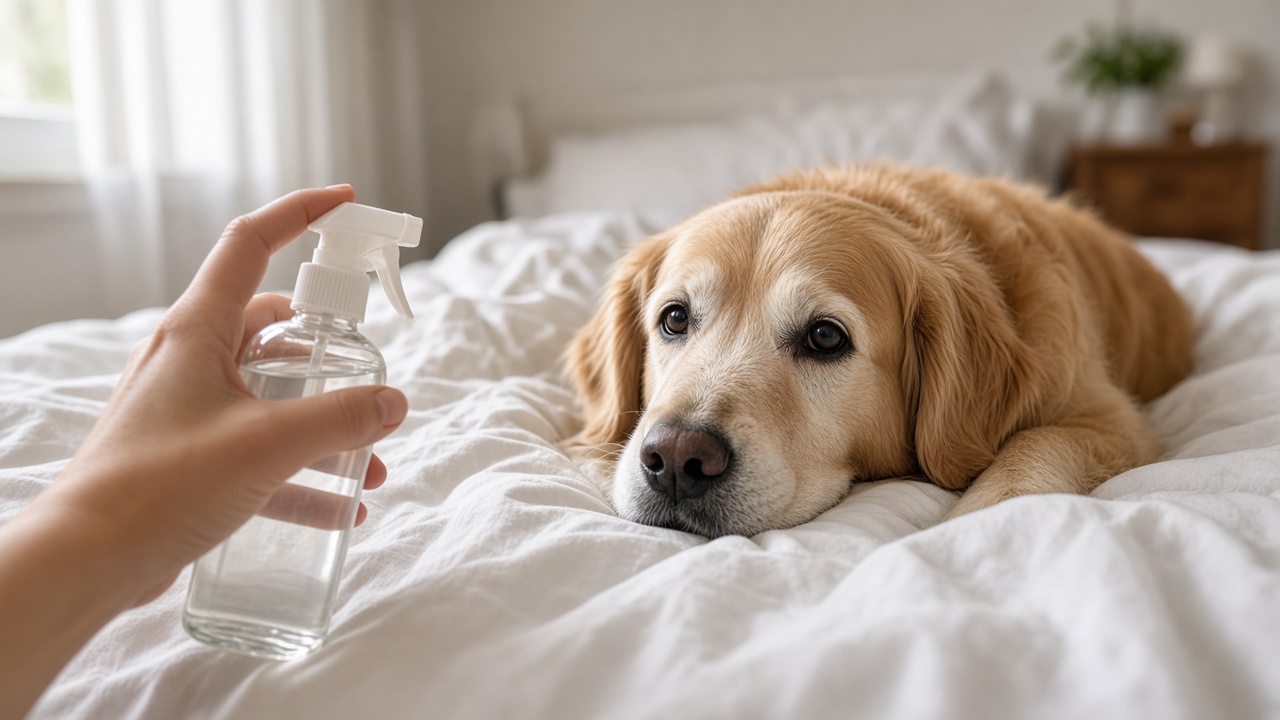
- Spray an enzymatic cleaner at full strength. The Nature’s Miracle page for Urine Destroyer for Dogs says to spray, wait 10 minutes, then blot with a white cloth.
- Strip the sheets and wash them hot if the fabric allows.
- Put a waterproof cover on the mattress.
- Write down the time, the urine amount, and whether the dog was asleep.
Do not use that Nature’s Miracle product on untreated hardwood, leather, suede, silk, or wool. Skip ammonia cleaners, because they can leave a urine-like smell. The Nature’s Miracle page says other detergents may chemically set stains that then will not lift.
Do not crate a leaking incontinent dog on a soaked pad all night, because that is a skin problem rather than a training plan.
Bring this list to the visit:
- When the bed-peeing started, and whether it happens in sleep, after greetings, or when you leave
- Water intake changes and the spay or neuter date, if you have it
- Any leftover drugs in the house, plus a urine sample if you caught one
FAQ
Is my dog peeing on the bed to punish me?
No. Spite is not one of the four causes on this page. Dogs pee on beds because of illness, sleep leakage, marking, or a weak house-training rule.
Why does my dog only pee on the bed at night?
Night wetting often fits sleep leakage or a medical urge that builds during long hours away from a door. The 2024 ACVIM consensus ties USMI leaks to rest and lying down. A clinic can sort leakage from a full-bladder accident.
How can I tell marking from a full pee on the duvet?
Marking is small and quick, and a full pee is larger and longer. The American Kennel Club states that marking usually takes a few seconds, while a healthy empty takes around 20 seconds. Several dots on pillows point to marking, and one soaked crater under a sleeping dog points to leakage or illness.
Can I give leftover incontinence chews from another dog?
No. Dose and diagnosis are clinic work. The DailyMed label for PROIN lists 2 mg per kg twice daily and warns that the drug can hide a urinary tract infection.
What cleaner should I use on the mattress?
Use an enzymatic pet cleaner at full strength, then blot. The Nature’s Miracle page for Urine Destroyer for Dogs says to wait 10 minutes after spraying before you blot with a white cloth. A 2007 Journal of the American Veterinary Medical Association study found counseled owners used enzymatic cleaners far more often than owners who got no talk.
When is bed-peeing an emergency?
Go now if the dog cannot pass urine, strains without a stream, collapses, or has a swollen belly. Blood in the urine plus pain also belongs in an urgent visit. Recurring small leaks in a bright, eating dog still need a same-week clinic slot.