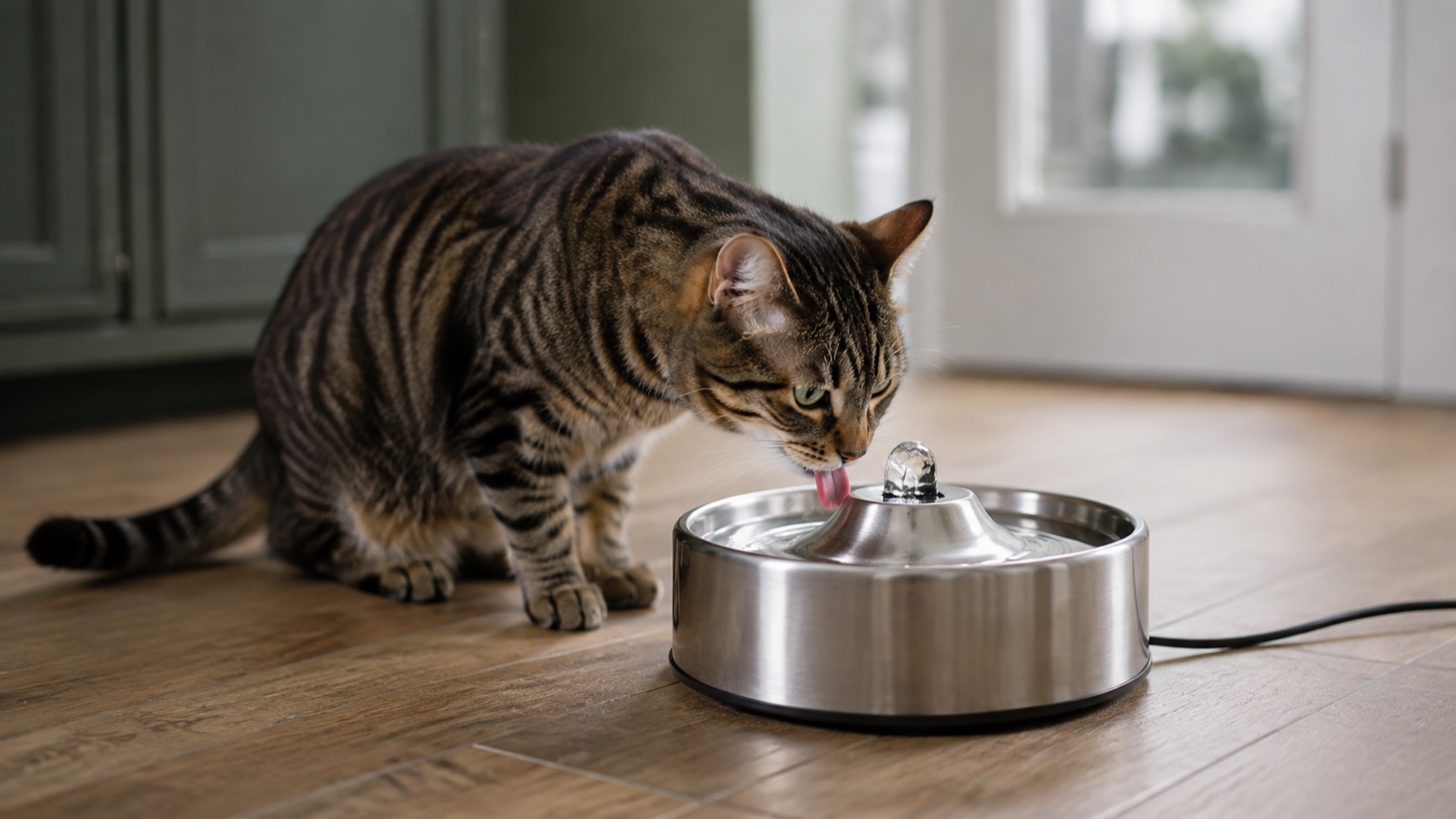
Quick answer: Film one coughing bout, then book a clinic visit if it repeats or no hairball appears. Open-mouth breathing or blue-gray gums is an emergency now. Do not treat a dry cough as a grooming habit at home.
Cats cough when hair, allergens, heartworm, or infection inflame the lower airway, not from a human cold. This page is a research brief that compares published clinic guidance and current maker spec sheets. We did not examine a cat, shoot chest films, culture an airway, or time any cough on video.
A named organization had to publish a checkable number for a cause or product to appear here. That is our Checkable-Number Rule. We skip prescription drugs, human cough syrup, and any SKU without a maker spec sheet.
How we chose what this page covers
Our research team analyzed published papers and five currently sold product pages. We did not run a lab, score brands, or rank a top list.
A home product enters the table only if its maker lists a non-price spec for one cough scenario. Those scenarios are inhaler delivery, particle filtration, swallowed-hair lubrication, litter dust, and household stress.
A product that only markets soothing respiratory support, with no listed number, stays out. The same rule cuts medical claims. We do not invent a figure Cornell, the American Heartworm Society, or a journal paper did not publish.
We cover hairballs, asthma, bronchitis, infection, and heartworm for one reason. Those groups are the ones those organizations actually quantified.
Hairball or cough: what you can actually see
Cats crouch and stretch the neck for both a hairball and a true cough. The useful split is output, not posture.
A hairball event ends with a wet retch and a tubular wad of fur. A respiratory cough is often dry. It may finish with a retch that produces nothing.
The Journal of Feline Medicine and Surgery reported cough in 95% of 73 cats with feline asthma. That series is not a house-cat census. It still shows how often clinics hear hairball and find airway disease.
Film 10 to 20 seconds of the spell on your phone. Note whether fur hits the floor. Note whether the mouth stays open after the spell.
Bring that clip to the clinic. We did not review any owner videos for this page.
Asthma, bronchitis, and infection
Cornell Feline Health Center states that asthma affects 1% to 5% of cats. A second Cornell briefing estimates more than 80 million cats in American homes. It also estimates 800,000 or more of those cats live with asthma.
Cornell puts the average age at diagnosis between 4 and 5 years. Sex does not clearly change risk on those pages. Large studies have not proven a Siamese bias.
Asthma is an allergic narrowing of the lower airways. Dust, smoke, pollen, mold, spray cleaners, and dusty litter are the usual listed triggers. The cat may wheeze, breathe faster at rest, or hunch with the neck out.
The Journal of Feline Medicine and Surgery found abnormal lung radiographs in 94% of those asthma cats. Blood eosinophilia appeared in 40% of the asthma group. The chronic bronchitis group sat at 27%.
The same paper said one sign cannot separate the two diseases. Infection can look the same at home. Cornell lists infectious pneumonia and lungworms among the look-alikes.
Lungworms and inhaled grass also trigger coughing. Those causes need clinic tests, not a gel from a cupboard.
Cornell describes inhalant drugs given through a spacer mask for about 10 seconds. That figure is clinic technique, not a home experiment. Do not start a human inhaler without a prescribed plan.
Heartworm-associated coughing
Indoor housing does not close this file. The American Heartworm Society says infected mosquitoes come indoors. Indoor and outdoor cats both carry risk.
The Society describes heartworms as foot-long parasites. In cats, most larvae never become adults. Cats with adult worms typically have just one to three worms.
Many affected cats have no adult worms at all. Immature worms still injure the lungs. That injury is called heartworm-associated respiratory disease, or HARD.
On the same pages, infected dogs may carry 30 or more worms. Cats usually have six or fewer. One or two worms can still make a cat very ill.
Adult worms live up to 2 or 3 years in cats. They live 5 to 7 years in dogs. Larvae need about 6 months to mature after a bite.
Inside the mosquito, the larval stage takes 10 to 14 days. The American Heartworm Society reports diagnosis in all 50 states. After Hurricane Katrina, the Society cites 250,000 relocated pets, many already infected.
The Society’s think 12 rule is a yearly test and a preventive every 12 months. There is no approved drug that kills adult heartworms in cats. The canine adulticide is not safe in cats.
Prevention is the tool the Society names. Cough, asthma-like attacks, and periodic vomiting are the signs it lists first.
When a cough cannot wait
Same-day emergency signs are simple. Open-mouth breathing at rest is one. Gums or tongue that turn blue or gray is another.
Collapse, fainting, or a sudden refusal to walk is a third. Cornell grades asthma from intermittent mild spells to life-threatening oxygen loss. Pink tissues turning blue is that last grade.
Waiting for a weekday slot is not a plan in that state. A repeating dry cough for more than two days still belongs on a clinic calendar. So does a cough after a new aerosol, a new litter, or a house guest who smokes.
So does a cough in a cat that goes outdoors in mosquito season. Do not give a human cough suppressant. Do not wait for a second hairball that never arrives.
Home products with published specs
These five products are currently sold. Our research team compared their maker pages only.
Across those five spec sheets, only one product lists a pair of inhaler masks. Only one lists a three-number CADR. Only one lists milligrams of petrolatum per teaspoon.
Only one lists a dust-free percent. Only one lists pheromone coverage in square feet. None of these products diagnoses a cough.
None replaces a clinic exam.
| Product | Maker | Cough scenario it maps to | Listed attribute | Maker upkeep note |
|---|---|---|---|---|
| AeroKat Chamber | Trudell Animal Health | Prescribed inhaler delivery | Ships 1 small mask and 1 medium mask; Flow-Vu inhalation indicator | Fits a metered-dose inhaler; medication sold separately |
| Airmega 100 | Coway | Bedroom particle load | CADR 108 smoke, 124 dust, 112 pollen; 405 ft² at 2 air changes/hr | 3-stage filter; listed filter life 1 year |
| Laxatone, tuna flavor | Vetoquinol | Confirmed hair passage | 1,285 mg white petrolatum per 6 g teaspoon | ½–1 tsp daily for 2–3 days, then ¼–½ tsp 2–3 times a week |
| Ultra Litter | Dr. Elsey’s | Litter-box dust | 99% dust-free unscented clay; fill 3–4 inches | Scoop twice daily; do not flush |
| FELIWAY Classic Refill | Ceva | Household stress after change | Up to 30 days of F3 pheromone in 700 sq ft | Replace refill every 30 days; replace diffuser head every 6 months |
Trudell Animal Health states that more than 80% of pet parents found the AeroKat Chamber easier than pilling. Those owners had used both pills and the chamber. That is Trudell’s own owner survey, not a drug trial.
The chamber only matters after a clinician prescribes an inhaler. Coway lists the Airmega 100 at 8.7 by 15.6 by 8.7 inches. The unit weighs 6.6 pounds.
Power draw is 25 W. Noise is listed at 20 to 48 dB(A). The maker claims capture of particles down to 0.01 microns.
Place the unit in the room where the cat actually sleeps. An open plan larger than 405 square feet will not get two air changes an hour from this model.
Vetoquinol’s Laxatone page is a hair lubricant, not an asthma drug. Use it only when a clinician has already tied the retch to fur. A dry cough with no wad of hair is the wrong job for petrolatum gel.
Dr. Elsey’s Ultra is unscented natural clay. The 99% dust-free claim is the maker’s. Perfume-heavy litter is a listed Cornell trigger.
Deepen the box to the stated 3 to 4 inches. That depth cuts the dust cloud a cat kicks up.
Ceva’s FELIWAY Classic refill is an F3 facial pheromone, not a bronchodilator. The US product page asks for 4 feet of clear space above the outlet. Stress can follow a move, a remodel, or a new animal.
It does not explain a wet lung on an X-ray.
Lowering irritants without guessing a diagnosis
Change one variable at a time after the clinic visit, not before.
Stop aerosol sprays and scented candles in the cat’s rooms. Keep tobacco smoke out. Switch to an unscented, low-dust litter if the current box throws a cloud.
Give the cat a high rest away from the box. A stable modern cat tree keeps sleep air farther from stirred clay. That is habitat design, not treatment.
Outdoor time raises pollen, dust, and mosquito contact. If you still walk a cat, a tight chest strap can add effort to every breath. Fit matters more than color.
Our safest cat harness guide is the place to compare strap layout. Cancel walks during an active cough.
A new dog can spike hiding, overgrooming, and stress panting. Those signs are not proof of asthma. Slow the introduction.
Use the steps in how to introduce a rescue dog to a cat. Plug a FELIWAY Classic diffuser in the cat’s main room if the maker’s 700-square-foot coverage fits that space.
Watch resting breaths when the cat is asleep. Count the chest rises for 15 seconds and multiply by four. Bring that number to the clinic with your video.
We did not set a cutoff from our own timing.
FAQ
Why is my cat coughing like a hairball but nothing comes up?
That pattern is a common owner report in feline asthma papers. The Journal of Feline Medicine and Surgery saw cough in 95% of its asthma cases. A dry, repeating hack with no fur wad is an airway problem until a clinic says otherwise.
Can a cat catch my cold and start coughing?
Human cold viruses are not the cause this page can document. Cats do get their own viral airway infections. Those infections still need a clinic exam.
The published cough lists run through hair, allergens, heartworm, and infection. They do not run through a shared human cold.
How common is asthma as a reason for coughing?
Cornell Feline Health Center puts asthma at 1% to 5% of cats. That is hundreds of thousands of animals if the 80-million-cat household figure holds. Most coughing cats are not in that slice, so the clinic still has to rule it in or out.
Does an indoor cat still need heartworm prevention?
The American Heartworm Society says yes, because mosquitoes enter houses. The Society wants a yearly test and a 12-month preventive. Adult worms are uncommon in cats, yet one to three worms, or even larvae alone, can injure lungs.
There is no approved adulticide for cats.
When is coughing an emergency?
Open-mouth breathing, blue or gray gums, collapse, or extreme effort at rest cannot wait. Cornell calls tissue blueness a life-threatening asthma grade. A two-day dry cough without those signs still needs a booked exam.
It is not an excuse to try a human inhaler overnight.
Can an air purifier or new litter stop the cough?
Coway’s Airmega 100 lists CADR numbers and a 405-square-foot room at two air changes an hour. Dr. Elsey’s Ultra lists 99% dust-free clay. Those specs describe air and dust, not a diagnosis.
Cornell notes that cleaner indoor air has not been rigorously proven as feline asthma therapy. Use them as irritant control after the clinic workup.
Should I give Laxatone the first time I hear a cough?
Vetoquinol lists 1,285 mg of white petrolatum in each 6-gram teaspoon. That gel is for swallowed hair. It does not open inflamed bronchi.
If nothing hairy lands on the floor, skip the gel and get imaging on the calendar.