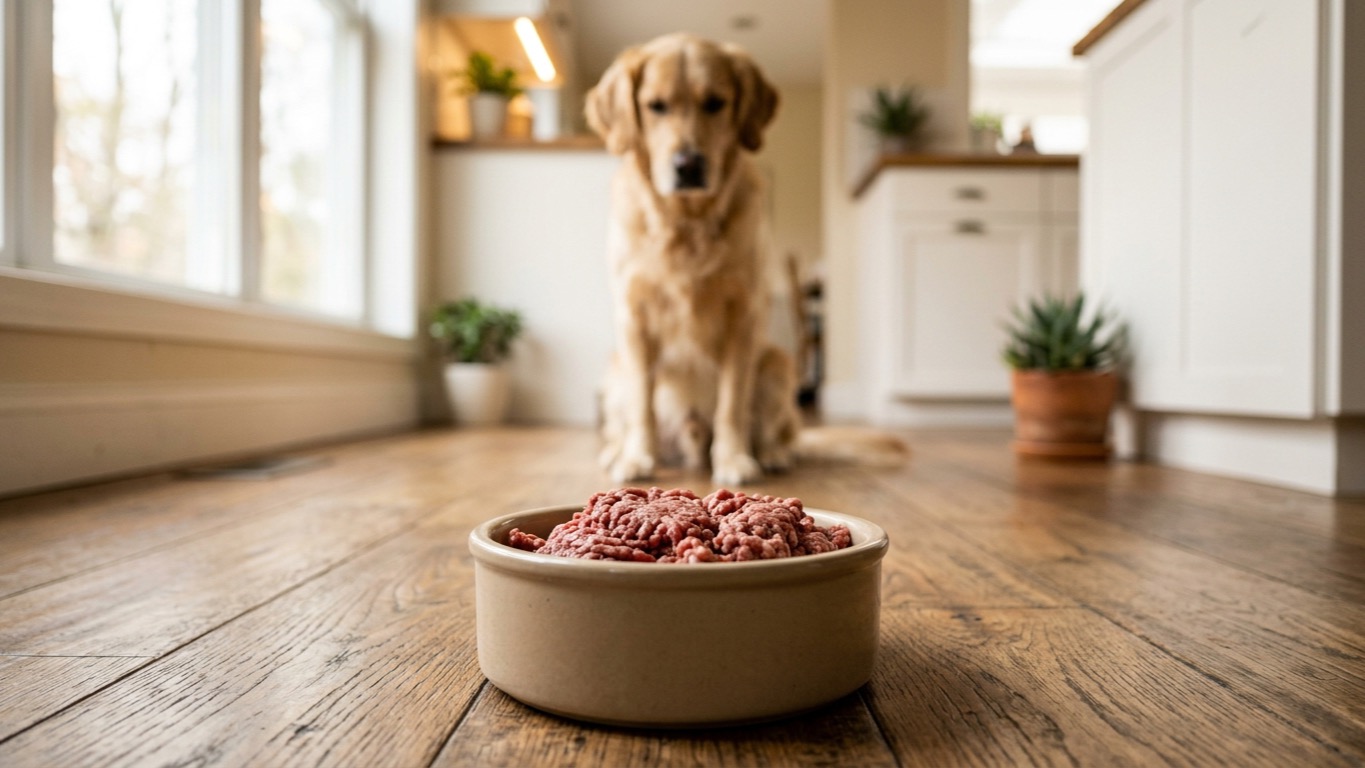
Quick answer: A healthy dog can swallow one typical cat treat without being poisoned. Do not use cat treats as a daily snack or training stash. Keep every extra under the AVMA’s less-than-10% calorie practice, then switch back to a canine-labeled treat.
One typical cat treat will not poison a healthy dog, but a daily handful can blow a 10% calorie cap. This page is a label-and-spec briefing from The Pet Bench research desk. We did not run feeding trials, pantry taste tests, or clinic chart reviews.
Our research team compared published guaranteed analyses and calorie lines on maker pages. We then lined those figures against AAFCO nutrient floors and FDA labeling rules. The goal is a usable amount, not a permission slip to raid the cat’s pouch.
How we chose which treats appear here
We used one rule: the Label-Species Rule. A treat entered this page only if its maker’s U.S. product page names cats as the intended species. It also had to list a calorie figure in text and be currently sold.
We left out dual-species bags, homemade recipes, and dental toys with no food label. We also left out products whose maker page hid protein and fat behind images we could not read as text.
That cut is why this page names four lickable or freeze-dried treats with full numbers. It is not a catalog of every grocery crunchy.
What AAFCO and FDA actually require on a treat bag
The Association of American Feed Control Officials says treat products are not usually meant to be complete and balanced food. The AAFCO Model Pet Food Regulations do not require treats to meet those nutrient profiles.
AAFCO still wants the words “snack” or “treat” on the front panel. If those words appear, AAFCO says the product should be given sparingly as an occasional reward.
On its labeling page, AAFCO lists eight required label items for pet food, including treats. Three of those items must sit on the front: brand and product name, intended species, and the quantity statement.
The guaranteed analysis must show minimum crude protein, minimum crude fat, maximum crude fiber, and maximum moisture. AAFCO notes that “crude” names the lab method, not the quality of the nutrient.
Products marked as a snack, treat, or supplement on the front panel are exempt from a nutritional adequacy statement. Feeding directions are optional for those treats unless the bag also claims complete and balanced nutrition.
The Food and Drug Administration regulates pet food under the Federal Food, Drug, and Cosmetic Act. FDA says animal food must be safe, made under sanitary conditions, free of harmful substances, and truthfully labeled.
FDA’s own labeling rules require product identity, a net quantity statement, and the maker’s name and place. Ingredients must be listed from most to least by weight. Many states then add AAFCO model language on top of that federal floor.
Canned pet foods must also meet low-acid canned food rules in 21 CFR 113. That rule is about killing viable microorganisms in sealed cans. It does not turn a treat into a meal.
AAFCO is blunt about species. Cats require nutrients such as taurine and pre-formed vitamin A that dogs do not.
A cat treat can be legal and truthful. It can still be the wrong daily extra for a dog.
Why cat formulas sit higher than dog floors
AAFCO’s Dog and Cat Food Nutrient Profiles set adult-maintenance protein at 18.0% dry matter for dogs. The same adult-maintenance floor for cats is 26.0% dry matter.
Adult-maintenance fat floors split the same way. AAFCO sets 5.5% dry-matter fat for dogs and 9.0% dry-matter fat for cats.
Growth and reproduction raise the dog protein floor to 22.5% dry matter. The cat growth-and-reproduction protein floor is 30.0% dry matter.
AAFCO also sets a taurine minimum for cat food. Extruded cat diets must provide at least 0.10% taurine on a dry-matter basis. Canned cat diets must provide at least 0.20%.
The dog profiles we read do not set a taurine minimum for adult maintenance. Dogs can make taurine from other sulfur amino acids when the diet supplies those building blocks.
None of those floors make a stolen cat treat a poison. They explain the density gap. A cat snack can pack more protein and fat than a same-size dog snack.
Treats are also allowed to skip the complete-and-balanced claim. AAFCO says a heavy treat habit can upset an otherwise complete diet and add unneeded calories. That kitchen risk is the usual problem, not a hidden toxin in every tube.
How many cat treats fit a dog’s daily extra budget
The American Veterinary Medical Association published 2023 healthy-weight client material. It tells owners to limit treats to less than 10% of daily calorie needs. The same brochure uses about 514 calories as the daily example for a 20-pound neutered dog.
Ten percent of 514 calories is 51 calories. That 51-calorie slice is the whole treat budget for that example dog, including training bits and table scraps.
Our research team applied that 51-calorie slice to maker-listed calories. INABA Churu Chicken Recipe lists 6.0 kcal per tube, so eight tubes reach 48 kcal.
Catit Creamy Chicken & Turkey Recipe lists 10.6 kcal per 15-gram tube. Five tubes reach 53 kcal, which already overshoots the example cap.
PureBites Chicken Freeze Dried Cat Treats list about 2 kcal per piece. Twenty-five pieces reach 50 kcal.
Stella & Chewy’s Meowfulls Chicken & Chicken Liver Cat Treats list 1 kcal per piece. Fifty-one pieces fill the same 51-calorie slice.
Those counts are arithmetic on published labels. They are not a feeding trial. A smaller dog, a puppy, or a dog on a weight-loss plan has a thinner slice than 51 calories.
Stella & Chewy’s Meowfulls page sets the same 10% ceiling for cats. Use that ceiling when a dog steals the bag.
If you already share human snacks, the same slice has to cover those too. A fatty cube of cheese can spend the budget before any cat tube is opened.
Four currently sold cat treats, compared by listed attributes
The table below uses only numbers printed as text on each maker’s product page. As-fed protein and fat are not comparable across wet tubes and dry bites without a dry-matter conversion.
We did that conversion in the notes under the table. We did not invent missing values.
| Product | Form | Crude protein (min) | Crude fat (min) | Moisture (max) | Listed calories |
|---|---|---|---|---|---|
| INABA Churu Chicken Recipe | Lickable tube | 7.00% | 0.20% | 91.00% | 6.0 kcal/tube |
| Catit Creamy Chicken & Turkey Recipe | Lickable 15 g tube | 7.0% | 1.5% | 90.0% | 10.6 kcal/tube |
| PureBites Chicken Freeze Dried Cat Treats | Freeze-dried pieces | 74% | 3% | 5% | About 2 kcal/treat |
| Stella & Chewy’s Meowfulls Chicken & Chicken Liver | Freeze-dried pieces | 45.00% | 26.00% | 5.00% | 1 kcal/treat |
On a dry-matter basis, Churu’s 0.20% as-fed fat becomes about 2.2% fat. Catit’s 1.5% as-fed fat becomes about 15% fat.
PureBites’ 3% as-fed fat becomes about 3.2% fat. Stella & Chewy’s 26.00% as-fed fat becomes about 27% fat.
That spread is the real story. A wet tube can look low-fat on the panel. It can still sit near a dry bite once water is removed.
Moisture is the other split. INABA lists 91.00% moisture. PureBites and Stella & Chewy’s both list 5.00% moisture.
INABA also lists taurine at 0.025% minimum and vitamin E at 310 IU/kg. Catit Creamy Chicken & Turkey lists taurine at 0.1% minimum.
INABA’s four-tube pack lists a 2.0-ounce net weight, with 0.5 ounce in each tube. PureBites lists 85 treats in the 1.09-ounce bag, made from 0.25 pound of raw chicken breast.
Stella & Chewy’s lists 4,368 kcal/kg for Meowfulls. INABA lists 430 kcal/kg for Churu Chicken Recipe. Catit lists 704 kcal/kg for the chicken-and-turkey tube.
Those kilogram figures track water. Wet tubes look light per kilogram, and dry bites look heavy. Per piece is the number that matters when a dog is begging.
None of these four products is labeled as a dog treat. INABA’s feeding line says the product is not intended to be fed as a meal. That line is written for cats, and it still fits a dog that found the tube.
When one stolen treat is a problem, not a shrug
One piece is a labeling mismatch, not an emergency for most healthy adult dogs. The problem starts when the dog eats the serving meant for the cat, then comes back for more.
High-fat extras can trigger vomiting or diarrhea in a dog that is not used to them. Dogs with a history of pancreatitis are a special case. A fatty freeze-dried liver bite is a poor surprise for that dog.
Puppies, tiny breeds, and dogs on prescription diets have less room for error. Their calorie budgets are small. Their main food may already be tightly controlled.
Watch the ingredient list for onion, garlic, xylitol, and chocolate. Those are the classic dog toxins. They are uncommon in the four treats above, but grocery flavors change.
FDA wants ingredients listed by weight. Read that list every time you buy a new flavor. Do not assume last month’s recipe is this month’s recipe.
If the dog ate a large amount, call your clinic. Give the product name and an estimate of pieces or tubes. Bring the bag so the calorie line is in hand.
A single lick from a creamy tube is still a shared-food event in a multi-pet home. Wash the cap. Store the box out of muzzle range.
Better extras that stay inside the same calorie slice
The clean fix is a treat labeled for dogs. Use the same 10% slice and count pieces. Subtract those calories from the meal if the bag tells you to.
If you want a watery, low-calorie reward, some owners use small cubes of watermelon or cantaloupe. Those pages cover seeds, rind, and serving size. Fruit is still part of the same daily extra budget.
Cheese is the opposite kind of extra. It is dense and easy to overserve. Keep it rare if the dog already stole a cat tube that day.
Do not replace a complete dog food with cat treats. AAFCO’s treat page warns that large amounts, without cutting the main meal, can add weight.
The species line on the front panel is the cheapest safety check in the aisle. If it says cat, it is built for a cat’s nutrient set. A dog can survive a bite, but should not live on that bite.
FAQ
Can dogs have cat treats every day?
No. A daily cat-treat habit spends the AVMA’s less-than-10% calorie slice on the wrong species formula. Use a canine-labeled training treat for routine rewards, and save the cat pouch for the cat.
What if my dog ate a whole pouch or several tubes?
Count the listed calories and call your dog’s veterinarian with that total. Eight INABA Churu Chicken tubes are 48 kcal, and five Catit Creamy Chicken & Turkey tubes are 53 kcal. Watch for vomiting, diarrhea, or a painful belly.
Are lickable cat treats safer for dogs than crunchy ones?
Safer is the wrong word. Lickable tubes are mostly water, so each tube can look modest on the calorie line. Fat still varies: Catit Creamy Chicken & Turkey lists 1.5% fat, while Stella & Chewy’s Meowfulls lists 26.00% fat. Compare the panel, not the texture.
Can puppies have cat treats?
Skip them as a habit. AAFCO’s growth protein floor for dogs is already 22.5% dry matter, and puppy meals are built to that life stage. A cat treat is an unplanned extra. Ask your puppy’s veterinarian before you add any new snack.
Do cat treats contain ingredients that are toxic to dogs?
The four maker pages in our table do not list onion, garlic, xylitol, or chocolate. That is not a blanket pass for every flavor on a store shelf. Read the ingredient list each time. If you see a known dog toxin, do not share the treat.
How should a two-pet house split treat time?
Feed species-labeled treats in separate rooms. Close the cat’s tub. Use the same 10% calorie slice for the dog, including anything stolen. A stolen tube still counts.
Can I use cat treats as high-value training bait?
You can, once. You should not build a cue on them. Training uses many repetitions, and INABA lists 6.0 kcal per tube while Catit lists 10.6 kcal per chicken-and-turkey tube.