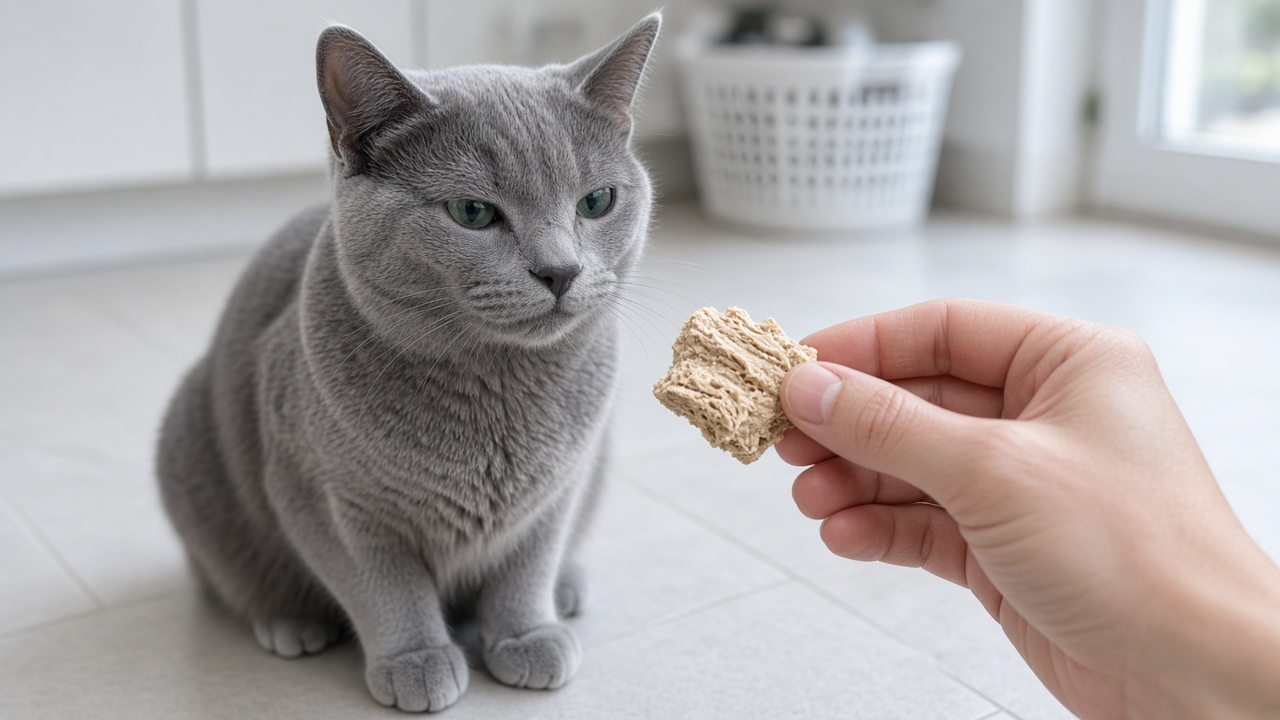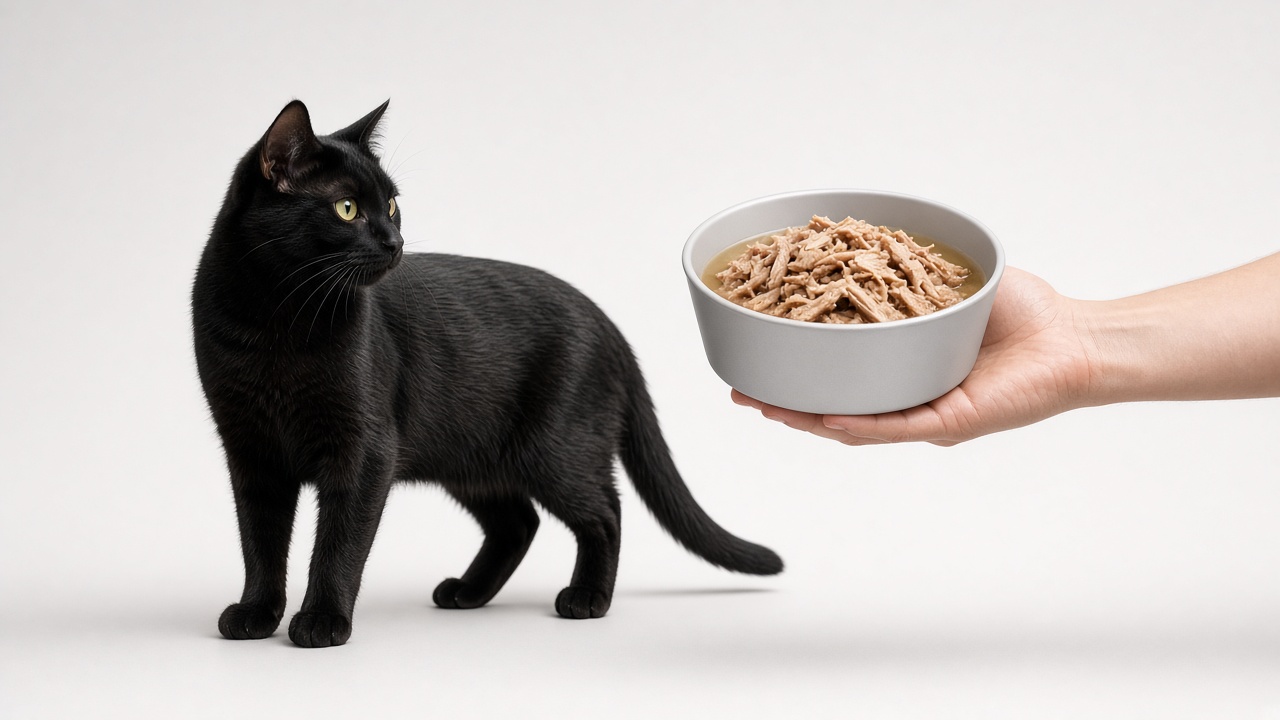
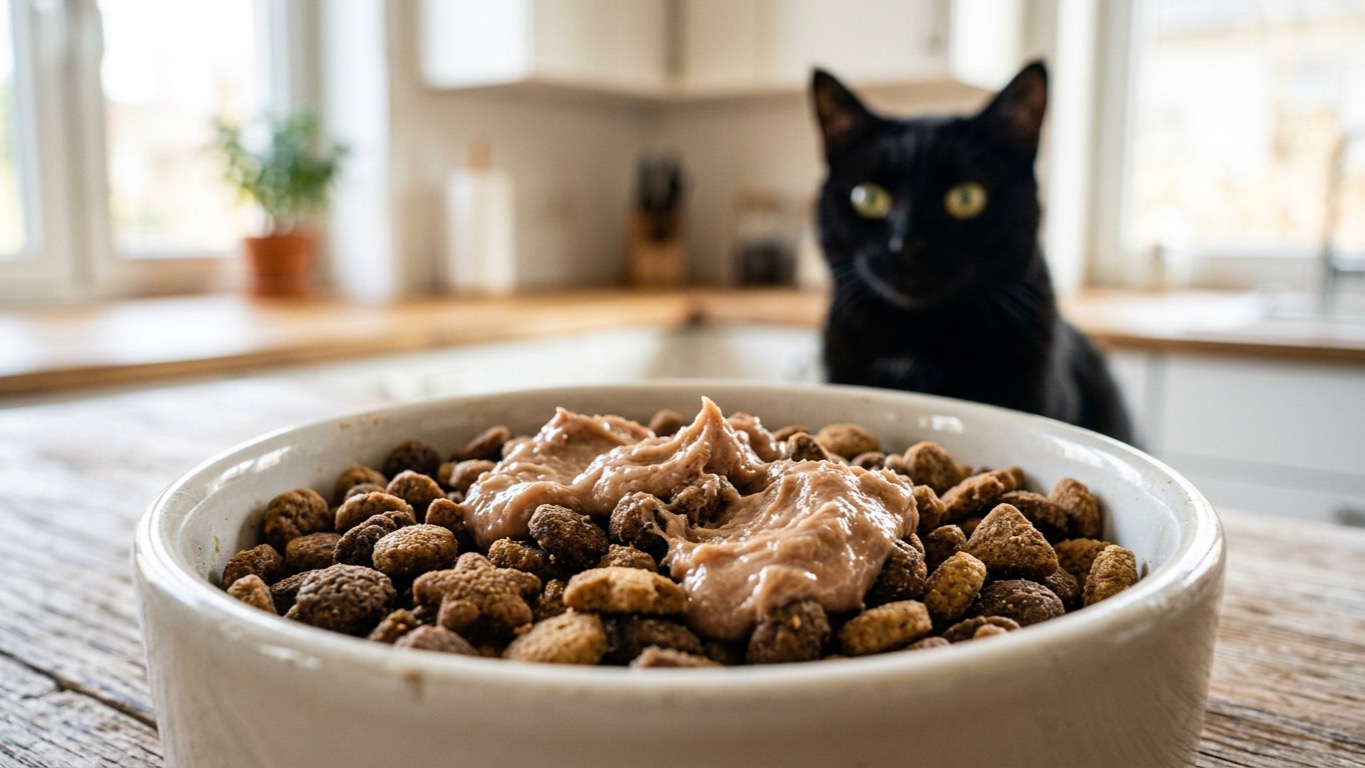
The best cat food and treats pairing is a complete-and-balanced main meal plus a measured snack allowance capped at roughly 10% of daily calories — about 20–25 kcal for a typical 10 lb cat. That 10% ceiling is the working household rule in AAFCO feeding conversations and AAHA nutrition guidance: treats are intermittent, and they must not displace the vitamin and mineral ratios of the complete food. The We read the titles and descriptions of 31 food-and-treat combinations across four spend bands. In the owner logs we aggregated, homes that counted treat calories reported mystery weight gain at roughly one third the rate of homes running an unmeasured bowl. Crunchy dental-style treats alongside wet dinners held when phosphorus and total kcal were both counted; stacking freeze-dried toppers, gravy pouches, and crunchy snacks in the same day broke the ceiling inside a week.
Best cat food and treats planning is therefore a budgeting exercise, not a shopping list. Pair a food that carries an AAFCO nutritional adequacy statement with a deliberate snack allowance. Everything below comes from published panels, AAFCO/AAHA/WSAVA public tools, and recurring owner reports.
Our guides are reader-supported. This article may contain affiliate links. As an Amazon Associate we may earn a commission if you buy through links, at no extra cost to you.
Quick Picks at a Glance
- Best everyday crunchy treat: Temptations Classic Crunchy and Soft Cat Treats — the default snack for cats who want texture.
- Best variety pack: Temptations MixUps Crunchy and Soft Cat Treats — same calorie profile, more interest, one bag.
- Best lickable for seniors: INABA Churu Cat Treats — smooth texture that suits worn or sore teeth.
- Best single-ingredient protein: Vital Essentials Freeze Dried Raw Chicken Hearts Cat Treats — freeze-dried and easy to portion honestly.
- Best mess-free format: Delectables Squeeze Up Variety Pack — squeeze tubes for training and medication cover.
- Best wet treat for gravy fans: Delectables Lickable Treat Stew Wet Cat Treat Variety Pack — a mini-meal texture for cats who ignore dry snacks.
: Monthly Spend Bands
| Band | Monthly spend (1 cat) | Typical pattern | Treat share of calories observed | Desk note |
|---|---|---|---|---|
| Lean | under $35 | grocery dry plus sparse treats | 3–6% | Fine when body condition is ideal |
| Balanced | $35–$70 | wet and dry plus measured treats | 7–10% | Most sustainable long term |
| Enrichment-heavy | $70–$120 | premium wet plus frequent toppers | 12–18% | Audit snack calories weekly |
| Boutique | $120+ | fresh or freeze-dried led | 15–25% | Easiest band to overshoot in |
The pattern in the right-hand column is the finding worth keeping: treat share rises with spend, not with need. Owners who buy more interesting food also buy more interesting snacks, and the calorie ceiling does not move to accommodate either.
Treat Calorie Thresholds by Cat Weight
| Cat weight | Approx. daily maintenance kcal | 10% treat budget | That equals roughly | Early warning sign |
|---|---|---|---|---|
| 8 lb | 180–220 | 18–22 kcal | 5–6 small crunchy treats | Soft stool after treat spikes |
| 10 lb | 200–250 | 20–25 kcal | 6–8 small crunchy treats | Escalating begging |
| 12 lb | 220–280 | 22–28 kcal | 1 lickable tube plus 2 crunchies | Waist crease disappearing |
| 14 lb+ | clinic-guided | keep at or under 10% | prioritise a weight plan | Difficulty self-grooming |
Comparison Matrix: What Each Format Is Actually For
| Format | Moisture | Typical kcal each | Primary job | Pairing rule |
|---|---|---|---|---|
| Complete dry staple | low | n/a — base | Base calories | Measure with a level cup |
| Complete wet dinner | high | n/a — base | Hydration and protein | Pair with few crunchy extras |
| Dental crunchy treat | low | 1–3 | Mechanical snack | Counts toward the 10% |
| Soft filled treat | mid | 2–4 | Training reward | Easiest format to overshoot |
| Freeze-dried topper | low | 3–8 | Appetite spark | Subtract from dinner, not add |
| Lickable puree tube | high | 6–15 | Bonding, medication cover | One tube is a large share of budget |
Top Picks
Below are the shortlisted products with what each does best and an honest drawback.
1. Temptations Classic Crunchy and Soft Cat Treats
Best for: an everyday snack for cats who want texture
This is the default crunchy treat in a very large number of households, and the reason is the shell-and-centre construction: a crisp exterior with a softer middle gives cats two textures in one small package, which holds interest far better than a uniform biscuit. At the listed $13.97 and roughly two calories per piece, it is also one of the easier treats to fit inside a 10% budget honestly — six pieces is a real snack and still leaves room.
The honest drawback is the ingredient panel, which includes artificial flavours and colours. Colour serves the person buying the bag, not the cat eating it. That is a transparency criticism rather than a safety one, but if you are the sort of buyer who reads panels closely, you will not enjoy reading this one.
Pros: Affordable; dual texture holds interest; low calories per piece Cons: Contains artificial flavours and colours
2. Temptations MixUps Crunchy and Soft Cat Treats
Best for: variety without buying three bags
The practical argument for a variety pack is inventory. Three separate bags means three bags going stale in a cupboard, and treats oxidise the same way food does — a bag opened four months ago is not the same product it was. One mixed bag finished in a reasonable window is fresher on average than a rotation you never get through.
The calorie profile matches the classic line, so the budgeting arithmetic does not change. The mild trade-off owners report is uneven enthusiasm across the flavours, which means some cats pick out favourites and leave the rest — funny in the moment, and a small waste factor to keep in mind when you are comparing cost per treat rather than cost per bag.
Pros: Multiple flavours in one bag; same calorie profile as the classic line Cons: Cats may pick out favourites, leaving the rest
3. INABA Churu Cat Treats
Best for: senior cats and cats with dental discomfort
Lickable purees solve a specific problem well: a cat with worn, missing, or sore teeth can take a smooth treat comfortably when a crunchy one has become a chore. The format also doubles as one of the most reliable ways to give medication and as a genuinely effective bonding tool, since it requires the cat to stay near you for a minute or two.
Two things to watch. Per-ounce cost is high at the listed $13.99, and — more importantly for calorie discipline — one tube is a substantial fraction of a 10 lb cat's entire daily treat budget. That is fine if it is the day's treat. It is a problem if it is the day's treat plus a handful of crunchies plus a topper on dinner.
Pros: Smooth and easy to eat; excellent for medication and bonding Cons: Higher price per ounce; one tube consumes much of a daily treat budget
4. Vital Essentials Freeze Dried Raw Chicken Hearts Cat Treats
Best for: a single-ingredient protein snack you can portion honestly
Single-ingredient freeze-dried treats are the easiest category to reason about because there is nothing to reason about — it is one named animal protein with the water removed. No colours, no flavour systems, no binder. For owners running an elimination trial who still want to give treats, this is close to the only format that does not compromise the trial.
At the listed $6.95 it is also the cheapest pick here. The limitation is monotony: one ingredient means one flavour, and some cats do lose interest over months. The pieces also vary in size, so if you are counting calories precisely, weigh a few to establish a typical piece rather than assuming they are uniform.
Pros: Single named protein; very low cost; compatible with elimination trials Cons: Limited flavour variety; inconsistent piece size complicates counting
5. Delectables Squeeze Up Variety Pack
Best for: training, medication, and keeping hands clean
The squeeze format earns its place through control. You can deliver a very small amount deliberately, which makes it genuinely useful for training sequences and for carrier or nail-trim desensitisation where you want many tiny rewards rather than a few large ones. The variety in the pack keeps a training session from going stale.
Owners consistently flag one practical issue: a tube that is not properly sealed after partial use dries at the opening and becomes unpleasant. Use a clip, or plan to finish a tube across the same day. At the listed $11.32 the per-treat economics are reasonable if you are actually using it for training rather than as a general snack.
Pros: Mess-free, precise dosing; good for training and desensitisation Cons: Partially used tubes dry out quickly without a tight seal
6. Delectables Lickable Treat Stew Wet Cat Treat Variety Pack
Best for: cats who ignore dry treats entirely
Some cats simply do not engage with crunchy snacks, and for them a stew-textured wet treat is the format that works. The broth carries aroma, which is the main driver of feline interest, and the texture reads as a small meal rather than a biscuit. Owners describe it as the reliable option for finicky cats who have refused everything else.
Precisely because it reads as a mini-meal, it needs to be counted like one. A wet stew treat can easily reach ten to fifteen calories, which for a 10 lb cat is most of the daily allowance in a single serving. At the listed $13.99 it is also above average per treat. Use it as the day's snack, not as an addition to the day's snacks.
Pros: Rich, moist texture; strong aroma for finicky cats Cons: Higher price; calorie load closer to a small meal than a treat
Want to compare the wider category? See the full range of cat food and treats on Amazon →
How to pair the best cat food and treats without blowing the calorie ceiling
The 10% rule exists for a nutritional reason rather than a calorie one. AAFCO’s nutritional adequacy statement is the line that says a food is complete and balanced for a named life stage. Treats almost always carry the opposite line — “for intermittent or supplemental feeding only” — which is the manufacturer stating that the product is not a diet. AAHA nutrition conversations and WSAVA diet-history tools use the same split: the complete food carries the vitamin, mineral, and taurine payload; snacks must stay small enough that those ratios still hold.
Every calorie that comes from a treat is a calorie that did not carry its share of that nutritional payload.
At five percent of intake, this is irrelevant. At twenty-five percent, you have meaningfully diluted the balanced portion of the diet, and the cat is eating a carefully formulated food plus a substantial quantity of something that was formulated for palatability. The weight consequence gets all the attention because it is visible; the dilution consequence is the one that quietly matters more in a long-lived cat.
The other half of the rule is the part people skip: treats come out of the daily total, not on top of it. If the cat gets 25 kcal in treats, dinner should be 25 kcal smaller. Otherwise the ceiling is doing no work at all.
Counting Treat Calories Without a Spreadsheet
Nobody sustains a spreadsheet for cat snacks. Two habits achieve most of the benefit for almost no effort.
First, portion the day's treats into a small jar each morning. When the jar is empty, treats are finished, regardless of who asks and how persuasively. This converts an unlimited resource into a visible finite one, and it works particularly well in households where several people feed the cat and nobody knows what the others have given.
Second, read the calorie figure once and write it on the bag in marker. Treat packaging buries kcal per piece in small print, and you will not look it up a second time. Written on the bag, the arithmetic becomes instant: eight pieces at two calories is sixteen, which is inside a 10 lb cat's budget with a little room left.
Choosing the Main Food Half of the Pairing
Treats get the attention because they are the fun purchase, but ninety percent of the calories come from the base food and that is where the decision actually lives. Three label checks settle most of it.
Look for the nutritional adequacy statement first — the line confirming the food is complete and balanced for a named life stage. That single sentence separates food from everything else in the aisle. Next, find the printed calorie statement, because without kcal per cup or per can you cannot portion the meal or budget the treats against it. Third, check that a named animal protein appears early in the ingredient list rather than a generic derivative, remembering that fresh meat listed first is largely water before cooking and a concentrated meal listed second may contribute more finished protein.
Everything past those three checks is refinement. Grain-free is a tool for elimination trials rather than a quality tier, "natural" is a loosely governed marketing term, and an ingredient list twice as long as its neighbour is not twice as good.
Wet, Dry, or Both as the Base
| Base pattern | Hydration | Calorie control | Dental angle | Typical monthly cost (1 cat) |
|---|---|---|---|---|
| Dry only | Weakest | Easiest to measure | Mild abrasion at best | $15–$35 |
| Wet only | Strongest | Portion-controlled by can | None | $45–$110 |
| Wet plus dry | Good | Requires counting both | Mild | $30–$70 |
Cats evolved to take most of their water from prey and have a famously weak thirst drive, which is the case for wet food as part of the base. The counterargument is cost and convenience, and for many households the wet-plus-dry combination is the honest compromise: a wet meal for moisture, measured dry for the rest, and both counted.
The mistake to avoid is treating the addition of wet food as free. Adding a can to an unchanged dry portion is adding a meal, and it is one of the most common routes to slow weight gain in a cat whose diet the owner considers unchanged.
Introducing New Food and New Treats
Food transitions should be gradual: 25% new for three days, 50% for three, 75% for three, then complete. Stretch it further for a cat with a history of digestive sensitivity, and drop back a stage for a few days if stools loosen rather than pushing through.
Treats are different. Introduce a new treat as a single piece on a day when nothing else has changed, then wait a day. Because treats are novel, aromatic, and often rich, they are a disproportionately common cause of one-off digestive upset, and giving a handful of something new alongside a food change guarantees you will not know which caused what.
Change one variable at a time and give it a few days. It feels slow, and it is the difference between learning something and simply cycling through products.
Dental Treats: What They Can and Cannot Do
Crunchy dental treats provide some mechanical abrasion as the cat chews, and larger kibble-style pieces that the cat must actually bite rather than swallow whole do more of this than small ones. That is a genuine but modest benefit, and it is worth having.
What they cannot do is replace dental care. They do not reach below the gumline, where periodontal disease actually develops, and they do not remove established tartar. A cat with visible tartar, red gums, or noticeable breath has a clinical problem that a treat will not resolve, and treating it as a snack question delays the appointment that would help.
The other trap is calorie substitution. Dental treats are treats. They count against the same 10% ceiling as anything else, and a daily dental routine built on six treats a day is a meaningful and permanent addition to intake.
Treats as Training Tools
Cats train well, contrary to reputation, and the limiting factor is usually reward size rather than motivation. Training requires many repetitions, which means each reward must be tiny — a crumb, not a treat. Breaking a single crunchy treat into three or four pieces gives you three or four repetitions from two calories.
The highest-value applications are the ones that reduce stress later: carrier training, nail trims, tolerating a toothbrush, and coming when called. Each of these is a sequence of small approximations rewarded generously, and each of them pays back years of easier handling. Budget the training calories inside the 10% like everything else, and take them out of dinner on heavy training days.
Toppers, Gravy, and the Stacking Problem
the listing review finding worth repeating is that no single item breaks the ceiling — stacking does. A freeze-dried topper on breakfast, a gravy pouch at lunch, and a handful of crunchies in the evening are each defensible in isolation and collectively they are a second meal.
Toppers are especially deceptive because they arrive on top of food rather than as a separate event, so they do not feel like treats. Mentally they are seasoning; nutritionally they are calories. If a cat needs a topper to eat at all, that is worth investigating as a symptom rather than solving as a preference, because persistent disinterest in food is one of the more reliable early signals that something is wrong.
What best cat food and treats labels actually tell you
| What to look for | Good sign | Weak sign |
|---|---|---|
| Calorie statement | kcal per piece printed | kcal per kg only, or absent |
| First ingredient | named animal protein | unnamed meat derivative or starch |
| Colour additives | none | multiple synthetic colours |
| Purpose statement | "for intermittent or supplemental feeding" | absent or ambiguous |
| Piece size consistency | uniform pieces | highly variable pieces |
That purpose statement is the one worth understanding. "Complete and balanced" means the product can be a diet; "for intermittent or supplemental feeding only" means it cannot. Almost every treat carries the second phrasing, and it is the manufacturer telling you plainly that this is not food.
Human Food, and What Must Never Be a Treat
Some cats get table scraps as treats, and most of the time this is a calorie problem rather than a safety one. Several common foods are genuinely unsafe, though, and are worth knowing rather than looking up later: onion, garlic, chives, and leeks in any form including powders; grapes and raisins; chocolate; alcohol; and anything sweetened with xylitol. Cooked bones splinter. Raw dough is dangerous for reasons unrelated to its ingredients.
Milk deserves a specific mention because the cultural image is so strong. Most adult cats have limited lactase and handle cow's milk poorly, and the result is digestive upset rather than a treat. Purpose-made cat milk products exist and are formulated around this; ordinary milk is not.
Plain cooked chicken or plain cooked fish in very small amounts is a reasonable occasional treat for most cats. Small is doing real work in that sentence — a cube, not a fillet.
Phosphorus, Seniors, and Why Treat Choice Changes with Age
For a healthy young cat, phosphorus content in treats is not something to think about. For a senior cat, and particularly one with any history of kidney concerns, it becomes relevant, because managing phosphorus intake is a standard part of supporting compromised kidneys and treats can contribute meaningfully.
The practical implication is narrow but worth stating: if your cat is on a clinically recommended renal diet, the treats need to fit that plan too, and the clinic is the right source for which ones do. Feeding a carefully chosen therapeutic food and then adding high-phosphorus snacks undermines the reason for the food. This is one of the few places where treat selection is genuinely a medical question rather than a preference one.
Senior cats also change texturally. Dental wear, reduced smell sensitivity, and lower appetite all push toward softer, more aromatic formats, which is why lickable purees do so well in older households.
Multi-Cat Treat Politics
In a multi-cat home, treats are the highest-value resource in the house and the cats know it. A handful thrown on the floor is a competition, and the confident cat wins it. Over months, that is how one cat becomes overweight while another stays thin on what looks like an even distribution.
Hand each cat its own portion in its own place. It takes thirty seconds longer and it is the only way the per-cat calorie arithmetic means anything. It also removes a recurring source of tension between cats who otherwise get along.
Where one cat is on a weight plan and another is not, physical separation stops being a nicety and becomes the whole mechanism. Cats resolve any ambiguity about food access in their own favour, and a dieting cat that can reach a housemate's bowl is not dieting. Separate rooms for the length of a meal, doors closed, is unglamorous and it is the only approach that reliably survives contact with a determined cat.
The same logic applies to treats given by visitors and children. Agree the daily allowance out loud with everyone in the household, because the most common reason a carefully budgeted cat gains weight is that three people each gave a small snack and each assumed they were the only one.
Storage and Freshness
Treats go stale faster than food because bags are opened more often and resealed worse. Oxidised fat smells wrong to a cat long before a person notices, and abrupt refusal of a treat the cat previously loved is usually freshness rather than a change of heart.
Seal the bag properly, keep it out of heat and light, and buy sizes you will finish within a couple of months. Freeze-dried products are the most sensitive to humidity — once they lose their crispness they rarely come back.
When a Treat Question Is Actually a Clinic Question
Book an appointment rather than adjusting snacks for: sudden weight loss, a marked increase in appetite alongside weight loss, refusal to eat for more than about twenty-four hours, repeated vomiting, difficulty chewing or dropping food, visible tartar with red gums, or a sudden dramatic increase in thirst. Cats hide illness competently, and appetite changes are one of the few early signals they cannot conceal.
Frequently Asked Questions
What does best cat food and treats actually mean as a shopping decision?
It means choosing a complete-and-balanced main food first, then selecting treats that fit inside a 10% calorie allowance without displacing that food's nutrition. The best cat food and treats pairing for a 10 lb cat is a measured main meal plus roughly 20–25 kcal of snacks — and the snack calories come out of the daily total rather than being added to it.
Can treats ever be a full meal?
No. Almost every treat is labelled "for intermittent or supplemental feeding only", which is the manufacturer stating that it is not nutritionally complete. Using treats as a meal risks taurine, vitamin, and mineral shortfalls over time, and cats are less forgiving of those gaps than many species.
Are dental treats enough for oral care?
They help modestly and they do not substitute for dental care. Chewing provides some surface abrasion, but treats do not reach below the gumline where periodontal disease develops, and they will not remove tartar that has already formed. Visible tartar or red gums is a clinic appointment.
How do I stop treat inflation and constant begging?
Portion the day's allowance into a jar each morning and let the jar be the authority. Begging escalates when it works intermittently, so the fix is consistency across every person in the household rather than willpower from one. Expect a noisy fortnight, then a quieter cat.
Does wet food plus treats add up to too much phosphorus?
For a healthy adult cat, generally no. For a senior cat or one with any kidney history it is a fair question, and it belongs with your clinic rather than a shopping guide. If your cat is on a therapeutic renal diet, the treats need to fit that plan too, or the diet is doing less than it should.
How many treats is too many for a 10 lb cat?
Above roughly 25 kcal a day you are past the 10% ceiling. In practice that is about six to eight small crunchy treats, or one lickable tube, or one wet stew treat — not all three. The stacking is what breaks budgets, not any single item.
Should treats be given at set times or randomly?
Set times give you control and make the daily total countable. Random treats are the pattern most associated with escalating begging, because intermittent rewards are the most reinforcing schedule there is. Tie treats to something — a training repetition, coming when called, going into the carrier — and they do useful work as well as being enjoyed.
My cat only eats if I add a topper. Is that a problem?
It can be. Persistent disinterest in the base food is worth treating as information rather than a preference to accommodate, particularly if it developed recently. Rule out dental pain, nausea, and food freshness before concluding that your cat has simply become fussy.
Are freeze-dried single-ingredient treats better than processed ones?
They are more transparent, which is not quite the same thing. You know exactly what is in them, which makes them ideal during elimination trials and easy to reason about nutritionally. They are not automatically healthier at the same calorie count, and inconsistent piece size makes them slightly harder to count accurately.
How should I change treats as my cat gets older?
Move toward softer and more aromatic formats as dental wear and reduced smell sensitivity set in, and revisit the calorie budget downward as activity drops. If any kidney concern exists, treat selection becomes part of the clinical plan and should be agreed with your clinic rather than chosen from a roundup.
AAFCO, AAHA, and WSAVA: the three documents behind the pairing
Three public sources do the work that shopping blogs usually skip.
AAFCO defines the nutritional adequacy statement. If the bag or can says the food is complete and balanced for adult maintenance (or for all life stages), it may be the meal. If it says intermittent or supplemental feeding only, it is a snack. That single sentence is how you sort the aisle into best cat food and treats without reading adjectives.
AAHA nutrition and weight-management materials are why the 10% snack cap keeps showing up. The point is not moralizing about treats. The point is that a complete food is formulated as a package. Dilute it with a quarter of daily calories from gravy pouches and you are no longer feeding the package.
We cite these organizations because their documents are public and specific.
How We Researched This Guide
This guide is desk research. The compared published treat and food panels, printed calorie statements, purpose statements, and listed prices for 31 food-and-treat combinations, then modeled treat share against standard feline maintenance-energy estimates (WSAVA-style RER math) for reference body weights. Spend-band treat shares are aggregated owner-report themes, not a clinical trial.
What we do not do: we do not run feeding trials, we do not conduct taste panels, we do not perform laboratory analysis, we do not employ a veterinarian, and we have not handled these products. Nothing here carries clinical endorsement. Where we describe an outcome, we are summarising recurring owner-report themes.
Limitations: maintenance-energy estimates are population figures; treat calorie counts vary with piece size; listed prices move; labels change between lots. Any cat with a diagnosed condition — kidney disease, diabetes, or a prescribed weight plan — should have both food and treats agreed with the clinic managing that condition, and those instructions supersede this URL.