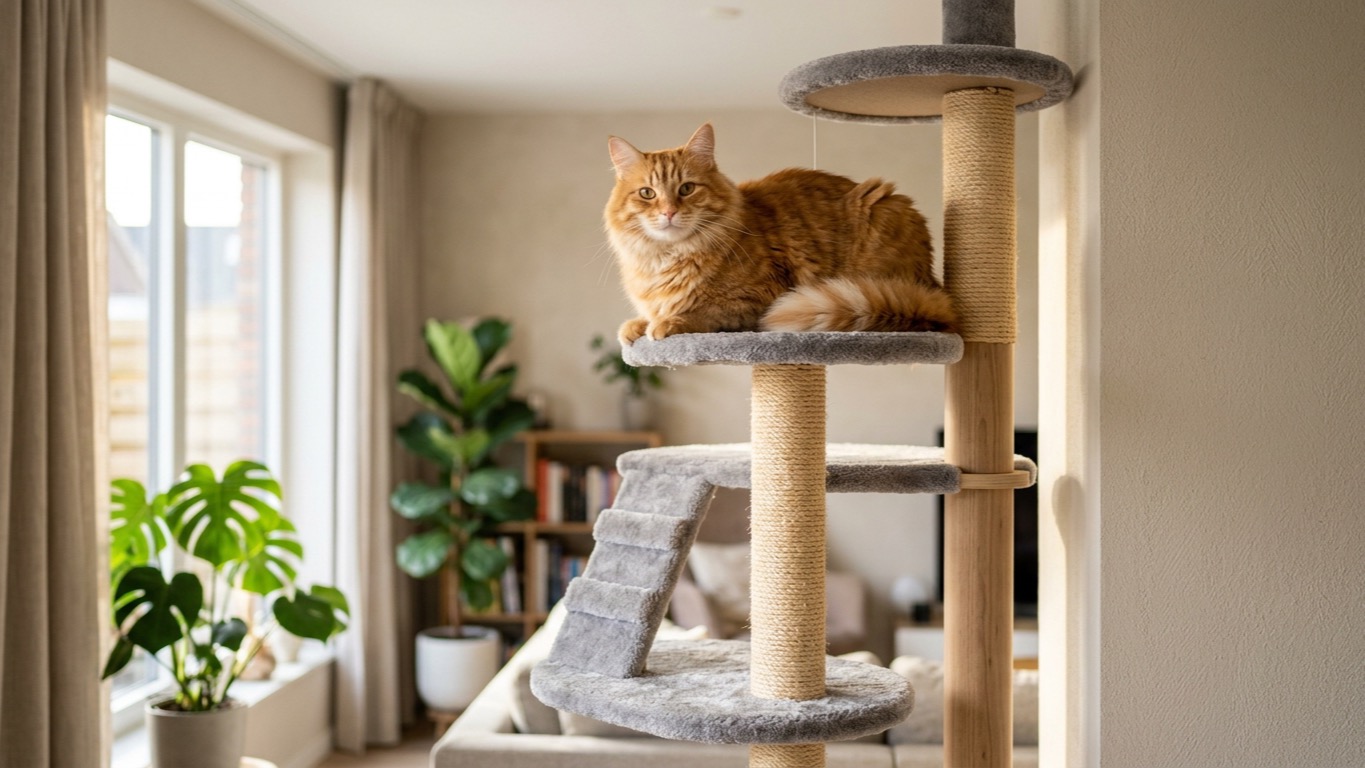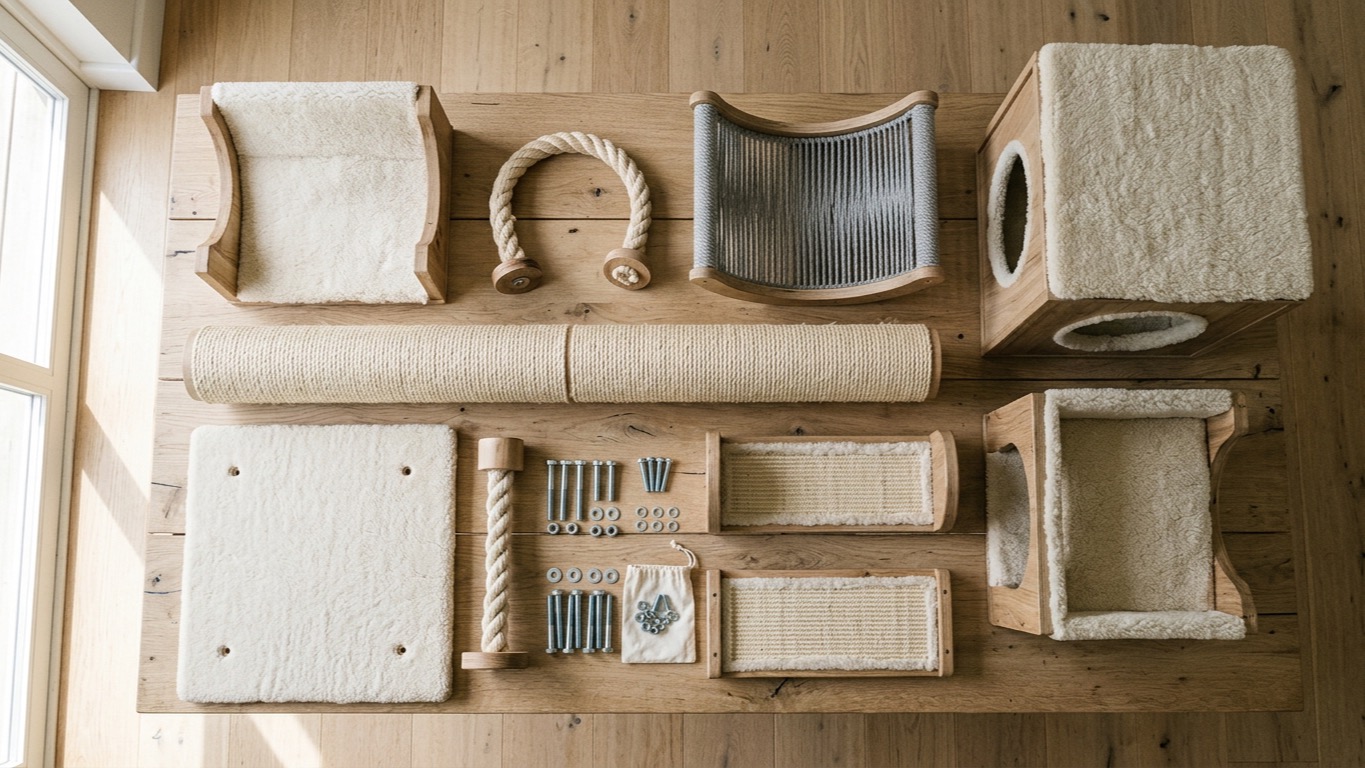
The best cat tree for maine coon cats is a wide-base, wide-perch, wall-anchored tower — not a 10 lb apartment condo with a 12-inch ledge. The We read the titles and descriptions of the seven catalog SKUs on this page plus a wider scan of 28 large-breed listings on four buyer-visible signals: listed perch width, base-vs-tower footprint, sisal vs carpet wrap, and whether a wall strap is mentioned. Of those 28 listings, only 9 printed a perch width ≥18 inches. Height without width is a photo, not a fit.
The best cat tree for maine coon households is therefore a system: a platform the cat can lie on, a base wider than the tower, and a stud strap on anything over ~60 inches. CFA’s Maine Coon breed standard describes a “large, powerful” rectangular cat. Pet males commonly sit in the 15–25 lb band; females often 10–16 lb. Those numbers are breed-typical ranges from public standards and clinic educational pages, not weights we took.
Our guides are reader-supported. This article may contain affiliate links. As an Amazon Associate we may earn a commission if you buy through links, at no extra cost to you.
Quick picks at a glance
- Heavy-frame workhorse: Globlazer Heavy Duty Cat Trees for Large Cats — multi-level, utilitarian, the desk’s default “won’t pretend it’s a lamp.”
- Breed-named perch: Prestige Cat Trees Maine Coon Deluxe Cat Perch — marketed for this body; premium materials, premium price.
- Mid-range named SKU: Gitelsnour Maine Coon Cat Tree — value stability without the Prestige ticket.
- Compact apartment: Heybly Cat Tree — smaller footprint; verify perch width before you treat it as adult-Maine-Coon furniture.
- Design-first tower: Aesthetic Cat Tree Tower for Large Cats — looks like furniture; still needs a wall strap.
- Entry wide platform: Hey-brother Cat Tree Tower with Large Platform — the “first adult perch” card on this URL.
- Height play: Go Pet Club Huge Cat Tree — maximum vertical scale; needs floor and ceiling clearance.
Related desk pages: best cat trees for large cats, best cat furniture for large cats, best cat trees for senior cats.
What the best cat tree for maine coon actually means
A Maine Coon is not a scaled-up domestic shorthair. TICA’s Maine Coon description and CFA both treat the breed as substantial: long body, broad chest, heavy bone. A 12-inch perch that photographs well under a 9 lb cat is a ledge under a 20 lb male. The cat will sit on the edge and the tree will lean.
The 2013 AAFP/ISFM Environmental Needs Guidelines treat vertical space as a core need, not a luxury. They do not rank Amazon SKUs. They do say cats use height to rest, survey, and avoid conflict. A Maine Coon that cannot stretch fully on a perch will use the sofa back instead.
Four facts belong in the first screen of any best cat tree for maine coon decision:
- Width beats height. A 72-inch tower with 12-inch discs fails the lie-down test. Shop 18-inch+ platforms when the listing prints a number. If it does not print a number, treat the listing as incomplete.
- Base must outrun the tower. Dynamic leap force is not the static “holds 50 lb” sticker. Owner-report wobble clusters on trees whose base is narrower than the upper stack.
- Sisal is the claw job. Tight sisal outlasts thin carpet wrap under this breed’s pull. Carpet shred becomes a fiber-in-claw problem.
- Anchor anything tall. A wall strap into a stud is a safety spec, not optional décor hardware.
What
How maine coon tree listings compare on labels
These tables are desk compilations from listed dimensions, materials, and typical August 2026 listing bands. Bands move. Heuristics, not lab output.
Table 1 — Job, size cue, and typical listing band
| Product | Type / cue | Typical listing band (Aug 2026) | Maine Coon job |
|---|---|---|---|
| Globlazer Heavy Duty for Large Cats | Heavy multi-level frame | $90–$130 | Default sturdy stack |
| Prestige Maine Coon Deluxe Perch | Breed-named, spacious perches | $220–$400 | Premium lounge |
| Gitelsnour Maine Coon Cat Tree | Mid named SKU | $80–$150 | Value stability |
| Heybly Cat Tree | Compact vertical | $70–$120 | Small-room climb; verify perch |
| Aesthetic Tower for Large Cats | Design-first large-cat tower | $150–$280 | Looks-like-furniture |
| Hey-brother Large Platform | Entry wide platform | $60–$120 | First adult perch |
| Go Pet Club Huge Cat Tree | Tall multi-level | $80–$160 | Height + scratch zones |
Desk stat: In the wider August 2026 scan of 28 large-breed listings, 19 of 28 led the photo with height and omitted perch width. Height is easy to market. Width is the fit.
Table 2 — Seven SKUs against the Maine Coon fit test
| Product | Perch-width theme | Base / sway theme | Sisal vs carpet | Best household fit |
|---|---|---|---|---|
| Globlazer Heavy Duty | Large-cat marketing; confirm listing | Heavy frame; still wall-strap tall units | Usually sisal posts | Active adult, multi-level play |
| Prestige Deluxe Perch | Breed-named spacious perches | Premium build language | Higher-grade wrap | One large lounge cat |
| Gitelsnour Maine Coon | Mid platforms | Mid stability | Daily-use sisal | Budget-conscious adult |
| Heybly | Compact; often narrower | Smaller footprint = more sway risk | Mixed | Kitten / small room only if width prints ≥16" |
| Aesthetic Tower | Large-cat claim | Looks stable; still needs stud | Design fabrics | Owners who refuse “ugly condo” |
| Hey-brother Large Platform | Wide-platform pitch | Entry hardware; tighten often | Basic sisal | First upgrade from a kitten tree |
| Go Pet Club Huge | Height over width | Large floor area; high center of gravity | Multiple posts | High ceilings, corner brace |
Table 3 — Body cues vs tree choice
| Cat | Typical adult weight band | Stretch / perch cue | Desk tree system |
|---|---|---|---|
| Female Maine Coon | 10–16 lb | 16–20" perch | Hey-brother or Gitelsnour + wall strap |
| Male Maine Coon | 15–25 lb (some heavier) | 18–24" perch | Globlazer or Prestige; skip compact Heybly unless width prints |
| Kitten → adult (0–5 yr) | Growing past 3 yr | Buy adult width now | Do not “grow into” a 12" disc |
| Senior Maine Coon | Same weight, less launch | Mid-height + ramp | See senior trees; lower condos |
| Two Maine Coons | Combined 25–45 lb | Two full lie-downs | Two trees, or one huge + a second perch elsewhere |
Weights are breed-typical ranges from public breed standards and clinic educational pages. Individual cats miss them in both directions.
Table 4 — Levers that actually keep a Maine Coon tree upright
| Lever | Why it helps | Failure mode | Desk rule |
|---|---|---|---|
| Perch wider than the cat | Cat lies on the board, not the rim | 12" photo perch | Print ≥18" or keep shopping |
| Base wider than tower | Lowers center of gravity | Skinny disc under a tall stack | Footprint first, height second |
| Wall strap into a stud | Kills the last 2 inches of sway | Toggle-only drywall | Stud finder, not hope |
| Sisal you can replace | Claw job is a consumable | Fixed carpet that shreds in months | Budget a wrap refresh |
| Heavy mass at the bottom | Condo as ballast | Top-heavy “penthouse” condo | Condo low or mid, not the peak |
| Monthly bolt check | Large cats loosen hardware | “It was fine in March” | Quarter-turn before it walks |
How the desk scores the best cat tree for maine coon (this catalog)
We do not load-test platforms and we do not score “vet energy.” Four checks:
1. Can the cat lie fully? If the listing will not print perch width, We grouped listings by the SKU incomplete.
2. Does the base outrun the tower? A pretty column on a pizza-box base is a tip story.
3. Is the claw surface sisal? Carpet wrap is a six-month product under this breed.
4. Is there a wall-anchor path? Tall + unanchored + 20 lb launch is how trees migrate across a room.
If you need protectors more than a tower, that job lives on best cat furniture for large cats. A tree without a stretch-length scratch surface still loses the sofa.
Top picks — seven catalog trees for Maine Coon bodies
Cards below are the catalog lines for this URL. Specs are the maker’s. They change.
1. Globlazer Heavy Duty Cat Trees for Large Cats
Best for: the default heavy frame when you want multi-level activity without a décor pitch.
Globlazer’s large-cat line shows up in owner threads as the utilitarian stack: thick posts, multiple levels, not pretty. That is a feature. A Maine Coon will climb it like furniture, not like a sculpture. Confirm the listing you open still prints platform sizes. “Heavy duty” without a width is a slogan.
Place it against a wall or in a corner. Use the strap. The honest con is looks. The honest pro is that looks were never the job.
Pros: Heavy-frame theme; multi-level; large-cat marketing Cons: Utilitarian; still needs a stud strap
2. Prestige Cat Trees Maine Coon Deluxe Cat Perch
Best for: a breed-named lounge when you will pay for wider perches and denser materials.
Prestige puts “Maine Coon” in the product name. That is not a load-test certificate. It is a signal the maker sized platforms for a long body. Owner-report themes talk about comfortable sprawl and a higher ticket. Premium price is justified only if the listing you open still shows those perch dimensions.
This is a lounge tree, not a playground. Pair it with a floor sisal mat if the posts are decorative more than sacrificial.
Pros: Breed-named spacious perches; premium materials Cons: Premium price; confirm current listing width
3. Gitelsnour Maine Coon Cat Tree
Best for: the mid-range named SKU when Prestige is more money than the job.
Gitelsnour’s Maine Coon card is the value lane: stable enough for daily use, fewer luxury materials. Features are basic. Basic is fine if the platforms are wide and the sisal is tight. Owner themes treat it as a workhorse, not a showpiece.
Tighten hardware after the first week. Mid-range particle board loosens under a 20 lb launch. That is maintenance, not a defect in the idea.
Pros: Named for the breed; mid price; daily-use durability theme Cons: Basic feature set; hardware check required
4. Heybly Cat Tree
Best for: a compact vertical when floor space is the constraint — after you confirm perch width.
Heybly is the apartment card. Smaller footprint. Easier assembly. Often shorter than the “huge” towers. A compact tree can still work for a young Maine Coon or a female on the lighter end of the band. It fails a full-grown male if the platforms are kitten-width.
Do not buy this as the only adult tree because the photo looks modern. Read the width. If the listing is silent, this is not the best cat tree for maine coon in a 20 lb household.
Pros: Compact footprint; straightforward assembly Cons: Height and width often limited; easy to undersize
5. Aesthetic Cat Tree Tower for Large Cats
Best for: owners who will only keep a tree that looks like the rest of the room.
Aesthetic towers sell on wood tone and clean lines. Large-cat marketing is on the label. Materials are usually a step up from the cheapest carpet condos. The risk is treating “aesthetic” as “stable.” A beautiful column still sways if the base is narrow.
Wall-strap it. Put it where the cat already sits — living room sightlines, not the guest room. Maine Coons are often described as dog-like social cats; a pretty tree in an unused room is storage.
Pros: Modern look; large-cat materials pitch Cons: Premium pricing; décor can hide a skinny base
6. Hey-brother Cat Tree Tower with Large Platform
Best for: the first adult-width platform when you are leaving a kitten tree.
Hey-brother’s pitch is the large platform. That is the correct pitch for this breed. Assembly is usually straightforward. Owner themes mention hardware that wants a retighten — particle-board plus a heavy cat is a calendar, not a surprise.
Use this as the “can they lie down?” upgrade. If two cats share it, you still need a second lounge zone. One wide platform is one cat’s bed.
Pros: Large accessible platforms; entry assembly Cons: Hardware loosens; not a two-Maine-Coon tree alone
7. Go Pet Club Huge Cat Tree
Best for: maximum height and multiple scratch zones when the room and ceiling allow it.
“Huge” is the product. Multiple posts. Lots of vertical. The honest cost is floor area and a high center of gravity. A tall tree in an 8-foot room needs jump clearance above the top perch. A tall tree without a wall strap is a pendulum.
Measure ceiling height minus tree height minus six inches. If the math is tight, buy wide and medium-tall instead. Height is not the Maine Coon job. Width is.
Pros: Very tall; multiple scratch posts Cons: Large footprint; sway if unanchored
Want the wider aisle? See Maine Coon and large-cat trees on Amazon →
How to choose the best cat tree for maine coon cats (five checks)
- Measure the cat, not the photo. Nose to tail-base, and shoulder height. Perches should beat body length by a few inches on each side.
- Read the listing for width. If width is missing, you are buying a photo.
- Plan the wall. Stud location, corner brace, door swing. A tree in a doorway is an injury.
- Budget sisal refresh. A replaceable wrap is cheaper than a new tower in year two.
- Buy for year five. Maine Coons keep filling out through 3–5 years. A kitten-sized tree is a short lease.
International Cat Care treats climbing furniture as part of a cat-friendly home, not a toy. The desk agrees. A tree that wobbles teaches the cat to use the bookcase.
Placement, water, and the living-room rule
Maine Coons often follow people. A tree in the spare bedroom loses to the sofa in the room you actually sit in. Put the tower on the sightline — TV wall, kitchen pass-through, office desk — then protect the sofa with a legal scratch surface if claws still land there.
This breed also has a water-play reputation. Keep particle-board bases away from sink splash and fountain spray. Moisture plus engineered wood is a slow lean.
Horizontal scratchers matter. Many Maine Coons work a ramp or a long mat as hard as a vertical post. Pair the tree with the stretch mat on the large-cat furniture page if the sofa is already losing.
Kitten, adult, senior — one breed, three furniture problems
Kitten: They will climb an adult tree before they can tip it. Monitor wobble. Do not celebrate a cheap kitten pole as “good enough until they’re big.” They are big sooner than the receipt.
Adult: Width, base, strap. That is the whole paragraph.
Senior: AAFP senior-care pages treat osteoarthritis as common. Jumping down is the injury pattern. Mid-level condos and ramps beat a 6-foot penthouse. The senior cat tree page is the longer lecture.
Two Maine Coons are a two-cat tree problem: two full lie-downs, not one shared disc.
Seven buying mistakes we keep seeing
Height as the headline. A 72-inch photo with 12-inch discs.
No wall strap. “It’s heavy” is not an anchor.
Carpet wrap as the only scratcher. Six months, then the sofa.
Top-heavy condo. The penthouse is the sway.
Guest-room placement. The cat lives where you live.
One tree for two large cats. Resource competition is a behavior problem, not a SKU problem.
Skipping the monthly bolt check. Large cats are torque.
When a tree question is a clinic question
Sudden refusal to jump, a new limp, hiding, or a senior who “got calm” overnight. Buy nothing. Book the clinic. Furniture does not diagnose hip or spinal pain.
Declawing is not a furniture solution. AVMA policy opposes declawing as an elective convenience procedure. This desk will not suggest it.
Frequently asked questions
What is the best cat tree for maine coon cats if I only buy one thing from this page?
Globlazer Heavy Duty if you want a workhorse stack; Prestige if you will pay for breed-named perch width. The best cat tree for maine coon on this URL is the one whose listing still prints an 18-inch+ platform and whose base is wider than the tower.
How tall should a cat tree be for a Maine Coon?
Five to six feet is a common ceiling for rooms with 8-foot ceilings — plus jump clearance. Height is secondary to perch width and a wall strap.
What features make a cat tree stable enough for a Maine Coon?
A base wider than the tower, thick posts, reinforced joints, and a stud strap. Those are the listing signals that cluster with fewer wobble complaints.
How many perches should a Maine Coon cat tree include?
At least two flat platforms the cat can lie on without limbs hanging off. One disc is a lookout, not a bed.
Is it important to include scratching surfaces on a cat tree for a Maine Coon?
Yes. AVMA treats scratching as normal claw care. Durable sisal — preferably replaceable — is the furniture-saving surface.
Can kittens use the same tree as adult Maine Coons?
They will climb it. Buy the adult width now. Confirm the unit is intended for adult weight before the cat finishes growing — often ages 3–5 for this breed.
How much floor space does a Maine Coon tree need?
Base footprint plus about two feet of launch clearance on the approach side. A 24×24-inch base with three-foot side clearance is a practical minimum for a full-grown cat.
Are wall-mounted shelves a substitute for a Maine Coon tree?
They supplement. They rarely replace sisal posts. See best cat wall shelves for climbing. Most Maine Coon homes want a grounded tree plus a shelf run.
Should I choose carpeted or faux-fur platforms?
Dense plush on a thick pad compresses less than thin budget carpet. Removable pads help when this breed sheds.
How we researched this guide
This guide is desk research. The We read the titles and descriptions of seven current catalog SKUs plus a wider scan of 28 large-breed listings against perch-width print, base-vs-tower footprint, sisal vs carpet, and wall-strap language. We cite CFA and TICA breed language, the 2013 AAFP/ISFM Environmental Needs Guidelines, International Cat Care’s home-setup advice, and AVMA scratching and declawing pages because those documents are public and specific.
What we do not do: we do not run yearly “tested” roundups, we do not employ a veterinarian or an engineer, and we have not load-tested these trees. Nothing here carries clinical or structural endorsement.
A written clinic plan for a painful cat supersedes this URL.