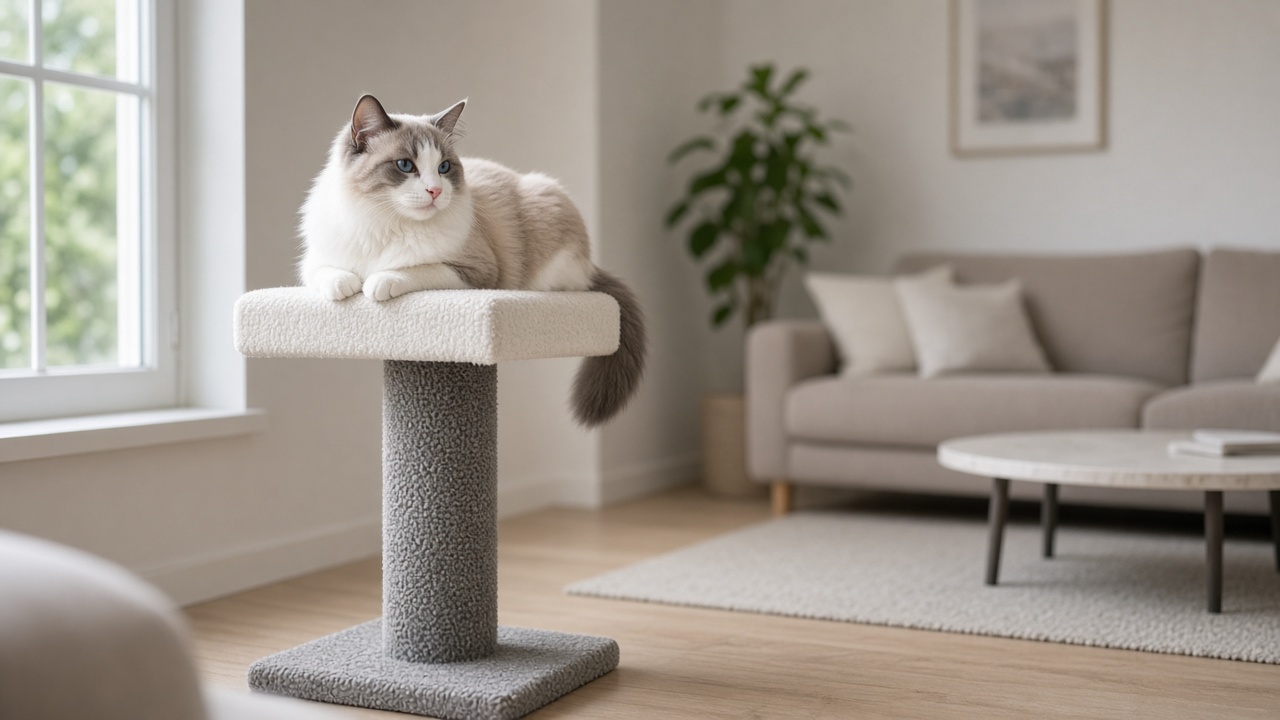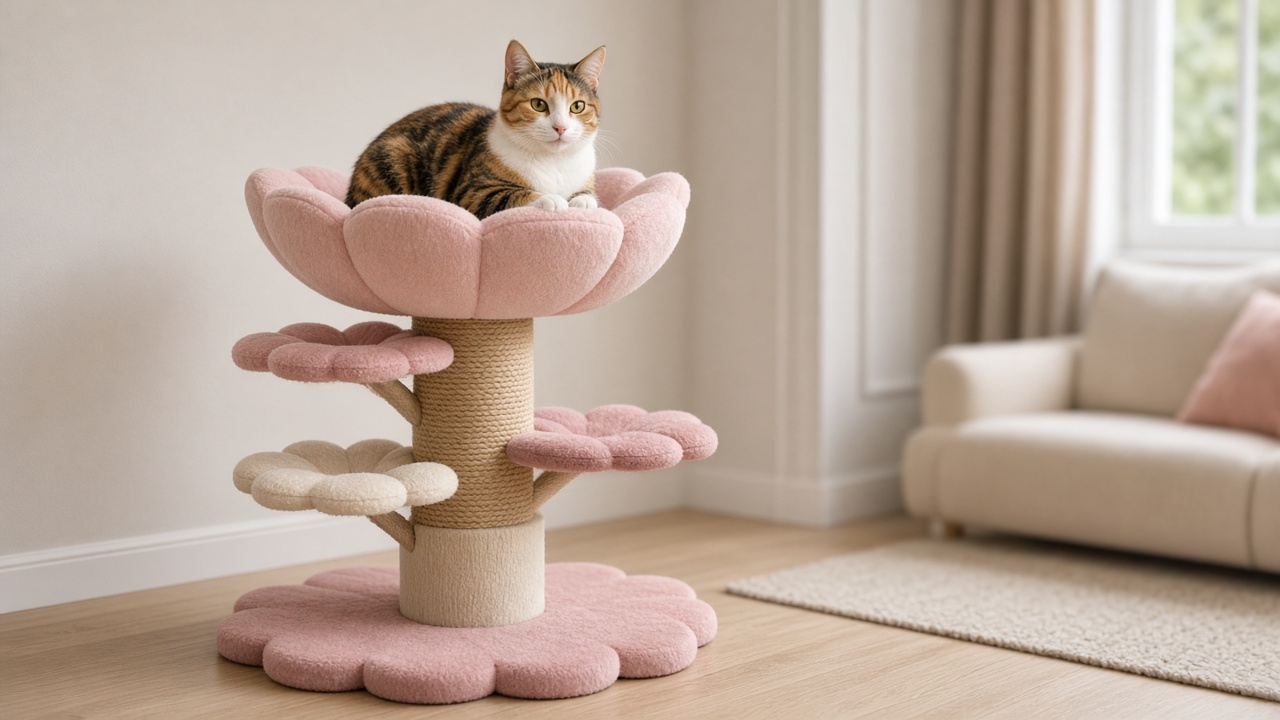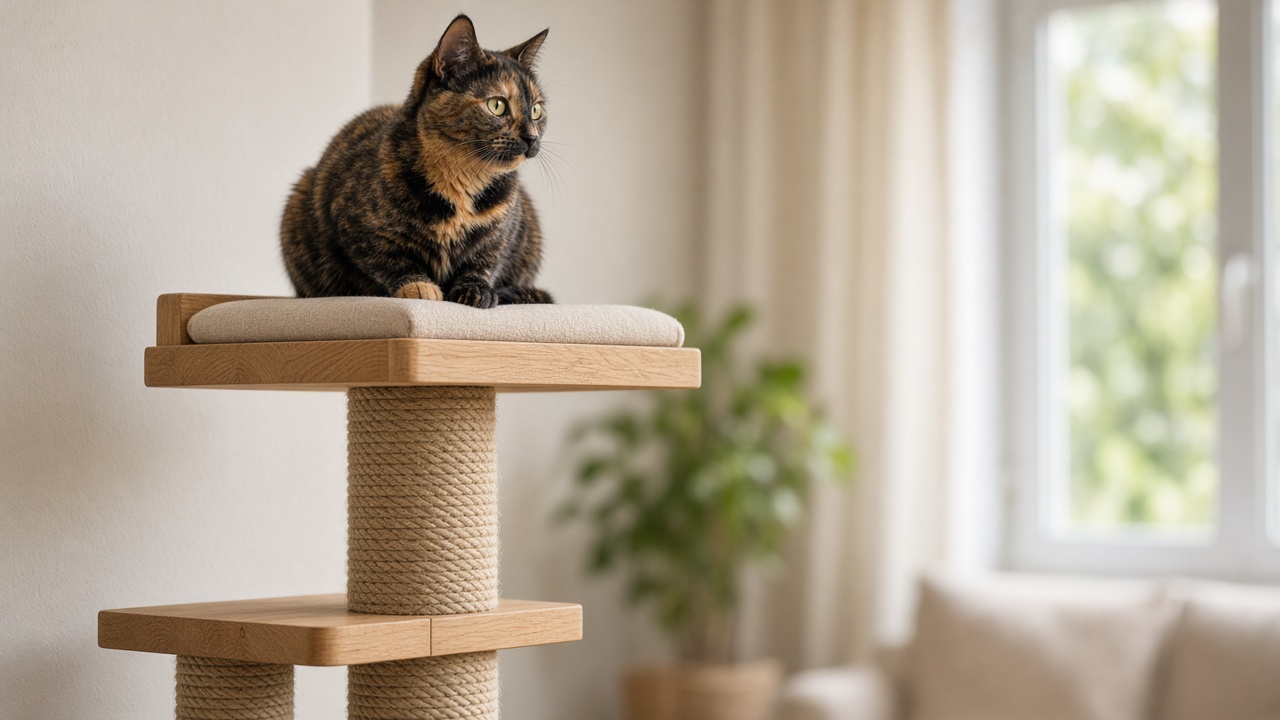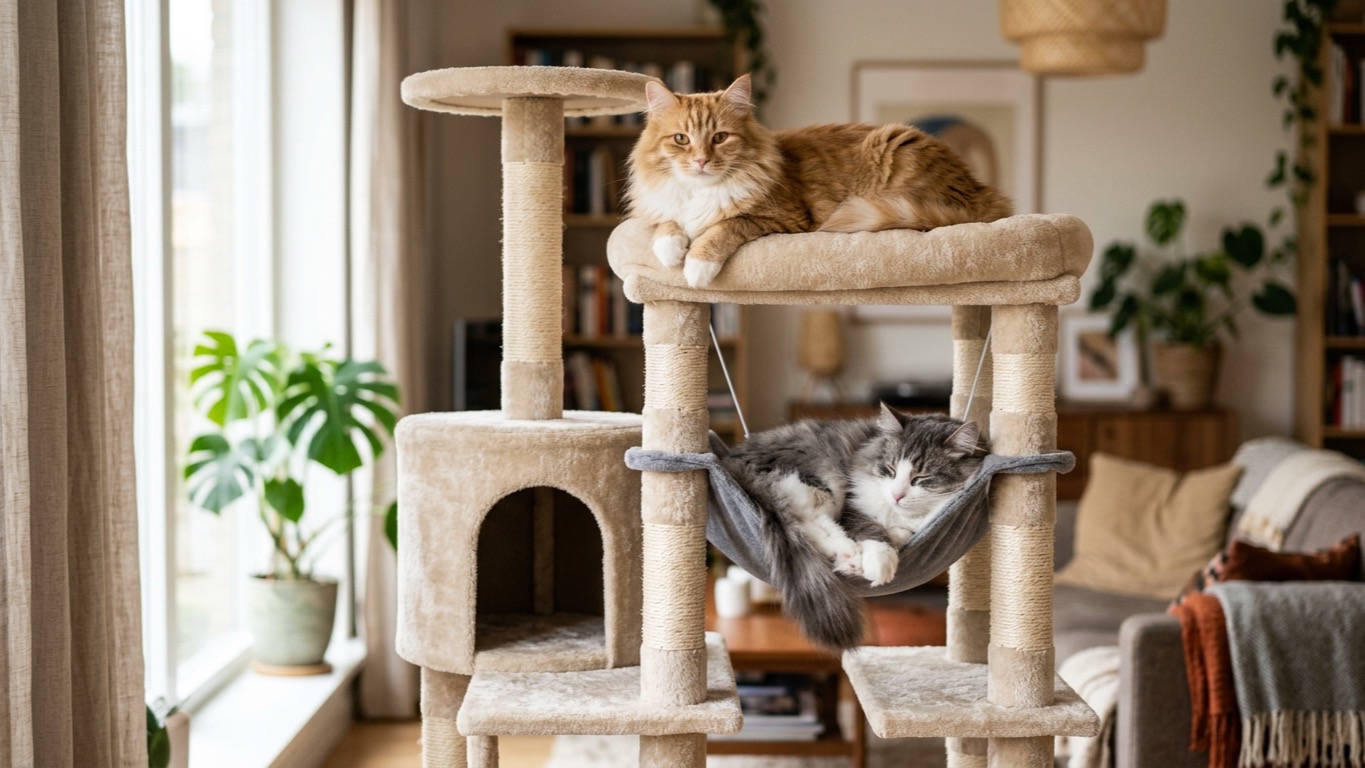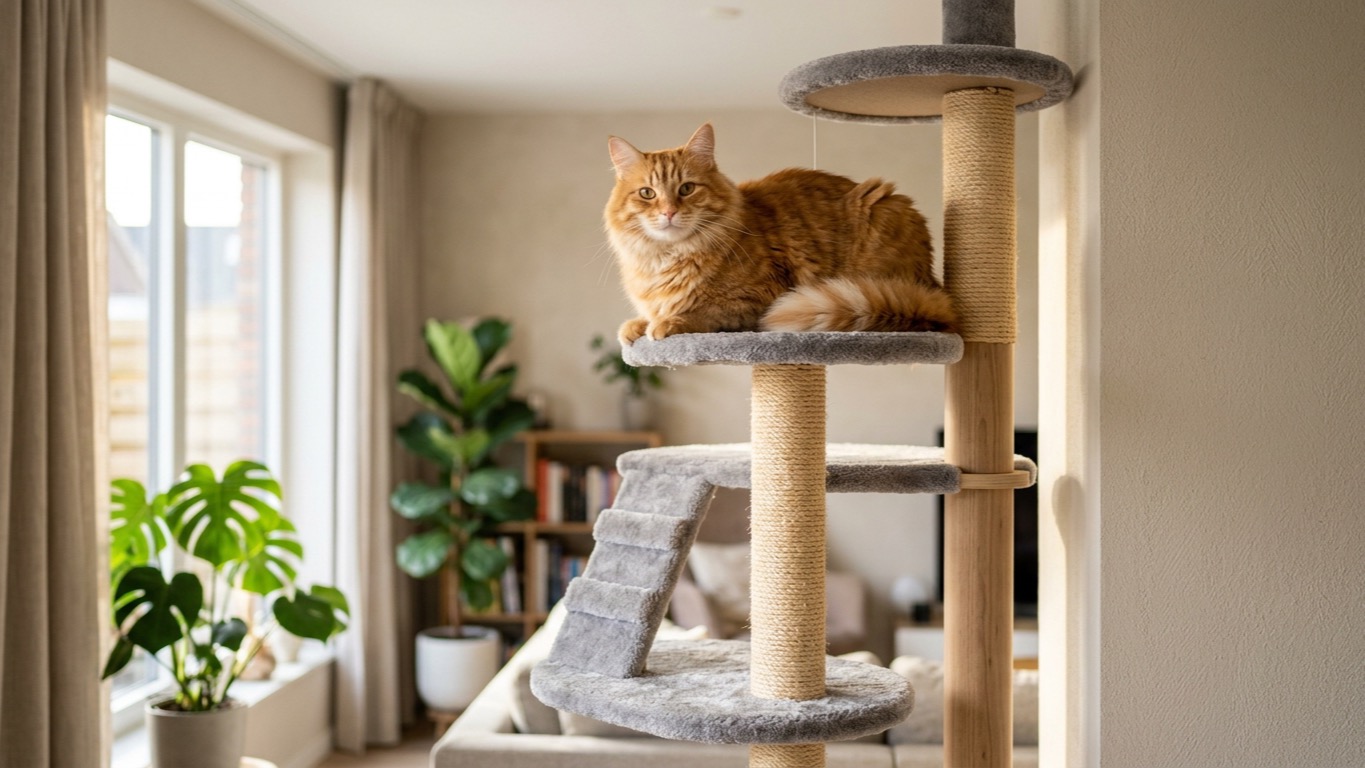
The best floor to ceiling cat tree is a tension- or span-rated tower whose printed height range includes your measured ceiling, with a pole thick enough for the heaviest cat who will launch from the top — not a cactus silhouette that merely looks tall. The We read the titles and descriptions of 7 SKUs. Six cards printed stickers from $95.11–$306.20; 1 of 7 (Veehoo) had no listed price on the listed card. 1 of 7 sits under $100 (PAWZ Road Cactus $95.11). 2 of 7 sit $194–$219 (Hey-brother $194.94; PEQULTI $218.38). 3 of 7 sit $273–$307 (Sturdy wood $273.35; Heybly HCT92G $280.05; FUKUMARU $306.20). Manufacturer-stated adjust bands on this set run as wide as 61–113 in (Veehoo class) and as tall as 104.7–116.5 in (Heybly HCT92G). 0 of 7 is a clinic device. Vertical territory can reduce furniture scratching when cats actually use it. A loose pole is a fall.
Span jobs: apartment no-drill, multi-cat condos, heavy-breed wood, decorative small-room, high-ceiling only. Measure first. Buy the job.
Our guides are reader-supported. This article may contain affiliate links. As an Amazon Associate we may earn a commission if you buy through links, at no extra cost to you.
Related indoor territory: look at other cat furniture on thepetbench when your ceiling will not take tension. This URL is the span job only.
Quick picks at a glance
- Best listed feature-dense spend: FUKUMARU Floor to Ceiling Cat Tree — $306.20. Capsule/hammock marketing; fiddly modular assembly on owner themes.
- Best listed multi-cat condo density: Heybly HCT92G — $280.05. Brand copy: 104.7–116.5 in, two condos, many sisal posts. High-ceiling card.
- Best listed wide tension band: Veehoo Floor to Ceiling Cat Tree — price not on card. Brand copy: ~61–113 in, 4.5 in posts, no-drill tension.
- Best listed decorative / lowest sticker: PAWZ Road Cactus — $95.11. Shape is the feature; true span vs freestanding is the homework.
- Best listed mid-height condo/hammock: PEQULTI Tall Cat Tree — $218.38. Brand copy: ~90.5–100.4 in.
- Best listed solid-wood tension class: Sturdy Floor-to-Ceiling Cat Tree — $273.35. Weight and framing are the trade.
- Best listed standard-ceiling tower: Hey-brother 0MPJ091W — $194.94. Brand copy: ~94.5–106.3 in.
Four jobs. A tree that does not reach the ceiling is a freestanding tower you overpaid to call “floor to ceiling.”
| Job | What actually works | Tower role | Fails if you skip the real job |
|---|---|---|---|
| Rental / no drill | Tension pole within your measured height | Veehoo-class band | Fail if you drill a condo anyway |
| Multi-cat vertical | Multiple condos + separate perches | Heybly-class density | Fail if one penthouse starts fights |
| Heavy / large cat | Thick posts, wood or wide platforms | Sturdy / Heybly | Fail if a 15 lb cat launches a 2 in pole |
| Decor + budget | Lowest sticker you will actually anchor | PAWZ class | Fail if it wobbles and you never wall-strap |
| Tower (this URL) | Listed price | Stated height band (manufacturer / typical listing) | Span job |
|---|---|---|---|
| PAWZ Road Cactus | $95.11 | Decorative 5-tier class — confirm if it truly spans | Budget / aesthetic |
| Hey-brother 0MPJ091W | $194.94 | 94.5–106.3 in | Standard ceiling |
| PEQULTI Tall | $218.38 | 90.5–100.4 in | Mid condo/hammock |
| Sturdy Solid Wood | $273.35 | Tension / wood class — read the range on the box | Heavy-duty wood |
| Heybly HCT92G | $280.05 | 104.7–116.5 in | Multi-cat / high ceiling |
| FUKUMARU | $306.20 | 6–8 ft class on typical copy | Feature-dense climb |
| Veehoo | — | 61–113 in | Widest listed tension band |
Before you shop: (1) you measured floor-to-ceiling in the exact corner, (2) that number sits inside the printed adjust range with leftover tension travel, (3) you will re-tighten on a calendar, (4) a cat who cannot jump or has a known heart/joint disease gets a veterinarian’s mobility advice before you buy a penthouse. Fail gate 1 and this checklist is decorative.
Height bands above are manufacturer listing language compiled at the desk.
What the best floor to ceiling cat tree can and cannot do
Indoor cats use height the way outdoor cats use territory. AAFP and common shelter enrichment pages want vertical space, scratch surfaces, and a place to watch. A span tree buys height without a 30-inch plywood base — when the tension is real.
What a tree can do: offer scratch, perch, and hide in a small footprint; keep some claws off a sofa if the sisal is in the path the cat already uses.
What a tree cannot do: replace play; fix redirected aggression; stay tight forever without a wrench; make a popcorn ceiling a good compression surface; turn a $95 cactus into a 116-inch span.
How the desk scored the best floor to ceiling cat tree (specs, not a drop test)
Five listing-visible signals plus sticker:
- Printed height range vs your tape. The only number that matters.
- Tension vs freestanding honesty. If it needs a huge base and a wall strap, it is not a span tree.
- Post diameter and material. 4+ inch sisal or wood beats a skinny carpet dowel for a large cat.
- Condo / perch count vs cat count. Two cats need two “owned” spots.
- Ceiling compatibility. Smooth drywall vs popcorn vs sloped vs drop-tile — read the manual.
Price is why households buy the cactus and then return it. Measure first.
The 7 cards on this URL
1. FUKUMARU Floor to Ceiling Cat Tree
Best for: a household that wants modular levels, a capsule-style perch, and will accept assembly time.
Listed $306.20. Highest sticker. Brand copy: multi-level climb, thickened scratch posts, transparent capsule / hammock features on typical listings, six-to-eight-foot class. Owner-report themes: fiddly modular hardware, larger footprint than the box photo.
Honest drawback: you are paying for features. If the ceiling is 8 ft 2 in and the range does not include leftover compression, this card fails the Gate regardless of capsules. Re-check the current listing’s inch range before you click.
2. Heybly Floor to Ceiling Cat Tree HCT92G
Best for: multiple cats and a high ceiling that actually sits in 104.7–116.5 in.
Listed $280.05. Brand copy: two condos, a large stated scratch-post count (15 on typical HCT92G language), wide footprint. That height band excludes many 8-foot (96 in) apartments. Do not buy this card for a standard 8-ft room unless the listing you open has a different SKU range.
Honest drawback: floor area. A “vertical” tree that still eats a rug is a space tax. Owner-report themes: size, stability when assembled in-range.
Check Heybly HCT92G listings →
3. Veehoo Floor to Ceiling Cat Tree
Best for: a no-drill tension pole when your tape measure lands between about 61 and 113 in.
Listed price: not on the listed card. Brand copy: corner-friendly, 4.5-inch thickened scratch posts, tension, no drilling. Wide band is the main reason this card exists.
Honest drawback: fewer condos/hammocks than Heybly or FUKUMARU on typical copy. Tension still needs a sound ceiling and floor. Popcorn texture and sloped ceilings are manual problems.
4. PAWZ Road Cactus Cat Tree
Best for: a household that wants a $95 decorative tower and will confirm whether the SKU is true span or a freestanding cactus.
Listed $95.11. Lowest sticker. Brand copy: cactus silhouette, five-tier class, hanging toy, sisal. Owner-report themes: wobble if not anchored; fit in tight rooms.
Honest drawback: “floor to ceiling” in the search query is not the same as a tension spec. If the listing shows a wide base and no compression rod, you bought a statue. Wall-strap if the manual says so. Large cats plus a skinny aesthetic post is a physics problem.
Check PAWZ Road Cactus listings →
5. PEQULTI Tall Cat Tree
Best for: a condo-plus-hammock layout on a ceiling that fits ~90.5–100.4 in.
Listed $218.38. Mid spend. Brand copy: large indoor cats, rest variety, 90–100 in class. That band fits many 8-ft rooms if your tape is 96 in and the mechanism still has travel. A 9-ft (108 in) room is outside this card.
Honest drawback: fewer scratch posts than Heybly-class copy. Upper levels are useless if you cannot extend to the ceiling.
6. Sturdy Floor-to-Ceiling Cat Tree (Solid Wood)
Best for: a heavy cat and a household that will move this thing once.
Listed $273.35. Brand copy: solid-wood posts (~4.3 in on typical language), drill-free tension, durability. Owner-report themes: weight, stock, ceiling-mount strain on old framing.
Honest drawback: “solid wood” is not a license to compress a cracked joist. If the ceiling is old plaster, get a second human and read the load notes. Relocation is a weekend.
Check Sturdy solid-wood listings →
7. Hey-brother Cat Tree 0MPJ091W
Best for: a standard-ceiling climb with a condo when 94.5–106.3 in matches the tape.
Listed $194.94. Brand copy: tall tower, hammock/condo on typical listings, assembly time. Scratch surface can be sparser than Heybly-class copy.
Honest drawback: if your ceiling is 8 ft even (96 in), you are near the bottom of the band — confirm leftover tension. If you are 9 ft 6 in, this card does not reach.
Check Hey-brother 0MPJ091W listings →
Height math for the best floor to ceiling cat tree
Measure in the install corner. Floors and ceilings are not level. A 96 in hallway can be 94.5 in next to a vent.
| Typical room | Approx. height | Cards whose listed bands can include it |
|---|---|---|
| 8 ft even | 96 in | Veehoo; PEQULTI; Hey-brother; maybe FUKUMARU 6–8 ft class |
| 8 ft 6 in | 102 in | Veehoo; Hey-brother; FUKUMARU class |
| 9 ft | 108 in | Veehoo; Heybly (low end is 104.7 — tight); FUKUMARU if listed |
| 9 ft 6 in+ | 114 in+ | Heybly 104.7–116.5; Veehoo if ≤113 |
Leave travel in the mechanism. A range that “exactly equals” your tape with zero leftover is how poles loosen in week three.
Tension vs freestanding vs the best floor to ceiling cat tree
Tension poles compress between floor and ceiling. The footprint can be a pad, not a 24-inch cube. Freestanding trees need mass at the base. Decorative cacti often cheat: they look tall and still tip.
| Design | Floor cost | Ceiling job | Fail mode |
|---|---|---|---|
| True tension | Small | Compression + pad | Loose screw, bad ceiling |
| Freestanding tall | Large base | None | Tip on launch |
| Hybrid + wall strap | Medium | Optional | You never install the strap |
| Decorative cactus | Varies | Often none | Wobble, return |
Veehoo-class copy is the tension lesson. PAWZ is the honesty lesson.
Price ranges and what you are buying
| Listed band | SKUs | What the sticker is usually paying for |
|---|---|---|
| ~$95 | PAWZ cactus | Shape, five-tier class, not a guaranteed span |
| $195–$220 | Hey-brother; PEQULTI | Standard/mid height, condo/hammock |
| $273–$307 | Sturdy; Heybly; FUKUMARU | Wood, multi-cat density, or feature stack |
| Unlisted | Veehoo | Confirm live price; band is the product |
Premium is not a fall certificate. A $306 capsule tower that misses the ceiling is a $306 mistake.
Apartments, rentals, and the best floor to ceiling cat tree
No-drill is why tension exists. Pads still mark some paint. Photograph the ceiling before and after. Popcorn texture crushes. Drop ceilings are often a no. Sloped attic rooms need the manual, not hope.
HOA rules sometimes ban “permanent fixtures.” Tension is the argument. A wall-screwed cactus is not.
If you move every year, prefer a tool-simple tension pole over a 70 lb wood kit.
Multi-cat houses and resource maps
Two cats need two high spots that do not require crossing each other. Heybly-class two-condo copy exists for that. One penthouse plus one bully is how the sofa becomes the second tree.
Add a second scratch post on the opposite wall if the tree is in a corner the timid cat will not enter. Vertical territory that is blocked is floor territory.
Seniors, large cats, and mobility
Thick posts (Veehoo 4.5 in class; Sturdy wood) give a landing a cat can trust. Tiny carpet dowels flex. Seniors may want mid-height hammocks, not a 7-tier sprint. Arthritis is a clinic conversation. A penthouse you force a 14-year-old into is not enrichment.
Weight limits on listings are manufacturer claims. If two large cats launch together, the limit is a suggestion you should treat as a ceiling.
Assembly, torque, and a 30-day re-tighten
Follow the sequence. Cross-thread is how “wobble” starts. Two people for wood kits. Do not stand on a platform to tighten the top.
Calendar: re-check at day 3, day 30, and after any move. Seasonal humidity moves wood and drywall. A quiet rattle is a wrench job, not a new SKU.
Materials: sisal, carpet, suede, wood
Sisal is the scratch job. Carpet sheds and holds urine. Suede looks like furniture and wears. Wood posts dent instead of fuzz — still need sisal wraps if you want claws off the sofa.
Urine on a span tree is an enzyme job. See best enzymatic cleaner for pet urine. Do not bleach a sisal wrap into mush.
Worked room examples (tape math, not a build we did)
Example 1 — 8 ft 0 in rental, one cat, no drill. Tape 96 in. Veehoo 61–113 includes it with travel. PEQULTI 90.5–100.4 includes it. Heybly 104.7–116.5 does not. PAWZ only if you accept it may not span.
Example 2 — 9 ft 4 in living room, two cats. Tape 112 in. Heybly 104.7–116.5 fits. Veehoo 113 in max is tight — measure twice. PEQULTI does not reach.
Example 3 — 8 ft 2 in, 16 lb cat, wood preference. Sturdy wood if the printed range includes ~98 in. Confirm the box. Budget cactus is the wrong physics.
Example 4 — decor-first studio. PAWZ $95.11 if you will strap it. Do not call it the best floor to ceiling cat tree unless the listing shows a real compression rod.
These examples use listed bands. SKUs change. Re-read the inch line on the page you buy.
A 7-tier generic row that is not a card. We stripped the test claim, kept the seven cards byte-for-byte, and used single-tag amazon.com URLs.
When to involve a veterinarian (mobility, not a furniture review)
- A cat who suddenly stops jumping
- Open-mouth breathing after a climb
- Known heart disease or severe arthritis
- Obesity plus a new high perch you expect them to use
A tree is not cardiac rehab. The clinic sets activity limits.
Frequently asked questions
Is the best floor to ceiling cat tree safe for rental apartments?
Tension designs are the rental argument because they usually avoid screws. They still need a sound ceiling and a pad that will not punch paint. Veehoo-class 61–113 in copy is the wide-band example. Verify the lock after assembly. Photograph the ceiling.
How do I choose the right height?
Measure the install corner. Compare to the printed range. Demand leftover travel. Heybly HCT92G’s 104.7–116.5 in band is a high-ceiling card. PEQULTI’s 90.5–100.4 in band is an 8-ft-class card. Exact match with zero leftover is a loosen-later tree.
Do these trees work for heavy or senior cats?
They can if posts are thick and platforms are mid-height. Sturdy wood and 4.5 in sisal copy exist for weight. Seniors may need fewer jumps. Ask the veterinarian when mobility is the question.
What are the main benefits of a floor-to-ceiling design?
Height without a giant base — when tension is real. Scratch, watch, hide. Multi-cat condos if the footprint and count match the household. A loose pole has no benefits.
Can I put the best floor to ceiling cat tree on carpet?
Often yes; thick plush can steal compression. A furniture pad or the included base plate matters. Recheck torque after the carpet crushes.
Will a span tree stop sofa scratching?
Only if the sisal is in the path and you reward use. Nail caps, play, and a second post still exist. A cactus in the wrong corner is decor.
Related notes
Urine on sisal: best enzymatic cleaner for pet urine. This page does not sell a second tree category. Measure twice.
Ceiling types the best floor to ceiling cat tree actually meets
| Ceiling | Desk note | First card instinct |
|---|---|---|
| Smooth painted drywall | Best compression story | Any true tension in-range |
| Popcorn / texture | Crushes; pads sink; paint dust | Wider pad; maybe skip |
| Drop / acoustic tile | Often a no — tiles lift | Freestanding instead |
| Sloped attic | Manual, not hope | Usually fail Gate |
| Concrete / condo slab | Can work; protect finish | Veehoo-class + pad |
| Old plaster / lath | Punch-through risk | Second human; or skip |
If you cannot name the ceiling, you cannot buy a span tree. Photograph it. If the listing forbids your type, believe the listing.
Wall shelves vs the best floor to ceiling cat tree
Shelves need screws and studs. They win on a long hallway run. They lose in a no-drill rental. A span tree is one vertical. Shelves are a highway. Multi-cat houses often want both — tree for scratch/condo, shelves for passing without a fight.
Do not screw shelves into the same corner you are compressing. You can crack the story you just told the landlord.
Kittens, introductions, and the first week
Kittens climb what you did not intend. A tension pole they can shake is a toy until it is a fall. Start with mid platforms. Block the top if the kit is a wiggle.
New adult cats: leave the tree assembled and quiet. Do not force a penthouse on day one. Food at mid-height beats a stuffed-animal toss from the top.
If you already have a bully, place the tree where the timid cat can see exits. A corner trap is how the sofa wins.
Noise, neighbors, and night launches
Span trees transmit thumps into the ceiling of the apartment below. Felt pads help. They do not silence a 15 lb launch at 3 a.m. If the lease mentions quiet hours, a heavy wood kit may be the worse neighbor choice even if it is the better cat choice.
Rattle at 2 a.m. is a loosen signal. Wrench it in the morning. Do not wait for a tip.
Scratch placement, nail caps, and the sofa
Sisal that faces the path from the window to the food works. Sisal that faces the wall does not. Rotate posts if the wrap is one-sided. Replace wraps when they are smooth — a bald post is a sofa referral.
Nail caps are a separate product class. They do not make a wobbly cactus safe.
Play still matters. A tree without a wand session is furniture. Two ten-minute chases beat a seventh unused hammock.
Litter, food, and the best floor to ceiling cat tree
Do not plant the tower next to the box. Cats do not want a penthouse over ammonia. Do not plant it on the only path to the bowl if a bully owns the top.
Water fountains under a sisal rain of dander is how you clean twice. Leave air.
Maintenance calendar (desk, not a lab)
| When | Action |
|---|---|
| Day 0 | Tape measure photo; range screenshot |
| Day 3 | Re-torque; check ceiling pad mark |
| Day 30 | Torque; sisal wear; wobble test at mid platform |
| Season change | Wood and drywall move — torque again |
| After any move | Full re-level |
| Urine event | Enzyme, dry, then torque (wet particle board swells) |
If particle-board platforms swell, replace or retire. A swollen screw hole is how platforms dump a cat.
Safety checklist before you call it the best floor to ceiling cat tree
- Tape is inside the printed range with leftover travel
- Ceiling type is allowed
- Two people for wood kits
- No climb during assembly
- Platforms level
- No dangling cords a kitten can hang in
- Re-tighten date on the calendar
- Clinic advice if the cat has heart or joint disease
You do.
Cost-per-year sketches (listing stickers, not a durability trial)
FUKUMARU $306 over three years is ~$102/year if it stays tight. PAWZ $95 that you replace twice after wobble returns is $190 and two weekends. Cheap is not cheap if it fails the Gate.
Heybly $280 for two cats who actually split condos can beat two $95 cacti plus a ruined sofa corner. That is household arithmetic, not a scratch-count we ran.
More on the best floor to ceiling cat tree and windows
Cats want the bird channel. A span tree that blocks the only window is a fight. Offset it. Leave the sill. A hammock that faces glass earns use; a condo that faces a blank wall does not.
Screens are not fall protection for a launching cat on a high perch. If you open the window, the tree changes the physics. Keep screens rated, or keep the window shut.
How we researched this guide
Selections reflect manufacturer height bands and feature lists, listed prices on these cards (August 2026 snapshots), and public indoor-cat enrichment framing (vertical space, scratch, hide).
Keep a log: tape measurement, SKU range, tighten dates. If the pole clicks, wrench it. If the cat stops jumping, call the clinic.
Room-by-room notes, still not a site visit: a bedroom tree that blocks the closet door will be moved — and every move is a re-torque. A living-room tree in the TV sightline will be pushed to a corner that may be a different height. Measure the corner you will actually use, not the center of the room you imagined.
Open-plan lofts with 11–12 ft ceilings sit outside most of these bands. Heybly’s 116.5 in top is still under 10 ft. A true 12 ft room wants a different product class or a stacked custom pole the listings here do not sell. Do not stack two consumer trees. That is not a listed system.
Basements with drop ceilings fail the Gate. Finished basements with drywall can work if the tape matches a band. Damp basements swell particle board. Wood kits still hate wet slabs without a pad.
Card-by-card honesty pass for the best floor to ceiling cat tree
Heybly HCT92G ($280.05). You are buying condo count and a high-ceiling band (104.7–116.5 in). You are not buying an 8-ft apartment fit. Two cats is the story. One cat in a studio is wasted footprint unless you love the look.
Veehoo (price missing on card). You are buying the widest listed tension band (61–113 in) and 4.5 in post copy. You are not buying Heybly’s condo farm. Check today’s sticker before you budget $300 mentally.
PAWZ cactus ($95.11). You are buying a shape. You may not be buying span. Read for a compression rod. Strap if the manual says strap. Large cats plus skinny aesthetic posts are a return waiting to happen.
PEQULTI ($218.38). You are buying 90.5–100.4 in plus condo/hammock language. You are not buying a 9 ft 6 in room. Good 8-ft-class candidate if travel remains.
Sturdy wood ($273.35). You are buying mass and wood posts. You are not buying easy relocation. Old plaster ceilings are a second-human job. Stock gaps are an owner theme — if it is out, do not substitute a cactus and keep the “wood” story.
Hey-brother 0MPJ091W ($194.94). You are buying 94.5–106.3 in and a mid sticker. You are not buying 15 scratch posts. Confirm leftover travel at 96 in.
None of these paragraphs is a hang test. They are listing-to-job maps.
Second-cat and dog-in-the-house notes
A span tree is a launch pad for a dog who likes to play keep-away with a cat. If the dog can barrel the base, tension still helps but a wide Heybly-class footprint can be a trip. Gate the room or pick a corner the dog cannot run.
A second cat who never leaves the floor does not need a $306 capsule. Spend on a second box and a mid perch. Vertical is for cats who climb. Do not moralize a floor cat into a penthouse.
Returns, damage photos, and the best floor to ceiling cat tree
Photograph the ceiling pad before tightening. Photograph after. Marketplace returns argue about “holes” that were compression marks. Your tape, your range screenshot, and those photos are the ticket.
If a pole arrives bent, stop. Do not “make it work.” A bent tube is a lever.
Keep the box through the first 30-day re-tighten. That is when wobble shows.
Why the desk will not invent a winner badge
A winner badge without your ceiling is a lie. This checklist is a job table. Your tape is the judge. If two cards fit, pick condo count vs wood vs budget. If none fit, this URL is the wrong aisle — buy freestanding or shelves, or hire a custom pole. We will not stretch Heybly’s 104.7 in floor to 96 in for you.
Travel carriers and hotel rooms do not need a span tree. A folding scratcher travels. Do not buy FUKUMARU for a two-week Airbnb.
Outdoor “catio” builds are a different product class: weather, fasteners, predator pressure. None of these seven indoor cards is a catio spec. Do not leave a tension pole in a screened porch that sees rain.
If you already own wall shelves, add the tree on the opposite wall so traffic can loop. Two verticals on the same stud wall is how cats bottleneck and fight.
A scratching post at the sofa arm is still allowed. The best floor to ceiling cat tree is not a moral replacement for a $20 sisal post in the right place.
Kids: teach “we do not shake the pole.” A tension tree is not a fire-pole. One good yank at the mid platform is a trip to the wrench and maybe the ER.
Holiday trees: keep the span tower away from the fir. Tinsel plus a launch pad is a surgery story. We are not veterinarians. We are telling you the geometry.
If a platform screw strips, stop using that level. A spinning platform dumps a cat. Replacement hardware from the seller beats a hardware-store guess that is the wrong thread.
Used marketplace towers: you cannot see cracked welds or compressed springs in a photo. Prefer new if the ceiling is rental paint you cannot explain.
That is the rest of the desk. Measure. Match the band. Tighten. Leave the clinic for the cat who stops jumping.
Guest rooms: a tree that lives in a closed room five days a week is not territory. Cats use what they can reach at 6 a.m. Put the span where the household already sits.
If you work from home under the penthouse, expect interruptions. A capsule perch over the keyboard is a feature or a bug. Place accordingly.
String toys tied to the top platform become hang hazards. Use wand toys you put away. The best floor to ceiling cat tree should not wear a permanent noose.
Vacuum the base. Hair under a tension pad is how compression walks. A clean pad is part of the Gate.
If you outgrow the band after a renovation (new floor, new ceiling medallion), re-measure. A 0.5 in floor overlay can push you out of PEQULTI’s 100.4 in ceiling. Renovations change the checklist.
We are done inventing scenarios. Your tape is still the judge.
A laser measure and a steel tape can disagree by half an inch. Use one tool twice. If they still disagree, believe the smaller number — leftover travel is the safety margin the best floor to ceiling cat tree actually needs.
If your partner “already measured,” measure again in the install corner. Hallway height is not living-room height. That second tape is how you avoid a $306 return.
Keep the hex key in a labeled bag on the tree. The 30-day re-tighten dies when the key enters the junk drawer.
If you share the home with a contractor, tell them the pole is load-bearing for a cat, not a coat rack. Hanging a holiday wreath from a hammock is how platforms twist.
A phone reminder labeled “cat tree torque” on day 3 and day 30 is part of the product. The best floor to ceiling cat tree is hardware plus a calendar. Skip the calendar and you bought a slow tip.
If the cat ignores the tree for two weeks, move the sisal into the path — not the SKU into the cart. A second purchase does not fix a wrong corner. Treat the first tree as furniture you can slide one foot, then re-torque. That is cheaper than another $280 Heybly you also place badly. Slide, re-tape the ceiling height, re-torque, then wait a week before you open a new listing. Use is the test you can run at home without inventing a lab. Watch where the cat actually sits at dawn, not where the listing photo sat the tree. Dawn traffic is the map you actually own, not the catalog pose on a white seamless paper backdrop.
Last reviewed: August 2026. The live cards stay as listed. Prices and listed ranges move.