Quick answer: Pick a two-ingredient oil-and-water spray, such as KONG Naturals Catnip Spray or From The Field Catnip Oil Spray Rejuvenator, and mist a scratcher—not the cat. If two short trials produce no roll or rub, stop buying stronger bottles and try silver vine herb instead.
A catnip spray is a mess-free nepetalactone mist for toys and scratchers, but it will not convert a cat that ignores dried catnip.
This page is a spec-comparison note from our research team.
BMC Veterinary Research reported that 68% of 100 domestic cats responded to catnip. The same paper reported that 79% responded to silver vine.
A louder label cannot close that gap. The bottle only delivers scent. It does not add the response gene.
How we chose which sprays to include
Our research team analyzed maker pages for currently sold catnip sprays. We used one selection rule and kept it visible.
A spray entered this page only if the maker listed a water-plus-catnip-oil or catnip-extract formula and a stated fill volume. That is the Surface-First Spray Rule: we cover object mists for toys, scratchers, and beds.
We left out silver-vine-only oils, bubble solutions, and dried-leaf shakers. We also left out pheromone calming mists and furniture deterrent sprays. Those products solve different jobs.
Reseller copy was not enough.
That rule cut a long shelf list down to five sprays. The five share a job: put catnip scent on a surface without loose leaf.
They do not share a fill size. They do not share how much oil the maker discloses.
Top 7 Catnip spray
The picks below are the 7 catnip sprays on sale right now, listed with what each suits best and an honest drawback. Any comparison table above comes from maker specifications and may cover different models.
1. from The Field | Catnip Spray Rejuvenator for Cat Toys & Scratchers |
Best for: Owners refreshing tired scratchers
From The Field sells this as a toy-and-scratcher rejuvenator, not a coat spray. The maker page lists a 1 oz mix of catnip essential oil and distilled water, and it tells buyers to shake because the oil sinks. A spray or two is the listed dose for a tired toy or a post you want the cat to use.
Pros: Budget toy-rejuvenator spray; Listed 1 oz fill Cons: Small one-ounce bottle
2. KITTY KA-ZOOM Catnip Spray for Cats
Best for: First-time indoor spray buyers
KITTY KA-ZOOM lists a steam-distilled catnip oil and distilled-water mist for toys, beds, and scratchers. The maker page sells it as mess-free play at this $6.99 tier. The same listing notes that not every cat reacts, so a cheap first bottle is the honest use.
Pros: Low $6.99 price; Simple oil-water mist Cons: Few details beyond price
3. Meowijuana Premium Catnip Spray for Cats
Best for: Homes rotating many toys
SmarterPaw’s Meowijuana page lists a 3 oz bottle of distilled water and catnip oil for toys, scratchers, and new beds. The brand says the spray holds no THC or CBD. Owners report using it as a mess-free touch-up on posts; they also report cats that ignore it.
Pros: Listed 3 oz bottle; Water-and-oil formula Cons: Pricier than budget sprays
4. AmeizPet Catnip Spray for Cats 50 ml (1.69 Oz)
Best for: Travelers packing a tiny bottle
AmeizPet prints the fill in the name: 50 ml, or 1.69 oz. At $11.57 that is mid-list money for a travel-size scratcher and toy mist. The bottle is easy to stash; it will not last like a 3 oz refill.
Pros: Printed 50 ml size; Compact travel-size mist Cons: Small bottle, mid price
5. Ulvixar Catnip Spray for Cats
Best for: Mid-price standalone toy mist
Ulvixar sits at $12.99 as a standalone catnip spray, above the budget pair and below the kits. Listing copy frames it as a mess-free mist for toys and scratchers. Public pages do not publish a water-to-oil split, so you are buying a mid-tier bottle, not a documented formula.
Pros: Mess-free spray format; Standalone mid-price bottle Cons: Thin published formula details
6. Smokey's Stash Catnip Spray and Dried Catnip Bundle for Cats
Best for: Owners wanting spray plus leaf
Smokey’s Stash is a kit: a catnip spray plus dried leaf. The maker page lists a 2 oz oil-and-water spray and a pop-top of cut herb, so you can mist a toy and still sprinkle a pinch. Owners who want both forms get them; they also take on flakes the spray-only bottles avoid.
Pros: Spray-plus-leaf bundle; Two-ounce spray included Cons: Dried leaf still sheds
7. Catnip Spray
Best for: Shoppers comparing unlabeled bottles
This card is titled only “Catnip Spray,” and Amazon lists it at $19.88, the highest price here. The heading does not name a brand, a fill, or a formula split. Buyers at this tier are paying a premium for a generic bottle, not a documented kit or a stated ounce count.
Pros: Single spray-bottle format; No extra leaf mess Cons: Highest price, thinnest label
Comparison: Catnip spray at a Glance
Want to browse every option? See the full range of catnip spray on Amazon →
What a catnip spray is, and what it is not
Dried catnip sheds flakes. A spray is the same plant signal in a liquid carrier. The active scent in catnip is nepetalactone.
BMC Veterinary Research measured cis-trans nepetalactone at 1,010 μg per gram in dried catnip. The paper found only 3 μg per gram in silver vine fruit galls.
Silver vine still won more cats. Other compounds did that work.
So a spray that lists only catnip oil is not a silver vine substitute. It is a neater way to place catnip scent.
Catit states on its catnip page that about two-thirds of domestic cats respond to the herb. That claim sits close to the BMC Veterinary Research figure of 68%.
Meowijuana states that kittens under 6 months rarely respond at all. BMC Veterinary Research enrolled cats of six months or older. A spray will not “wake up” a young kitten on demand.
A catnip spray is also not a skin medicine. Dog wound mists are a different product class. See our hot-spot spray guide.
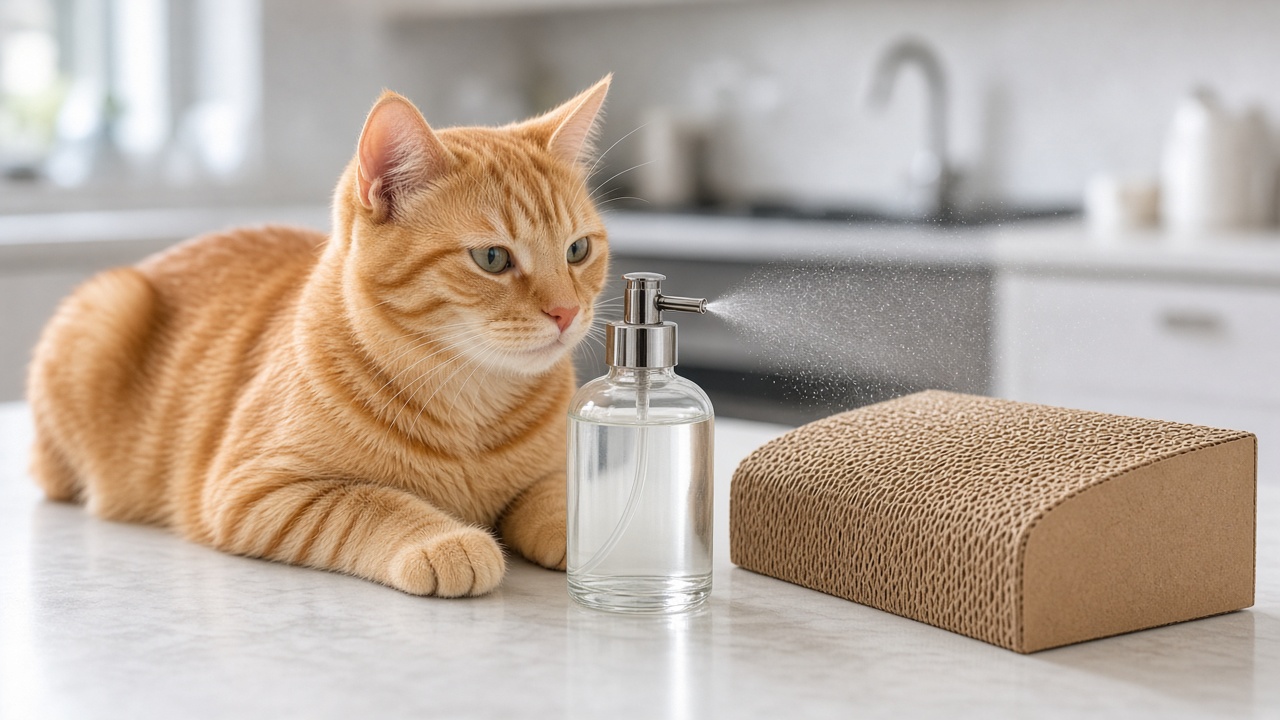
Do not spray the cat. Spray the object you want the cat to use.
Five bottles, compared by listed attributes
Our research team built a Pet Bench Spray spec listing review from five maker pages. We scored what each page disclosed, not how a cat “liked” a bottle.
Only one of the five pages listed an oil percentage. KONG Company lists Naturals Catnip Spray as 99% water and 1% catnip.
Fill volume ranged from 1 oz to 4 oz. That’s a fourfold spread on the same product type.
KONG Company lists a 1 oz bottle. From The Field lists 1 liquid ounce. Meowijuana lists 3 ounces.
Catit lists 3 fl oz, or 90 ml. Multipet lists 4 oz.
KONG Company lists the 1 oz spray at $7.99. Meowijuana lists the 3 oz spray at $10.99. That is about $3.66 per ounce on the Meowijuana page, versus $7.99 per ounce on the KONG page.
Those figures are list prices on the maker pages. They are not live checkout prices. They are not a value ranking.
| Product | Fill volume | Listed formula | Maker-stated use | Extra listed spec |
|---|---|---|---|---|
| KONG Naturals Catnip Spray | 1 oz | 99% water, 1% catnip | Toys, teasers, scratchers, condos | Bottle 1.26 × 1.26 × 4 in; made in USA |
| From The Field Catnip Oil Spray Rejuvenator | 1 liquid oz | Catnip essential oil and distilled water | Toys, beds, scratch posts | About 200 sprays; carton 5 × 1 × 1 in |
| Meowijuana Catnip Spray | 3 oz | Distilled water and catnip oil | Toys, scratchers, new beds | Grown in USA and Canada; no THC or CBD |
| Catit Catnip Spray | 3 fl oz (90 ml) | Concentrated extract of Canadian catnip | Toys, posts, play areas | Item #50753 |
| Multipet Catnip Garden Mist | 4 oz | Catnip aroma mist; no oil % listed | Toys, scratchers, play areas | Item 20504 |
KONG Company also lists a bottle weight of 0.06 lbs. It tells buyers to shake well before use.
From The Field says the essential oil is heavier than the water. The oil sits at the bottom until you shake the bottle. That is a concrete handling fact, not a potency score.
From The Field also states that about 300 pounds of catnip buds yield 1 kilo of pure catnip essential oil. The same page says the spray launched in 2004.
Meowijuana states the spray contains no marijuana, THC, or CBD. That matters only because the brand name confuses first-time buyers. The listed contents are water and catnip oil.
Catit calls its spray a concentrated extract of pure Canadian catnip. The page does not publish an oil percentage.
Multipet describes Catnip Garden Mist as a 4 oz aroma spray for toys and play areas. The maker page does not list a water-to-oil split. We treated that silence as silence.
How to apply a spray so the scent lasts
Use the Surface-First Spray Rule in the room, not only on this page. Mist the object, then step back and wait for the cat to approach.
KONG Company says to shake well before use. From The Field says the same, because the oil settles. Skip the shake and you may spray mostly water.
Start with one short burst on a scratcher or a tired toy. From The Field says a spray or two is enough to refresh a favorite toy. Meowijuana also says a spray or two can help a new bed feel familiar.
Do not soak fabric. Extra liquid does not add extra responders. It only adds wet spots and leftover mint.
Give the first trial five to ten minutes. Then put the bottle away.
BMC Veterinary Research used a washout of at least five minutes between plant materials. Home use can follow that pause.
If the cat rolls, rubs, or licks the object, you have a responder. Repeat on that same class of object later. Do not spray every surface in the room.
If the cat sniffs and leaves, wait a day. Try one more short burst on a different object. Two blank trials are enough to stop shopping for a “stronger” catnip spray.
Store the bottle cool and out of sun. From The Field notes that catnip essential oil is sensitive to heat and direct light. A windowsill is a bad shelf.
When a stronger bottle still fails
A blank response is usually genetics, not a weak nozzle. BMC Veterinary Research found that 31 of the cats did not respond to catnip. Of those 31, 22 cats, or 71%, still responded to silver vine.
The same paper found that 10 of those 31 cats, or 32%, responded to Tatarian honeysuckle. Six of the 31, or 19%, responded to valerian root.
Silver vine is the first alternate herb to try. It is not a second catnip spray with a louder label.
BMC Veterinary Research also reported that 94 of 100 cats responded to at least one of the four plants. Six cats responded to none. A small group will ignore every bottle you buy.
Meowijuana states that about 50–75% of cats are genetically wired to react to catnip. That range overlaps the BMC Veterinary Research result. It does not promise your cat is inside the range.
Age can mute intensity even when the gene is present. BMC Veterinary Research split 89 cats at a median of 4 years and 10 months. Older cats showed more mild catnip responses: 35% mild versus 12% in the younger group.
A senior cat may still sniff and walk off. That is not proof the spray is empty.
Do not keep stacking sprays on the same afternoon. Habituation is short, but it is real. Put the bottle up after one clean trial.
Scratching, leftover scent, and household mess
The useful job for most homes is redirection. You want claws on a post, not on a sofa arm.
From The Field tells buyers to spray a scratching post so the cat leaves the couch. Meowijuana gives the same use: spray a scratcher when the couch is losing. Catit frames the spray as a tool to teach where it is safe to play and scratch.
That’s training by scent, not punishment. Pair the mist with a post that already stands where the cat likes to scratch.
Cats that shred upholstery create the same household problem dogs create when they chew wood and foam. Our furniture-chewing guide covers the dog side of that damage. The cat side still needs a legal scratch target in the same room.
A spray will not rebuild a shredded arm. It can make the legal target more interesting than the illegal one.
Leftover mist can linger on fabric. Some people like the mint. Some do not.
If the room still smells after play, treat the fabric as a household odor job. That is the work of a pet odor eliminator spray, not a second coat of catnip.
Keep catnip spray off human bedding if you share it. Keep it off food bowls. Keep it off the cat’s face.
Multipet’s larger 4 oz bottle suits a house with several scratchers. The 1 oz bottles from KONG Company and From The Field suit a single post and a few toys. Volume is a logistics choice, not a quality score.
FAQ
Does catnip spray work if my cat ignores dried catnip?
Usually no. The spray carries the same plant signal in water, so a mist will not install the missing response. BMC Veterinary Research showed that 32% of cats in that sample did not respond to catnip.
Try silver vine herb next. In that paper, 71% of catnip non-responders still responded to silver vine.
How much should I spray on a toy?
One short burst is the starting dose. From The Field says a spray or two refreshes a favorite toy. Meowijuana says the same for a new bed.
Soak a toy and you waste liquid. You also wet stuffing that then holds odor you may not want.
Is a 4 oz bottle stronger than a 1 oz bottle?
No. Fill volume is how long the bottle lasts, not how hard the scent hits. Multipet lists 4 oz, while KONG Company and From The Field list 1 oz.
KONG Company is the only maker among these five that publishes a 1% oil figure. Bigger plastic is not a stronger formula.
Can I spray my cat directly?
No. These bottles are object mists. KONG Company lists toys, teasers, scratchers, and condos, and Catit lists toys, posts, and play areas.
Spray the item. Let the cat choose contact. Direct coat spraying is outside every maker page we used.
Why do some bottles need a hard shake?
From The Field says pure catnip essential oil is heavier than distilled water. It sinks. KONG Company also says to shake well before use.
A lazy shake can send out a weak first mist. Shake, then spray once.
Will a kitten respond to catnip spray?
Often not. Meowijuana states that kittens under 6 months rarely respond. BMC Veterinary Research started its sample at six months of age.
Wait until the cat is older, then run two short object trials. Do not keep buying bottles in the meantime.
Can catnip spray replace a pheromone calming diffuser?
No. This page covers play and scratch redirection. It does not cover synthetic pheromone products.
BMC Veterinary Research studied plant materials as olfactory enrichment. That is a play signal, not a clinic protocol for distress.