Quick answer: A chinchilla cat is a silver- or golden-tipped Persian, not a separate U.S. show breed. Plan on near-daily combing, indoor living, and green or blue-green eyes. Skip this cat if you cannot brush most days.
A chinchilla cat is a Persian color class with tip-only guard hairs, not a separate CFA breed. This page is a research-desk brief that compares published registry standards and current maker specs. We did not handle live cats, run coat trials, or interview catteries for this draft.
Selection rule: We cover only silver and golden chinchilla and shaded Persians as The Cat Fanciers’ Association and the Governing Council of the Cat Fancy describe them. We leave out chinchilla rodents, British tipped cats, and Burmillas. A tool enters the table only if the maker’s page lists cat use plus a measurable spec.
A color class, not a standalone CFA breed
Search results often treat “chinchilla cat” as its own breed. Show paperwork does not.
The Cat Fanciers’ Association’s 2026 Persian standard places Chinchilla Silver and Chinchilla Golden in the Silver and Golden Division. Our research team counted eight championship color classes there, not counting the AOV class.
CFA still scores the cat as a Persian. Head, including eye size and ear set, is worth 30 of 100 points. Body type is worth 20, and coat is worth 10.
Color is worth 20 points and eye color is worth 10. Balance and refinement take 5 points each. Add color and eye color and you get 30 points, three times the coat score.
CFA’s silver and golden note is blunt. Eye color should be green or blue-green. The association disqualifies copper, yellow, gold, amber, or any other color.
The Governing Council of the Cat Fancy’s May 2025 Standard of Points lists the silver chinchilla as PER ns 12 64. GCCF withholds certificates for copper, yellow, gold, or amber eyes. It wants emerald or blue-green.
CFA’s Persian body is cobby, low, and medium to large. Toes number five in front and four behind. The nose is short and snub, with a break centered between the eyes.
Nostrils must stay open enough for free breathing. Pet ads sometimes sell a longer-nosed “doll face,” which is a marketing label, not CFA’s written type.
How the tipped coat is built
The look is a white or honey undercoat with dark tips. It is not a solid silver dye job.
The International Cat Association’s Uniform Color Descriptions, Version D dated 09/04/20, draw a hard line. On a shaded cat, color runs from the tip to about one-third of the way down the hair shaft. On a chinchilla, only the tip of each guard hair is colored.
GCCF uses the same fraction on shaded silver. Its May 2025 text says tipping can be one-third of the complete hair length. The cat must still read darker than a chinchilla.
CFA’s Chinchilla Silver asks for a pure white undercoat. Black tipping on the back, flanks, head, and tail should sparkle. Chin, ear tufts, stomach, and chest stay pure white.
Eye rims, lips, and nose are outlined in black. Nose leather is brick red. Paw pads are black.
CFA’s Chinchilla Golden flips the undercoat to pale honey or bright apricot. Black tipping should enhance gold, not bury it. The general effect is lighter than a shaded golden because there is less tipping.
Golden nose leather is rose. Paw pads are black.
TICA’s same color document says shaded and chinchilla kittens may be born with a visible tabby pattern. As they mature, the wide band grows. Do not judge tipping depth from a kitten photo.
GCCF treats leftover tabby marks, plus brown or cream tinge, as defects on a silver chinchilla. CFA wants the adult coat long, thick, and standing off the body, with a fine, glossy texture.
The ruff is immense and continues as a deep frill between the front legs. Ear and toe tufts are long, and the tail brush is very full. That coat is why daily tools matter more than a rare salon visit.
Grooming that protects the sparkle
The ASPCA’s cat grooming page sets a baseline for ordinary cats. One or two brushings a week help a typical coat. Long-haired indoor cats shed year-round and need sessions every few days.
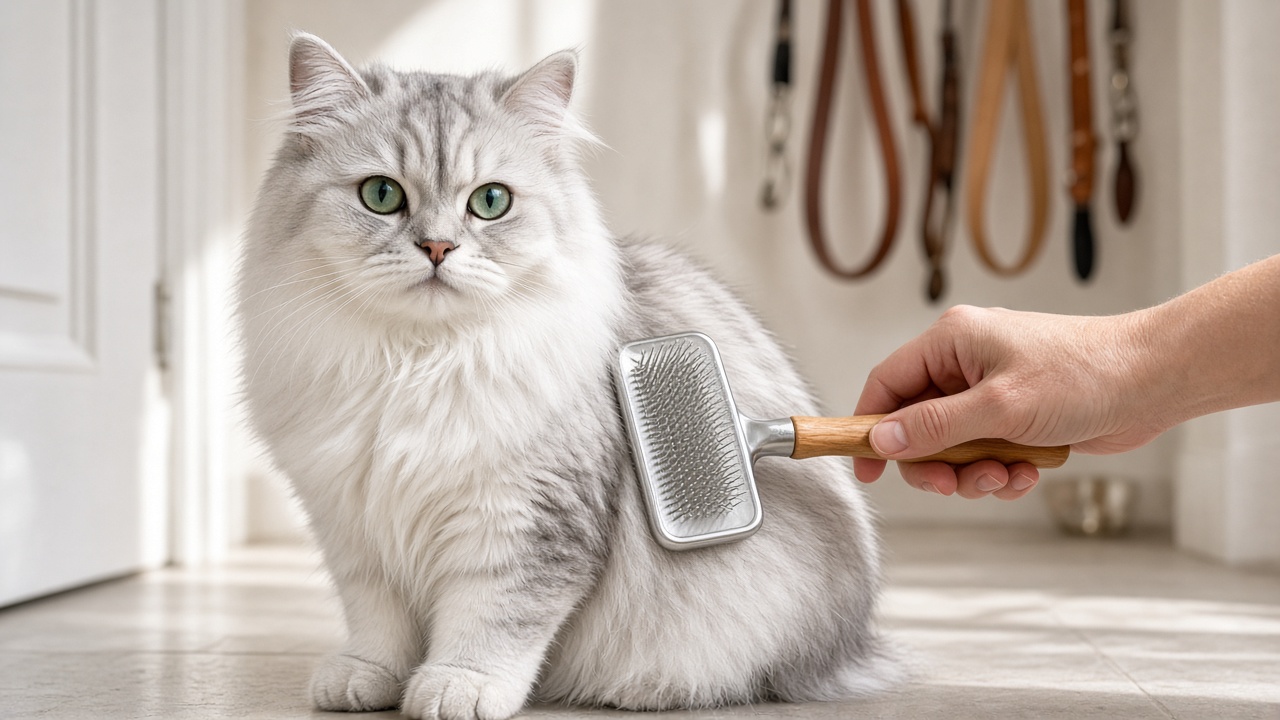
A chinchilla’s coat is a long Persian coat with a pale undercoat. Pale hair shows mats, food specks, and tear marks faster than a solid black coat. Plan on a full comb most days.
Start at the skin, not the tips. The ASPCA’s longhair method begins at the abdomen and legs and combs fur upward toward the head. Neck fur combs up toward the chin.
Part the tail down the middle and work each side. Check armpits, behind the ears, the ruff, the belly, and the trousers. A missed mat there pulls skin and hides dampness.
Do not yank a hard mat. The ASPCA says to tease small knots with fingers first. If a knot will not yield, stop and use a person trained to de-mat cats.
Baths help the white undercoat, but they are not daily work. The ASPCA fills the tub with three to four inches of lukewarm water. It mixes one part cat shampoo to five parts water.
Human shampoo is called out as drying. Keep foam and spray off eyes.
A pale face often needs a separate wipe. CFA’s standard wants open nostrils and a short muzzle. Tear paths stain white hair, so use a damp, plain cloth.
Coat health also starts in the bowl. The Association of American Feed Control Officials says its cat nutrient profiles list 44 nutritional parameters.
The U.S. Food and Drug Administration says a “complete and balanced” cat food must meet an AAFCO Cat Food Nutrient Profile or pass an AAFCO feeding trial. FDA dates the first cat profiles to 1992 and the latest update it names to 2016.
Tools we compared on maker pages
Our research team compared published specs, not home trials. The table is an attribute grid. It is not a ranking.
| Product | Maker | Type | Coat fit on maker page | Published spec |
|---|---|---|---|---|
| Safari by Coastal Cat Self-Cleaning Slicker Brush | Coastal Pet | Self-cleaning slicker | Short and long hair | 7 in L × 3.25 in W; coated stainless steel pins |
| Hertzko Self-Cleaning Dog & Cat Slicker Brush | Hertzko | Self-cleaning slicker | Long or short hair | Retractable bristles; button release |
| Hertzko Long Teeth Comb | Hertzko | Metal pin comb | Long-hair areas | 25 mm metal teeth |
| Hertzko Pet Dematting Tool | Hertzko | Dematting blade | Cats and dogs | Maker lists safety edges for knots |
| TropiClean Berry + Coconut Deep Cleanse No Rinse Cat Shampoo | TropiClean | No-rinse foam | Cat coats | 7.4 oz; made in the USA |
Coastal Pet’s Safari page lists the slicker as one size, 7 inches long and 3.25 inches wide. Pins are coated stainless steel.
Hertzko’s site lists a self-cleaning slicker for long or short coats, with bristles that retract on a button. The same maker’s Long Teeth Comb uses closely spaced 25 mm metal pins for long-hair zones.
That tooth length reaches a Persian ruff better than a short flea comb. Hertzko’s Pet Dematting Tool is a knot tool, not a finish brush.
TropiClean’s Berry + Coconut Deep Cleanse No Rinse Cat Shampoo is a 7.4 oz foam. The maker’s page says it is made in the USA and needs no rinse.
Foam, then brush. That path helps a cat that hates water, but it is not a substitute for a true bath when the coat is greasy.
Keep a wide-tooth comb as the daily hero. Use the slicker for loose hair, and save the dematter for a knot you can see and hold.
Temperament and the quiet-home fit
CFA’s Persian breed page describes the cat as playful yet placid. It will chase a toy if you ask. It is happier taking attention than inventing chaos.
CFA also says this is not a cat that is likely to invade the kitchen counter or climb the drapes. Persians “prefer to keep their feet on the ground at all times.”
Expect that same temperament from a chinchilla. The color class is not a separate personality breed. Quiet rooms fit better than a house that runs at a shout.
CFA calls the breed easy to train once kittens learn grooming. Start combing in short, paid sessions. Do not wait until the adult coat arrives.
CFA says Persians can live with children of all ages and can coexist with other pets. Coexistence is not automatic. A slow, closed-door plan still matters.
If you are adding a dog, use a staged plan such as our guide to introduce a rescue dog to a cat safely.
Indoor life protects a pale coat and a short face. For grass time, fit a harness first; see our safest cat harness brief.
CFA’s “feet on the ground” line does not ban a perch. A low tower from our modern cat tree picks gives a watch-spot without drapes.
Keep litter extra clean. Long trousers drag waste and stain the white undercoat.
Health facts owners should read first
Persian lines carry known inherited risks. A chinchilla is not exempt because the coat is tipped.
Cornell University’s College of Veterinary Medicine says polycystic kidney disease occurs most often in Persians. Cysts are present at birth. They can be found in kittens as young as six months.
Clinical signs are most often recognized around seven years of age. Cornell’s page, quoting Richard Goldstein, then an associate professor there, says a cat may have one large cyst or 30 or more small ones.
Mature cysts typically range from less than one millimeter to more than a centimeter. Goldstein notes that a genetic test will not tell you how badly a given cat is affected.
CFA’s breed page says PKD shortened many Persian lives in the early 2000s. The association says the problem is now better controlled with genetic testing and by not breeding affected cats. Ask any seller for PKD test papers on both parents.
CFA also records an older type problem. Emphasis on refined features once produced smaller-than-average nostrils and breathing trouble.
Look at the nares in person. CFA’s standard requires nostrils open enough to breathe without restriction. Face folds hold dampness, so wipe them.
None of this is a diagnosis. A feline clinician still owns the medical plan.
FAQ
Is a chinchilla cat its own breed?
Not in CFA’s 2026 Persian standard. Chinchilla Silver, Chinchilla Golden, and the blue versions are color classes inside the Silver and Golden Division. GCCF also codes the silver chinchilla as a Persian, PER ns 12 64.
How often should I groom a chinchilla cat?
The ASPCA says long-haired indoor cats need grooming every few days. A pale Persian coat shows mats sooner, so most homes do better with a daily comb. Skip several days and the ruff and armpits are the first to lock.
Why do chinchilla cats have green eyes?
CFA requires green or blue-green eyes in the Silver and Golden Division. Copper, yellow, gold, or amber is a disqualification. GCCF uses the same wrong-color list and asks for emerald or blue-green.
What is the difference between chinchilla and shaded?
TICA’s Uniform Color Descriptions say a shaded cat carries color about one-third of the way down the shaft. A chinchilla is tip-colored only. GCCF allows shaded-silver tipping up to one-third of hair length and wants the cat to read darker than a chinchilla.
Are chinchilla cats good with dogs and kids?
CFA says Persians can live with children of all ages and can coexist with other pets. They are also described as placid, not as counter surfers. A loud toddler or a chase-happy dog can still overwhelm them.
Do they shed less than other Persians?
No published CFA or GCCF standard claims a lighter shed. The coat is still long, thick, and standing off the body. The ASPCA notes that indoor longhairs shed all year.
Can I keep a chinchilla cat outdoors?
Free roaming risks a stained coat, a torn ruff, and face trauma. Indoor housing with a window perch fits CFA’s note about keeping feet on the ground. If you want grass time, use a fitted harness and stay with the cat.