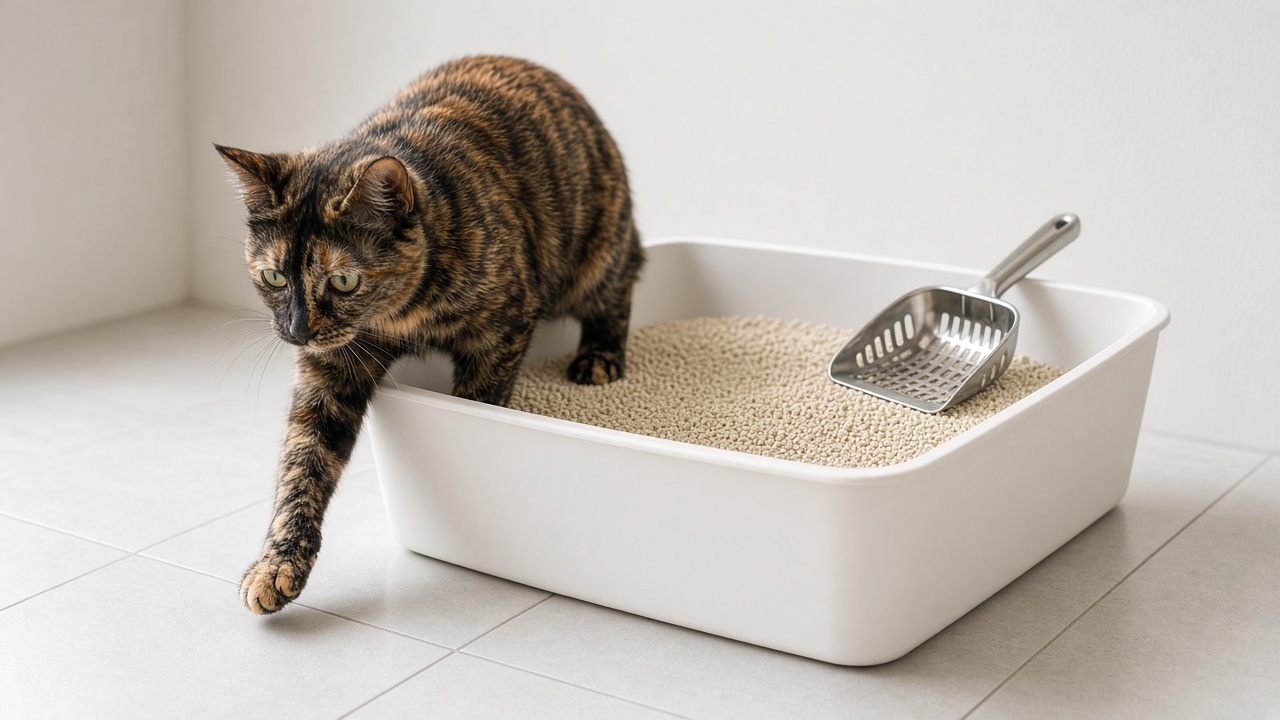
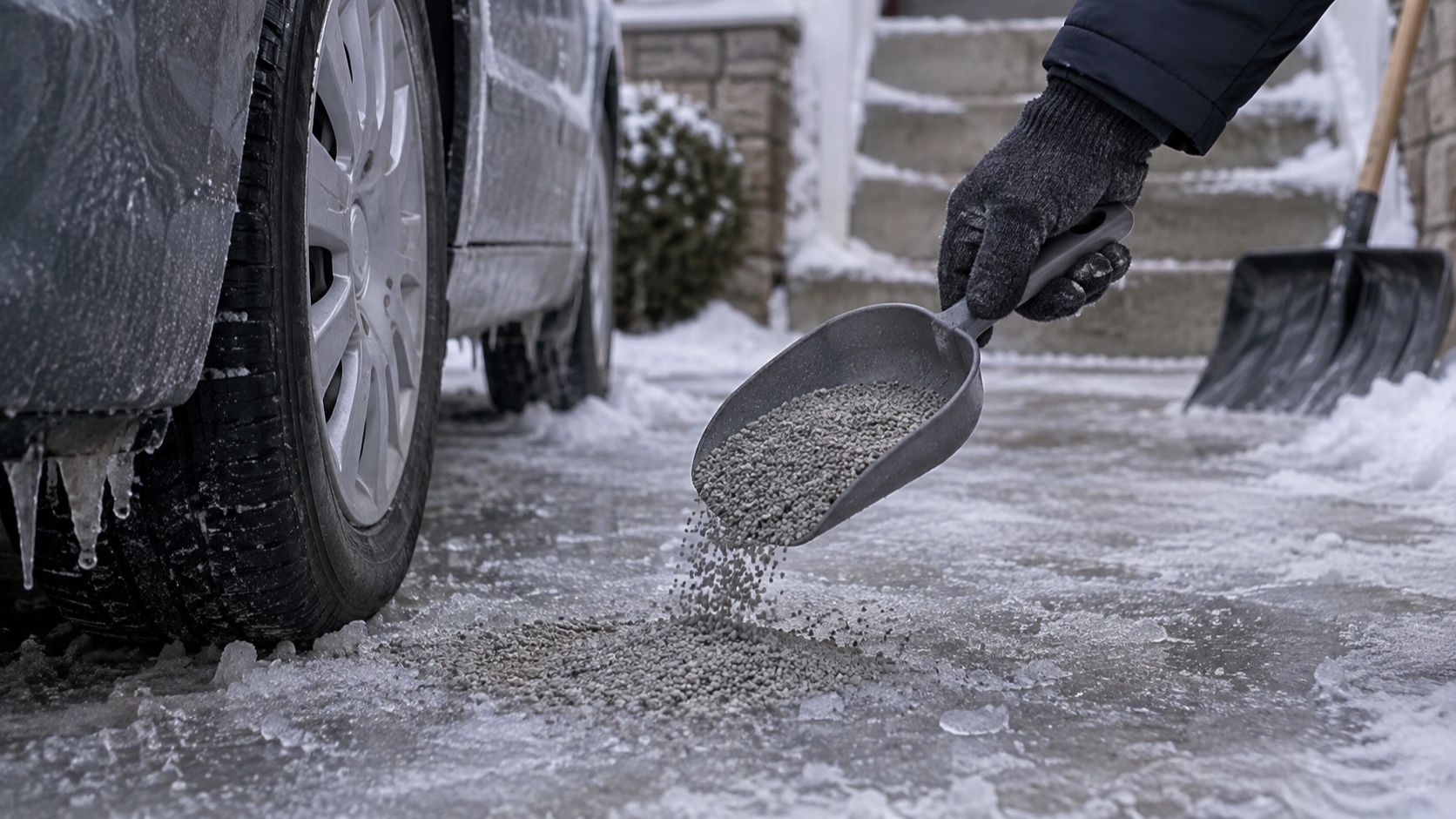
Quick answer: Do not treat cat litter as ice melt; it will not dissolve ice on a walk or driveway. Unused non-clumping clay or wood pellets can add short-term grip under a stuck tire. You still need a shovel or a real deicer to remove ice.
Unused household cat litter does not melt ice or lower water’s 32°F freeze point. This page is a research-desk comparison of maker specs and highway deicer data.
Our research team compared published specs from Cargill, the Federal Highway Administration, Fresh Step, World’s Best Cat Litter, Feline Pine, and the ASPCA. The salt pages list freeze points and pounds of ice melted. The litter pages list absorbency, fill depth, and box life, and none of the three litter maker pages list a freeze point.
We only cover unused household litter sold for a litter box, and that is the selection rule. A product had to be unused box litter in one of four forms:
- Clay granules, clumping or non-clumping
- Silica-gel crystals
- Corn granules
- Wood pellets
We left out used or soiled litter, plus rock-salt bags, calcium-chloride pellets, fertilizer, ash, and homemade brine. Those are deicers or yard products, not box litter.
We name Fresh Step, World’s Best Cat Litter, and Feline Pine because their maker pages state the filler. Store clay is still clay, and store pellets are still wood.
If you keep pellet litter for the box, our guide to pellet cat litter covers box setup, not driveway use.
Why salt melts ice and litter does not
Salt melts ice by mixing with water and dropping the freeze point.
Litter cannot do that job. The Federal Highway Administration’s 1996 anti-icing manual states that a brine must stay liquid below 32°F to work. Pure ice melts at 32°F, and a salt mix can stay liquid at a lower temperature.
Cargill’s deicing page states these melt rates for rock salt:
- At 30°F, 1 pound of salt melts about 46 pounds of ice.
- At 20°F, 1 pound of salt melts about 9 pounds of ice.
- At 1°F, 1 pound of salt melts about 4 pounds of ice.
Cargill’s same page states that salt can work down to a lowest mix temperature of −6°F. It also states that crews treat 15°F to 20°F as the practical working range.
The Federal Highway Administration’s 1996 manual lists these mixes:
- A common road-salt mix is about 23 percent sodium chloride by weight and freezes at about −6°F.
- Calcium chloride can stay liquid near −60°F at about 30 percent by weight.
- Magnesium chloride’s listed mix is 21.6 percent by weight and freezes at about −28°F.
Litter pages do not publish those freeze-point numbers. Clay, silica, corn, and pine are built to hold urine, not to make a brine.
The Federal Highway Administration’s 1996 manual also states a moisture rule:
- Calcium chloride starts pulling water from air at 42 percent relative humidity.
- Sodium chloride starts pulling water from air at 76 percent relative humidity.
That is how a deicer starts a liquid film on a dry grain. The three litter maker pages we read do not list a humidity trigger or a freeze-point curve.
Use this Three-Job Winter Surface Test on a slick walk:
- Melt the ice. That needs a chemical that lowers the 32°F freeze point.
- Add grip. That needs grit that stays hard when wet.
- Wait. Sun, air, and a shovel still clear ice with no chemicals.
Cat litter can only try job two, and it fails job one on every maker page we read.
If you need the ice gone, shovel first and use a labeled deicer only after that. The Federal Highway Administration’s 1996 manual states that some agencies skip salt at or below about 15°F.
What clay, silica, corn, and pine litter do on ice
Litter sits on ice as grit or mush.
Fresh Step’s FAQ page states that its clumping formula uses sodium bentonite clay, limestone, activated charcoal, fragrance, and borates. Its non-clumping clay is clay plus fragrance, and its crystals are silica gel plus fragrance.
Silica gel, on that same Fresh Step FAQ page, is a porous solid that traps liquid and then lets it evaporate. That is a drying job in a box, not a freeze-point job on a walk.
World’s Best Cat Litter’s FAQ page states that all 10 of its formulas are made from whole-kernel corn grown in the United States. The same page states that the brand does not contain sodium bentonite or clay.
It also states that Multiple Cat Ultra Absorb offers up to 60 percent more absorption than traditional clay litter. It lists 30 days of box performance. That 60 percent figure is a box claim, not a pounds-of-ice claim.
Feline Pine’s FAQ page states that its non-clumping litter is 100 percent pine. Sawdust from lumber mills is compressed into pellets that act like sponges, then break into sawdust. The same page says to dump the box at about 90 percent sawdust.
On ice, that breakdown is a problem, because wet pellets do not stay as hard grit.
Here is the attribute split our research team used.
| Material | Lowers the 32°F freeze point? | Stays hard when wet? |
|---|---|---|
| Unused non-clumping clay | No | Only until it soaks |
| Clumping clay | No | No; it is built to clump |
| Silica-gel crystals | No | No; they trap liquid |
| Corn granules | No | Softens as they absorb |
| Pine pellets | No | Break into sawdust |
| Sodium chloride | Yes | Dissolves as it works |
The ASPCA’s January 22, 2026 de-icer page states that sand can add traction. It also states that clay cat litter can absorb moisture and help prevent slips. Absorbing a water film is not the same as melting the ice under it.
Clumping clay is built for odor in a box. Our guide to clumping litter for odor control is about that box job.
How unused litter can help a stuck tire
Unused non-clumping clay can add grit under a spinning tire, but it still leaves the ice in place.
Fresh Step’s FAQ page states that non-clumping clay can help free a stuck car in two ways. A bag in the trunk adds weight, and the clay can also go under the tires as grit.
The same page says to use the non-clumping version only. It also states that clumping litter and crystals will cause a slippery mess.
If you use unused non-clumping clay or unused pine pellets under a tire, follow this order:
- Clear snow and ice from around the stuck wheels.
- Confirm the tailpipe is open so exhaust can leave the car.
- Sprinkle unused non-clumping clay or unused pine pellets in front of the tires.
- Use the lowest gear, ease forward, and ease back if the tires spin.
- Stop if the grit turns to paste, because paste is not grip.
Fresh Step’s FAQ page does not list a cup count for the tire job. Use enough grit to cover the rubber patch you can see.
Pine pellets can work for the same short moment. Feline Pine’s FAQ page states that a 7-pound bag of non-clumping pellets lasts about 4 weeks in a box.
Do not use the bag that is already in the litter box. Used litter carries waste. How often you change cat litter is a box schedule, not a reason to dump dirty litter on ice.
Why clumping clay and crystals make ice worse
Wet clumping clay and wet silica gel can make a slick surface slicker.
Fresh Step’s FAQ page states that clumping litter needs 3 to 4 inches in a box. The first fill may take 14 pounds or more. That depth exists so urine can form a scoopable clump.
On a walk, the same habit turns granules into wet cakes that freeze again below 32°F.
Fresh Step’s FAQ page states that crystals do not clump on urine. Users remove solids daily and dump the box every 20 to 30 days.
On ice, those crystals still trap liquid. Trapped meltwater can sit and refreeze as a glaze.
World’s Best Cat Litter’s FAQ page tells owners to keep 2 to 3 inches of corn litter in the box. That depth lets clumps form before liquid hits the pan. Corn is absorbent on purpose.
On a driveway, that same absorbency pulls water into a soft mash.
Feline Pine’s FAQ page states that clumping pine litter is 50 percent lighter than clay by volume. It compares 9 pounds of that clumping pine to 18 pounds of clay.
If the bag in your hand is clumping clay, crystals, or corn, keep it for the box. Fresh Step’s FAQ page states that a 10-pound sack of non-clumping clay can soak up to a gallon of liquid on a shop spill.
Keep pets away from deicers and used litter
Keep dogs and cats off treated ice, and never put used litter outside as grit.
The ASPCA’s January 22, 2026 de-icer page states that common deicers include sodium chloride, calcium chloride, potassium chloride, and magnesium chloride. The same page states that rock salt can irritate paws and raise sodium levels if a dog eats it.
The ASPCA’s page states that there are no specific rules for calling a deicer pet-safe. Products sold that way often use urea or magnesium chloride. The page still warns that those mixes can upset a stomach.
The ASPCA’s page also tells owners to wipe or rinse paws after a walk. It suggests booties and keeping dogs inside during de-icing. If a pet may have eaten a deicer, the page lists ASPCA Poison Control at (888) 426-4435.
Used litter is a separate hazard. Fresh Step’s FAQ page states that unused litter is safe to handle. Pregnant people and immunosuppressed people should avoid used litter because of toxoplasmosis risk from feces.
Do not spread used litter on a walk. If a pet walks a salted path, wipe feet, legs, and belly when you come in. Then park the litter bag back by the box, not by the shovel.
FAQ
Does cat litter melt ice on a sidewalk?
No. Unused household cat litter does not melt ice or lower water’s 32°F freeze point. Cargill’s deicing page and the Federal Highway Administration’s 1996 manual describe that freeze-point job for salts, not for clay, silica, corn, or pine.
Can I use clumping cat litter for traction?
No. Fresh Step’s FAQ page states that clumping litter and crystals cause a slippery mess on snow and ice. Clumping clay is designed to bind liquid into a cake, and that cake can refreeze and make a walk worse.
Is unused clay litter better than sand for grip?
Sand stays hard when wet, while clay soaks and can turn to paste. The ASPCA’s January 22, 2026 de-icer page lists both sand and clay litter as traction options. For a path you will walk all day, sand is the cleaner grit.
Will crystal litter dry a wet icy step?
Fresh Step’s FAQ page states that silica-gel crystals trap liquid and then let it evaporate in a box. On a cold step, trapped water can sit and refreeze, so crystals stay a box product rather than a step dryer.
Can I dump old litter from the box onto the driveway?
No. Used litter carries feces, and Fresh Step’s FAQ page warns that used litter is the toxoplasmosis risk, not unused clay. Keep box waste in the trash, and use a fresh unused bag only if you need grit under a tire.
Does corn or pine litter melt ice because it is “natural”?
No. World’s Best Cat Litter’s FAQ page states its 10 formulas are corn and lists up to 60 percent more absorption than clay in a box. Feline Pine’s FAQ page states its non-clumping pellets are 100 percent pine and break into sawdust.
What should I keep in the car for winter traction?
Keep unused non-clumping clay or unused pine pellets only as grit, plus a shovel if you have space. Fresh Step’s FAQ page states that a trunk bag can add weight and that non-clumping clay can go under spinning tires. Pack a labeled deicer only if you also need melt, and keep that bag sealed away from pets.