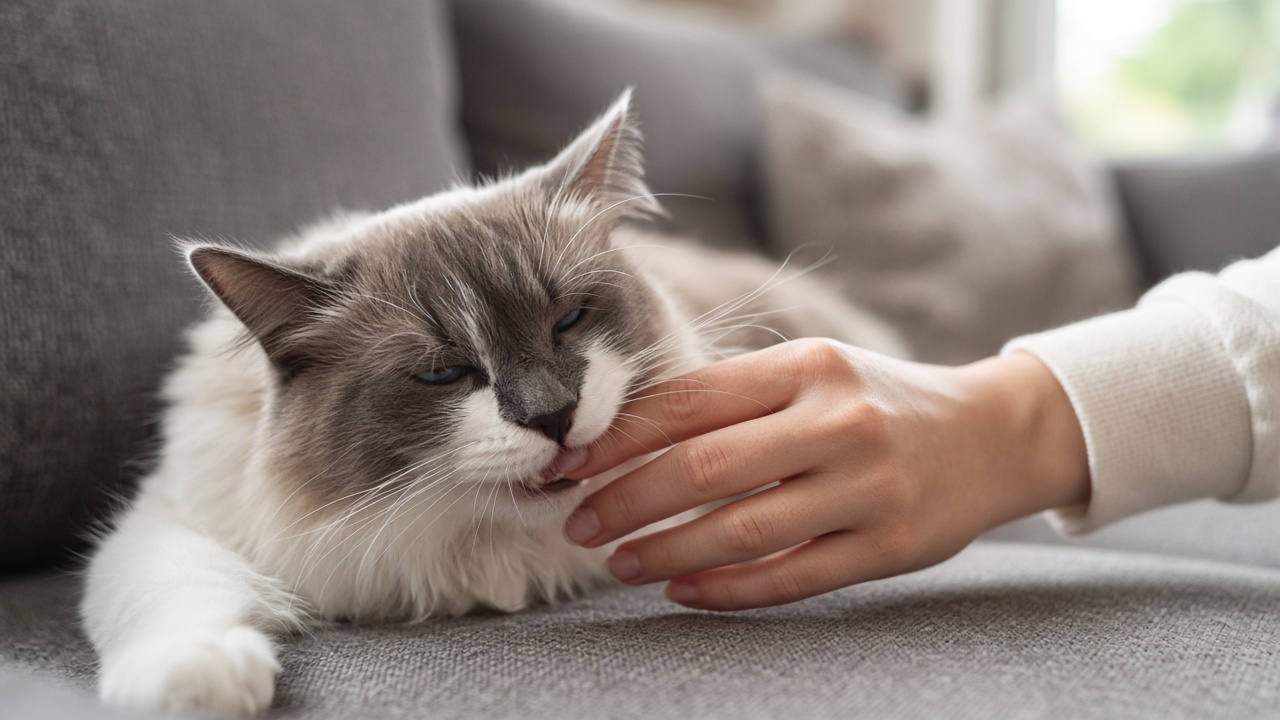
Quick answer: Treat a sudden gentle bite as a stop or play signal, then end contact. Move play onto a long wand and stop when the tail flicks. Skin-breaking bites, or new nips in an older cat, need a clinic visit.
A gentle bite after petting or play is a stop or redirect signal, not a random attack. This page is a research-desk explainer of papers and maker specs; we did not examine your cat, run a home trial, or film bites.
Selection rule: we cover only inhibited nips that do not break skin and that happen during petting, play, or idle contact. We leave out deep punctures, fights between cats, and any attempt to name a medical diagnosis.
Why a gentle bite feels like it came from nowhere
The bite is usually the last step, not the first. Cats send quieter signals first. People miss those signals, then call the nip random.
The ASPCA lists play aggression as the most common type of aggressive behavior that cats direct toward their owners. It is common in cats younger than two years. The same page says petting-induced nips often follow stroking that starts pleasant and turns irritating.
A 2009 Journal of Feline Medicine and Surgery survey asked 107 owners in São Paulo. Human-directed aggression showed up in 49.5% of cats. Petting and play were the most common contexts.
Cornell University College of Veterinary Medicine reports a shelter figure. Among cats surrendered for behavioral reasons, 27% were relinquished for aggression. A missed signal at home can become a housing crisis later.
Watch the face and the tail, not the mood you hoped for. Dilated pupils, ears turning back, and a tail flick are the usual prelude. The Cornell page names those same cues before play pounces and petting nips.
Petting nips and so-called love bites
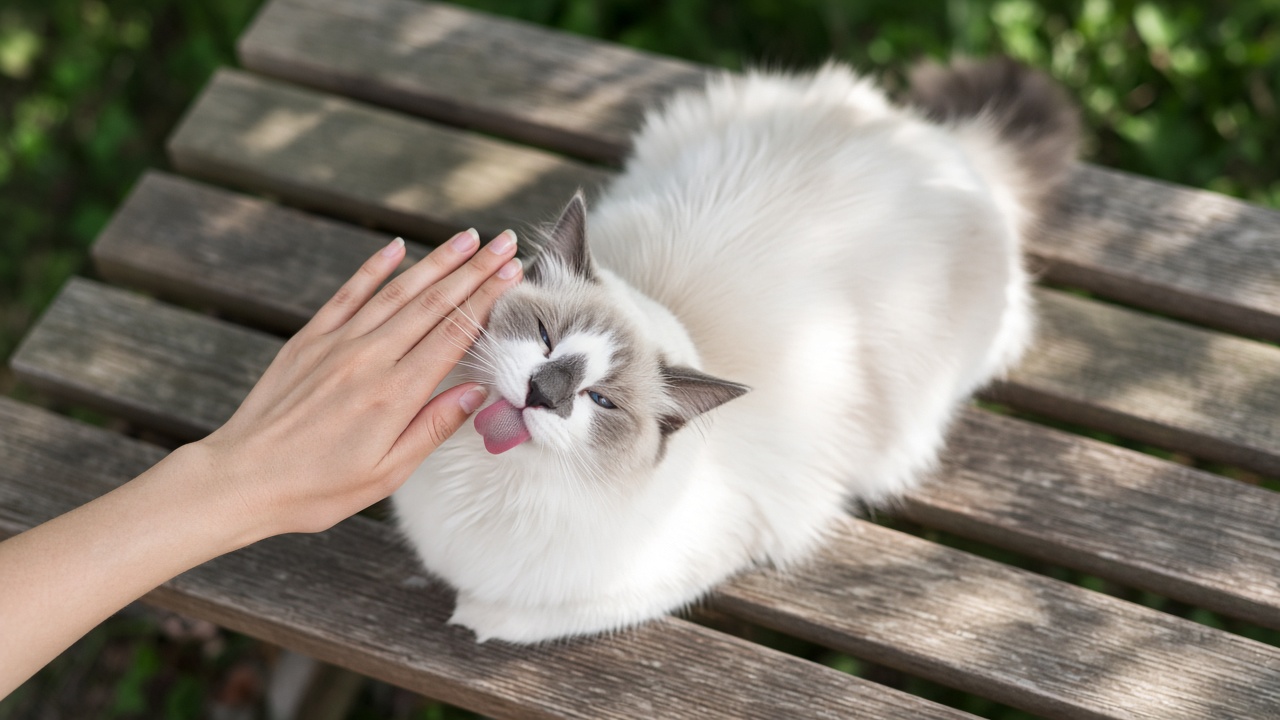
A soft mouth on your hand during a calm cuddle can be grooming. Cats nibble each other while they lick. That mouthing is inhibited and should not break skin.
A different bite happens after you keep stroking. The cat asked for contact, then hit a limit. The Journal of Feline Medicine and Surgery, in a 2019 review by Amat and Manteca, says petting-related aggression accounts for up to 40% of aggressive-behavior cases at referral services.
Owners in that review often call the bite unpredictable. The cats still tense, rotate their ears, or whip the tail first. The warning is small, but it is still a warning.
A 2026 Life journal study enrolled 100 cats in Thailand. Handling-induced aggression showed up in every cat. Grooming, bathing, brushing, or nail trimming triggered severe biting or scratching in 56% of them.
Holding, hugging, or kissing triggered it in 29%. Touch or petting triggered it in 26%. That sample was clinical, not a random neighborhood.
Stop at the first tail flick. Do not add one more stroke. Cornell’s advice is to reward brief, light stroking, then lengthen the session only if the cat stays loose.
Avoid the belly and the base of the tail if those spots end in a grab. Many cats accept cheeks and chin longer than a full-body rub.
Play bites aimed at hands and ankles
Play looks like hunting. Stalk, chase, grab, bite. If your fingers were the toy last month, they are still the toy today.
The ASPCA notes that orphaned or early-weaned cats may never learn bite inhibition from littermates. Hand-wrestling teaches the opposite lesson. Movement under a blanket can start the same sequence.
In the Thailand Life study, play-induced aggression showed up in 78% of the 100 cats. During play, every caregiver in that study used bare hands. Thirty-two percent of the cats delivered severe play bites.
Amat and Manteca call this misdirected predatory behavior. It is silent and targets motion. Their review links it more often to young cats, indoor cats, and single-cat homes.
Keep your hands out of the game. A wand puts the prey at the far end of a stick. Comparing published specs, only one of the four toys below lists a 25-inch telescoping gap plus a 30-inch cord.
You do not need a dog-training kit to change what a cat practices. The same idea showed up in our J and J dog training supplies review. The tool you put in front of an animal is the behavior you get.
End the session when pupils blow wide and the toy is ignored for your wrist. Freeze. Walk out if the mouth stays on skin.
Redirected arousal that looks random
Some nips have nothing to do with you. A cat sees a stranger cat through glass. It cannot reach the trigger, then mouths whoever is near.
The ASPCA calls redirected aggression common. It is dangerous when the bite is uninhibited. Arousal can last minutes to hours after the outdoor cat is gone.
That delay is why people say the bite came from nowhere. The 2019 Journal of Feline Medicine and Surgery review notes that some authors attribute up to 50% of people-directed referral cases to redirected attacks.
Some cats stay aroused about 30 minutes. Others stay wound up for days.
Do not pick up a staring, puffed, growling cat. Pull the shade. Leave the room.
Wait until the body softens before you offer a hand. A car ride can load the same system. Handling into a carrier, then lifting out, is a lot of contact.
A cat that nips after travel is often reacting to that handling. Fur left on the upholstery is a separate cleanup job. We covered that in how to get pet hair out of car seats effectively.
How to cut the next nip short
Use a three-context map. Name the moment: petting, play, or redirected stare. Then change only that context.
For petting, set a short timer in your head. Stop before the first flick. If the cat asks again, give one stroke and pause.
For play, run the hunt on a wand, then let the cat catch the lure. The Jackson Galaxy maker page for the Gotcha! Cat Wand tells owners to follow play with a treat or meal.
If that meal is wet food, do not leave the bowl out for hours. We explained the time limit in how long can wet cat food sit out.
For redirected stares, block the window view that starts the spiral. Do not soothe with petting while the cat is still locked on.
Do not yell, tap the nose, or spray water. Cornell says physical punishment can raise fear and worsen aggression. The ASPCA says the same for painful punishment.
Ignore the play bite. Become boring. Reward the next calm approach with a toss toy, not a wrestle.
Kids miss ear turns. Cornell says to keep small children from petting a cat with a history of petting-induced nips. That is a household rule, not a scolding.
Hands-off toys compared by how they keep teeth off skin
Our research team compared published specs for four toys still sold on their maker pages. We picked them because each gives the mouth a target that is not a finger. We skipped laser-only pointers, because those pages do not give the cat a catch.
No rank. No price band. Match the toy to the job.
| Product | Play job | Listed size | Hands stay off | Maker notes |
|---|---|---|---|---|
| Jackson Galaxy Gotcha! Cat Wand | Person-led hunt | 25-inch telescoping wand; 30-inch retractable cord | Yes, at wand-and-cord length | Natural feathers; replaceable attachments |
| Cat Dancer | Person-led flutter | 3 by 2 by 6 inches; 0.6 ounces | Partial; short wire lure | Spring steel and rolled cardboard; made in Wisconsin |
| KONG Kickeroo Cactus | Solo kick and wrestle | 8.5 by 2.25 by 14.5 inches | Yes; no hand in the toy | 95% polyester, 3% catnip, 2% crinkle film |
| Catit Senses Circuit | Solo track chase | 20 by 27 by 24.5 centimeters; 1.375 kilograms | Yes; ball stays in the track | BPA-free; more than 100 layouts |
The Gotcha! wand is the only one in this set with a listed telescoping length of 25 inches. The maker also lists a 30-inch retractable cord.
Cat Dancer Products lists the original Cat Dancer at 3 by 2 by 6 inches and 0.6 ounces. The lure is spring steel and rolled cardboard, made in Wisconsin.
The KONG Company lists the Kickeroo Cactus at 8.5 by 2.25 by 14.5 inches. The fill is 95% polyester, 3% catnip, and 2% crinkle film.
The official Catit store lists the Senses Circuit at 20 by 27 by 24.5 centimeters and 1.375 kilograms. The same page says it rebuilds into more than 100 layouts.
Use the wand when you can steer prey away from your skin. Leave the Kickeroo Cactus or the Catit circuit out for solo bursts. Store feather wands after play so the cat cannot chew the cord.
Two of these four toys need a person to move them. Two do not. Hands-off practice only works if a real object replaces your fingers.
When a nip is not a communication problem
Pain changes the story. Cornell lists hyperthyroidism, osteoarthritis, dental disease, and central nervous system problems as medical reasons for aggression. A new bite pattern in a senior cat is a clinic question, not a toy question.
Skin that breaks is also a different problem. The NCBI StatPearls review of animal bites says cat bites have an infection rate of about 30% because teeth drive bacteria deep. About 4.5 million people in the United States sustain animal bites each year.
About 750,000 of those bites need medical care. Cat bites make up 5% to 20% of bites that receive care.
A Journal of the American Veterinary Medical Association study counted North Carolina emergency visits from 2008 through 2010. Cat bite or scratch visits ran at 18.8 per 100,000 person-years. Infection was diagnosed in 898 of 5,314 of those visits, or 16.9%.
Wash a broken-skin bite with soap and water. Then use your usual medical channel. This desk does not treat wounds.
Fear bites look different from love nips. The ASPCA describes a crouched body, tucked tail, and flattened ears. Do not reach in to comfort that posture.
If the mouth is hard, repeated, and paired with a long window stare, treat it as redirected arousal. Give space first.
FAQ
Why does my cat bite me gently while purring?
Purring can sit next to grooming or next to overload. Context decides. A loose body and a soft mouth after a head rub is often a social nibble.
A taut back and a whip of the tail means stop, even if you still hear a purr.
Is a love bite a sign my cat likes me?
It can be. Cats nibble bonded cats. It can also be a request to change the interaction.
Keep the ones that stay soft. End the ones that escalate.
Why does my cat bite me and then lick the spot?
That pair looks like allogrooming. The lick does not cancel a hard bite. If teeth leave marks, shorten contact and move play to a wand.
How long should I pet before I stop?
There is no universal minute count in the papers we read. Watch the cat, not the clock. Stop at the first ear turn or tail flick.
Lengthen later only if those cues stay gone.
Should I hiss or tap my cat’s nose after a nip?
No. Cornell and the ASPCA both warn that physical punishment can raise fear and make aggression worse. Become still, then leave.
Offer a toy later, not a scold.
Can hunger make gentle biting worse?
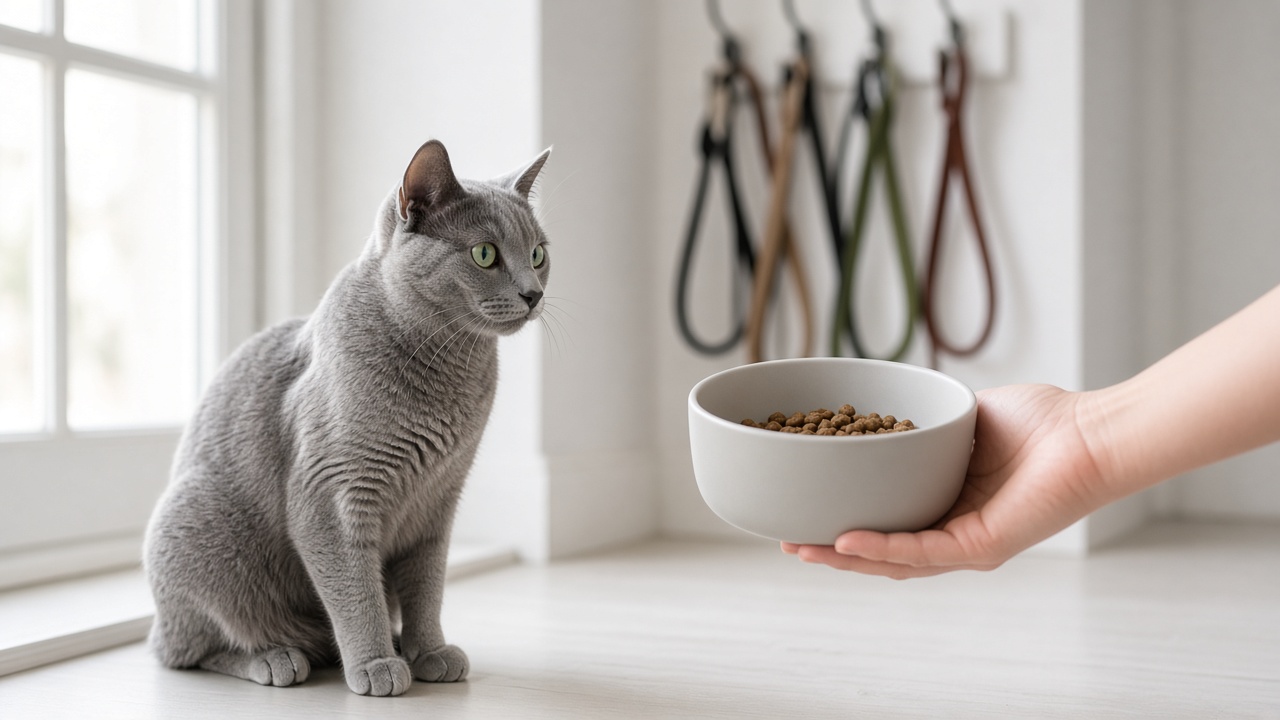
A bored, unfed cat will hunt what moves, including ankles. A short wand session, then a meal, uses that drive. Do not use your hands as the prey.
When should I call the clinic about biting?
Call if skin breaks, if bites start in a cat that never nipped, or if an older cat suddenly hates touch. Pain and illness sit outside this article’s selection rule.
A gentle nip is information. Read the tail. Change the toy.