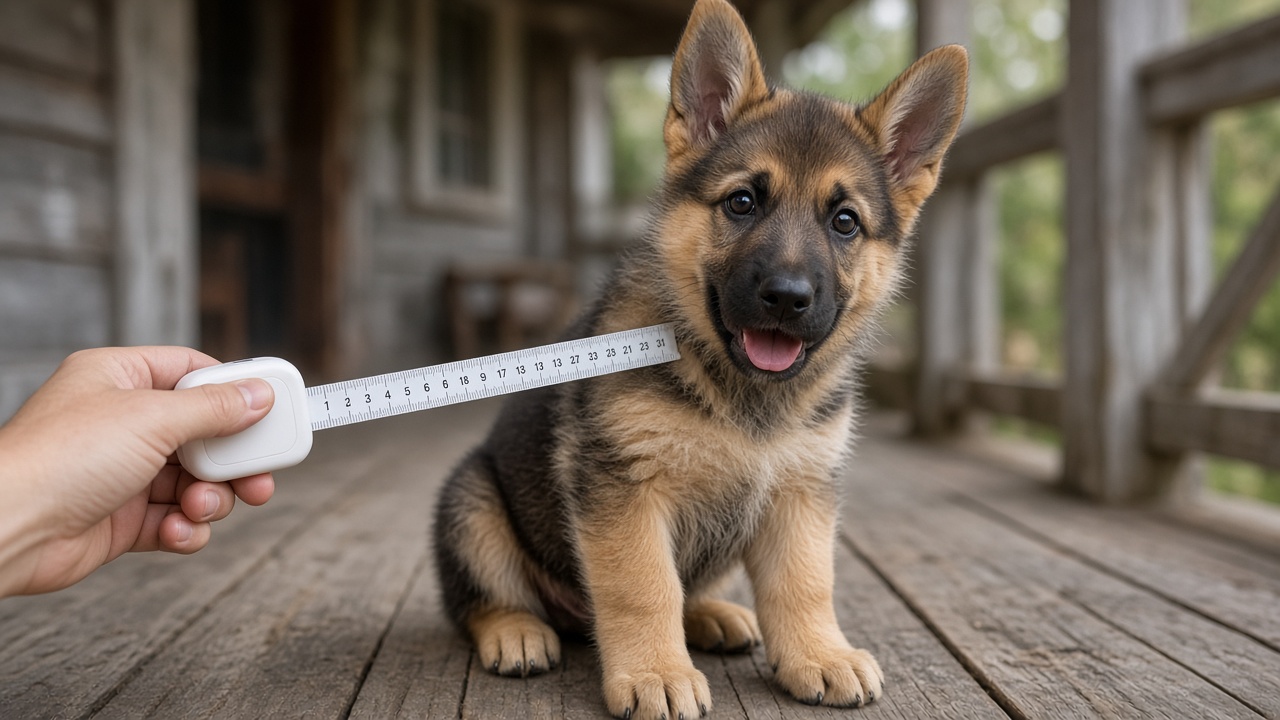
Quick answer: Adult size follows size class, not one age for every puppy. Use a published breed standard or parent weights, then plot three serial weights after 12 weeks. Small dogs often finish by 8 months, while giant dogs can keep filling out until 24 months.
Small-breed puppies often finish height by 8 months; giant-breed puppies can keep growing to 24 months.
This page is a research-desk size guide from published standards, growth-chart methods, and maker size bands. We did not weigh litters, run feeding trials, or score commercial DNA kits.
Our selection rule is the Published-Number Rule. A method or product enters only if a named organization publishes a checkable adult-size number. Folk ‘double it at 6 months’ formulas, paid calculators, and breed gossip stay out.
Size class, not a single birthday
A puppy’s final size is a size-class problem first. It is not a mystery number pulled from a calendar.
The American Kennel Club states that puppies may keep growing from 6 to 24 months. Small breeds often stop growing by 6 to 8 months.
Medium breeds often reach adult size around 12 months. Giant-breed puppies often grow until 12 to 18 months.
The American Kennel Club notes that some Mastiffs may not finish until 24 months. Those ranges answer the search query. They do not give one adult weight for every puppy.
WALTHAM Petcare Science Institute publishes the same split in metric bands. Extra-small dogs under 9 kg are described as full grown in 1 year.
Dogs in the 30–40 kg band are described as full grown in 18 months. Some giant breeds take almost 2 years.
Males and females do not share one curve. WALTHAM Petcare Science Institute states that males typically grow faster than females. That is why its digital charts split sex as well as size.
PLOS One published the underlying growth-standard paper in 2017. The authors noted canine size ranging from the 1 kg Chihuahua to the 115 kg Saint Bernard. Larger breeds in that paper can take up to 24 months.
Breed examples from published standards
A breed name is useful only when a club publishes a number you can check.
The American Kennel Club Official Standard of the Chihuahua sets adult weight at not to exceed 6 pounds. Any dog over 6 pounds is a disqualification in that standard.
The American Kennel Club Labrador Retriever standard sets working weight at 65 to 80 pounds for dogs. Bitches are listed at 55 to 70 pounds.
Height at the withers is 22½ to 24½ inches for dogs. Bitches are listed at 21½ to 23½ inches. A variance greater than ½ inch outside those heights is a disqualification.
That Labrador band crosses a feed-label line. The Association of American Feed Control Officials defines large-size growth as 70 pounds or more as an adult.
A bitch listed at 55 to 70 pounds can sit at or below that cutoff. A dog listed at 65 to 80 pounds can sit above it. Same breed, two label paths.
The American Kennel Club German Shepherd Dog standard sets desired height at 24 to 26 inches for males. Bitches are listed at 22 to 24 inches. That standard does not publish a working-weight band.
The American Kennel Club Great Dane standard sets a male floor of 30 inches at the shoulders. It prefers 32 inches or more if the dog stays in proportion.
The female floor is 28 inches. It prefers 30 inches or more. Dogs under those minimums are disqualified.
The Great Dane standard does not publish a pound range. Height-only standards cannot become an honest pound forecast.
The American Kennel Club Beagle standard splits the breed by height, not pounds. The 13 Inch variety is for hounds not exceeding 13 inches. The 15 Inch variety stops at 15 inches.
Mixed puppies and unknown parents
A mixed puppy still has a size class. It does not have a single breed standard.
WALTHAM Petcare Science Institute says its charts can be used for mixed-breed dogs. If the mix is not in the list, the tool tells you to select mixed breed.
Parent weights, if known, help you pick a starting adult-weight band.
PLOS One reported that growth could be described by size category. Breed-specific curves were not required for most of the 24 breed curves they checked. Agreement was good for 20 of those 24.
A 12-week mixed pup that tracks like a 25–40 kg adult is not a ‘small mix’ because one parent looked small. Plot the weights. Then pick the band.
If both parents are unknown, start with three plotted weights. Change the chart band if points keep riding the top or bottom edge.
WALTHAM Petcare Science Institute says the digital tool may prompt a different estimated adult weight after several plots. Do not treat a shelter age guess as a birthday.
How to plot weight so a size estimate can be checked
A single weigh-in shows size today. It does not show adult size.
WALTHAM Petcare Science Institute validates its curves from 12 weeks of age. Weights added before 12 weeks can be stored. Growth lines appear only after two weights, 2 weeks apart, logged after 12 weeks.
The most useful start window is 12 to 20 weeks. That is the fastest growth stretch.
For an adult-weight estimate, the institute wants 3 measurements, 2 weeks apart, after 12 weeks. The pup should then keep following the same curve.
The 50th centile is not a target. The institute lists nine centile lines: 0.4th, 2nd, 9th, 25th, 50th, 75th, 91st, 98th, and 99.6th.
Crossing two centile lines is the warning, not sitting low or high. PLOS One treats a flat line before adult weight as a disturbance signal.
Weigh every 2 to 4 weeks up to 6 months of age. Then weigh every 1 to 3 months until the pup is fully grown.
WALTHAM Petcare Science Institute discourages daily weigh-ins. Meals and toileting create noise.
Its home method is simple. Weigh yourself holding the puppy, then weigh yourself alone and subtract. For a breed under 6.5 kg, a box can replace a hold.
The charts were built from 50,000 healthy young dogs. Those dogs were weighed at Banfield Pet Hospitals in the United States.
They stayed healthy and in ideal body condition through the first 3 years. The current digital set uses 14 charts across seven size groups, split by sex.
After the pup reaches adulthood, WALTHAM Petcare Science Institute flags a weight change of more than 5%. That is a clinic question, not a home guess.
Foods sold by expected adult weight
Food does not set adult height. It can change how fast a pup fills a genetic frame.
The Association of American Feed Control Officials tightened large-size growth calcium in the 2016 Official Publication. Large-size dogs are those expected to reach 70 pounds or more as adults.
Growth foods for that group have a maximum of 1.8% calcium on a dry-matter basis. Other growth foods may still go to 2.5% calcium.
The calcium-to-phosphorus ratio stays between 1:1 and 2:1. That 70-pound line is why a size forecast matters at the bag.
A Labrador male in the 65-to-80-pound American Kennel Club band can sit on either side of it.
Comparing published specs, Royal Canin sells dry puppy formulas by expected adult weight. Those bands meet the Published-Number Rule.
Wet SKUs, breed-specific bags, and adult maintenance recipes stay out of the table. For calorie math and calcium context, see our puppy nutrition guide.
Wet recipes are covered in our wet puppy food guide.
| Formula | Expected adult weight | Puppy feeding window | kcal per cup | Protein min. | Fat min. |
|---|---|---|---|---|---|
| Royal Canin X-Small Puppy | Up to 8 lb | Up to 10 months | 405 | 29.0% | 18.0% |
| Royal Canin Small Puppy | 9–22 lb | Up to 10 months | 349 | 29.0% | 18.0% |
| Royal Canin Medium Puppy | 23–55 lb | Up to 12 months | 410 | 30.0% | 18.4% |
| Royal Canin Large Puppy | 56–100 lb | Up to 15 months | 349 | 28.0% | 14.0% |
| Royal Canin Giant Puppy | Over 100 lb | Up to 8 months | 338 | 32.0% | 12.0% |
Energy per cup is not a straight climb with adult size. X-Small Puppy is listed at 405 kcal per cup. Medium Puppy lists 410 kcal per cup.
Small Puppy and Large Puppy both list 349 kcal per cup. Giant Puppy lists 338 kcal per cup.
The feeding windows also refuse a simple ‘bigger means longer on the same bag’ story. Giant Puppy is labeled up to 8 months. Large Puppy is labeled up to 15 months.
Royal Canin’s US page for Giant Puppy calls that 2-to-8-month span the intense growth stage with controlled energy.
Royal Canin Large Puppy starts its adult-weight band at 56 pounds. That is 14 pounds below the Association of American Feed Control Officials 70-pound large-size definition. The bag still carries an AAFCO growth statement that includes large-size dogs of 70 pounds or more as an adult.
Giant Puppy lists calcium at a minimum of 1.1% and phosphorus at a minimum of 0.92%. Those floors sit under the Association of American Feed Control Officials 1.8% large-size calcium ceiling.
What adult size does not decide
Adult size does not decide manners, energy, or chew need.
Jaw size and tooth stage change while the skeleton is still open. A toy pup can finish height before a giant pup cuts its last puppy teeth.
For chew tools matched to that stage, see our puppy teething toys guide.
Adult size also does not decide a healthy body. The American Kennel Club notes that after height growth ends, dogs still add muscle and body fat.
A finished withers height can hide a soft frame. Keep plotting weight after the legs look ‘done.’
PLOS One recorded a small growth shift by neuter timing. Neutering before 37 weeks was tied to a slight upward shift.
Neutering after 37 weeks was tied to a slight downward shift. The authors said those shifts were small next to ordinary dog-to-dog spread.
Separate neuter charts were not required. WALTHAM Petcare Science Institute reports a similar finding for dogs that reach a healthy adult weight.
Size estimates fail when the pup is ill, underfed, or pushed to grow too fast. The charts assume healthy pups in ideal condition. They are not a diagnosis.
FAQ
How big will my mixed-breed puppy get?
Use parent weights if you have them. Then plot three weights after 12 weeks on a size-class chart. PLOS One found that size categories described growth for most of the 24 breed curves it checked.
Does doubling weight at 6 months predict adult size?
That folk rule is not a published growth standard. WALTHAM Petcare Science Institute estimates adult weight from a curve after 3 weights, 2 weeks apart, after 12 weeks of age. Small dogs may already be near adult size at 6 months.
When do puppies stop growing taller?
The American Kennel Club says small breeds often finish by 6 to 8 months. Medium breeds often finish around 12 months. Giant breeds often continue to 12 to 18 months, and some Mastiffs may take 24 months.
Can food make my puppy bigger than genetics allow?
Food cannot rewrite a breed standard, though it can change growth speed and body fat. The Association of American Feed Control Officials caps large-size growth calcium at 1.8% dry matter. That cap applies to dogs expected to reach 70 pounds or more as adults.
How often should I weigh my puppy?
WALTHAM Petcare Science Institute recommends every 2 to 4 weeks until 6 months. Then weigh every 1 to 3 months until fully grown. Skip daily checks, because the meal-to-meal swing hides the trend.
Do male puppies finish larger than females?
Often, yes, inside the same breed. The American Kennel Club Labrador standard lists dogs at 65 to 80 pounds and bitches at 55 to 70 pounds. WALTHAM Petcare Science Institute says males typically grow faster.
What if my puppy’s points jump across chart lines?
One jump can be a bad weigh-in or a short illness. WALTHAM Petcare Science Institute treats a cross of two centile lines as the action trigger. Recheck the date and the scale, then weigh again in 2 weeks.