Quick answer: Cap each closed-crate block at the puppy’s age in months plus one hour, then take a potty break. Feed meals in the crate only after the puppy walks in for food. Buy the adult size and shrink the floor with a divider.
A two-month-old puppy should stay in a closed crate no longer than three hours before a potty break.
This page is a research-desk schedule built from published shelter and maker pages, not a home-trial log.
Our research team compared those pages, and we did not time bladder holds, film puppies, or buy the crates named below.
Selection rule: we cover home housetraining for puppies from eight weeks to 12 months. We include crates that list a divider or a published interior size. We leave out one-block eight-hour workday plans, outdoor runs, and cat confinement.
Named crates may have retailer links after this article.
Age-plus-one crate time limits
The closed-door clock is the first rule, not the crate brand.
The Animal Humane Society tells owners to use age in months plus one for crate hours, so a two-month-old puppy gets a three-hour cap.
Use that cap for each closed block, because young dogs cannot hold bladder and bowel for a full workday.
The Animal Humane Society also says a puppy forced to soil the crate becomes harder to housetrain.
Map the cap by age:
- 8 weeks (2 months): 3 hours
- 12 weeks (3 months): 4 hours
- 16 weeks (4 months): 5 hours
- 20 weeks (5 months): 6 hours
- 24 weeks (6 months): 7 hours
If the puppy is still small, stop sooner, because the formula is a ceiling, not a target.
The Animal Humane Society says crate training can take several days or several weeks, and age, temperament, and past handling all change the pace.
Do not jump from a five-minute door close to a three-hour errand. Build that time while you are still home.
A copyable daily schedule
A usable day is a loop of potty, meal, play, then a short crate nap.
The Merck Veterinary Manual says puppies leave the mother at about 7 to 8 weeks, and that is when most home schedules start.
The same Merck page lists bathroom cues you can put on a clock:
- First thing in the morning
- Last thing at night
- After meals
- After a nap
- During the night for very young puppies
Here is an 8-week sample that stays inside a three-hour crate cap:
- 6:30 a.m.: potty, then play
- 7:00 a.m.: breakfast in the crate
- 7:20 a.m.: potty
- 7:30 a.m. to 10:00 a.m.: crate nap
- 10:00 a.m.: potty and play
- 11:00 a.m.: lunch in the crate
- 11:20 a.m.: potty
- 11:30 a.m. to 2:00 p.m.: crate nap
- 2:00 p.m.: potty and play
- 4:00 p.m.: dinner in the crate, then potty
- 4:30 p.m. to 6:30 p.m.: floor time
- 9:30 p.m.: last potty, then bedtime crate
Shut the meal-time door only if the puppy is already calm and eating.
At 3 to 6 months, drop to three meals and stretch naps toward four hours.
At 6 to 12 months, drop to two meals, which matches the Merck Veterinary Manual meal counts.
If you work a full day, do not treat eight hours as one crate block. The Animal Humane Society says to use a puppy-safe room or ex-pen for longer absences.
Put the open crate in that room with water, toys, and a potty zone so it stays a bed, not an all-day stall.
First-week crate introduction
The first week is about walking in for food, not surviving a closed door.
The Animal Humane Society lays out a three-step intro, and you should follow it in order.
- Place the crate in a room you use a lot, such as the kitchen.
- Fasten the door open so it cannot swing and scare the puppy.
- Drop treats around the crate, then just inside, then all the way back.
- Stop if the puppy freezes, and do not push the body in.
- Repeat until the puppy walks in on its own for food.
Step two is meals. After the puppy enters for treats, feed regular meals near the crate, then deeper inside.
When the puppy eats while standing fully in, close the door and open it as soon as the meal ends.
Then add time after the last bite, up to 10 minutes, and cut back if the puppy starts to whine.
Step three is short closed sessions while you are home:
- Cue the puppy in with a food tidbit.
- Sit near the crate for 5 to 10 minutes.
- Step out of sight for a few minutes.
- Sit again, then open the door while the puppy is quiet.
- Repeat several times a day.
The Animal Humane Society says you can start short absences after about 30 quiet minutes in the crate. Keep overnight potty trips until the puppy can hold longer.
Crate the puppy 2 to 20 minutes before you leave so the crate is not only a leaving cue.
Crate meals need a bowl and a droppable treat. Our J and J dog training supplies review lists a kit with bowls, a leash, and a treat pouch.
Crate attributes that matter for puppies
Size and a shrinkable floor matter more than a brand story.
The Animal Humane Society says a puppy should stand at full height and turn in a circle, because extra floor often becomes a potty corner.
MidWest Homes for Pets states the iCrate comes in 7 sizes, from 18-inch to 48-inch, and lists a divider panel to shrink living space.
Buy the adult size, then use the divider until the puppy can stand, turn, and lie down with little spare floor.
Petmate tells owners to add 3 to 4 inches of length and height past the dog’s own measures. Measure nose to tail base, then head to floor.
Our research team compared listed interiors on two Petmate pages, and the 36-inch Sky Kennel lists 32.5 by 22 by 26 inches inside.
The 36-inch Traveler Ultra Vari Kennel lists 32.5 by 26 by 26 inches inside. That is four extra inches of width at the same listed size.
Gunner’s G1 Kennel page lists four sizes, with the Medium at 25 by 18 by 19.75 inches inside and 38 lb empty.
That Gunner page is built around a snug car fit, not a puppy divider.
| Model | Body type | Listed size range | Puppy-size path | Other listed trait |
|---|---|---|---|---|
| MidWest iCrate | Folding wire | 7 sizes, 18-inch to 48-inch | Divider panel included | Single-door or double-door style |
| Petmate Sky Kennel | Hard plastic | 6 sizes, 21-inch to 48-inch | Add 3 to 4 inches past the dog | Handle only on 21-inch and 28-inch |
| Petmate Traveler Ultra Vari Kennel | Hard plastic | 6 sizes, 21-inch to 48-inch | Same add-on rule as Sky Kennel | 36-inch interior width listed at 26 inches |
| Gunner G1 Kennel | Double-wall plastic | 4 sizes, Small to Large | Snug travel fit on the maker page | Medium empty weight 38 lb |
Petmate’s Sky Kennel page also lists a 21-inch interior of 18.75 by 13.5 by 14.5 inches and a 15 lb weight cap. The same page claims at least 90% pre-consumer recycled plastic and IATA 51st edition (2025) compliance.
Gunner lists the G1 Small empty weight at 27 lb, and MidWest lists a leak-proof pan, rubber feet, and a fold-flat iCrate frame.
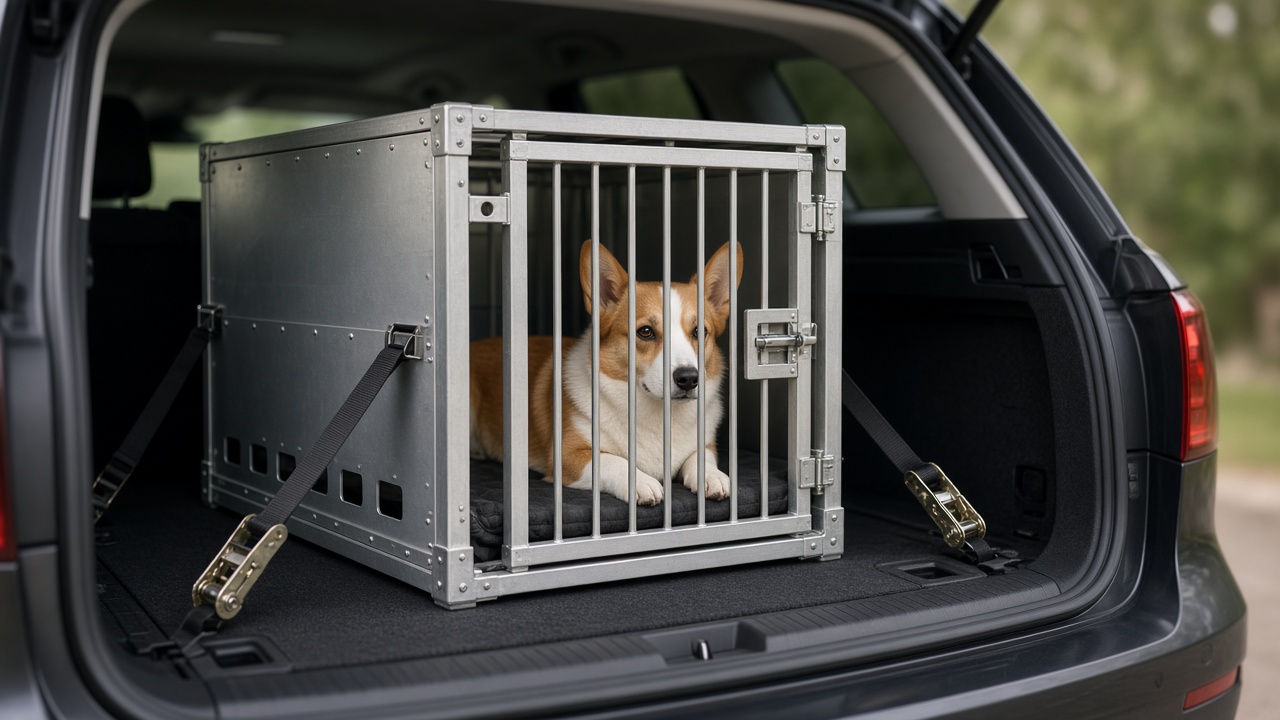
A wire crate with a divider is the usual housetraining pick, while a hard plastic kennel is the usual travel pick.
Do not mix those jobs on day one.
Meals, nights, and potty timing
Meals set the potty clock, and night placement keeps the crate from feeling like exile.
The Merck Veterinary Manual says housetraining usually takes just a few weeks with early trips outside, so praise the outdoor potty.
Feed a growth diet while the puppy is still growing, and look for the AAFCO statement the Merck page names on puppy food.
Most dogs reach adulthood at 9 to 12 months on that Merck page, though large and giant breeds can take almost 2 years.
Meal counts belong on the crate calendar:
- 6 to 12 weeks: 4 meals
- 3 to 6 months: 3 meals
- 6 to 12 months: 2 meals
Close the door only after the puppy is already eating, and open it before panic starts.
Crate meals are timing, not portion math. Our puppy nutrition guide covers label checks and how much to scoop.
At night, keep the crate near the bedroom, because the Animal Humane Society says that avoids social isolation and lets you hear a potty plea.
Take a night trip if the puppy cries after a quiet stretch, and make it a potty walk, not play.
The Merck page also notes vaccines every 2 to 3 weeks until about 4 months, with socialization heaviest between 2 and 4 months.
Crate naps should not replace those short, safe people meetings.
What this schedule does not cover
This schedule is for dog puppies in a home, and it is not an 8-hour office lock-in.
Do not use the crate as punishment, because the Animal Humane Society says the crate should pair with good things only.
Do not yell at the crate or bang the door, because that makes whining worse.
A puppy crate is a dog den, and it is not a cat walking tool.
If you also keep a cat that needs outdoor control, use a fitted harness, not this den schedule. That tool class is covered in our safest cat harness article.
Skip this plan if the puppy tries to force the door. The Animal Humane Society says to let that puppy out and rebuild the intro.
FAQ
How long can I leave a puppy in a crate during the day?
Use the Animal Humane Society rule: age in months plus one hour, so a two-month-old puppy has a three-hour cap.
That cap is per closed block. If you must be gone longer, use a puppy-safe room with an open crate and a potty zone.
When should I start crate training?
Start the week the puppy comes home, often at 7 to 8 weeks, which is the Merck Veterinary Manual age for leaving the mother.
Keep the first days to open-door treats and meals, and add a closed door only after the puppy walks in for food.
How big should a puppy crate be?
The Animal Humane Society says the puppy should stand fully and turn in a circle, because extra floor often becomes a toilet.
MidWest lists seven iCrate sizes from 18-inch to 48-inch and includes a divider. Petmate says to add 3 to 4 inches past the dog’s height and length.
Should I feed my puppy in the crate?
Yes, once the puppy enters for food on its own, because the Animal Humane Society uses meals to build a good crate link.
Match meal count to age on the Merck Veterinary Manual table, and keep the door open for the first crate meals.
What if my puppy cries in the crate at night?
First meet food, water, potty, and rest needs, because the Animal Humane Society says to sort distress from a simple test.
If the puppy tries to break out, open the door. If the cry follows a quiet hour, take a short potty trip and return to bed.
Can I crate a puppy for a full workday?
Not as one closed block, because the Animal Humane Society says young dogs cannot hold for a workday or a full night at first.
Split the day with a person, a walker, or an ex-pen plan, and keep the crate as a bed inside that plan.
Do I need a wire crate or a plastic kennel?
For housetraining, a folding wire crate with a divider is the usual fit, and MidWest’s iCrate page lists that divider and seven sizes.
For cargo travel, Petmate’s Sky Kennel page lists IATA 51st edition (2025) compliance and six sizes. Gunner’s G1 page is built around a snug car fit, not a growing-puppy divider.