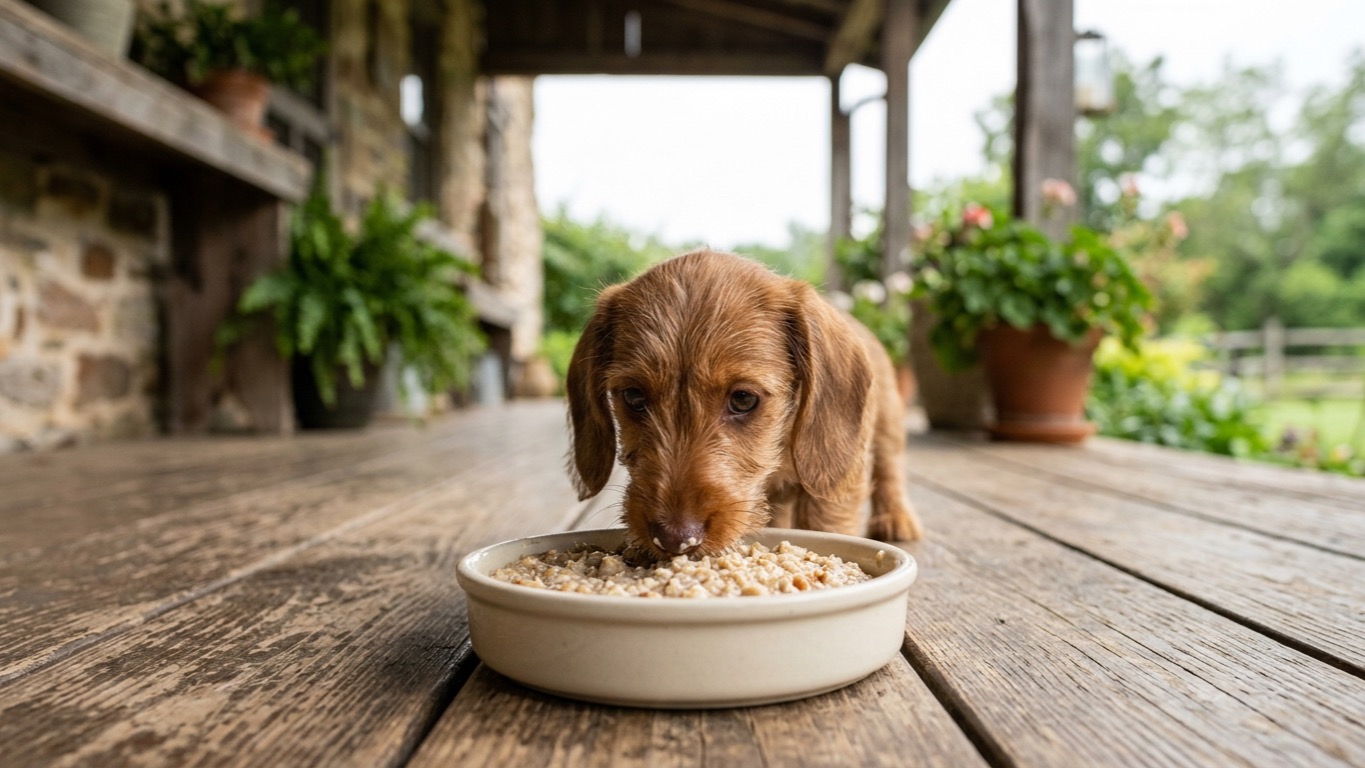
Quick answer: Mix a growth-labeled puppy food with warm water or a puppy milk replacer until it looks like oatmeal. Offer it in a shallow dish starting around 3 to 4 weeks of age. Thicken the mash as chewing starts, and keep milk feeds until the pups eat well on their own.
Puppy gruel is oatmeal-thick growth food mixed with water or milk replacer, offered from 3 weeks of age. This page is a research-desk mix guide from The Pet Bench.
Selection rule: We included a product only if its maker page names a puppy, growth, or weaning use. That same page also had to publish protein, fat, and calorie figures we could read. We excluded adult maintenance foods, cow’s milk, raw farm goat milk, treats, and any recipe that lacked a growth statement.
Our research team compared those published specs. We also did not rank the cans.
When a litter is ready for gruel
Cornell University College of Veterinary Medicine says puppies start to experiment with solid food as early as 3 weeks of age. Mothers may still make milk for up to 10 weeks. Most litters are fully on solids between 7 and 10 weeks.
PetAg’s weaning guide starts most nursed litters around 4 weeks. It waits until 5 weeks for bottle-fed pups. It wants them fully weaned by 7 to 8 weeks.
Purina’s weaning page starts softened meals at about 4 weeks and keeps them wet at first. By around the seventh week, that page aims for dry food only if dry food is the end goal.
Those three timelines overlap. A 3-week start is the earliest window we found. A 4-week start is the more common maker cue.
Watch the pups, not only the calendar. PetAg lists walking steadily, interest in the dam’s food, and the first premolar as readiness signs.
Cornell notes that the first four weeks still depend on the dam’s milk, including colostrum. Its ideal window for staying with the dam is 8 to 12 weeks. That social timeline is separate from mash, and gruel can start while the litter still nurses.
The Bench Mash Rule
Call it the Bench Mash Rule. It has three rungs.
Rung one is a loose oatmeal slurry. Use it for first licks. The dish should be shallow and hard to tip.
Rung two is a thicker mash. Use it once the pups lap without choking. Reduce the liquid a little each day.
Rung three is barely damp food, then the food as sold. Stop adding extra water when the pups chew and drink from a water bowl.
Purina’s page gives two starter ratios. For wet food, mix two parts food to one part water. For dry food, mix one part food to three parts water.
Purina also says to soak dry kibble in hot water for about 15 minutes, then mash it. Cool it toward body temperature before serving.
PetAg’s milk replacer pages use a different liquid recipe. Whisk 1 part Esbilac powder into 2 parts warm water. The same 1-to-2 mix appears on Goat’s Milk Esbilac, and PetAg says not to use a blender for those powders.
Do not treat those two systems as one scoop. Purina’s 1-to-3 soak is food plus water. PetAg’s 1-to-2 mix makes a milk-like liquid you can fold into food.
PetAg says to discard unused reconstituted Esbilac after 24 hours in the fridge. Its weaning guide is stricter on leftover mash. Discard uneaten reconstituted Healthy Development mix after 2 hours.
Never force a muzzle into the bowl. PetAg flags choking risk if you push a face into the dish.
Two mixes: canned slurry and soaked kibble
A canned growth food is the faster first mash. Add a little warm water or mixed milk replacer, then stir until it looks like oatmeal.
A dry growth kibble is the slower first mash. Soak it, wait, then smash it.
Both paths need a growth statement on the label. The Association of American Feed Control Officials defines “complete” as containing the required nutrients. It defines “balanced” as those nutrients in the correct ratios.
AAFCO lists growth as one of four life stages, with gestation and lactation, maintenance, and all life stages.
Royal Canin’s US mousse page states it is formulated to AAFCO profiles for gestation, lactation, and growth. That claim includes large dogs that will weigh 70 lb or more as adults. Hill’s lists Puppy Chicken & Barley Entrée for puppies up to 1 year and for pregnant or nursing dogs.
For a wider canned shortlist after weaning, see our wet puppy food guide.
Keep cow’s milk out of the bowl. PetAg’s milk replacer pages formulate for puppies, not leftover carton milk. Goat’s Milk Esbilac is a finished powder with added nutrients, not raw farm goat milk.
Offer fresh water once weaning starts. PetAg and Purina both say the water dish belongs in the room from the first mash.
Teeth will come in while the mash thickens. A puppy teething toy can occupy a chewing mouth between meals. It does not replace food.
How much to offer, and how often
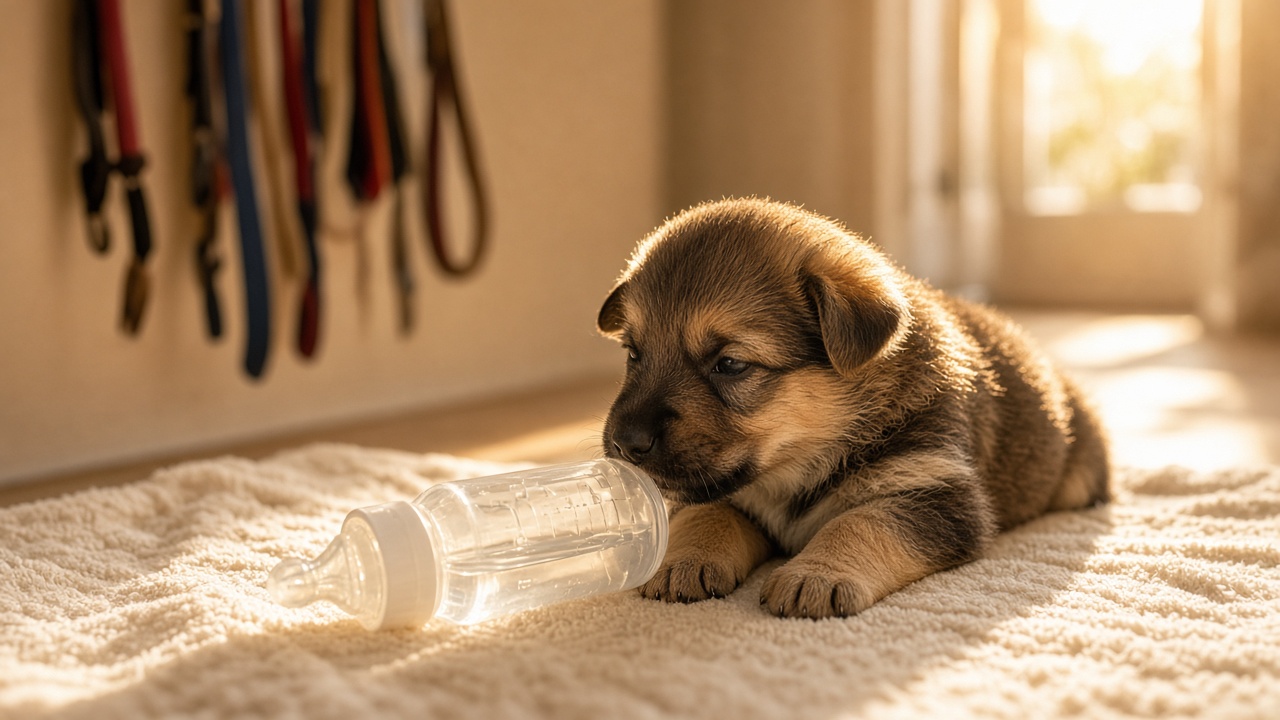
PetAg’s Esbilac page is the most specific liquid dose we read. Feed 2 tablespoons, or 30 mL, of reconstituted Esbilac per 4 ounces, or 115 g, of body weight daily.
Split that total across feedings every 3 to 4 hours. An 8-ounce puppy, PetAg says, needs 4 tablespoons across 24 hours.
That dose is for the liquid, not kibble mash. Once food enters the mix, use the food label and watch weight.
PetAg’s Healthy Development page, formerly Esbilac 2nd Step, starts at 4 to 5 weeks. That is when pups stand and lap from a bowl. Feed it until 7 to 8 weeks, about 4 times per day.
Weigh the litter at least once a week. The weaning guide prefers a check every 2 to 3 days.
Healthy Development is labeled for intermittent or supplemental feeding only. PetAg says it should not exceed 10% of daily calories.
Purina splits the day into three smaller meals until the puppy is older. Royal Canin’s mousse is aimed at weaning pups up to 2 months old.
After that window, move to a growth food that matches size. Daily amounts after mash belong in our puppy nutrition guide.
Warm the mash. Do not serve it hot. PetAg says to warm reconstituted Esbilac to room or body temperature.
Products we compared for a first mash
Our research team lined up five currently sold items from maker pages. Two are milk replacers, one is a weaning cereal, and two are complete wet growth foods.
The table is an attribute grid.
| Product | Form | Maker-stated window | Mix or serve note | Protein, as listed | Fat, as listed | Calories, as listed |
|---|---|---|---|---|---|---|
| PetAg Esbilac Puppy Milk Replacer Powder | Powder | Newborn to 6 weeks | 1:2 powder to water; no blender | 33.0% min | 40.0% min | 5098 kcal/kg; 13.2 kcal/tbsp mixed 1:2 |
| PetAg Goat’s Milk Esbilac Puppy Milk Replacer Powder | Powder | Newborn to 6 weeks | Same 1:2 mix; no blender | 33.0% min | 40.0% min | 5098 kcal/kg; 13.2 kcal/tbsp mixed 1:2 |
| PetAg Esbilac Healthy Development | Powder cereal | 4 to 5 weeks through 7 to 8 weeks | 1:2 powder to water; supplemental only | 26.0% min | 12.0% min | 3773.4 kcal/kg; 27.77 kcal/tbsp dry |
| Royal Canin Starter Mother & Babydog Ultra Soft Mousse In Sauce | Wet mousse, 5.1 oz | Weaning up to 2 months | Mash as sold, or thin with water | 8.5% min | 4.5% min | 972 kcal ME/kg; 141 kcal ME/can |
| Hill’s Science Diet Puppy Chicken & Barley Entrée | Wet loaf, 13 oz | Puppies up to 1 year | Soft loaf; thin with water | 29% protein, dry-matter | 20.3% fat, dry-matter | 1339 kcal/kg; 495 kcal/can |
The calorie gap is the useful comparison. Hill’s lists 495 kcal in a 13 oz can, about 38 kcal per ounce. Royal Canin lists 141 kcal in a 5.1 oz can, about 28 kcal per ounce.
A small mousse can is a different energy density, not a tiny meal.
Esbilac powder is denser still before water goes in. PetAg lists 31.6 kcal per tablespoon of dry powder, then 13.2 kcal per tablespoon after the 1-to-2 mix.
Protein also shifts by format. Both Esbilac powders list 33.0% minimum crude protein as sold. Healthy Development drops to 26.0% protein and 12.0% fat.
That drop is a planned step from a milk-like powder to a cereal.
Royal Canin’s as-fed protein looks low at 8.5% because moisture is listed at 80.5% maximum. Hill’s publishes dry-matter protein at 29%. Do not treat those two figures as the same kind of number.
Goat’s Milk Esbilac matches Esbilac on mix, dose, and calories. PetAg lists 150 g, 12 oz, and 5 lb sizes. Regular Esbilac lists 12 oz, 28 oz, and 5 lb.
Esbilac powder also lists 130,000 colony-forming units of named bacteria per gram. Opened powder can sit at room temperature for up to 2 months, PetAg says, then 1 month in the fridge or up to 6 months frozen.
Royal Canin lists DHA at 0.03% minimum, vitamin E at 133 IU/kg, and ascorbic acid at 80 mg/kg. Hill’s dry-matter table lists calcium at 1.27% and phosphorus at 1.05%.
We left out the two-cup kibble plus 12.5-ounce blender recipe that circulates on other sites. We could not tie that scoop count to a maker page.
We left out adult dog food, cow’s milk, cream, farm goat milk, and homemade broth as a complete meal. PetAg’s weaning guide says not to use adult food. AAFCO puts the nutritional adequacy statement on commercial growth foods, not on broth.
We left out sick or failing-to-gain pups as a DIY case, and we left out a ranked “top” list. Weight loss, vomiting, or a pup that will not lap needs a clinician, not a thicker mash.
If a pup still nurses well at 3 weeks, you can wait a few days. If a dam is drying up early, start the slurry sooner and keep PetAg’s milk replacer dose in play. Mix only what the litter will finish.
FAQ
What is puppy gruel?
Puppy gruel is growth-labeled food mashed with warm water or puppy milk replacer until it is loose enough to lap. The usual target is oatmeal. It is a bridge from milk to chewable food, not a lifelong diet.
Can I start gruel at 3 weeks?
Cornell University College of Veterinary Medicine says pups may try solids as early as 3 weeks. PetAg and Purina more often start closer to 4 weeks. If the pups walk and still nurse, a thin slurry is the conservative first step.
Should I mix milk replacer or only water?
Water works for canned or soaked kibble, and Purina’s page uses water in both starter ratios. Milk replacer adds calories. If you use Esbilac, mix the powder 1 to 2 with warm water first, then fold that liquid into the food.
How often should I offer the mash?
PetAg’s weaning guide and Healthy Development page both point to about 4 meals a day. Purina uses three smaller meals for young pups. Keep milk feeds until the pups hold weight on food alone.
How do I know the mash is too thin or too thick?
Too thin looks like soup and leaves the pups wet without a full belly. Too thick sits in clumps they cannot lap. Aim for oatmeal, and if a pup coughs, stop and thin the next bowl less.
When do I stop making gruel?
PetAg wants most pups on solids by 7 to 8 weeks. Cornell allows a full wean as late as 10 weeks. Reduce liquid as chewing improves, and stop the slurry when the pup eats the growth food as sold and drinks water.
Can leftover gruel sit out?
No. PetAg’s weaning guide says to discard uneaten reconstituted Healthy Development mix after 2 hours. Reconstituted Esbilac liquid can be refrigerated up to 24 hours.