Quick answer: Decide if the harness is overhead or step-in before you touch the dog. Put it on that way only, buckle the girth behind the elbows, then check a two-finger gap. Clip the leash only after every strap sits flat and the girth check is done.
A walk harness goes on only two ways: over the head, or both front paws in, then the girth buckle. This page is a put-on guide from published maker charts, and
What this guide covers, and what it leaves out
Our research team analyzed only everyday walk harnesses whose US maker pages publish a girth chart and a put-on method.
That is the selection rule for this article. We cover overhead and step-in harnesses used on a sidewalk leash, and we leave out car-crash harnesses, head collars, and lift-assist vests.
We compared published specs on three current maker pages: Ruffwear’s Front Range page, PetSafe’s Easy Walk page, and Kurgo’s Tru-Fit Smart page.
Kurgo’s Tru-Fit Smart page lists a 10-inch seat belt loop and states the walking harness is not crash tested. That line is why car travel stays out of this guide.
Identify the harness in your hands first
The open buckle tells you whether this is an overhead harness or a step-in harness.
Do this on the floor, not on the dog, because a mixed-up first move often leaves a buckle open.
Look for these marks:
- Overhead: one neck loop you can hold open, plus a girth strap that still needs a click
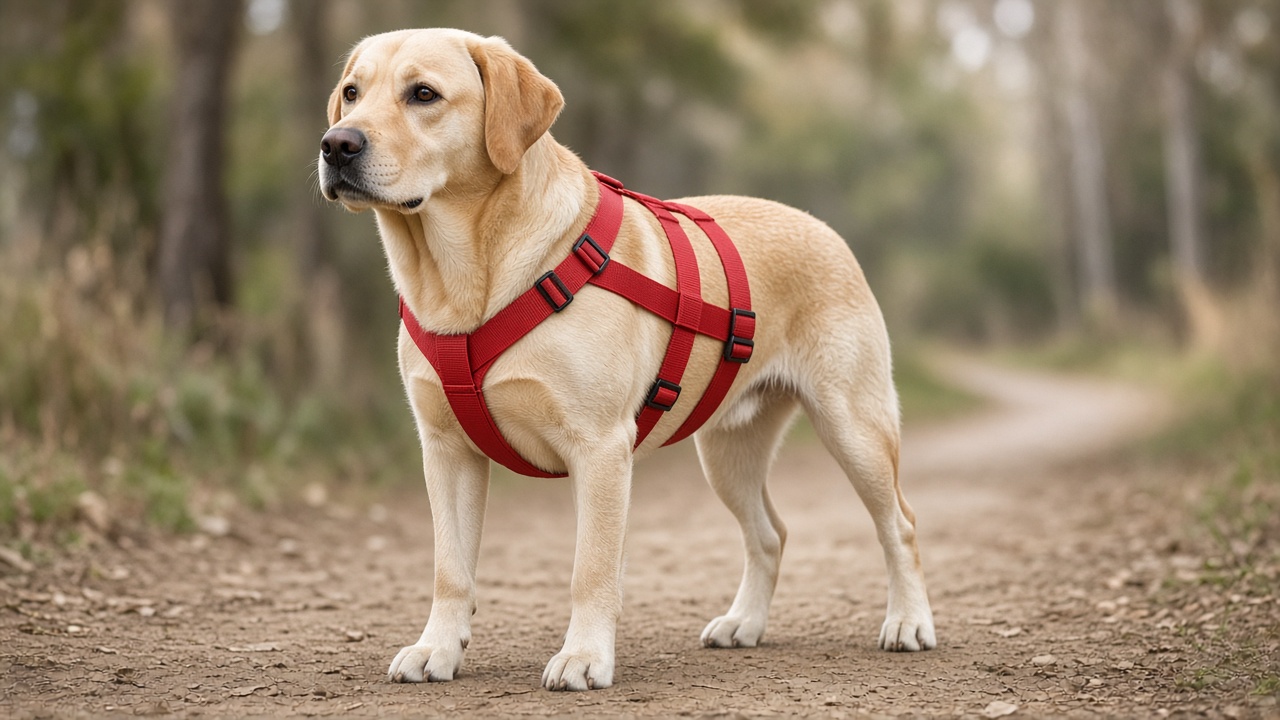
- Step-in: two front-leg holes when the harness lies flat, plus a buckle that closes on the back
- Front-clip: a D-ring or loop on the chest, often used on a no-pull style
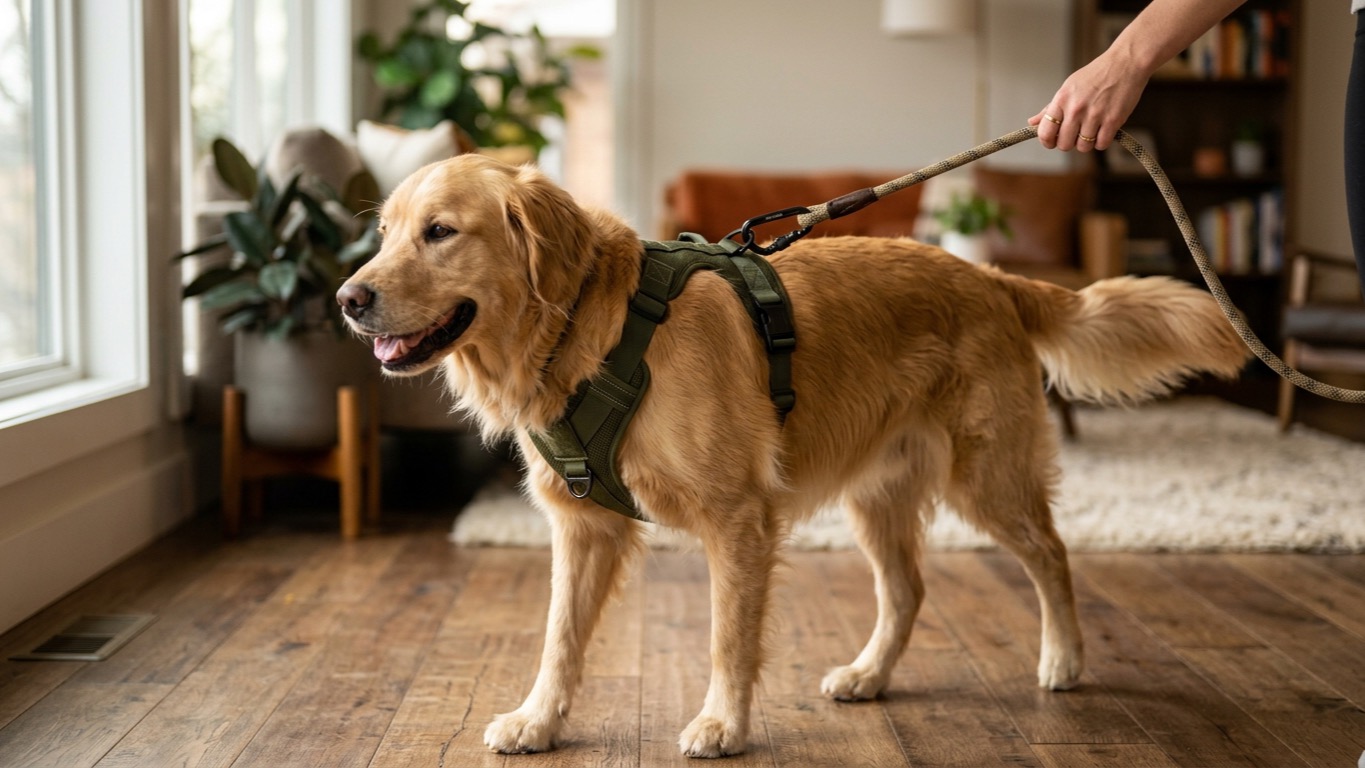
- Back-clip: a ring centered on the back for a standard leash
PetSafe’s Easy Walk page describes a front chest leash attachment and a belly strap in a different color from the rest of the harness.
Ruffwear’s Front Range page lists two leash attachment points: an aluminum V-ring on the back and reinforced webbing on the chest. Kurgo’s Tru-Fit Smart page also lists front and back leash attachments.
If your dog pulls, the clip choice is a walking problem, not a put-on problem. Use our guide on how to stop a dog from pulling on leash after the harness sits correctly.
Measure girth before the first put-on
Chest girth behind the front legs is the measurement every maker chart in this guide uses.
Skip weight as the first number, because PetSafe’s Easy Walk page says weight ranges are only approximate. Kurgo’s fit page says chest and neck beat weight.
Use a soft tape. If you lack one, wrap a leash around the chest, then measure that leash.
Take the readings this way:
- Girth: widest part of the rib cage, just behind the front legs
- Chest width on PetSafe’s chart: across the front of the chest, one inch past the front legs
- Neck on Kurgo’s chart: thickest part of the neck, just above the shoulders
- Stance: the dog standing, not sitting
Ruffwear’s Front Range page says to measure around the widest part of the rib cage. If the dog is between sizes, that page says to choose the larger size.
Ruffwear’s sizing page dated May 21, 2024 lists a XXXS girth of 9 to 13 inches and an XL girth of 36 to 42 inches. The Front Range product page groups the top end as L/XL at 32 to 42 inches.
Comparing those published specs, the lowest listed start is 9 inches on Ruffwear’s sizing page. The highest listed upper girth is 49 inches on PetSafe’s Extra Large row.
For a full tape-measure walkthrough, use our dog harness size guide.
| Maker harness | Low chest or girth | High chest or girth | Adjustment points |
|---|---|---|---|
| Ruffwear Front Range | 13 to 17 in (XXS) | 32 to 42 in (L/XL) | 4 |
| PetSafe Easy Walk | 12 to 17 in (Petite) | 32 to 49 in (Extra Large) | 4 |
| Kurgo Tru-Fit Smart | 12 to 18 in (X-Small) | 28 to 44 in (X-Large) | 5 |
Ruffwear’s Front Range page lists $59.99, PetSafe’s Easy Walk page lists $20.69, and Kurgo’s Tru-Fit Smart page lists $18.87.
How to put on an overhead harness
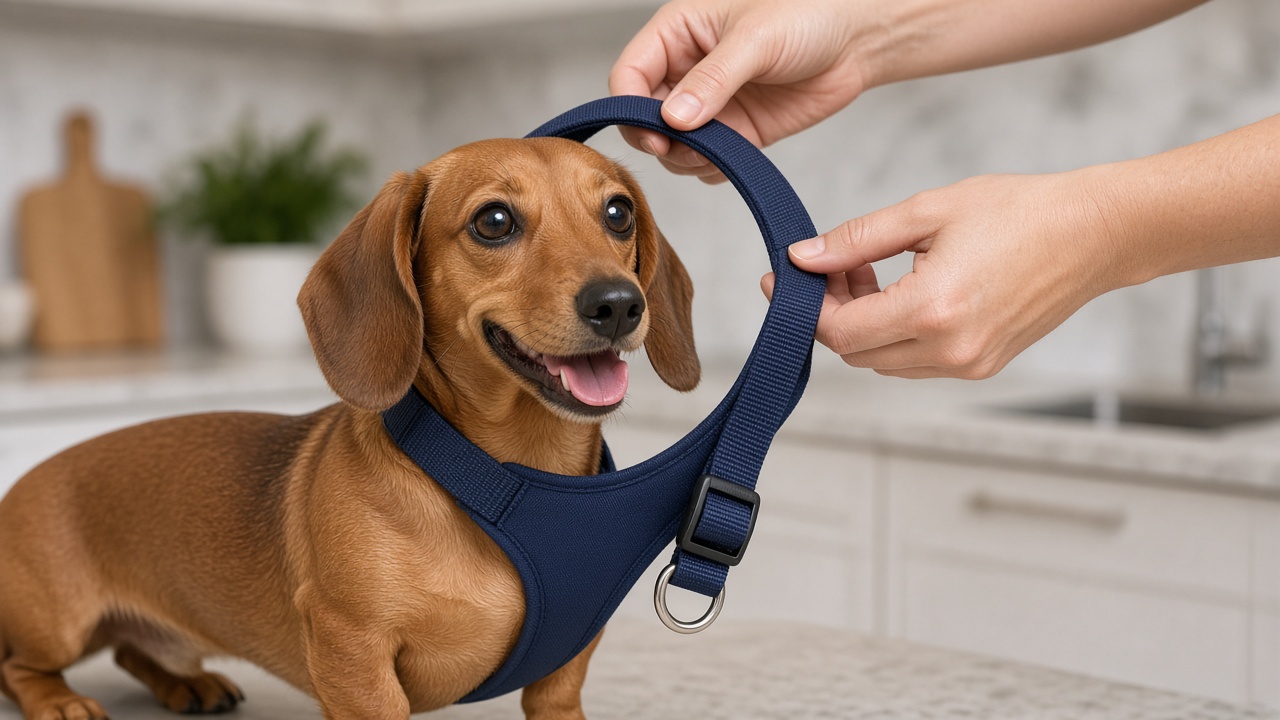
An overhead harness goes on head-first, then the girth straps buckle behind the elbows.
Kurgo’s July 14, 2022 fit page tells you to loosen every strap before the first outing. Do that, because a tight neck loop makes the dog back up.
Kurgo’s Tru-Fit Smart page describes the same path in one line: slip it over the head, then clip a couple of buckles.
Follow this order:
- Unclip the girth buckle or buckles, and hold the neck loop wide.
- Let the dog sniff the harness, and do not jab the loop at the muzzle.
- Slide the neck opening over the head, and keep labels or handles on the back.
- Drop the chest piece onto the chest so the center strap runs between the front legs.
- Reach under the rib cage and bring the girth strap up behind both elbows.
- Click each buckle, listen for the snap, and check that fur is not in the latch.
- Stand the dog and watch the chest plate, which should stay centered.
Kurgo’s first-outing steps add one extra move after the head slide. Lift the chest piece so it touches the chest and belly, then fasten the side buckles behind the front legs.
Ruffwear’s Front Range page lists four points of adjustment, so use them after the buckles click. PetSafe’s Easy Walk page also lists four adjustment points and says the harness has been sold since 2004.
Do not attach the leash during these steps, because a leash on a half-buckled harness turns a wiggle into an escape.
How to put on a step-in harness
A step-in harness goes on paws-first on the floor, then the back buckle closes over the shoulders.
This style has no neck loop to slide, so a head-first try leaves one leg hole empty.
Follow this order:
- Lay the harness flat with the leg holes open and the back buckle at the top.
- Ask the dog to stand over the harness, or lift one front paw at a time.
- Place each front paw in its hole, because both front legs must be through.
- Pull the harness up the legs to the chest until the chest plate sits flat.
- Bring the two back panels up over the shoulders.
- Click the back buckle and check the latch.
- Smooth each strap so nothing is twisted in the armpit.
If the dog will not step, lift the paws instead of chasing the dog around the room.
A step-in harness still needs a girth check. The leg holes should sit on the upper legs, not in the armpits.
If your dog hates paw handling, switch to an overhead style.
Puppies often outgrow a size before they outgrow the put-on method.
Ruffwear’s sizing page says many larger dogs may not reach full size until around 12 to 18 months.
The same page uses a 3-month-old puppy with a 17-inch chest girth as the between-size example. It says to size up from XXS to XS.
A growing puppy also raises a collar question. Put-on steps stay the same, but the tool choice does not. See dog harness vs collar for puppies for that split.
Check the fit before you clip the leash
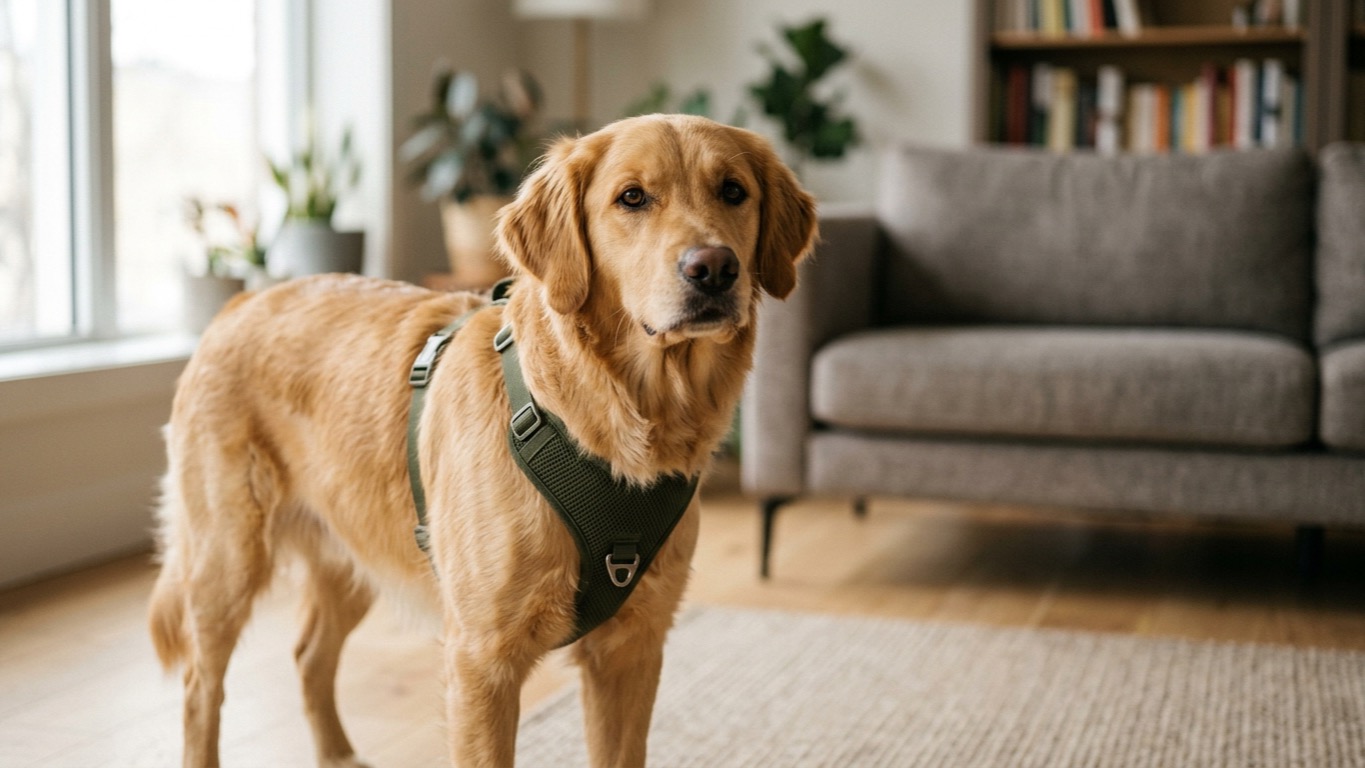
After the buckle clicks, confirm two fingers at the girth and a centered chest plate.
Kurgo’s fit page states the two-finger rule in plain words. You should fit two, and only two, fingers between the dog and the harness at any point.
Use that gap at the girth strap as your first check, then watch the dog walk.
Run this list before the leash goes on:
- Two fingers slide under the girth behind the elbows
- The girth strap sits on the rib cage, not the soft waist
- The chest plate is centered and does not rotate
- No strap sits in the armpit crease
- Every buckle is closed
- The dog can sit, stand, and step without the harness sliding forward
If a whole hand fits under the girth, the harness is too loose. If you cannot fit one finger, it is too tight.
Kurgo’s fit page lists signs of a poor fit. Those signs include bare spots, chafing, a rotating back piece, or a dog that wriggles free.
If the back piece rotates, the size or the strap balance is wrong. Recheck girth, then reset the adjustment points the maker lists.
Ruffwear’s Front Range page lists four adjustment points, Kurgo’s Tru-Fit Smart page lists five, and PetSafe’s Easy Walk page lists four.
Do a second check after a short walk, because straps settle and a door-side gap can open on the sidewalk.
Mistakes that leave the harness on backward
A rotated chest plate or an unused buckle means the harness is not on yet.
Watch for these failures:
- Chest plate on the back: the harness is backward
- One empty leg hole on a step-in: a paw was missed
- Girth strap in front of the elbows: the buckle was closed too far forward
- Neck loop twisted: the label side was flipped
- Leash clipped before the last buckle: the dog can step out under load
- Walk harness used in a car: Kurgo’s walking page says its 10-inch seat belt loop is not crash tested
If the dog backs out, stop the walk and do not tighten at random. Lay the harness out again and restart from the type check.
A front-clip harness can still be on backward, so the chest ring must sit on the chest, not the shoulder blade.
Long coats hide a pinched buckle, so run a finger under each latch after the click.
If you cannot get two fingers under the girth after every strap is opened, the size is wrong. Go back to the tape instead of forcing the next hole on the strap.
FAQ
How do I tell an overhead harness from a step-in harness?
Lay it flat and look for the open path. An overhead harness has a neck loop you can hold like a collar. A step-in harness shows two front-leg holes and a buckle that meets on the back.
How tight should a dog harness be?
Kurgo’s fit page says two fingers, and only two, should fit between the dog and the harness. The girth should sit on the rib cage behind the elbows, and the chest plate should stay centered when the dog steps. If the dog can walk out of it, the harness is too loose.
Why does my dog back out of the harness?
The usual cause is a loose girth or a strap that sits too far forward. Restart the put-on from the type check, close the girth behind the elbows, and repeat the two-finger test. If the dog still slips free, the size on the maker chart is wrong, not the last strap hole.
Should I clip the leash on the front or the back?
Ruffwear’s Front Range page and Kurgo’s Tru-Fit Smart page both list a front point and a back point. PetSafe’s Easy Walk page lists a chest attachment only. Use the back ring for a calm walk, or the front point if you need to turn the dog’s shoulders.
How often should I recheck fit on a puppy?
Recheck girth every time you put the harness on. Ruffwear’s sizing page says many larger dogs may not reach full size until around 12 to 18 months. A 17-inch girth on that page’s 3-month-old example sits between XXS and XS, and the page says to choose the larger size.
Can I put a harness on a sitting dog?
You can start with a sit for an overhead neck loop. You still need the dog standing to set the girth behind the elbows, because a sit hides the rib cage and pulls the strap forward. For a step-in harness, the dog must stand so both front paws can enter the holes.
What if the chest plate slides to one side?
That is a fit failure on Kurgo’s list, because the back piece should not rotate. Open the adjustment points, center the chest plate, and tighten both sides evenly. If it still slides, compare your girth number with the maker chart and change size.