Quick answer: Clear a safe run space and wait the burst out. Add a walk plus a stuffed toy later so leftover energy has a job. Do not chase, punish, or crowd a sliding dog.
Dog zoomies are self-ending Frenetic Random Activity Periods, not a named disease or a training failure.
This page is a research-desk explainer of published behavior notes and maker specs, and we did not time home sprints, film clinic cases, or score a kennel trial.
Cornell University College of Veterinary Medicine says there is no known specific cause. Behavior resident Pamela J. Perry writes that FRAPs appear to release pent-up energy or ease stress.
A happy burst can still end in a crash if the dog hits a stair or a slick floor. Our research team compared published specs for four currently sold toys that can give leftover energy a job.
What a zoomie is, and what it is not
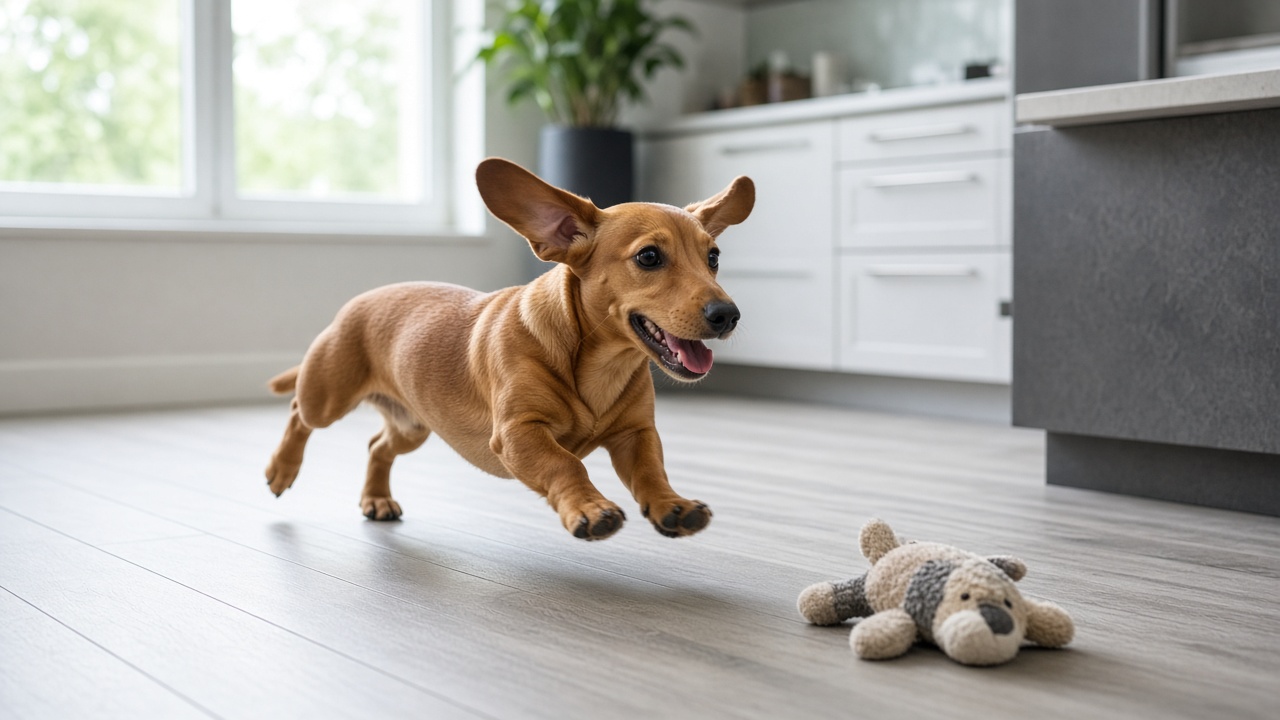
A zoomie is a sudden sprint, spin, or figure-eight. Dogs often tuck the rear and run as if a playmate might grab the tail.
Cornell’s Riney Canine Health Center page calls this frenetic random activity periods, or FRAPs. The college says the bursts are most common in puppies and young dogs.
Older dogs can still zoom now and then. Cornell is clear that some dogs keep the habit for life.
The burst is not a trick you failed to teach. It is also not a diagnosis on its own.
Cornell lists no lab test that proves a FRAP. Perry’s note is observational.
A seizure looks different. The dog does not bounce back with a loose body and a play bow.
If the dog seems in pain, frightened, or unable to settle, Cornell says to seek clinical help. This page does not replace a clinic visit.
Our selection rule for this page
We used one rule for every product on this page.
A toy had to be currently sold, and its maker had to publish a size, a fill amount, or a numbered play step. The toy also had to give a dog a job after a sprint: stuff, fetch, hold a chew, or solve a puzzle.
We left out crates, collars, calming chews, and anything sold as a medical device. We also left out ranked “best of” lists.
That rule is why the table below has four rows, not ten. Comparing published specs is not a home trial.
Triggers Cornell lists
Cornell names several recurring settings. The list is not a cause-and-effect proof. It is a map of when owners often see the burst.
The college lists arriving home after work. It lists late evening. It lists play, and training that overstimulates the dog.
It also lists the minutes after a dog defecates. And it lists any moment that feels exciting.
A bath is not on Cornell’s short list. Many owners still see a sprint when the towel comes off.
Treat that as an arousal spike after restraint, not as a Cornell finding. Keep the floor dry. Block the stairs.
Idle hours matter. Perry says a dog left alone with nothing to do may zoom to burn that backlog.
That is a schedule problem more than a “naughty” problem. A walk earlier in the day can shrink the backlog. So can a job that makes the dog think.
Food is not a Cornell trigger. Calorie load still shapes leftover energy later.
The Association of American Feed Control Officials says a lite dry dog food cannot contain more than 3,100 kilocalories per kilogram. AAFCO also requires a Calorie Content line in kilocalories per kilogram and per cup, can, or biscuit.
Read that line before you add extra mixers. A dense bowl plus a long idle stretch can leave a dog with steam to blow.
If the label lists chicken meal, you are looking at a concentrated protein ingredient, not a light snack. Match the cup count to the dog in front of you.
A sprint right after a gulp can also travel with a messy stomach. If food comes back up whole, start with our page on why a dog throws up undigested food.
How to tell a happy sprint from a scared one
Cornell says posture during and after the burst is the tell.
A happy zoomer stays loose. The body wiggles. The tongue may flap.
The dog may play bow when the speed drops.
Many dogs tuck the tail while they run. Cornell compares that tuck to keeping the tail away from a chasing playmate.
A frightened dog stays tight. The eyes widen. The tail stays pinned to the belly even after the dog stops.
The head may drop. The ears may fold back. Cornell says that kind of frenzy needs calm, not a cheer.
Do not add noise to a tight dog. Do not chase. Open a path to a quiet room or a familiar mat.
If the dog appears in pain, Cornell says to investigate the distress with clinical help. A limp after a crash is a reason to stop the game.
What to do while the burst is on
Use a three-step pattern we call Clear–Wait–Job.
Clear the path first. Cornell warns owners to keep a zooming dog away from stairs, slippery floors, obstacles, and the road.
Grass is Cornell’s preferred footing for hard running. Carpet and packed dirt are the next options the college names.
Hard floors, ice, gravel, and sand raise the slip risk. Fill yard holes, or mark them so the dog can see them.
Wait the burst out. Do not grab the collar mid-sprint. Do not turn it into a chase game in a hallway.
A chase tells many dogs the party should last longer. Stand still and soften your voice.
Then give a job. A job is a walk, a sniff, a stuffed toy, or a puzzle with a listed step count.
Do not stack a second wild game on top of a frantic puppy at night. Cornell notes late-evening FRAPs. An overtired youngster can get louder, not sleepier.
If the dog starts to mouth hands or chew shoes after the sprint, the leftover energy still needs an object that is legal to wreck.
How to give leftover energy a job
Cornell’s own menu is simple. Hike or jog if the dog’s age allows it. Play with a toy, or swim.
For the brain, the college points to household manners, new tricks, and scent games. A walk in a new place combines both.
That is the job half of Clear–Wait–Job. The sprint spent the spike. The job spends the rest.
Keep the job short enough that the dog can still settle. A second fetch marathon can rewind the arousal.
Stuffable rubber gives the mouth a task. A fetch ball gives the sprint a fence line. A numbered puzzle gives the nose a sequence.
Indoor tile is a poor fetch surface. That is a footing fact from Cornell, not a taste judgment.
Outdoor fetch still needs a closed space. Cornell says to keep an off-lead dog in an enclosed area.
Four toys compared by published specs
Our research team lined up four toys by the job they publish, not by a rank.
KONG lists the Classic in six sizes. Extra-small is for dogs up to 5 pounds. XX-large is for dogs 85 pounds and over.
The medium KONG Classic is listed at 2.25 × 2.25 × 3.5 inches and 0.25 pounds. KONG lists that size for dogs between 15 and 35 pounds.
KONG’s Classic page says the red rubber toy has been a staple for over forty years. The maker lists the material as 100% natural rubber and the origin as the USA.
Petmate sells the Chuckit! Ultra Ball in five sizes: Small, Medium, Large, X-large, and XX-large. The medium single pack is listed at 2.55 × 3.50 × 4.50 inches and 0.26 pounds.
Petmate describes an extra-thick rubber core, high bounce, and a ball that floats. The page says to supervise play and to replace a ball with rips, tears, or cuts.
West Paw lists the Qwizl in two lengths. Small is 5.5 inches, or 14 centimeters. Large is 6.5 inches, or 17 centimeters.
West Paw says the Zogoflex body has no BPA, latex, phthalates, or silicone. The maker says no dog toy is indestructible and to stop use if it is damaged.
Outward Hound lists the Nina Ottosson Dog Worker as a level 3 puzzle. The dog must complete three steps: swivel the flippers, scoot the blocks, and spin the center wheel.
The maker says the pieces stay on the board. The composite is listed as free of BPA, PVC, and phthalates. Outward Hound says not to leave a dog alone with the puzzle.
| Product | Job after a sprint | Maker-listed size or steps | Material | Maker caution |
|---|---|---|---|---|
| KONG Classic (Medium) | Stuffable chew with an erratic bounce | 2.25 × 2.25 × 3.5 in; dogs 15–35 lb | 100% natural rubber; made in the USA | Supervised use; size up for power chewers |
| Chuckit! Ultra Ball (Medium) | Outdoor fetch; floats | Medium pack 2.55 × 3.50 × 4.50 in; 0.26 lb | Extra-thick rubber core | Replace if ripped; supervise play |
| West Paw Qwizl (Large) | Hold and work a chew | Large 6.5 in / 17 cm | Zogoflex; no BPA, latex, phthalates, or silicone | Stop use if damaged |
| Nina Ottosson by Outward Hound Dog Worker | Level 3 treat puzzle | Three steps: swivel, scoot, spin | BPA-, PVC-, and phthalate-free composite | Do not leave the dog alone with the puzzle |
Use the KONG Classic after the burst, not as a hallway missile. Stuff kibble, then freeze it if you want the job to last.
Use the Chuckit! Ultra Ball only where a miss will not send the dog into a street. Petmate lists it for land or water play.
Use the West Paw Qwizl when the dog still wants to gnaw. Slide a stick treat through the tunnel.
Use the Dog Worker when the body is done running and the brain is not. Teach the three steps, then put the board away.
FAQ
Are zoomies normal in adult and senior dogs?
Yes, they can be. Cornell says FRAPs are most common in puppies and young dogs, but other dogs still zoom now and then for life.
Frequency should drop as the dog settles, not vanish on a birthday. A sudden new frenzy in a senior dog is a reason to ask a clinic about pain or distress.
Why does my dog get zoomies after a bath?
Cornell’s trigger list does not name baths. Many dogs still sprint when restraint ends and the towel comes off.
Treat it as leftover arousal, not as proof the shampoo failed. Dry the feet and block the stairs.
Should I try to stop the zoomies?
Do not punish a happy sprint. Cornell says the zoomies themselves will not hurt the dog. The crash risk will.
Clear the path, wait, then offer a job. Stopping the motion by force is how collars and shoulders get wrenched.
Can frequent zoomies mean my dog needs more exercise?
They can. Perry says frequent or poorly timed FRAPs may mean the dog needs more exercise and mental work.
Cornell’s examples include a hike, a toy, a swim, and scent games. Add those before the late-evening spike.
How do I tell zoomies from a seizure?
A happy FRAP ends with a loose body, a flap of tongue, or a play bow. Cornell says a frightened or painful dog stays tight, with wide eyes and a tail still pinned.
A seizure is not a play bow. If the dog cannot stand or does not recover, get clinical help.
Why do puppies get the zoomies at night?
Cornell lists late evening as a common FRAP window. Puppies also have short fuses after a long idle day.
More wild play at 9 p.m. often makes the noise worse. Shift the walk and the stuffed toy earlier.
Can food make zoomies worse?
Cornell does not list meals as a FRAP trigger. Extra calories can still leave more steam to burn.
AAFCO caps a lite dry dog food at 3,100 kilocalories per kilogram. If the dog gulps, then sprints, and then brings food back up, use the undigested-food page linked above.