Quick answer: Separate regurgitation from vomiting first. Whole food with no heaving usually means the meal never reached the stomach. Call a clinic the same day if it repeats, or if coughing, lethargy, or weight loss appears.
If the food is whole and comes up with no belly heaving, the meal never entered the stomach. This page is a research-desk briefing on published timing rules and label numbers.
Our selection rule
We used a Two-Clock Rule to decide what belongs here. Clock 1 is how soon the food returned, and Clock 2 is whether the belly heaved.
We covered household speed, treat, and timing patterns, plus published esophagus facts that match whole-food return. We left out product rankings, price tiers, and any food we could not match to a manufacturer page.
Our research team compared published specs from AAFCO’s calorie page and Hill’s k/d product page. Those comparisons are label math, not feeding trials.
How regurgitation differs from vomiting
Whole food with no heaving is regurgitation, not a digested stomach emptying.
The Merck Veterinary Manual’s owner page on esophageal disorders draws a hard line. Regurgitation is effortless and has few warning signs, while vomiting is an active process that starts with signs of nausea.
Watch the body, not only the pile, because heaving is the cleaner clue.
- Regurgitation: little warning, no belly heaving, food looks whole, often a tube shape
- Vomiting: drooling or restlessness first, then retching, then a heave
- Bile: yellow fluid points toward the stomach or gut, not a simple burp
The Merck Veterinary Manual also defines regurgitation as food or liquid that returns before it has reached the stomach. That definition answers most searches about undigested food on the floor.
A dog may eat the pile again, but that habit does not make the event safe. It only tells you the dog still wants the meal.
Write down two facts before you clean the floor, then bring those notes to the clinic.
- Minutes since the last meal
- Whether the sides of the belly pumped
Those two notes help a clinic sort esophagus problems from stomach problems.
Fast meals, leftover treats, and table scraps
Speed and extras can send food back up before digestion starts.
The United States Food and Drug Administration holiday-hazards page warns that a dog who gobbles a stocking of treats can choke or vomit. Unchewed treats can lodge in the trachea, esophagus, stomach, or intestines.
The same FDA page says a bone or chew may not cause signs at once. Hours to days later, a dog may vomit, have diarrhea, move less, refuse food, and show stomach pain.
Rich table scraps are a separate trigger, and the FDA page says high-fat trimmings and poultry skin can cause pancreatitis. Common signs it lists include vomiting, stomach pain, restlessness, shaking, diarrhea, fever, and weakness.
Salt is a number you can check, and the FDA page states that one cup of salt is 48 teaspoons. It also states that a 10-pound pet can get sick after eating just ½ teaspoon of table salt. It states that 1½ teaspoons of salt can be fatal.
If the only change was a gulp, a new chew, or a fatty leftover, start here.
- Pick up free-choice food so the next meal is measured
- Split the daily ration into two or three smaller bowls
- Keep human snacks and salt dough out of reach
- Do not offer another full meal until a clinic says it is safe
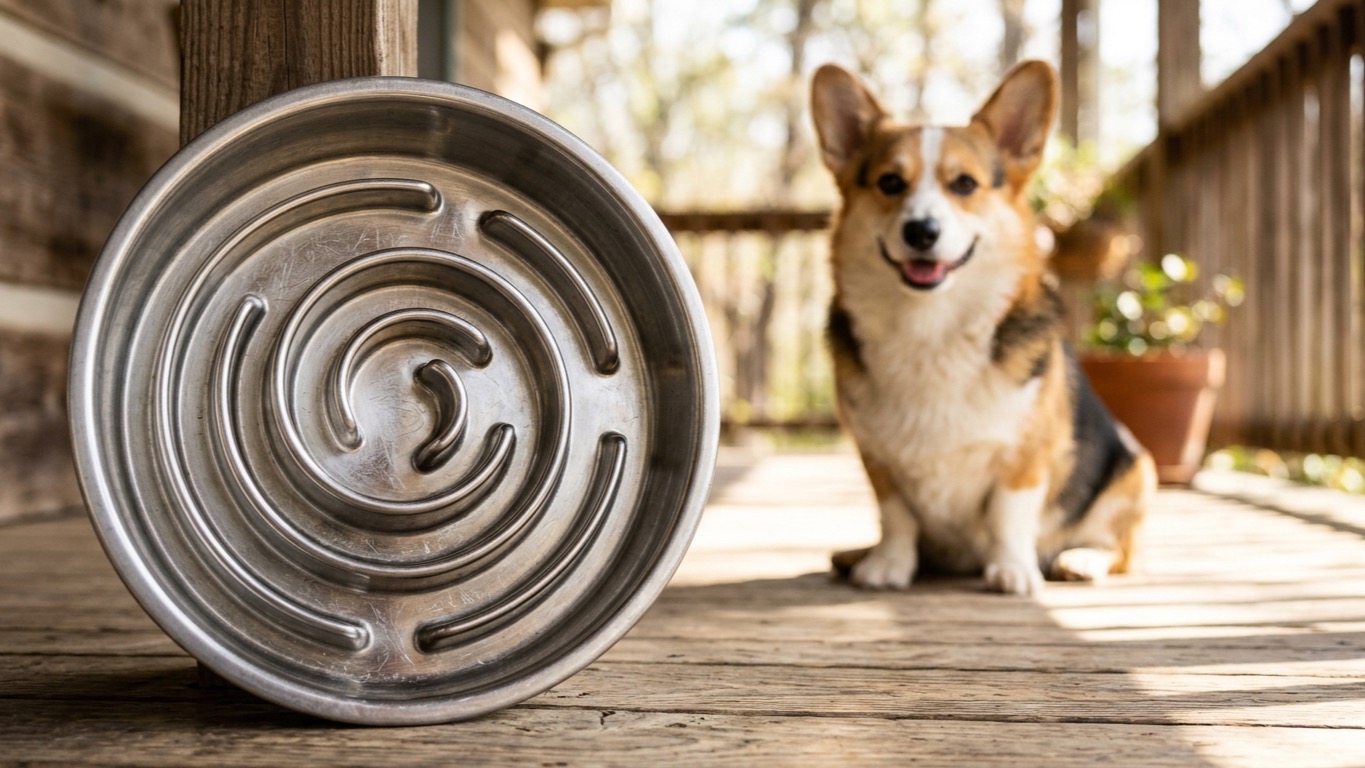
A slow-feed bowl can help a healthy gulper, but it does not treat a dilated esophagus. If whole food returns after every meal, skip home gadgets and call.
When the esophagus cannot move food
Repeated whole-food episodes can mean the esophagus is dilated or blocked.
The Merck Veterinary Manual’s professional megaesophagus page calls regurgitation the cardinal sign. A puppy with the congenital form often starts when solid food replaces milk. Adult dogs that develop it also start to regurgitate and then lose weight.
The owner version of that Merck chapter says dogs with megaesophagus suddenly start regurgitating undigested food soon after eating. Coughing and hard breathing may appear if food enters the airway.
A 2011 Journal of the American Veterinary Medical Association paper reviewed 71 dogs with generalized megaesophagus and found a median survival time of 90 days. Nineteen dogs, or 26.7%, died before discharge.
That JAVMA paper also found radiographic signs of aspiration pneumonia in 32 dogs, or 45%. An age at onset over 13 months was tied to shorter survival, and German Shepherd Dogs made up 14 of the 71 dogs, or 20%.
The same JAVMA paper reported how many dogs were still alive later.
- 62.3% at 1 month
- 41.0% at 1 year
- 31.3% at 2 years
- 22% at 5 years
The Merck professional page cites survival times of 1 to 3 months and a mortality rate of 74% in reported series. Those figures describe diagnosed megaesophagus, not a single gulp after a stolen sandwich.
Congenital cases can change, and the Merck professional page says some puppies improve by 6 months of age. The owner page repeats that 6-month window.
Published feeding posture is specific on the Merck professional page. Feed with the forelimbs higher than the hindlimbs, then hold that position for 10 to 15 minutes.
The owner page sets the angle at least 45 degrees and the hold at least 15 minutes. Those posture numbers apply after a clinic has named an esophagus problem.
The Merck owner page also gives two surgery numbers that are easy to confuse with megaesophagus care.
- About 65% of cricopharyngeal-muscle surgeries succeed
- Recovery after surgery for a stuck esophageal object has been reported at greater than 90%
Those percentages are not a home plan. They show why a clinic visit matters when whole food keeps returning.
When food comes up hours later with heaving
Whole food hours later, with retching, points to the stomach or gut.
This is the other side of the Two-Clock Rule: Clock 1 is late, and Clock 2 shows a heave. The FDA holiday page is useful here too, because a lodged bone or chew can wait hours to days before vomiting starts.
That delay is not “just a sensitive stomach.” Call the same day if any of these sit with the late pile.
- A swollen or tight belly
- Repeated heaving with nothing coming up
- No water staying down
- Blood in the pile
- Collapse or extreme quiet
Do not guess between a fatty scrap and a blockage. The FDA page says a clinic may need x-rays, an endoscope, or surgery to find a stuck piece.
A one-time heave after trash-raiding is still a clinic question if it repeats. It is also a clinic question if the dog cannot keep water down.
What protein labels do and do not explain
An AAFCO protein minimum does not tell you why food came back up.
Whole kibble on the rug is not a lab test of meat meal versus meat. Timing and heaving tell you more than the first line of the ingredient list.
AAFCO’s calorie-content page states adult maintenance crude protein at 18.0% on a dry-matter basis. Growth and reproduction crude protein is 22.0% on that same dry-matter basis.
That same AAFCO page states the association does not regulate, test, approve, or certify pet foods, so states and companies must meet the standards.
AAFCO also states it has no specific requirement for a “high protein” claim, and the claim must not be false or misleading. Raising protein on your own does not treat regurgitation.
If you want the nutrient case for higher protein in healthy dogs, see our briefing on high-protein dog food benefits. Calorie math belongs on the label, not in a guess.
AAFCO’s page assigns 3.5 kcal per gram to protein and carbohydrate, and 8.5 kcal per gram to fat. Its worked example averages 3688 kcal per kg, or 442.6 kcal per cup if that food weighs 120 grams per cup.
A kidney diet is a different product class. The manufacturer’s page for Hill’s Prescription Diet k/d with Chicken lists dry bags of 8.5 lb, 17.6 lb, and 27.5 lb. That page also tells owners to mix the new food in over a 7-day period.
Do not swap a prescribed kidney diet for a high-protein bag because kibble came back up. If a clinic already chose k/d, use our page on where to buy Hill’s k/d dog food.
What to do at home, and when to call
One isolated gulp-and-return is different from a repeating pattern, so the next steps should match that difference.
If the dog is bright, and this happened once after a stolen meal, watch closely. Withhold the next full bowl until you have a clinic plan, and offer small amounts of water unless a clinician said to stop water.
Record this list before you call so the clinic hears a clean timeline.
- Time of the meal and time of the return
- Heaving or no heaving
- Shape and color of the pile
- New treats, bones, trash, or table scraps
- Cough, fever, weight loss, or a tight belly
Call the same day if whole food returns more than once, or if there is cough, lethargy, or weight loss. Call now if the belly is tight, if blood appears, or if the dog cannot stand.
The JAVMA megaesophagus paper is the reason we do not wait on repeating regurgitation. Aspiration pneumonia was common in that 71-dog group, and median survival was 90 days once the diagnosis was on the record.
This desk cannot diagnose your dog from a description. A clinic can decide whether the next step is a slow-feed change, an x-ray, or an esophagus workup.
FAQ
Why is my dog throwing up undigested food right after eating?
If there is no heaving, the meal likely never reached the stomach. The Merck Veterinary Manual calls that regurgitation. Fast gulping can do it once, but repeating episodes need a clinic visit the same day.
Why does my dog throw up undigested food hours later?
Late return with retching is more likely vomiting from the stomach. The FDA holiday page notes that a stuck chew can wait hours to days before signs start. A tight belly, repeated empty heaving, or no water staying down is urgent.
Is it normal for a dog to eat the food again?
Many dogs will, but that does not make the event harmless. The Merck pages treat regurgitation as a sign, not a quirk. Keep the dog away from the pile and write down the two clocks.
Can a food change stop this?
A slower bowl can help a healthy gulper, but it will not fix megaesophagus. The Merck professional page says diet texture that works varies by dog. Some do better on gruel, and others do better on dry food or canned meatballs.
Should I switch to a high-protein food?
Not as a home fix for whole-food return. AAFCO’s page sets adult protein at 18.0% dry matter and does not define a “high protein” claim. Changing protein does not move food through a weak esophagus.
When is this an emergency?
Treat it as urgent if whole food keeps returning, if the dog coughs after meals, or if energy drops. The JAVMA paper found aspiration pneumonia in 45% of 71 megaesophagus dogs. A swollen belly or blood in the pile is an emergency now.
Do puppies outgrow this?
Some congenital megaesophagus cases improve by 6 months, per the Merck Veterinary Manual. Most dogs with a dilated esophagus do not simply outgrow it. A puppy that brings up solid food after weaning needs a clinic exam, not a wait-and-see plan.