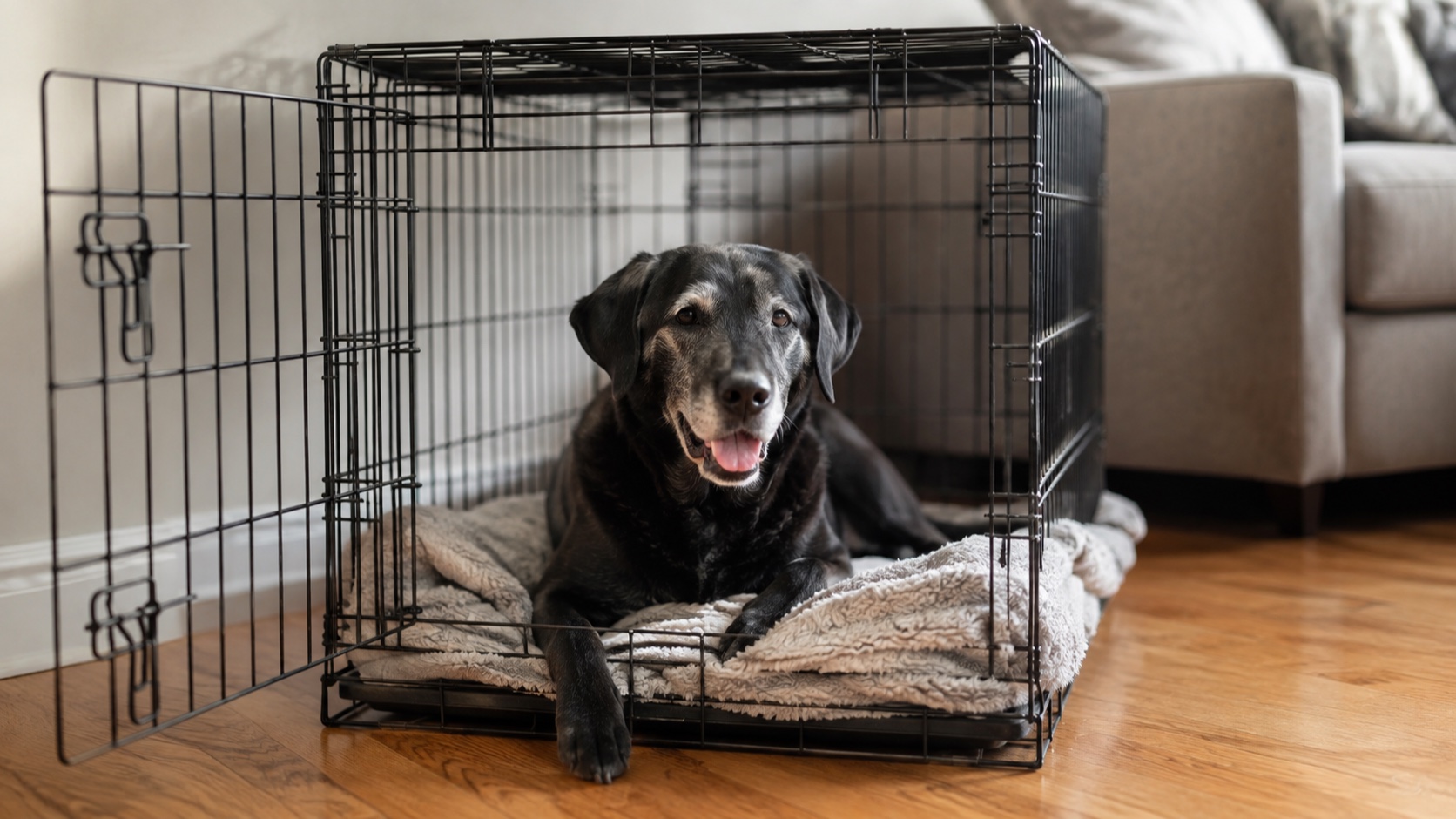
Quick answer: Start crate training an older dog with the door open, meals inside, and short closed-door sits. Add about 10 minutes per session until the dog can rest overnight. Skip punishment and all-day lock-ins on day one.
Most uncrated adult dogs accept overnight crate rest within 14 days if meals and bedtime start inside an open crate. This page is a desk comparison of published crate-training steps and current crate specs.
Who this guide covers
Selection rule: We cover dogs two years and older that are new to a crate or returning after a long gap. We include only home and travel crates whose maker still lists a stand-turn-lie size on a live product page.
We skip puppy week-one schedules as the main plan. We also skip outdoor kennel runs and furniture crates we could not confirm on a maker page.
An older dog can learn this. The work is slower than a puppy’s first week. The steps stay the same: open door, food inside, then short closed-door time.
Our research team compared published protocols from Humane World for Animals. We also compared sizing rules from the American Kennel Club. Then we lined up listed specs from four crate makers.
Size the crate before the first meal
Fit comes first. A crate that is too tight makes an older dog brace and quit. A crate that is too roomy can invite indoor accidents at one end.
The American Kennel Club tells owners to measure standing height from head to floor. Then measure length from nose tip to tail tip. Add 3 to 4 inches to each number for crate height and length.
Petmate’s own Vari Kennel page uses the same 3 to 4 inch add-on. Two separate publishers landed on the same buffer.
Watch the dog stand, turn, and lie down in the empty crate. The head should not duck. The hips should not press the side wall.
Long nails change how an older dog plants on a plastic pan. A slip on day one can sour the crate. Trim nails first with the calm handling in our guide to trimming dog nails at home.
Crate models we compared
We compared attributes, not ranks.
Our research team lined up maker-listed exterior lengths on five current models. The GUNNER G1 Intermediate lists 34 inches. The MidWest iCrate line uses a 42-inch size name, an 8-inch spread.
| Model | Shell | Maker-listed size | Maker-listed weight cue | Access and extras |
|---|---|---|---|---|
| MidWest iCrate Dog Crate, 42-inch Double Door | Wire | 42-inch option in a 7-size line from 18 to 48 inches | Size name only; no weight band on the maker page | Double-door style; divider panel; leak-proof pan; slide-bolt latch with Paw Block |
| Petmate All Purpose Vari Kennel, 40-inch | Plastic with a listed 90% pre-consumer recycled mix | Exterior 40 × 27 × 30 in; interior 36.25 × 24.75 × 28.8 in | 70–90 lb dog range; kennel weight 31.0 lb | Squeeze-latch door; interior moat; tie-down holes |
| GUNNER G1 Intermediate | Travel kennel | Exterior 34 × 23 × 28.5 in; 30 in high with handles; interior floor 30 × 18 × 25 in | Empty weight 48 lb | Reversible door; paddle latch with a key lock |
| GUNNER G1 Large | Travel kennel | Exterior 40.25 × 28 × 33.25 in; 34.5 in high with handles; interior floor 33.25 × 21 × 29 in | Empty weight 72 lb | Same reversible door and paddle latch |
| Impact Collapsible Dog Crate, 34-inch Intermediate | Aluminum | 34.5 × 23 × 29 in | Crate weight 35 lb | Folds; 0.817 in vents; side rails required for rigidity |
MidWest Homes for Pets lists the iCrate in seven sizes from 18-inch to 48-inch. The page also lists a divider panel and a removable leak-proof pan. That divider is for a growing puppy; a grown dog usually needs the full floor.
The Petmate 40-inch Vari Kennel lists a 70 to 90 pound dog range. Its interior is 36.25 inches long, shorter than the 40-inch name on the box. Measure the dog, not the label.
GUNNER lists the Intermediate empty weight at 48 pounds. It lists the Large at 72 pounds. That 24-pound gap matters if you will carry the kennel up stairs.
Impact lists the 34-inch Intermediate at 35 pounds. That is 13 pounds lighter than GUNNER’s Intermediate on the two maker pages. Impact lists 0.817 inch vents and says the side rails are required for assembly.
GUNNER’s product page cites a 2015 Center for Pet Safety crash test. It says its Intermediate was the only crate in that study that passed.
Pick wire if you want visibility. Pick the Vari Kennel if you want a darker den and a listed 90 percent recycled shell. Pick GUNNER or Impact if a rigid travel shell matters more than a fold-flat wire frame.
The 14-day open-door plan
Humane World for Animals says crate training can take days or weeks. Age, temperament, and past confinement all change the clock. An older dog with a bad crate memory sits at the long end of that range.
Days 1 to 3: park the crate in a room the family already uses. Tie the door open so it cannot swing. Drop treats inside, and do not push the dog in.
Humane World’s first feeding step is simple. Once the dog stands inside to eat, close the door for the meal. Open it as soon as the meal ends.
Add a few minutes after each meal. Keep going until the dog stays about 10 minutes past the last bite.
Days 4 to 7: add a cue such as “crate.” Sit near the closed door for 5 to 10 minutes, then step into another room for a few minutes. Return, sit again, and open the door while the dog is quiet.
Humane World’s next gate is a 30-minute quiet stay with you mostly out of sight. Do not jump from 10 minutes to an errand. If the dog whines, shorten the next sit.
Days 8 to 10: crate the dog for short stays while you are home. Humane World says to crate 5 to 20 minutes before you leave, not an hour before. Keep departures and returns dull.
Days 11 to 14: move bedtime into the crate. Start with the crate in the bedroom. Humane World says older dogs should stay nearby at first so the crate does not mean isolation.
A short, calm brush before a closed-door sit can lower arousal. Use the unhurried handling in our step-by-step dog grooming guide. Stop if the dog stiffens.
If you also keep a rabbit, do that animal’s table work in another room. Dryer noise and clippers can undo a quiet crate sit. Our rabbit grooming walkthrough keeps that work on a separate table.
Never use the crate as a scold. Humane World is plain on this. A crate used as a penalty becomes a place the dog will not enter.
How long an adult dog can stay crated
Humane World’s daytime cap for adult dogs is 4 to 5 hours. That is a ceiling, not a goal. A newly trained older dog should stay well under it for the first two weeks.
The same page says puppies under 6 months should not stay more than 3 to 4 hours. That figure is contrast only. This guide is not a puppy schedule.
A house-trained adult still needs a toilet break, water, and a walk. Humane World’s 4 to 5 hour figure is the number we keep.
Do not stack a 5-hour day crate on top of a full night crate and call that trained. The dog still needs hours out for walks and rest.
If your workday is longer than 5 hours, add a walker or a midday visit. The crate does not extend a bladder.
Nights, departures, and the first closed-door sleep
Put the crate where you sleep for the first week of nights. An older dog that cannot see you may pace, pant, or scratch. Those signs mean you should open the door and reset, not wait it out in another room.
Humane World says to ignore testing whines only after you have built the steps. If you have not reached the 30-minute quiet stay, night crying is information. You asked for too much.
Use the outdoor toilet cue if the whine continues. If the dog brightens and heads for the door, go out. Keep that trip short and dull, then return to the crate.
Do not open the door at the peak of a protest if the dog just went out. Wait for a few seconds of quiet, then open. Humane World’s logic is that a release on a whine teaches the whine.
Leave a washable bed if the dog will not shred it. Humane World says a bed or blanket belongs in the crate. Skip fabric if the dog is a chewer; a bare pan is safer than a swallowed scrap.
Covering a wire crate is optional. Leave vents clear.
When crate training is the wrong tool
Stop a closed-door session if the dog is frantic. Watch for constant barking, pacing, panting, drooling, or trying to break out. Those are stop signs, not stubborn ones.
Humane World says a crate will not fix separation anxiety. It may only block damage while the dog injures itself on the door. That problem needs a behavior plan, not a longer latch.
An older dog with new house soiling may have a medical limit, not a training gap. A crate cannot hold what the body cannot hold. Ask a clinician about pain, incontinence, or night waking before you add hours.
Some older dogs do better in an exercise pen than in a box. That is not a failure of the 14-day plan. It is a different tool for a dog that cannot settle in a closed crate.
If the dog will not eat near the crate after several days, move the bowl closer to the door. Then stop. Forcing the body in creates a fear memory that takes longer to undo than a slow start.
FAQ
How long does it take to crate train an older dog?
Humane World says the process can take days or weeks. Our 14-day open-door plan is a pacing target for a dog with no crate panic. A dog that already fears boxes may need the same steps stretched across a month.
Can you crate train a dog that has never used a crate?
Yes. Start with the door tied open and meals at the threshold. Do not skip to overnight lock-in. The first win is a dog that walks in for food without a shove.
How long can an adult dog stay in a crate during the day?
Humane World’s guideline is no more than 4 to 5 hours during the day. Newly trained older dogs should stay shorter than that until nights are quiet. Plan a walk and water at every release.
What size crate does an older dog need?
The American Kennel Club says to add 3 to 4 inches to standing height and nose-to-tail length. Petmate repeats that 3 to 4 inch buffer on its Vari Kennel page. The dog must stand, turn, and lie down without ducking.
Should I feed my older dog in the crate?
Yes, once the dog will step inside. Humane World uses meals to build a pleasant link. Close the door for the meal, then add time until the dog stays about 10 minutes after eating.
What if my older dog cries all night in the crate?
Check whether the dog needs to go out. If not, you likely jumped past the 30-minute quiet stay. Move the crate into the bedroom and go back to short closed-door sits during the day.
Is a crate the right tool if my dog destroys things when I leave?
Only after the dog can rest in the crate while you are home. Humane World says a crate does not treat separation anxiety. If the dog is frantic at the door, stop and get a qualified trainer involved.