Quick answer: Count breaths while your dog sleeps. If the rate stays over 30 a minute, or panting comes with gum-color change, collapse, or restlessness, get emergency care. Cool the room and offer water.
A sleeping dog who stays above 30 breaths per minute on three quiet nights has a rate VCA Animal Hospitals calls abnormal. This page is a research brief that compares published respiratory ranges with maker-listed home products. We did not examine dogs, run overnight sleep studies, or interview clinic staff.
Night panting is not one diagnosis. It is a visible rate you can count. Heat, pain, heart disease, and fear can all raise that rate after dark.
Our research team used one selection rule, the Night-Use Spec Rule. A product entered this article only if its maker page lists a numeric spec that still matters after bedtime. That means fill volume, cooling hours, room coverage, a weight-size band, or a sensor range.
We left out supplements, treats, prescription drugs, and any item whose maker page offered only adjectives.
Count sleeping breaths before you guess the cause
Start with a number, not a guess. VCA Animal Hospitals publishes a home breathing-rate method for this job.
Wait until the dog is asleep or lying still. Watch the chest rise and fall. One rise plus one fall is one breath.
Count for 30 seconds, then multiply by two. Or count for a full 60 seconds. Write the number down.
VCA Animal Hospitals states that a normal sleeping or calm resting rate is 15 to 30 breaths per minute. The same page says rates that stay above 30 are increased and abnormal.
Cornell University College of Veterinary Medicine lists a normal resting rate of 15 to 30 breaths per minute. It also says rates above 35 should prompt a clinic consult.
The Merck Veterinary Manual lists a slightly wider resting range. Its table of normal dog values gives 18 to 34 breaths per minute. Those three windows overlap, so use 30 as your action line tonight.
We call that check the Three-Night 30 Screen. Count once on three quiet nights, using the same clock method. If all three counts stay above 30, the rate matches VCA Animal Hospitals’ abnormal threshold.
A clinic can count the same way, which is what makes the claim checkable. VCA Animal Hospitals also lists night signs that raise urgency, including labored effort, restlessness, and a new “sphinx” sleep pose. Do not count during play or right after a walk.
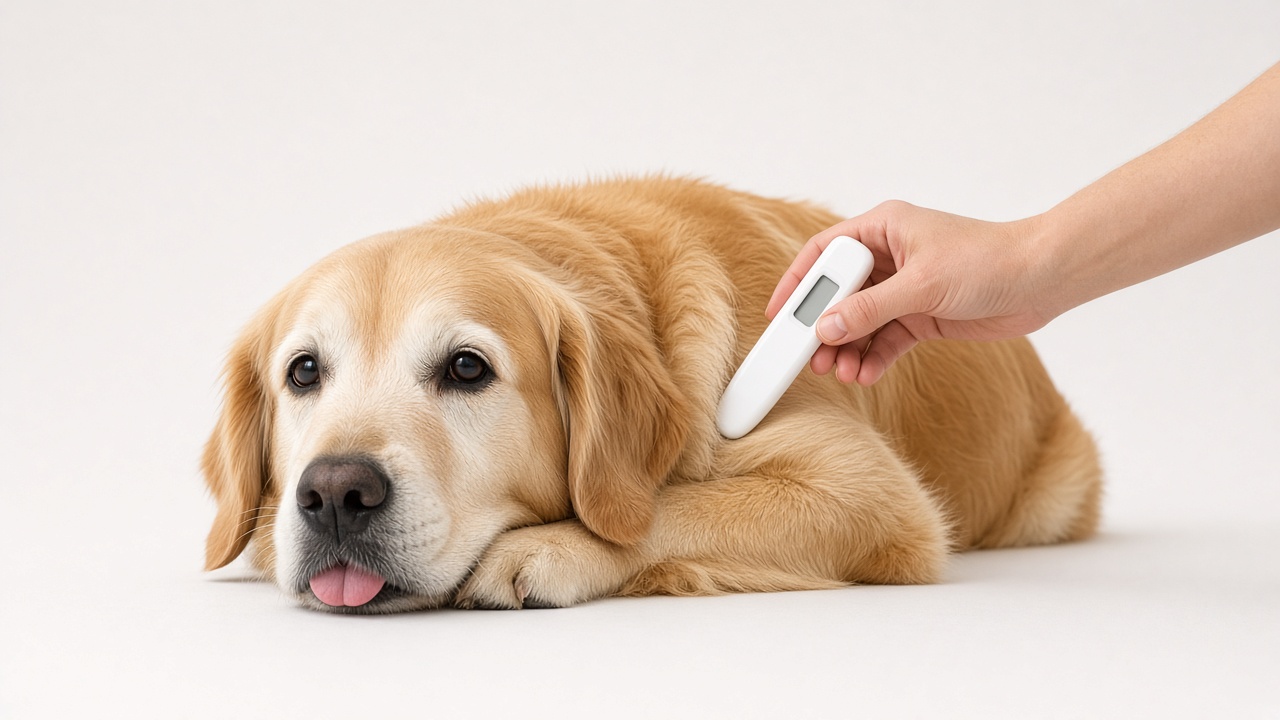
The Merck Veterinary Manual also lists two other baseline vitals: average body temperature of 101 to 102.5°F, and a resting heart rate of 70 to 120 beats per minute. Bring those counts to the clinic. Do not treat a high rate as a product problem first.
Heat and humidity after the lights go out
Dogs dump heat mainly by panting. The American Animal Hospital Association states that pets do not sweat the way people do. They rely on panting and limited paw-pad sweating.
A warm bedroom can keep that system running after midnight. So can a thick duvet, or a crate against a heat vent.
The American Animal Hospital Association says heatstroke usually begins above 104°F. It lists a typical normal body temperature of 100 to 102.5°F. It tells owners to stop active cooling once the reading falls to 103°F.
VCA Animal Hospitals uses a tighter ladder. A body temperature above 103°F is abnormal, or hyperthermic. Temperatures above 106°F, without prior illness, are most often called heat stroke.
Humidity matters because panting is evaporative. Moist air slows that exchange. A hygrometer gives you a number instead of a guess.
The AcuRite Indoor Temperature and Humidity Monitor, model 00613, is one tool for that job. AcuRite’s product page lists 32°F to 122°F, 16% to 98% relative humidity, and plus or minus 2°F accuracy.
Place it at dog height. AcuRite says high and low records cover a 24- to 36-hour window. The unit runs on one AA battery.
If the room sits near 80°F, a cooling surface can still feel cooler than the dog. K&H Pet Products states that its Cool Bed III absorbs a dog’s 102°F body heat. At an 80°F room temperature, K&H says the bed is 22 degrees cooler than that body temperature.
K&H also limits use to temperatures under 100°F and tells owners to keep the bed out of direct sun.
If gums change color, if the dog cannot stand, or if drool turns thick and ropey, skip the bedroom tweaks. The American Animal Hospital Association lists those among heatstroke signs and says not to use ice or wet-towel wraps, which can trap heat.
Move to a cool space and get emergency care. VCA Animal Hospitals says to pour cool, not cold, water over the head, belly, armpits, and feet, then stop cooling if a rectal temperature reaches 103°F.
Heart, lungs, and other clinic-level causes
A high sleeping rate can be a heart clue. VCA Animal Hospitals says a rising rest or sleep rate is an early sign of heart failure.
Cornell University College of Veterinary Medicine names rapid breathing among dog heart-disease signs, along with cough, weakness, and collapse. It names age-related mitral-valve disease as the most common canine heart disease.
That does not let a research desk name your dog’s valve. Lung disease, anemia, pain, and endocrine disease can also keep the mouth open after midnight.
We did not include prescription drugs in the product table. That was a rule, not a gap in the pharmacy.
The Food and Drug Administration’s May 6, 2026 Freedom of Information summary for NADA 141-627 describes Tessie, tasipimidine oral solution, at 0.3 mg per milliliter. Those figures belong to a prescription label, not a nightstand next to a cooling mat.
If the breath count is high and the dog is otherwise well, still call the clinic. VCA Animal Hospitals says to recount over the next few hours, then contact the clinic if the rate stays high.
If the high rate arrives with collapse, blue gums, or frantic effort, go in now. Do not wait for morning office hours.
Anxiety, storms, and pressure wraps
Fear can look like heat. Pacing, lip licking, and a tucked tail often travel with the pant. Night storms and leftover fireworks do this in many houses.
ThunderShirt for Dogs is a currently sold pressure wrap. ThunderShirt’s product page says the design applies gentle, constant pressure to the torso, and that 80% of users see improvement.
That 80% figure is the maker’s claim, not a survey we ran.
ThunderShirt lists sizes from XXS, under 8 pounds, through XXL, over 110 pounds. Its FAQ says overheating is not typical except in extreme conditions, and it gives 90°F in the sun as the example.
It also says to remove the wrap every one to two hours the first few times.
ADAPTIL Calm Home Diffuser, from Ceva, is a plug-in pheromone unit. ADAPTIL’s product page says each refill covers up to 700 square feet.
ADAPTIL’s FAQ says one refill lasts up to 30 days and the diffuser head should be replaced every 6 months. The room can take up to 24 hours to saturate.
ADAPTIL also says not to unplug the unit at night. Leave 5 feet clear above the outlet so the vapor can rise.
A diffuser cannot drop a 40-breath sleeping rate caused by heart failure.
Coat, nails, and senior comfort after dark
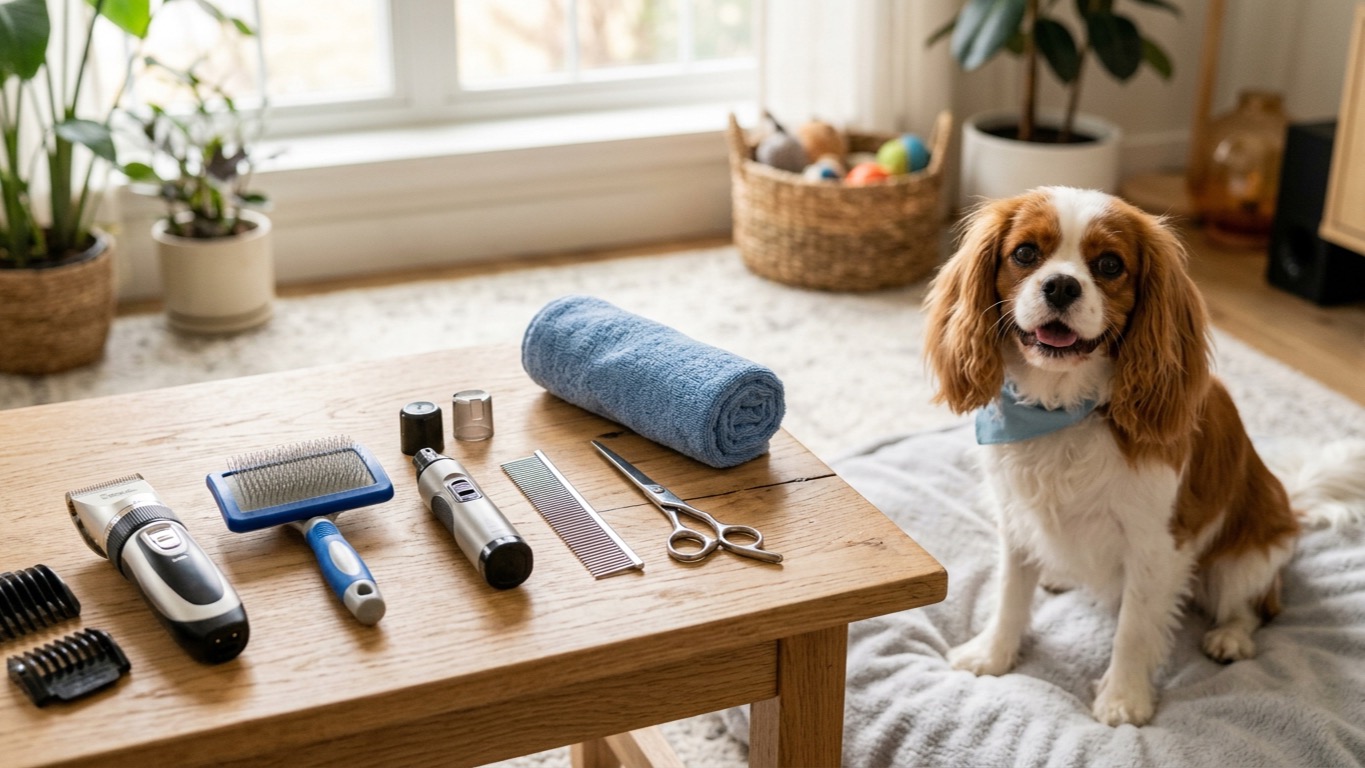
A dense or matted coat holds heat against the skin. Night panting can start there, especially in a warm room. A home groom is not a diagnosis, but it can still remove one heat trap.
If the coat is long or packed with undercoat, follow a careful step-by-step home grooming guide. Work in short sessions. Stop if the dog pants harder under the dryer.
VCA Animal Hospitals names hair-dryer exposure as a heat-stroke cause. Keep the dryer moving and the room ventilated.
Senior dogs add stiffness to the picture. Arthritis can make a dog shift all night and pant from pain. Grooming a senior dog at home needs slower handling and more rest breaks.
Long nails change how a dog lies down. They also puncture water beds. K&H Pet Products tells owners to keep nails trimmed so nails do not pierce the Cool Bed III.
If nails click on the floor, use a calm at-home nail trim. Trim a little. Do not chase a cooling-mat leak with a rushed cut.
None of this replaces a clinic exam in an older dog with a new night pant. Seniors are also the group Cornell flags for mitral-valve disease.
Home products we compared under the Night-Use Spec Rule
Our research team compared published specs on five currently sold products. We did not run overnight trials, and we did not rank them.
Across those five maker pages, only ADAPTIL lists a square-footage coverage figure, 700 square feet. Only K&H Cool Bed III lists a water-fill volume. Only the Green Pet Shop Cool Pet Pad lists a cooling-hour figure: up to 3 hours, then a 15- to 20-minute recharge.
We also compared the two largest cooling surfaces. K&H lists its Large Cool Bed III at 32 by 44 inches, which is 1,408 square inches. Green Pet Shop lists Extra Large at 27.5 by 43.3 inches, about 1,191 square inches.
The K&H Large surface is 217 square inches bigger on those published dimensions. Bigger is not better for every crate.
| Product | Maker-listed mechanism | Key numeric spec | Night-use constraint | Power or refill |
|---|---|---|---|---|
| K&H Cool Bed III | Water-filled Cool Core | Small 17×24 in, 1–1.5 gal; Large 32×44 in, 4–6 gal | Use under 100°F; keep out of sun | No electricity |
| Green Pet Shop Cool Pet Pad | Pressure-activated gel | Up to 3 hours cooling; 15–20 min recharge | Indoor or shade; not a hot car | No water or electricity |
| ADAPTIL Calm Home Diffuser | Dog-appeasing pheromone | Up to 700 sq ft; refill up to 30 days | Leave on 24 hours; 5 ft clear above | Electric plug-in |
| ThunderShirt for Dogs | Constant torso pressure | XXS under 8 lb through XXL over 110 lb | First uses: remove every 1–2 hours | Fabric wrap; machine wash cold |
| AcuRite Indoor Temperature and Humidity Monitor 00613 | Digital thermometer and hygrometer | 32–122°F; 16–98% RH; ±2°F | 24–36 hour high/low records | 1 AA battery |
Pick by the number you need. A 50-pound dog on a 17-by-24-inch pad will overflow the cool zone. A 700-square-foot diffuser will not cover a three-story house.
None of these products treats heart failure. None of them replaces a 30-breath count. K&H even states that the Cool Bed III is not a life-saving device.
FAQ
Why does my dog pant at night but seem fine in the morning?
Night rooms can run warmer than daytime shade. Pain and heart strain also show first when the body is still. A morning reset does not erase a 35-breath night.
How many breaths per minute is too many while my dog sleeps?
VCA Animal Hospitals calls a consistent sleeping rate above 30 breaths per minute abnormal. Cornell University College of Veterinary Medicine says rates above 35 should prompt a consult.
Can a cooling mat replace a clinic visit?
A mat can lower surface heat, but it cannot measure heart function. If the sleeping rate stays above 30, call the clinic even if the dog likes the pad.
Is night panting normal for brachycephalic breeds?
Short-nosed dogs have less efficient panting. The American Animal Hospital Association names pugs, boxers, and bulldogs as higher heatstroke risks.
Should I leave a ThunderShirt on all night?
ThunderShirt’s FAQ says to remove the wrap every one to two hours the first few times, and at least twice a day during long use. That is not an all-night first trial.
Does a pheromone diffuser work if I unplug it at bedtime?
ADAPTIL’s FAQ says not to unplug the Calm Home Diffuser at night, and that the room can take up to 24 hours to saturate. A unit off overnight is not the 24-hour use the maker describes.
When is night panting an emergency?
Go in now if panting arrives with collapse, seizures, thick drool, or abnormal gum color. The American Animal Hospital Association lists those as heatstroke signs.