
Quick answer: Read the whole cat, not just the eyes. Soft blinks and a loose body usually mean a request for food, play, or company. A hard stare with a stiff tail or flattened ears means give space and skip a stare-back.
A cat staring at you is asking for food, play, contact, or space, and the rest of the body tells you which. This page is a research-desk briefing on seven everyday stare contexts. We did not film household cats, run a feeding trial, or examine any cat in a clinic.
Our research team analyzed published behavior papers and compared current maker specs. We did not treat a stare as a diagnosis.
A scenario made this article only if a reader can sort it from ears, tail, blinks, and clock time. We call that the Four-Point Stare Sort.
A product made the table only if we opened its current maker page and copied a listed attribute. We left out breed lists, dream-state stacks, ranked lists, and any toy we could not verify on the maker site.
Use the four points in this order: ears, tail, blink style, then the clock. Forward ears plus a slow blink usually mean affection or a polite ask. Flattened ears plus a still tail usually mean a warning.
The American Veterinary Medical Association’s 2025 Pet Ownership and Demographic Sourcebook counts 76.3 million pet cats in the United States. That figure came from a weighted spring 2025 survey of 7,519 people.
The same AVMA table puts cats in 32.6 percent of U.S. households, or 43.1 million homes, at 1.8 cats per cat-owning household. Many of those cats will stare, but the meaning is not one thing.
1. Soft-eyed affection and the slow blink
A relaxed cat often holds your face, then narrows the lids. That sequence is not a vacant freeze.
A 2020 Scientific Reports paper from the University of Sussex Mammal Communication and Cognition Research Group measured this. Experiment 1 used 21 cats from 14 homes. Owners sat about 1 meter away.
After outliers, 18 cat–human pairs stayed in the analysis. Eye-narrowing rate rose from a control mean of 0.03 to 0.06 during the owner’s slow-blink cue.
Half-blink rate rose from 0.15 to 0.21 in the same contrast. Ordinary maintenance blinks did not shift.
Experiment 2 used 24 different cats. An unfamiliar person either slow-blinked or held a neutral face for 1-minute trials.
Half-blinks averaged 5.33 in the blink condition and 1.94 in the neutral condition. Eye-narrowing averaged 2.78 versus 0.33. Approach scores after an offered hand rose from 2.39 to 2.78.
The paper published those means on 5 October 2020 as Scientific Reports volume 10, article 16503.
Answer a soft stare with a slow blink of your own. Then wait. Do not lean in until the cat steps forward.
2. The meal stare
Many cats lock on at the usual bowl time. They may add a meow or a weave through your legs.
The 2013 AAFP and ISFM Feline Environmental Needs Guidelines, in the Journal of Feline Medicine and Surgery, note that cats may eat 10 to 20 small prey per day. A single dumped bowl fights that pattern.
The U.S. Food and Drug Administration explains how AAFCO profiles work on labels. The first AAFCO Cat Food Nutrient Profiles appeared in 1992. AAFCO last updated those profiles in 2016.
The FDA walk-through sets the adult-maintenance crude-protein minimum at 26 percent on a dry-matter basis. Canned food is typically 75 to 78 percent moisture. Dry food is typically 10 to 12 percent moisture.
A food stare at a set hour is often a schedule ask, not a calorie emergency. Check the portion against the bag and a cat feeding chart by weight before you add a second dinner.
If the stare starts hours early every day, split the ration. Do not grow the ration unless body condition says you should.
The PetSafe SlimCat Interactive Feeder lists a 2/3-cup meal capacity on the maker page. The Catit Senses Food Tree lists four levels and three inner-disc settings. Both turn a meal stare into paw work instead of a second scoop.
3. Play invitation and boredom
A play stare often comes with big pupils, a low crouch, and a tail twitch. The cat may then sprint, swat, or bounce off your feet.
That is a hunt script aimed at a moving target. You are the nearest moving thing.
The same AAFP and ISFM guidelines treat play and hunting chances as a required pillar, not a luxury. After social maturity, usually at 2 to 3 years, many cats want shorter play.
Keep sessions short. End on a catch. Then feed a portion of the daily ration.
The PetSafe Bolt Automatic Laser Light lists a 15-minute automatic shutoff and two modes on the maker page. Automatic mode uses an adjustable mirror. Manual mode is a handheld pointer.
Comparing published specs, that 15-minute timer is a hard stop. The SlimCat has no timer. It empties when the 2/3 cup is gone.
Laser play should still end with a physical toy the cat can grab. A beam has no body. Pair it with a wand or a ball from a guide to interactive toys for indoor cats.
4. Company check-ins
Some stares are just “are you still here.” The body stays loose. The cat may blink, trill, or walk over for a head rub.
The AAFP and ISFM guidelines say the most critical age for kittens to socialize with people is between 2 and 7 weeks. They also say a minimum of four people should handle kittens in that window.
Adult cats still use gaze to check a person. Answer with a slow blink or a short greeting. Then go back to your task if the cat settles.
5. Curiosity and household monitoring
Cats also stare at new objects, new guests, and odd human jobs, from a suitcase to a blender. Pupils may widen. Ears stay forward.
The tail is usually up or loosely wrapped, not lashing. This is information gathering. Let the cat look, then offer a sniff route.
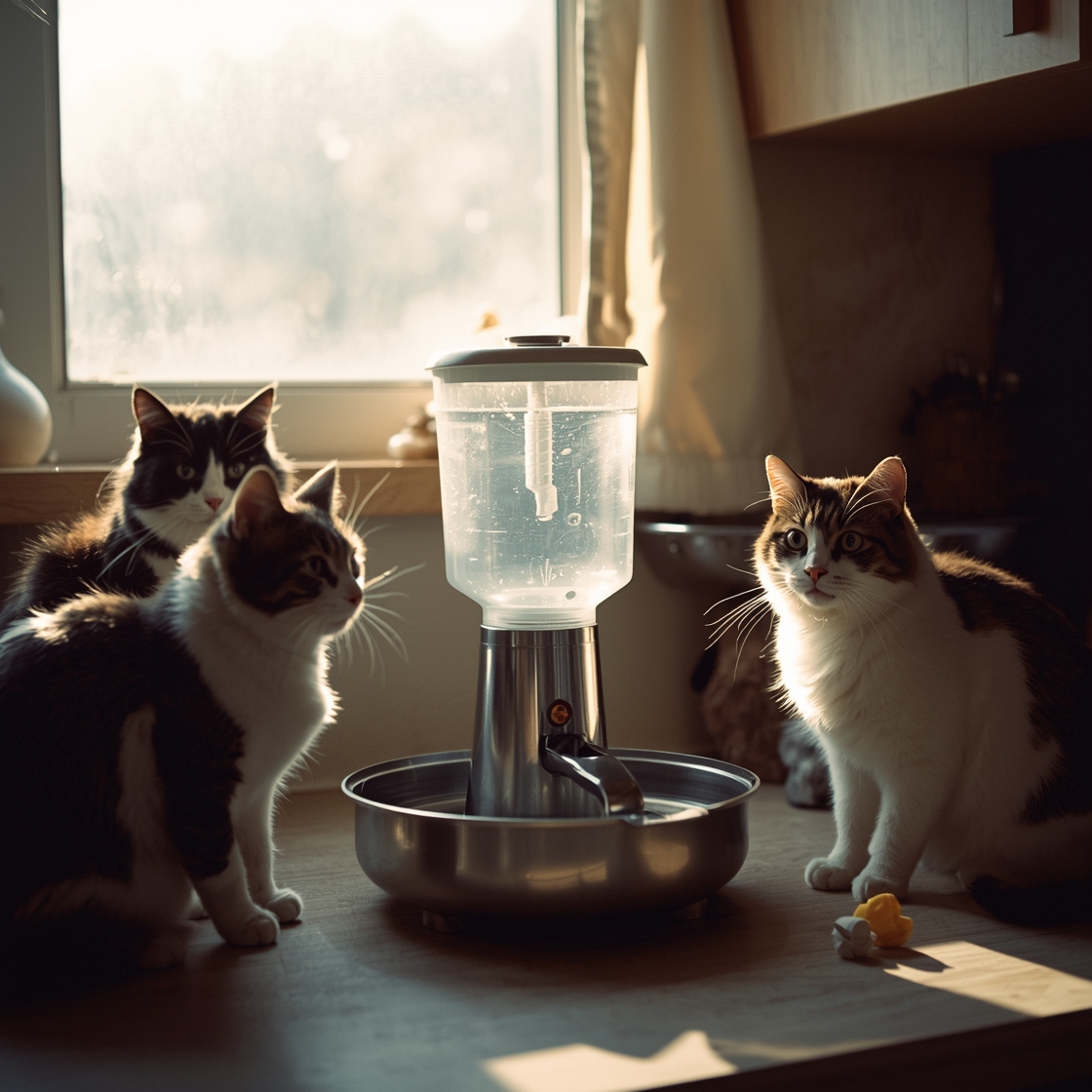
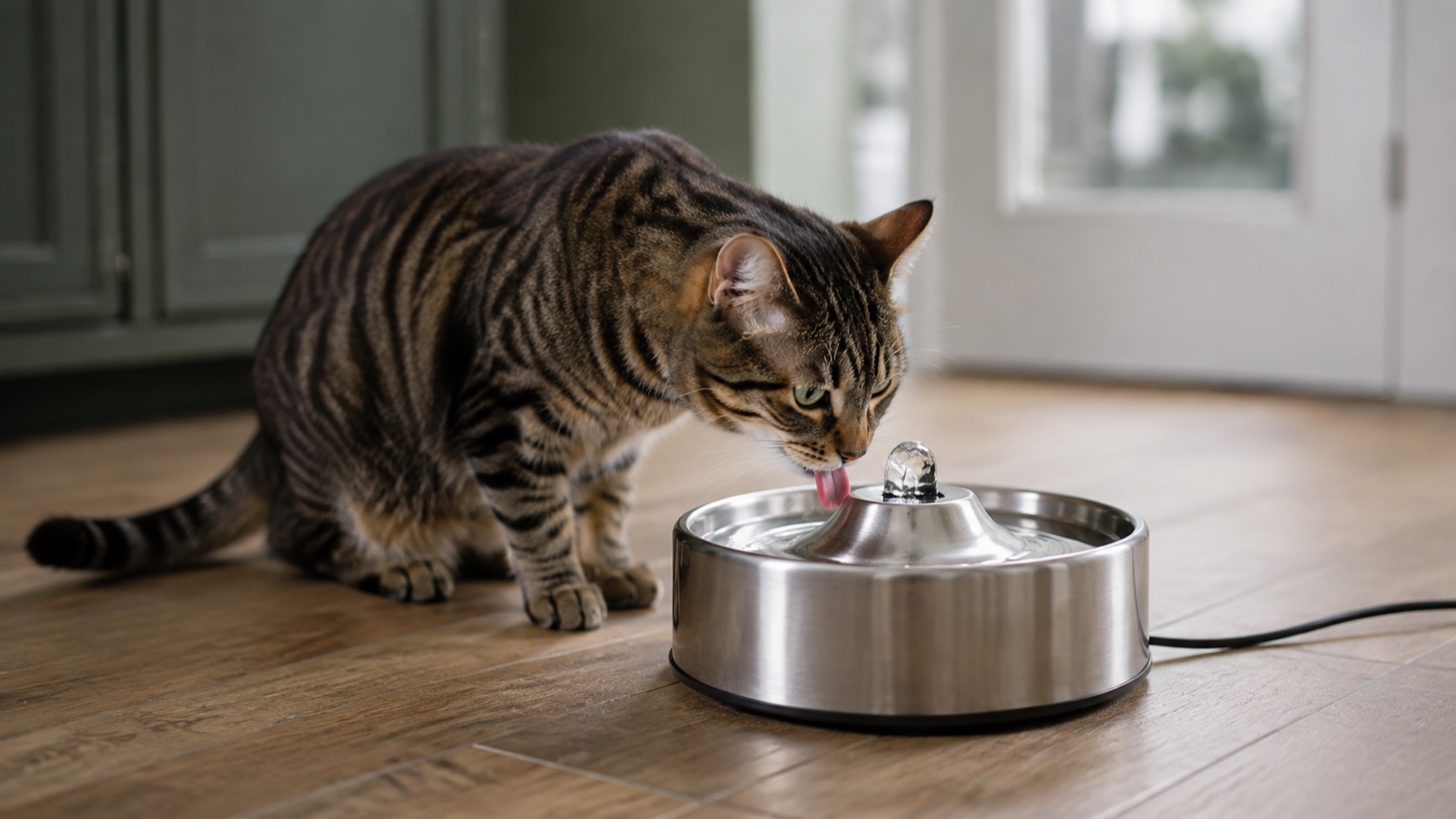
A water station can also pull a watchful stare. The Catit PIXI Drinking Fountain lists a 2-liter, or 67.5-fluid-ounce, reservoir.
The unit measures 8 by 8 by 6.7 inches and draws under 1 watt on a USB DC 5-volt, 1-amp adapter. If several cats share a bowl, a fountain can cut crowding at one dish.
See our comparison of pet water fountains for multiple cats for placement rules.
6. The hard stare that means back off
A warning stare is still, wide, and unblinking. The body stiffens. Whiskers push forward.
The tail may thrash or lock. Flattened ears and a puffed ridge along the back raise the stakes. This is not a request for a cuddle.
The Sussex team’s Experiment 2 pilot found that a neutral face with direct eye contact looked threatening to some cats. They changed the control to a neutral face without eye contact.
That finding is a useful household rule. Do not lock eyes with a stiff cat. Blink, turn your head, and add space.
Kids should learn this early: a hard stare plus a swish is a stop sign, not a game. If two cats freeze-stare, block the line of sight. Do not insert your face.
7. Vacant staring and when the pattern breaks
A social stare tracks you. A vacant stare does not. The cat may sit facing a wall, miss a jump, or walk the long way around furniture.
The Cornell University College of Veterinary Medicine Feline Health Center states that at least 60 percent of cats diagnosed with hypertension also have signs of chronic kidney disease. About 20 percent of cats diagnosed with hyperthyroidism are also diagnosed with hypertension.
Cornell lists systolic readings below 150 mmHg as low risk and readings above 180 mmHg as high risk. It also reports neurologic changes in 15 to 40 percent of hypertensive cats. Cardiac changes appear in up to 60 percent.
Ocular injury is the most common target-organ problem in that Cornell briefing. Sudden blindness and pupils that stay wide in bright light are clinic problems.
This desk does not diagnose those conditions. A new vacant stare, a missed jump, or a pupil that will not shrink in daylight is a reason to book a clinic visit.
Gear that matches the request, not a ranking
We compared published specs only. We did not time play sessions in a house. We did not weigh leftover kibble.
The table is an attribute sheet, not a top-four list. Pick the row that matches the stare you actually see.
| Product | Stare it can answer | Maker-listed size or fill | Power or load | Maker-listed session or capacity |
|---|---|---|---|---|
| PetSafe Bolt Automatic Laser Light | Play crouch and chase stare | 3.0 × 3.0 × 10.0 inches | 4 AA batteries, not included | 15-minute auto shutoff; automatic or manual mode |
| PetSafe SlimCat Interactive Feeder | Mealtime lock-on | Whole-meal ball | No power; BPA-free plastic | 2/3-cup fill; adjustable openings |
| Catit Senses Food Tree | Mealtime lock-on plus paw work | 14.8 × 14.8 × 13.1 inches | No power; BPA-free | Four levels; three disc settings; model 43151 |
| Catit PIXI Drinking Fountain | Water-bowl hovering | 8 × 8 × 6.7 inches; 1.49 lb | USB DC 5 V 1 A; under 1 W | 2 L / 67.5 fl oz reservoir; auto-shutdown |
The Bolt’s 15-minute cutoff is shorter than a bored evening. Plan a second short round later, or switch to a wand.
The SlimCat’s 2/3 cup is a full listed meal. Measure the day’s food first so the ball does not become extra calories.
The Food Tree’s 14.8-inch square base is a floor claim. The PIXI’s 67.5-fluid-ounce tank is small for two cats, so refill before the empty alert.
FAQ
Why does my cat stare at me without blinking?
An unblinking stare with a stiff body is often a warning. Give space and break your own gaze. An unblinking stare with a floppy body and a later slow blink is more often a hold-and-check.
Ears and tail decide faster than a guess about mood.
Why does my cat stare at me and meow?
Sound plus gaze is usually a request. Food, a closed door, and an empty fountain are the common three. Check the clock against the usual meal, then check water.
Answer the need once. Do not add a treat every time.
Why does my cat stare at me at night?
Night stares often sit on a crepuscular clock. Cats hunt at dusk and dawn. A late play session plus a measured meal can shift that energy.
A new vacant night stare with howling or bumping is a clinic question, not a sleep-training tip.
Is it bad to stare back at my cat?
A hard human stare can read as a challenge. The Sussex Experiment 2 pilot is why the researchers dropped direct eye contact from their neutral control. Soften your lids and look slightly aside.
A slow blink is safer than a contest.
Why does my cat stare at me while I eat?
Your plate is moving food in a social space. Some cats sit for a share. Some cats sit to monitor.
Do not feed from the plate if you want the stare to fade.
Can staring mean my cat is sick?
Yes, when the stare is vacant, new, or paired with other changes. Cornell’s hypertension briefing ties wide pupils and vision loss to target-organ injury. Book a clinic visit if the cat also drinks more, hides more, or misses familiar jumps.
How long should I play if my cat stares for a game?
Use short rounds. The PetSafe Bolt maker page sets automatic play at 15 minutes, then cuts the beam. That is a useful ceiling for laser chase.
End with a toy the cat can hold, then offer part of the daily food.