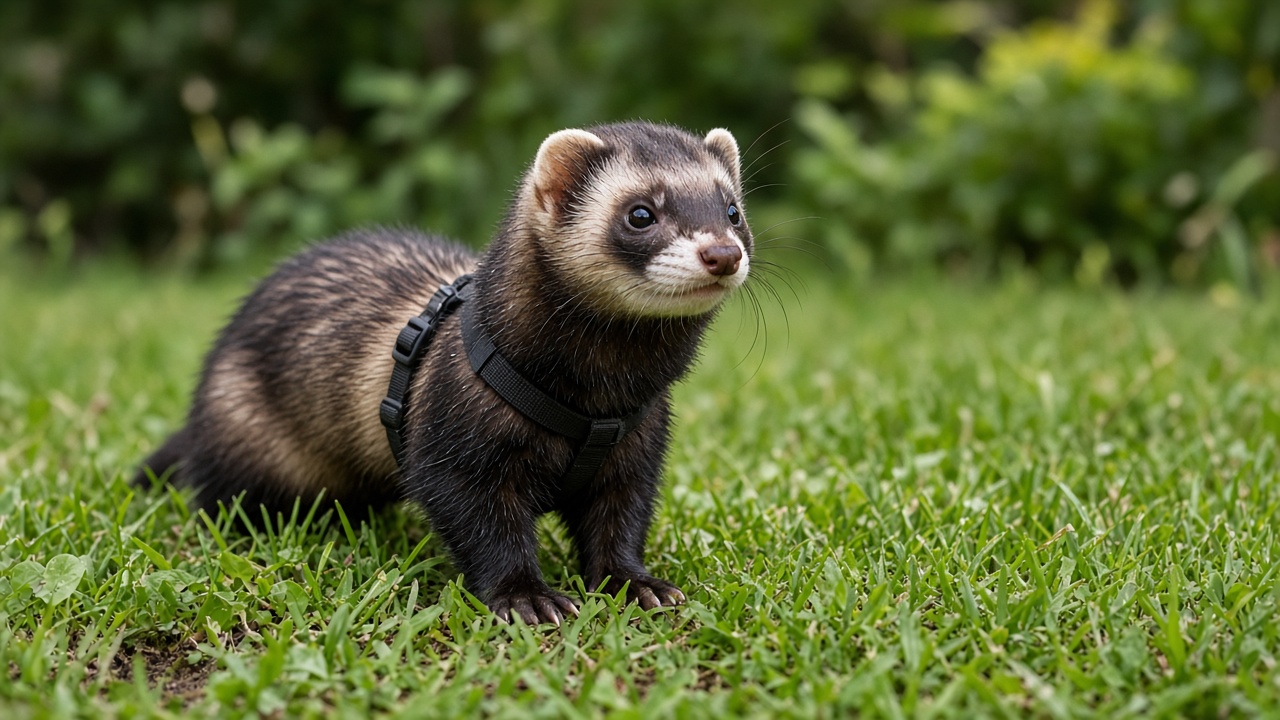
Quick answer: An angora ferret is a long-haired domestic ferret, not a separate species. Plan the same carnivore diet, secure housing, and daily play as for any ferret. Add coat checks during the twice-yearly shed, and do not treat the fluff as a calmer temperament.
An angora ferret is a long-haired domestic ferret whose coat can reach 2 to 8 inches. This page is a research-desk briefing on coat, grooming, and temperament, and
Our selection rule: we covered currently sold ferret-labeled dry foods whose maker pages publish a guaranteed analysis, plus housing and grooming facts that named organizations printed as numbers. We left out cat-food stand-ins, raw-diet protocols, and breeder sale prices.
What an angora ferret is
An angora ferret is still Mustela putorius furo. The long coat is a selected trait, not a second species.
Fairoak Ferrets, a United Kingdom breeder that publishes its own angora notes, dates the type to the last 25 to 30 years. The line began at a Scandinavian breeding facility. Workers there noticed extra hair on some rumps and then selected for it.
Fairoak Ferrets writes that a full angora can carry about three times as much fur as a short-haired ferret. That is a coat claim, not a weight claim. Body size still tracks ordinary ferret ranges.
That same page splits coats by dilution. A “Full” angora is the long type. A “Semi,” also called three-quarter, is next.
Then come Half and Part angora coats. They look fluffier than a standard coat. They stay shorter than a Full.
Fairoak Ferrets also flags an “angora nose” in some Full lines. Extra skin folds or fine hair can sit near the nostril. The page treats that as a cosmetic breeding debate.
Ask any seller for a pedigree and a look at the parents. Coat length in a young kit can mislead. Fairoak Ferrets states that a full coat can take a couple of years to arrive.
Coat length, undercoat, and seasonal molt
Fairoak Ferrets lists angora coat length at 2 to 8 inches. Guard hairs and undercoat grow to about the same length. That is why some owners say a Full angora “has no undercoat.”
The undercoat is still there. It is just not a short, hidden layer. On a short-haired ferret, the crimped undercoat sits below a smoother topcoat.
On a Full angora, those crimped tips show. Seasonal molt still happens. Winter coats look longer and denser.
Summer coats look shorter. Fairoak Ferrets says the summer coat still reads as longer than a standard ferret. A kit can look almost ordinary in its first months.
Do not grade an angora coat from a single summer photo. Wait for at least one full winter if length is the buying point. The long coat can hide thinness and lumps.
Feel the spine, hips, and belly through the fur on a set schedule. Hands-on checks beat a glance. Weigh the animal if the fluff looks the same but the frame feels sharp.
Grooming that matches the coat
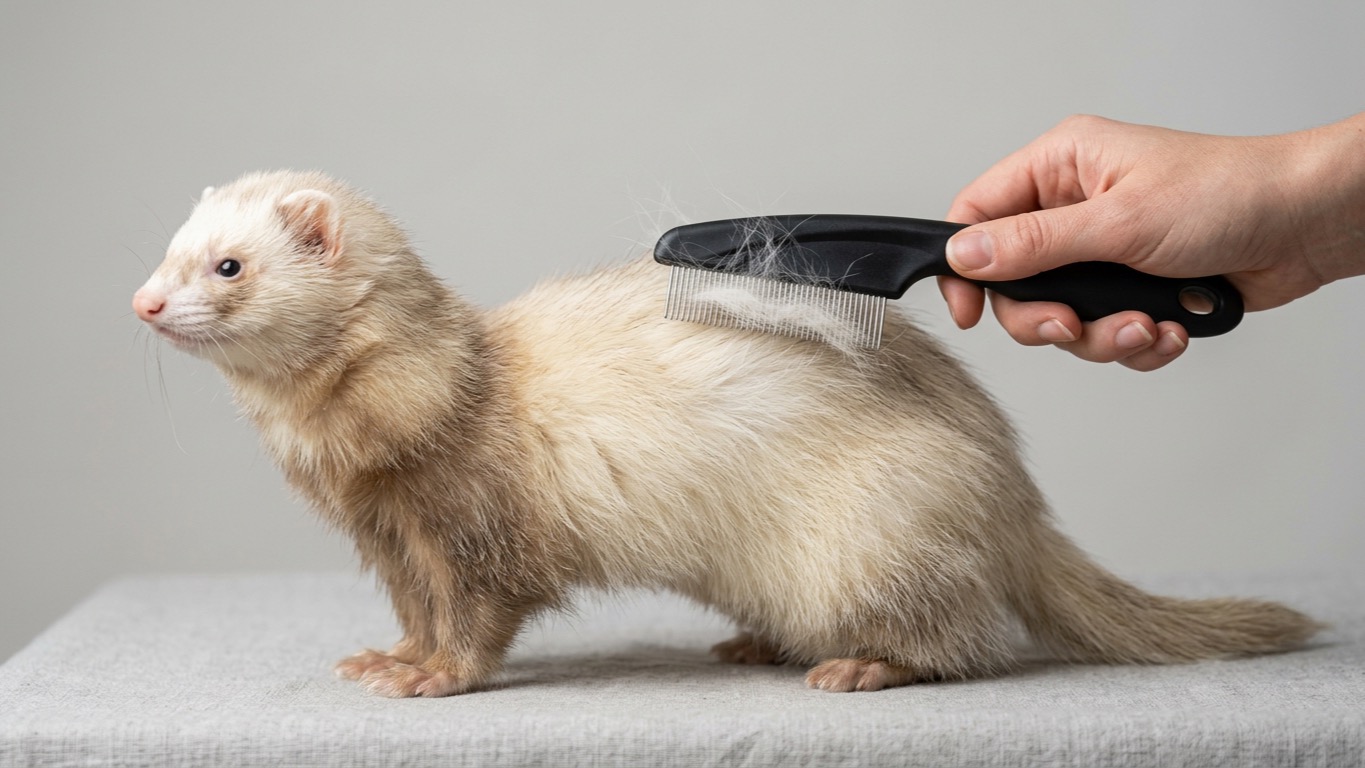
Fairoak Ferrets states that the angora coat does not tangle like a long-haired rabbit or cat. The page says the coat does not need extra brushing versus a short-haired ferret.
That claim is falsifiable. If mats form in armpits, groin, or behind the ears, the “no extra work” rule fails for that animal. Check those friction spots weekly anyway.
A soft brush still has a job. It pulls loose hair you can see. It also forces you to look at skin.
Use the brush as an inspection tool, not as a salon session. Over-bathing is the common error. Soap is not a personality fix.
The 2004 ferret husbandry paper in Veterinary Clinics of North America: Exotic Animal Practice advised bathing at most once a month. It called for a mild shampoo labeled for kittens or ferrets. That is a published ceiling, not a weekly ritual.
The Merck Veterinary Manual notes that removing anal scent glands does not remove the musky odor. That odor comes from sebaceous glands. A bath will not delete it.
Frequent soap strips skin oils. Glands then push more oil. The coat can look greasier and yellower.
Bathe when the animal is truly dirty. Nails still need regular trims. Long nails snag fleece and hammocks.
The 2004 husbandry paper described human nail trimmers as a common tool. Have styptic powder in the kit if a quick bleeds. Wipe only the visible outer ear canal with a product your clinic names.
That same paper described feline hairball laxatives at 1 to 2 mL, two to three times weekly, as a published hairball protocol. Treat that as a clinic conversation. Do not start a dose from a pantry shelf.
Temperament is not a coat feature
Coat length does not write personality. An angora ferret stays a ferret.
The Merck Veterinary Manual describes ferrets as inquisitive and lively. It also calls them notorious escape artists. Those traits do not shorten when hair lengthens.
Many ferrets are sociable. The same Merck chapter says some clinicians still prefer individual housing to limit group stress. If you keep a group, the Manual caps the group at 3 or 4 animals.
Play looks rough to people who know only cats. Neck nips and wrestling are common. Watch for a ferret that stops re-engaging or hides after every bout.
Bite history tracks handling and fear, not fluff. A Full angora that was poorly socialized will still snap. Children should not be the sole caretakers.
Housing, heat, and play time
The Merck Veterinary Manual says ferrets cannot sweat. They are highly susceptible to heatstroke. Keep cages out of direct sun.
The 2004 husbandry paper set a hard outdoor warning at temperatures over 32°C, or 80°F. Bring the animal inside before a room hits that mark. A long coat does not help here.
The Merck chapter wants wire-mesh housing with grids not exceeding 1 inch. It wants a sturdy floor and a door that locks. Ferrets open sloppy latches.
The enclosure roof should let a ferret stand on its hind limbs. Put the litter box away from food and sleep spots. Ferrets will otherwise mix those zones.
The Merck Manual prefers water bottles over bowls because ferrets spill bowls. Hammocks are favorite beds. The Manual rejects hay, straw, and wood shavings as cage substrate.
Standard cages are not a full life. The Merck chapter says ferrets need supervised time outside the cage. Add tunnels, balls, and foraging toys for that out time.
Ferret-proof before you open the door. The 2004 paper lists rubber, erasers, speaker foam, and pipe insulation as swallow risks. Long hair does not change those hazards.
Diet labels we compared
The Merck Veterinary Manual calls ferrets carnivorous. It wants 35% to 40% protein, carbohydrate under 25%, and fiber under 2.5%.
The 2004 husbandry paper used a nearby band: 30% to 40% protein, 18% to 20% fat, and about 2% fiber. It also stated gastrointestinal transit at 3 to 4 hours.
Our research team analyzed five currently sold ferret kibbles. We used only numbers printed on the maker pages.
Published crude-protein minima spanned 38.0% on Marshall Premium Ferret Diet to 62% on Wysong Ferret Epigen 90. That is a 24-point spread on the same shelf category.
| Product | Crude protein min | Crude fat min | Crude fiber max | Moisture max | Taurine min on the guaranteed analysis |
|---|---|---|---|---|---|
| Wysong Ferret Epigen 90 | 62% | 18% | 3% | 10% | 0.2% |
| Oxbow Essentials Ferret Food | 42.00% | 20.00% | 3.00% | 10.00% | 0.50% |
| ZuPreem Premium Ferret Diet | 40.0% | 20.0% | 3.0% | 10.0% | 0.15% |
| Mazuri Ferret Diet (formula 5MBU) | 40.00% | 20.00% | 4.00% | 12.00% | 0.25% |
| Marshall Premium Ferret Diet | 38.0% | 18.0% | 3.5% | 10.0% | Not listed on the guaranteed analysis |
Crude-fat minima sat at 18% to 20% across those five pages. Fiber maxima ran 3.0% to 4.0%. Moisture maxima were 10% or 12%.
Wysong’s page tells owners to introduce Ferret Epigen 90 over 15 days. Start near 10% of the bowl. Raise the share slowly.
Oxbow Animal Health lists taurine at 0.50% minimum, omega-3 fatty acids at 1.50%, and omega-6 fatty acids at 4.00%. ZuPreem tells owners to limit treats and other foods to 10% of the diet.
Bag sizes on ZuPreem’s page are 4.0 lb, 8.0 lb, and 30.0 lb. Mazuri’s 5MBU page says over 90% of protein comes from animal sources. It lists live microorganisms at 270,000 CFU/g.
Mazuri says adult ferrets weighing 2 to 4 lb typically eat 6% of body weight per day, or about 1/2 to 3/4 cup. Kibble size on that page is 1/4 inch by 5/16 inch.
Marshall Pet Products lists Marshall Premium Ferret Diet at 38.0% protein, 18.0% fat, and 3.5% fiber maximum. The first printed ingredients are chicken by-products (organs only), chicken, and chicken by-product meal.
None of these five labels is an angora-only diet. Match the label to the Merck protein and fiber bands, then watch body condition. Do not feed dog food.
The 2004 husbandry paper said canine diets fail on protein, fat, and carbohydrate. Grain-heavy bowls are a poor fit for a short gut.
Health signs a long coat can hide
A thick coat can mask weight loss. Weigh the ferret on a kitchen scale that reads grams. The 2004 paper listed typical neutered males at 800 to 1,400 g and neutered females at 500 to 900 g.
The Merck Veterinary Manual lists a healthy adult heart rate at 200 to 250 beats per minute. Respiration is listed at 33 to 36 breaths per minute. Rectal temperature is listed at 101.8°F, with a 100°F to 104°F range.
Hair loss, itch, and a greasy ruff can signal adrenal disease. The Journal of the American Veterinary Medical Association published a 130-case surgical series on ferret hyperadrenocorticism from 1995 to 2004. That paper reported a 98% one-year survival rate and a 70% five-year survival rate after surgery.
A long coat can hide early bald patches on the tail or flanks. Part the fur monthly. Photograph the same spots in the same light.
Insulinoma can show as weakness after a fast. Sugary treats are a poor idea for that reason. ZuPreem’s 10% treat cap is a label rule, not a candy license.
The Merck Manual says females are induced ovulators. Intact jills can stay in heat and develop severe estrogen-related pancytopenia. In the United States, most pet ferrets are already spayed or neutered before 6 weeks of age.
Life span in the 2004 husbandry table averaged 5 to 7 years, with some animals reaching 8 to 11 years. If appetite, stool, or play drops, book a ferret-experienced clinic. A research desk cannot examine your animal.
FAQ
Is an angora ferret a different species from a regular ferret?
No. It is the same domestic ferret, Mustela putorius furo, with a long-hair trait. Fairoak Ferrets traces that trait to selective breeding over the last 25 to 30 years.
How long does an angora coat get?
Fairoak Ferrets publishes a 2 to 8 inch range. Full length can take a couple of years. Winter coats look longer than summer coats.
Do angora ferrets need daily brushing?
Fairoak Ferrets says the coat does not tangle and does not need extra brushing. Still check armpits, groin, and ears each week. Use a soft brush as a skin check.
How often should I bathe an angora ferret?
The 2004 Veterinary Clinics of North America: Exotic Animal Practice husbandry paper said to bathe at most once a month. The Merck Veterinary Manual notes that scent-gland surgery does not remove musk. Extra baths often make oil and odor worse.
Does the long coat make an angora calmer?
No. The Merck Veterinary Manual describes ferrets as lively, curious, and skilled at escape. Temperament tracks genetics, early handling, and daily play time.
What protein level should I look for on a bag?
The Merck Veterinary Manual wants 35% to 40% protein, with fiber under 2.5%. Our comparison of five maker pages found published protein minima from 38.0% to 62%.
Can I keep several angora ferrets together?
The Merck Veterinary Manual says many ferrets are sociable, then limits groups to 3 or 4 if you house them together. Watch for persistent chasing or food guarding. Split the group if play stops being mutual.