Quick answer: Choose a multi-level wire habitat with bars at or under 1 inch and a floor of at least 24 by 24 inches. The Prevue Deluxe Critter Cage 484 lists the largest footprint we compared. No cage replaces daily time outside it.
Shoppers hunting ferret cages get a wall of similar wire boxes. The useful filter is not a slogan.
A ferret cage must list bars at or under 1 inch and a floor of at least 24 by 24 inches.
This page is a published-spec comparison of multi-level habitats. We did not house ferrets in these cages, run escape trials, or time any assembly.
Our research team analyzed maker pages from Prevue Pet Products and PawHut. We also read housing notes from the American Ferret Association, VCA Animal Hospitals, and the Merck Veterinary Manual. We then applied one selection rule, named below.
How we chose which cages appear
We call the filter the PetBench 1-Inch / 24-Inch Rule.
A cage enters this page only if it is a currently sold, multi-level wire habitat. Its maker page must list overall dimensions and a numeric bar or wire spacing of 1 inch or less.
We still include a listing that meets those two facts. We keep it even if its floor falls short of VCA Animal Hospitals’ 24-by-24-inch minimum. The shortfall stays visible in the table.
We excluded travel carriers, glass tanks, and single-level hutches. We also excluded any habitat whose maker page omits bar spacing.
We did not rank cages. We did not group them by price. We did not list prices.
Top 7 Ferret cages
The picks below are the 7 ferret cages on sale right now, listed with what each suits best and an honest drawback. Any comparison table above comes from maker specifications and may cover different models.
1. Large Two Full Story Deluxe Double Unit Small Animal Critters Rolling
Best for: Owners who want rolling two-story space
This large deluxe double unit is a two-full-story small-animal cage on wheels, the stacked rolling form most ferret shoppers compare first. Maker pages still file it as a critter home, so the title does not lock in ferret bar spacing or latch style. Owners who report buying this tier usually want the extra story and casters, then they check the listing photos before they assume the doors will hold a ferret.
Pros: Rolling two-story deluxe unit; Large stacked layout Cons: Generic small-animal branding
2. Deluxe Double Unit Two Full Story Small Animal Critter Home Rolling
Best for: Shoppers wanting deluxe form for less
This deluxe double unit is another two-full-story rolling critter home, listed below the large deluxe twin. The name sells the stacked layout and wheels, not a printed footprint. Owners comparing the two deluxe units often treat this as the same idea for less, and they report watching what shelves and ramps actually ship.
Pros: Two-story rolling home; Lower deluxe-unit price Cons: No published dimensions
3. PawHut Metal Small Animal Cage
Best for: Buyers who want a named metal cage
PawHut’s metal small-animal cage is a named mid-price box, not a titled two-story or rolling ferret unit. You get a catalog brand at about $98, with none of the ‘double unit’ language used on the deluxe stacks. Owners who want a recognizable maker still need to read height and bar gap on the product page; the title does not promise a ferret layout.
Pros: Named catalog brand; Mid-price metal cage Cons: No stacked layout listed
4. Deluxe Sturdy Wrought Iron Two Tiers Small Animal Critters Rolling
Best for: Keepers after wrought-iron two tiers
This deluxe cage calls out wrought iron, two tiers, and rolling casters for less than the other deluxe stacks. The title promises a sturdy two-level form, not a published height. Owners shopping iron and wheels at this price report treating ‘sturdy’ as marketing until they check weight and latch notes on the listing.
Pros: Wrought-iron two-tier form; Rolling cage under $90 Cons: No height in the title
5. VEVOR Metal Small Animal Cage 34.06"H 2-Tier Rolling Ferret Cage On
Best for: Tight budgets and lower ceilings
VEVOR’s metal cage is the only pick here that names ferrets in the title and prints a height: 34.06 inches, two tiers, on wheels. It is the cheap, short rolling option on this list. Owners chasing a sub-$60 ferret cage should read that 34-inch height as the limit, not as a tall double-unit tower.
Pros: Lowest price on list; Named two-tier ferret cage Cons: Only 34 inches tall
6. MidWest Homes for Pets Ferret Nation Double Unit Small Animal Cage
Best for: Long-term ferret-specific cage buyers
MidWest Homes for Pets’ Ferret Nation Double Unit is the only cage here sold under a ferret-specific line, and Amazon lists it far above the generic deluxe units. The name is the stacked double unit keepers already discuss, not a no-name critter home. Owners who pay this tier usually want that named system and report accepting the premium over rolling cages that cost a third as much.
Pros: Ferret-specific brand line; Double unit at a premium Cons: Highest price by far
7. X-Large 31"x18.5"x53.5"H Deluxe Double Unit Small Animal Critter Cage
Best for: Owners who need published tall dimensions
This X-large deluxe double unit is the only generic cage here that prints size in the title: 31 by 18.5 inches, 53.5 inches tall. That is a tall stack, and the name does not mention wheels. Owners who need the cage to clear a doorway or sit against a wall start with those numbers, then confirm doors and shelves on the maker page.
Pros: Published tall X-large size; Deluxe double-unit stack Cons: No rolling in the name
Comparison: Ferret cages at a Glance
Want to browse every option? See the full range of ferret cages on Amazon →
Size numbers from named organizations
Published floors do not agree. That gap is the point.
VCA Animal Hospitals suggests a minimum of 24 by 24 by 18 inches. That floor is 576 square inches.
The Merck Veterinary Manual wants a wire cage at least 3 feet by 3 feet by 2 feet. That is its figure for one ferret. That floor is 1,296 square inches.
It is 2.25 times the VCA floor.
The American Ferret Association does not publish a cage inch count. It does say ferrets need a large, well-ventilated cage when unsupervised.
None of the four cages we compared lists a 36-by-36-inch floor. Every cage we compared is shorter than Merck’s floor target.
Height is where current listings try to catch up. Prevue Pet Products lists the Deluxe Critter Cage 484 at 63-3/8 inches tall. That is more than 2.6 times Merck’s 24-inch height figure.
Treat the VCA floor as a hard lower bound, not a goal. Treat the Merck floor as the published room-to-roam number. Then buy height only after the footprint clears 24 by 24 inches.
Bar spacing is the escape number
VCA Animal Hospitals states a blunt rule. If a ferret can put its head through a gap, the body will follow.
That is why bar spacing is the first number we check. Every cage in our table lists spacing at or under 1 inch.
Prevue Pet Products lists 7/8-inch wire on the Feisty Ferret Home 485. It lists 7/16-inch wire on the Deluxe Critter Cage 484. The 484 gap is half the 485 gap.
PawHut lists 0.75-inch bar spacing on the 42-inch D51-215. It lists 0.4-inch spacing on the 47-inch D51-476V00BG.
Tighter bars help kits and slim jills. Wider bars still under 1 inch aid airflow and finger access. They do not excuse a tiny floor.
Do not borrow a rabbit cage for indoor use and hope the bars match. Rabbit habitats often trade spacing for width. Ferrets exploit that trade.
Multi-level layout for sleep and litter
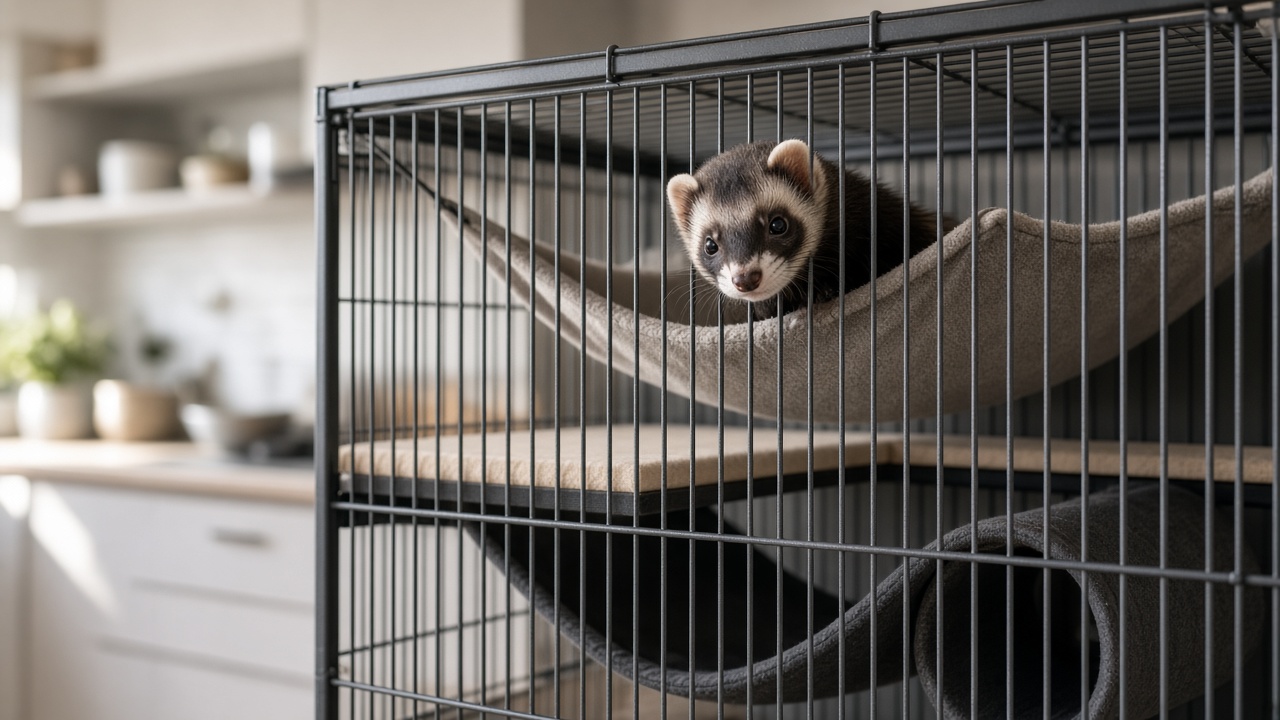
VCA Animal Hospitals prefers multi-tiered cages. It places eating, drinking, and toileting on the first level. It places sleep on upper levels.
The Merck Veterinary Manual says most ferrets prefer a small, confined sleep space. Hammocks and fabric huts are the usual tools.
The American Ferret Association says ferrets sleep an average of 18 hours per day. VCA Animal Hospitals gives a 12-to-18-hour range. The Merck Veterinary Manual also cites up to 18 hours.
A tall cage is not extra luxury. It is how you separate a litter corner from a nest while the animal sleeps most of the day.
Prevue Pet Products lists four levels of living space on the Feisty Ferret Home 485. That listing includes two plastic platforms and three ramps. Platform size is 20-3/8 by 7-7/8 by 3/4 inches.
Ramp size on that same page is 15-1/4 by 5 by 1/8 inches.
Prevue Pet Products lists five platforms and three ramps on the Deluxe Critter Cage 484. That is the densest shelf count in our set.
PawHut lists two levels on the 42-inch D51-215. Upper space height is 18.5 inches. Lower space height, base included, is 20.75 inches.
The listed hammock on that page is 14.25 by 15.75 inches.
A guinea pig cage is built for floor grazing. It is the wrong shape for this sleep-up, toilet-down pattern.
The American Ferret Association also advises against introducing ferrets to rabbits, hamsters, or guinea pigs. Do not share one habitat across those species.
Published specs side by side
Floor area below is length times width from each maker page. It is not a lab measurement.
| Model | Listed overall size | Listed bar or wire spacing | Levels and access | Floor area from listed L × W |
|---|---|---|---|---|
| Prevue Feisty Ferret Home 485 | 31 by 20 by 54 inches | 7/8 inch | Four levels; two front doors | 620 square inches |
| Prevue Deluxe Critter Cage 484 | 37 by 23-1/8 by 63-3/8 inches | 7/16 inch | Five platforms; two wide doors | About 856 square inches |
| PawHut 42-inch Ferret Cage D51-215 | 24 by 24 by 42 inches | 0.75 inch | Two levels; three doors | 576 square inches |
| PawHut 47-inch 4-Level D51-476V00BG | 27.2 by 17.3 by 47.2 inches | 0.4 inch | Four tiers; two large doors | About 471 square inches |
The Prevue Deluxe Critter Cage 484 lists about 856 square inches of floor. That is 49 percent above the VCA Animal Hospitals 576-square-inch floor.
The PawHut 42-inch D51-215 lists exactly 576 square inches. It matches the VCA floor and misses the Merck floor.
The PawHut 47-inch D51-476V00BG lists about 471 square inches. That is about 18 percent under the VCA floor. Its 17.3-inch width is the narrowest listing we compared.
Prevue Pet Products lists the Feisty Ferret Home 485 at 31 by 20 by 54 inches. Height without the stand is 41-1/2 inches. The 620-square-inch floor clears VCA by about 8 percent.
PawHut lists the D51-215 at 13.02 pounds. It lists the 47-inch four-tier at 25 pounds. Weight is not a welfare score.
It does flag how light a 42-inch frame can be.
Prevue Pet Products lists powder-coated steel mesh and a plastic tray on the 485. PawHut lists a 5.75-inch base on the D51-215 and a 5.9-inch tray on the 47-inch unit. Deep pans matter because ferrets back into corners.
The Merck Veterinary Manual warns that bare wire can harm paw pads. Solid pans and covered ramps are the listed answer on these pages. We did not inspect welds.
Cages we left out on purpose
We left out any habitat whose maker page hides bar spacing. A missing number cannot pass a falsifiable rule.
We left out glass tanks. VCA Animal Hospitals wants a well-ventilated cage. The Merck Veterinary Manual specifies a wire cage.
We left out single-level rabbit hutches and most starter cages for a Syrian hamster. Those products solve a different skull size and a different daily path.
We left out add-on units sold without a full dimension set on the same page. A second story is useful only after the first story is fully specified.
We left out room-scale pens with no listed bar pitch. A playpen is not a night cage.
If a listing says “ferret” and skips the gap width, skip the listing.
Heat, time out, and what the cage cannot do
The American Ferret Association sets comfort between 50 and 80 degrees Fahrenheit. It says ferrets cannot tolerate temperatures above 85 degrees Fahrenheit.
VCA Animal Hospitals says keep the space at or below 80 degrees Fahrenheit. The Merck Veterinary Manual gives a tighter comfort band of 65 to 75 degrees Fahrenheit.
Place the cage away from sun and drafts. The Merck Veterinary Manual says not to set it directly in front of windows. Ferrets lack sweat glands.
No published size replaces out-of-cage time. The American Ferret Association wants a minimum of 4 hours out per day. At least 2 of those hours should include human interaction.
VCA Animal Hospitals asks for at least two to three hours out, and more if possible. The Merck Veterinary Manual asks for 2 to 4 hours outside the cage each day.
Those three clocks do not match. The safest reading is the American Ferret Association’s 4-hour floor.
Adult ferrets on the American Ferret Association page range from 1 to 5 pounds. A 5-pound hob still needs the same bar rule as a 1-pound jill. Head-through-gap does not scale with weight the way owners hope.
The American Ferret Association also wants paper-based or wood-based pellet litter. VCA Animal Hospitals rejects clumping cat litter. The Merck Veterinary Manual also warns against clumping clay.
Keep food in the cage. The American Ferret Association wants dry food at 36 percent protein and about 20 percent fat if you feed kibble. The Merck Veterinary Manual wants food and water available at all times.
A cage is a lockable rest box. It is not a life.
FAQ
How big should a ferret cage be?
VCA Animal Hospitals suggests at least 24 by 24 by 18 inches. The Merck Veterinary Manual prefers at least 3 by 3 by 2 feet. None of the four cages we compared lists Merck’s 1,296-square-inch floor.
Buy the largest footprint that still lists bars at or under 1 inch.
What bar spacing is safe for ferrets?
Stay at or under 1 inch. Prevue Pet Products lists 7/8 inch on the Feisty Ferret Home 485. It lists 7/16 inch on the Deluxe Critter Cage 484.
PawHut lists 0.75 inch and 0.4 inch on the two models above. Kits and slim jills favor the tighter of those numbers.
Do I need a multi-level cage?
VCA Animal Hospitals prefers multi-tiered cages so sleep can sit above litter. Prevue Pet Products lists four levels on the 485 and five platforms on the 484. A single wide box can meet floor math and still mash nest and toilet together.
Can two ferrets share one cage?
The American Ferret Association treats ferrets as social. It does not set a pair-only inch count. VCA Animal Hospitals’ 24-by-24-by-18 figure is already a suggested minimum, not a pair plan.
If you house two, start from the Merck 3-by-3-foot floor. Add a second hammock and a second litter corner.
Are aquariums or hamster tanks okay?
No. VCA Animal Hospitals wants ventilation. The Merck Veterinary Manual specifies a wire cage.
A tank traps heat. Ferrets fail above 85 degrees Fahrenheit on the American Ferret Association page.
How many hours should a ferret spend out of the cage?
The American Ferret Association sets a 4-hour daily minimum, with 2 hours of human contact. VCA Animal Hospitals asks for two to three hours. The Merck Veterinary Manual asks for 2 to 4 hours.
Use the 4-hour figure.
Can I use a rabbit or guinea pig cage instead?
Only if that listing publishes bars at or under 1 inch. The floor must also be at least 24 by 24 inches. Most rabbit and guinea pig habitats fail one of those two facts.
The American Ferret Association also advises against housing ferrets with those species.