Quick answer: Ferrets are one species with eight AFA-listed colors, from sable brown to albino white. Pattern names describe white and point layout, not a second breed. Color does not change daily care, though white-headed patterns need hearing caution from published clinic data.
The American Ferret Association names eight standard ferret colors on its published color chart.
This page is a research-desk brief that did not score coats, run a breeding trial, or examine live ferrets.
Our research team analyzed that American Ferret Association chart. We also read one 2014 paper in the Journal of the American Veterinary Medical Association.
We compared published diet specs. We did not invent a ninth official color.
How we chose colors, patterns, and products
Selection rule: we cover colors and patterns named on the American Ferret Association color chart. We add coat-linked hearing counts from that JAVMA paper only. We omit hobby nicknames and retailer-invented shades.
For products, we include only species-labeled ferret diets. The maker page must publish protein, fat, fiber, and moisture. We exclude dog kibble, cat kibble, and unlabeled marketplace mixes.
We do not rank bags. We do not sort them by price. A living ferret can sit between two chart cells.
Eight colors on the American Ferret Association chart
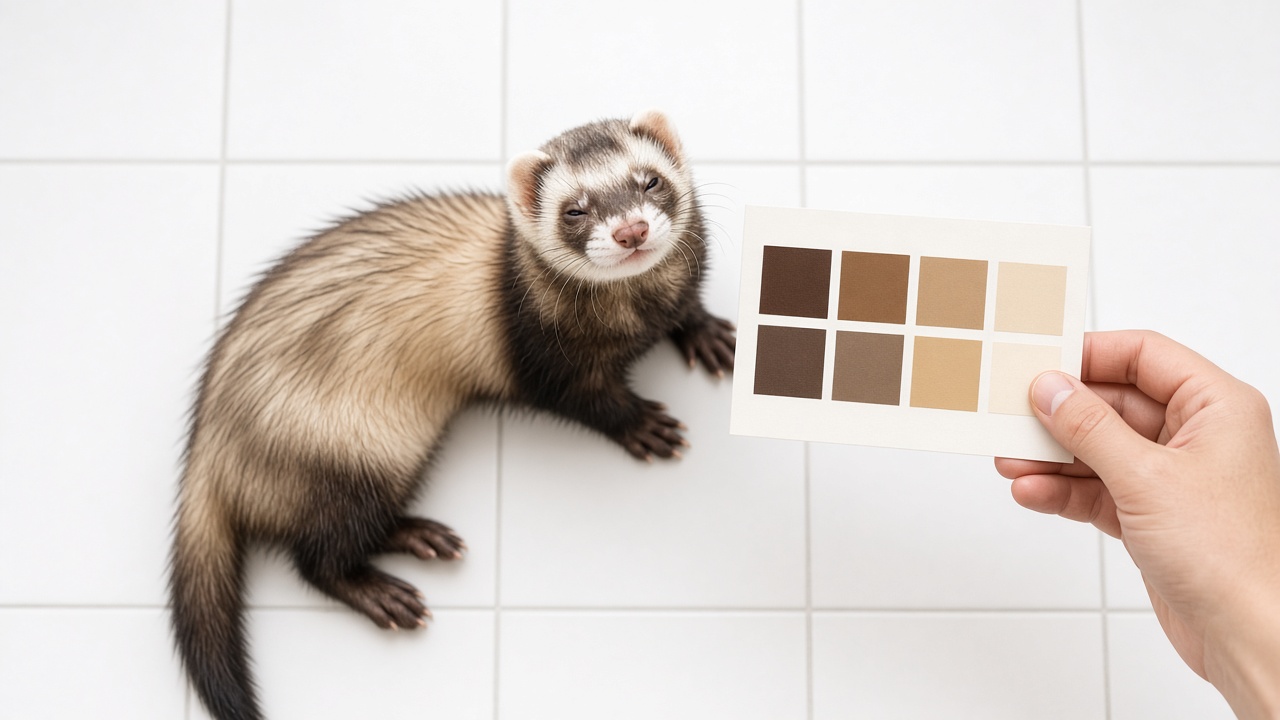
The American Ferret Association defines color by four traits. Those traits are guard-hair shade, undercoat, eye color, and nose color.
There is one pet species. Color is a coat class, not a separate breed.
White coats: albino and dark-eyed white
Albino, on that chart, is an absence of pigment and pattern. Guard hairs and undercoat are white to cream. White is preferred.
Eyes must be ruby red only. The nose must be pink only.
Any solid white ferret with red or pink eyes is an albino there. Dark-eyed White, often shortened to DEW, is a white-to-cream coat with burgundy eyes. The nose is pink only.
The American Ferret Association also names Dark-eyed White Pattern. That label is any ferret at least 90% white, with non-red eyes. A stripe, spots, or a sprinkle of colored guard hairs may remain.
Do not call a DEW an albino. The eye color splits the two classes.
Dark coats: black, black sable, and sable
Black, on the American Ferret Association chart, has true-black guard hairs. The preferred undercoat is white. A slight golden hue is acceptable.
Eyes are black or near black. The preferred nose is black or near black.
Black sable is colder. Guard hairs are dark ash blackish brown, with no warm brown tone. A glossy black shine is required on the chart.
The preferred black-sable undercoat is white to cream, but not yellow. Eyes are dark brown or near black. The preferred nose is ash blackish brown.
Sable has warm deep-brown guard hairs. The preferred undercoat is white to cream or light golden, but not yellow.
Sable eyes are brown or near black. The preferred nose is light brown, speckled brown, or a brown “T” outline.
In the 2014 JAVMA clinic sample, sable was the largest no-white-marking group. Piazza and colleagues counted 37 sables among 63 ferrets with no white markings.
Dilute brown coats: chocolate, champagne, and cinnamon
Chocolate, on that chart, has warm milk-chocolate guard hairs. The preferred undercoat is white. A slight golden hue is acceptable.
Brown eyes are preferred. Dark burgundy is acceptable.
The preferred nose is pink, beige, or pink with a light-brown “T” outline. A brick nose is acceptable.
Champagne is a tan, diluted version of chocolate. The preferred undercoat is white to cream, but not yellow.
Champagne eyes run light to dark burgundy. The preferred nose is beige, pink, or pink with a beige or light-brown “T” outline.
Cinnamon shows a strong reddish cast on the guard hairs. The American Ferret Association says a noticeable gap exists between cinnamons and champagnes.
Cinnamon guard hairs are a rich light reddish brown. The preferred undercoat is a golden hue. White is acceptable.
Cinnamon eyes are light to dark burgundy. The preferred nose is brick. The same chart states that cinnamons are not as common as champagnes.
Patterns and white-marking rules on the chart
The American Ferret Association treats pattern as concentration and placement of color. Pattern also covers white on the head or feet when those marks are present.
Standard, on that chart, should show about 90% to 100% colored guard hairs. Color concentration is lighter than Solid. Points stay easy to see.
Masks on Standard are full or “T” bar. Solid should be ideally 100% colored guard hairs. White guard hairs should realistically be 0% on body and points.
Roan is 50% to 60% colored guard hairs versus 40% to 50% white guard hairs. Mask and nose follow the underlying color.
Point, also called Siamese on the chart, shows a clear gap between body color and points. Black, black sable, sable, cinnamon, and chocolate must wear a thin “V” mask. A full or “T” bar mask is not allowed there.
Champagnes may have a “V” mask or no mask. Point noses should be lighter than the usual color-standard nose. Pink, beige, or a “T” outline fits that rule.
Blaze requires a long white blaze from the forehead, between the ears, and down the neck. The blaze preferably reaches the shoulders. Full masks are not acceptable.
Eyes on blaze run ruby to brown. The nose should be pink or pink with a light outline. All four feet should show white tips or mitts.
Panda should have an almost completely white head, including neck and throat. Colored eye rings are acceptable.
Panda eyes should be varying shades of burgundy. Mitts should be on all four feet.
Mitt requires white on all four feet. Eyes should be varying shades of burgundy. A bib, knee patches, and a white tail tip are acceptable.
Our research team counted the American Ferret Association combination grid as 6 pigmented colors by 6 pattern rows. That grid has 36 cells. One cell is marked N/A: Black Sable Point.
That leaves 35 named pigmented color-pattern cells. Albino, Dark-eyed White, and Dark-eyed White Pattern sit outside that grid.
How to name a ferret coat in three steps
Start with guard-hair color. Match the American Ferret Association cell that fits the points and body.
Next, read the undercoat at the skin. A yellow undercoat is out of preference on several dark colors. A golden undercoat is preferred on cinnamon.
Then add pattern. Say the color first and the pattern second. Examples include Sable Standard, Champagne Point, and Black Blaze.
Check the mask last. A full or “T” bar mask belongs on Standard and Solid. A thin “V” mask belongs on Point for the darker colors.
Do not force a rare name. If the reddish cast is weak, champagne is the closer chart cell. Name the coat you see now, not the kit you remember.
White markings and hearing data from JAVMA
Coat color does not set personality. It also does not set housing needs. Hearing data is the exception for white-headed patterns.
In 2014, the Journal of the American Veterinary Medical Association published a clinic study by Piazza and colleagues. The authors used brainstem auditory evoked response testing on 152 healthy European pet ferrets.
The ferrets were seen between 2008 and 2012. Ages ranged from 8 weeks to 6 years. The group included 67 males and 85 females.
Of the 152 ferrets, 108 (71%) had normal hearing. Forty-four (29%) were deaf.
Ten (7%) were unilaterally deaf. Thirty-four (22%) were bilaterally deaf.
All 11 panda ferrets were deaf. All 7 American panda ferrets were deaf. All 9 blaze ferrets were deaf.
All 63 ferrets without white markings had intact hearing. That group included 8 black, 3 chocolate, 15 pastel, and 37 sable ferrets.
Only 1 of 10 albino ferrets was deaf. Eight of 26 mitt ferrets without other white markings (31%) were deaf. Two of 5 DEW ferrets were deaf.
Among ferrets with a known premature-graying record, 87% of grayed animals were deaf. That compared with 9.6% of those without the trait. That split used 106 of the 152 animals.
The authors found no link between deafness and sex. They also found no link with the Angora trait. The paper notes that only European lines were tested.
This page does not diagnose hearing. It reports those published counts so a white-headed pattern is not treated as paint.
Coat contrast, diet specs, and what we compared
Guard-hair contrast is what makes a color readable. A dry, yellowed undercoat can hide a chocolate or champagne class.
We did not test diets on coats. We compared published specs.
Marshall Pet Products lists 38.0% minimum protein and 18.0% minimum fat on its Premium Ferret Diet page. Fiber is 3.5% maximum. Moisture is 10.0% maximum.
Wysong Ferret Archetypal-2 lists 38% minimum protein and 18% minimum fat. Fiber is 5% maximum. Moisture is 10% maximum.
That formula ships as a 5 lb bag, a 20 lb box, or a 40 lb case. Wysong starts a 15-day switch at about 10% new food.
Wysong Ferret Archetype Chicken lists 44% minimum protein and 36% minimum fat. Fiber is 0.5% maximum. Moisture is 4% maximum.
The maker sells that freeze-dried formula in a 7.5 oz bag. Wysong states it is not heated above 118° Fahrenheit.
Mazuri Ferret Diet lists 40.00% minimum protein and 20.00% minimum fat. Fiber is 4.00% maximum. Moisture is 12.00% maximum.
Mazuri also lists taurine at 0.25% minimum. Adults weighing 2 to 4 lb typically eat 6% of body weight per day, about 1/2 to 3/4 cup. The same page says over 90% of the protein comes from animal sources.
None of these numbers dye a coat. They keep guard hairs readable against the chart.
| Product | Form | Protein min | Fat min | Fiber max | Moisture max |
|---|---|---|---|---|---|
| Marshall Premium Ferret Diet | Kibble | 38.0% | 18.0% | 3.5% | 10.0% |
| Wysong Ferret Archetypal-2 | Extruded kibble | 38% | 18% | 5% | 10% |
| Wysong Ferret Archetype Chicken | Freeze-dried raw | 44% | 36% | 0.5% | 4% |
| Mazuri Ferret Diet | Extruded particle | 40.00% | 20.00% | 4.00% | 12.00% |
Pick a bag by the maker’s own analysis and your ferret’s stool and weight. Do not pick a bag to “create” cinnamon.
FAQ
How many colors do ferrets come in?
The American Ferret Association lists eight colors. They are Albino, Black, Black Sable, Champagne, Chocolate, Cinnamon, Dark-eyed White, and Sable. Those are show-chart classes, not eight breeds.
Are albino ferrets and dark-eyed white ferrets the same color?
No. The American Ferret Association gives albinos ruby-red eyes only and a pink nose only.
Dark-eyed White ferrets have burgundy eyes and a pink nose. Dark-eyed White Pattern starts at a minimum of 90% white.
What pattern is a “standard” ferret?
Standard, on the American Ferret Association chart, should show about 90% to 100% colored guard hairs. The body looks lighter than Solid, and the points stay obvious. Masks are full or “T” bar.
Does coat color change a ferret’s care needs?
Daily housing and handling do not change with sable versus champagne. The published exception is hearing risk in white-headed patterns.
In the 2014 JAVMA study, every panda, American panda, and blaze ferret in the sample was deaf. Ferrets with no white markings in that sample all heard.
Why did my ferret’s coat look darker as a kit?
Seasonal molt and age shift guard-hair density. The American Ferret Association judges the coat in front of you. Premature graying, in the JAVMA paper, appeared by 1 to 3 years of age in animals that showed it.
Can food change a ferret from sable to chocolate?
No published maker page we compared claims a color-class change. Diet can change how oily or dull the undercoat looks.
The four diets in the table publish protein and fat ranges. Those ranges support coat condition, not a new color name.
What is a roan ferret?
Roan, on the American Ferret Association chart, is 50% to 60% colored guard hairs. The rest is 40% to 50% white guard hairs.
The colored hairs should be sprinkled through the body. A black roan is also called silver on that chart.