Quick answer: Keep a pet ferret indoors in a lockable multi-level cage. Feed meat-first ferret kibble free-choice and plan daily supervised play. Confirm your city allows ferrets before you bring one home.
A pet ferret is an indoor carnivore that needs 35 to 40 percent protein food, a lockable cage, and daily play.
This page is a housing, diet, and handling brief from our research desk. We did not keep a ferret colony, run feeding trials, or sit through clinic exams.
How we chose what belongs here
Our selection rule is simple. We cover first-time indoor pet-ferret care only.
That means lockable multi-level cages, dry foods whose maker page names ferrets, and handling you can do at home. We left out breeding, show coats, raw-prey programs, and outdoor hutches.
For the food table, we included only currently sold kibbles. Each maker page had to print a guaranteed analysis and name ferrets as the intended species. We left out yogurt drops, gravy toppers, and dog kibble.
Housing stays in prose. MidWest Homes for Pets publishes latch and ramp features for Ferret Nation. It does not print a guaranteed analysis, so the cage is not in the food table.
Our research team compared those published specs. We did not open bags or score palatability. That gap is real.
Labels can change. Recheck the bag you buy.
What a pet ferret actually is
A pet ferret is a domesticated mustelid kept as a house companion. It is not a cat in a long body.
The Merck Veterinary Manual describes ferrets as carnivores that need 35 to 40 percent dietary protein. It also sets carbohydrate under 25 percent and fiber under 2.5 percent.
That range is falsifiable. If a later feeding trial shows healthy adults thrive below 35 percent protein, this brief is wrong.
The same Merck chapter says sexual maturity arrives at 4 to 8 months. In the United States, most pet ferrets are spayed or neutered before 6 weeks of age.
The U.S. Food and Drug Administration classifies ferrets as a minor species. Dogs and cats sit in the major-species list. Ferrets do not.
The Association of American Feed Control Officials lists ferrets among specialty pets in its purpose-statement guidance. AAFCO also states, on its consumer page, that it does not regulate, test, approve, or certify pet food.
Read that twice. A ferret bag can look official and still lack a species-specific AAFCO nutrient profile.
Housing that holds an escape artist
The Merck Veterinary Manual says standard ferret cages are often too small for real play. Supervised time outside the cage is the other half of housing.
Use wire mesh with grids not exceeding 1 inch. Merck names that limit. A sturdy floor and a lockable door matter as much as floor area.
Place three zones in the cage. Keep litter away from food. Keep sleep away from both.
We call that the Three-Zone Cage Rule.
Hammocks are the usual sleep spot in that Merck chapter. A box lined with a cotton shirt also works. Skip hay, straw, and wood shavings.
Dust can irritate the airway.
Ferrets do not sweat. Merck warns they overheat in direct sun. Keep the cage indoors, off a sunny window, and away from space heaters.
If you house more than one ferret, Merck advises capping a group at 3 or 4 animals. Some clinicians prefer singles. Watch for bullying either way.
MidWest Homes for Pets builds the Ferret Nation line for this job. Its product page lists ferret-proof dual-locking door latches and full-width double doors.
Swing-up locking ramps appear on Model 182 and Model 183 only. Locking casters sit on the stand. Shelves are leak-proof and height-adjustable.
We did not assemble a unit. We compared the published feature list. If a cheaper cage lacks a dual lock, treat it as a weekend crate, not a home.
Buy extra pans and scatter guards when pet supplies deals line up. Spare pans make daily cleaning faster.
Diet: read the guaranteed analysis
Leave dog food on the shelf. Ferrets need meat first, not grain first.
Merck’s 35 to 40 percent protein target is the yardstick. Fat can vary. Carbohydrate and fiber should stay low.
AAFCO does not publish a ferret nutrient profile the way it does for dogs and cats. So the bag’s purpose statement and the guaranteed analysis do the work.
Our Ferret Kibble Spec Scan compared five current ferret-labeled dry foods. Labeled crude protein ran from 38 percent to 42 percent. Labeled crude fat ran from 15 percent to 20 percent.
That spread is not a ranking. It is a label range. A 15 percent fat bag sits at the low end of those five labels.
A 42 percent protein bag sits above Merck’s 40 percent ceiling.
Oxbow Animal Health lists Oxbow Essentials Ferret Food at 42.00 percent minimum crude protein and 20.00 percent minimum crude fat. Fiber is 3.00 percent maximum. Moisture is 10.00 percent maximum.
Taurine on that Oxbow label is 0.50 percent minimum.
Oxbow’s feeding note is blunt. Fresh food should always be available. The first five ingredients are animal-based proteins and fats.
ZuPreem Premium Ferret Diet lists 40.0 percent minimum protein and 20.0 percent minimum fat. Fiber is 3.0 percent maximum. Moisture is 10.0 percent maximum.
Taurine on that ZuPreem label is 0.15 percent minimum.
ZuPreem tells owners to feed free-choice. Limit other foods and treats to 10 percent of the diet.
Mazuri Ferret Diet also lists 40.00 percent minimum protein and 20.00 percent minimum fat. Fiber is 4.00 percent maximum. Moisture is 12.00 percent maximum.
Taurine on that Mazuri label is 0.25 percent minimum.
Mazuri states that over 90 percent of the protein comes from animal sources. The extruded particle is 1/4 inch by 5/16 inch. Live microorganisms are listed at 270,000 CFU per gram.
Mazuri’s feeding page says adults weighing 2 to 4 pounds typically eat 6 percent of body weight per day. That is about 1/2 to 3/4 cup. Store the bag at 75°F or colder.
Use it within 1 year of the manufacturing date.
Marshall Premium Ferret Diet prints 38.0 percent minimum protein and 18.0 percent minimum fat on the Marshall Pet Products page. Fiber is 3.5 percent maximum. Moisture is 10.0 percent maximum.
Sunseed Vita Prima Ferret Food, sold by Vitakraft Sun Seed, lists 38 percent minimum protein and 15 percent minimum fat. Fiber is 5 percent maximum. Moisture is 14 percent maximum.
Vitamin A on that Sunseed label is 22,000 IU per kilogram.
Sunseed also caps supplemental meat or eggs at 10 percent of the daily diet. Food and water should stay out at all times.
| Product | Protein min | Fat min | Fiber max | Moisture max | Maker feeding note |
|---|---|---|---|---|---|
| Oxbow Essentials Ferret Food | 42.00% | 20.00% | 3.00% | 10.00% | Food always available |
| ZuPreem Premium Ferret Diet | 40.0% | 20.0% | 3.0% | 10.0% | Treats at or under 10% |
| Mazuri Ferret Diet | 40.00% | 20.00% | 4.00% | 12.00% | 6% of body weight for 2–4 lb adults |
| Marshall Premium Ferret Diet | 38.0% | 18.0% | 3.5% | 10.0% | Maker prints protein, fat, fiber, moisture |
| Sunseed Vita Prima Ferret Food | 38% | 15% | 5% | 14% | Treats at or under 10% |
Switch foods slowly. Sudden swaps cause soft stool. Keep a spare bag of the old formula for two weeks.
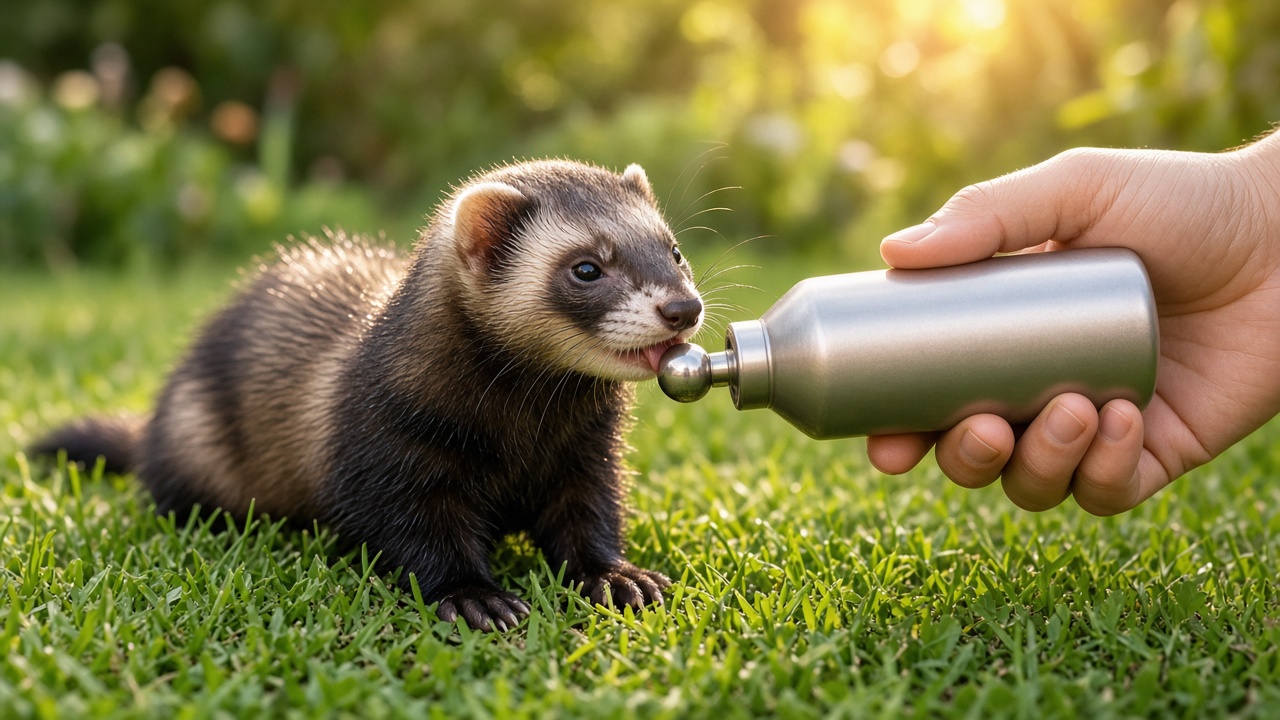
Water belongs in a bottle or a heavy bowl. Ferrets tip light dishes. Merck prefers bottles for that reason.
Skip sugary drops. They add carbohydrate without meat protein. Fruit and honey are not a ferret staple.
Handling, play, and ferret-proofing
Handle a ferret daily. Short sessions beat one long wrestling match.
Support the chest and hind end. Do not dangle the animal by the scruff for fun. A calm carry teaches the ferret that hands are safe.
The Merck Veterinary Manual notes that a ferret held on a forearm often settles. That is a clinic trick you can use at home.
Plan two or more out-of-cage blocks each day. A bored ferret shreds foam, rubber, and headphone cables.
Ferret-proof before the first free-roam. Block gaps under the stove and fridge. Close dryer doors.
Cover open ducts.
Rubber toys fail this species. Ferrets chew and swallow soft bits. Use hard plastic tunnels, cardboard tubes, and fabric dig boxes instead.
Litter training is possible. Put a low pan in every corner they already use. Ferrets back into corners.
Nails grow fast. A small pair of home grooming tools handles trims better than kitchen scissors. Cut only the clear tip.
A seasonal coat dump looks dramatic. It is normal. A rubber brush and a towel beat a full bath.
Smell, litter, and coat care
Intact scent glands and skin oils drive the musk. Descenting does not erase it. Merck says the musky odor comes from sebaceous glands, not the anal glands.
Daily pan changes cut the room smell more than perfume sprays. Use a paper or wood pellet litter made for small animals.
If the cage still reeks, read our odor control brief and start with the pans, not the ferret.
Wash hammocks weekly. A sour hammock will beat any air freshener.
Mazuri notes yucca extract on its label as an odor claim. Treat that as a label statement, not a room guarantee.
Do not bathe a ferret every week. Soap strips the coat and can make the musk stronger as oils rebound.
Health limits of a research brief
We are a research desk. This brief does not diagnose disease.
The Journal of the American Veterinary Medical Association reported a surgical series of 130 ferrets with adrenal disease. One-year survival was 98 percent. Five-year survival was 70 percent.
That paper is about one condition after surgery. It is not a lifespan promise.
Merck lists a healthy adult heart rate of 200 to 250 beats per minute. Resting rate that high is normal for this species. It is not a dog’s pulse.
Merck also lists three USDA-licensed rabies vaccines used in U.S. ferrets. Rabies shots start at 3 months of age in that chapter. Canine distemper shots are discussed at about 8, 11, and 14 weeks.
Vaccine choice is a clinic decision. Do not invent a schedule from a blog.
Watch for sudden limpness, black tarry stool, or a ferret that will not eat. Those are clinic hours, not wait-and-see hours.
Find an exotic-animal clinic before you need one. Minor-species drugs are thinner on the shelf. The FDA said so.
FAQ
How much cage space does one pet ferret need?
Merck says typical store cages are often too small for play. Use a lockable multi-level habitat and daily out-time. MidWest Ferret Nation Model 182 and Model 183 add swing-up locking ramps for that layout. The cage is a bedroom, not the whole day.
Can I feed cat food to a pet ferret?
Merck still allows high-quality kitten food as a fallback. A ferret-labeled kibble is the cleaner match. Our Spec Scan found ferret bags at 38 to 42 percent protein. Read the guaranteed analysis, not the cartoon on the front.
How many hours should a ferret stay out of the cage?
Merck says ferrets need room to play beyond a standard cage. Two or more supervised sessions a day is the practical pattern owners use. Unsupervised roaming is how ferrets vanish into sofas and appliances.
Why does my ferret smell musky?
Merck states that descenting does not remove the musk. Skin oils do that work. Clean pans, wash hammocks, and skip extra baths. If the room still smells like ammonia, the litter is the problem.
Are pet ferrets legal everywhere in the United States?
No. Some cities and states restrict or ban ferret ownership. Confirm the rule where you live before you pay a breeder or a shop. A legal ferret in one county can be illegal ten miles away.
Do pet ferrets need vaccines?
Merck describes rabies and canine distemper vaccination as common U.S. practice. It names three USDA-licensed rabies products and a 3-month minimum age for rabies. Ask a clinician who already treats ferrets. Do not shop vaccines by brand ads.
Can a pet ferret live alone?
Yes. Merck notes that wild polecats are solitary. Some clinicians prefer one ferret per household. Pairs can work if you have space and you watch for fights.