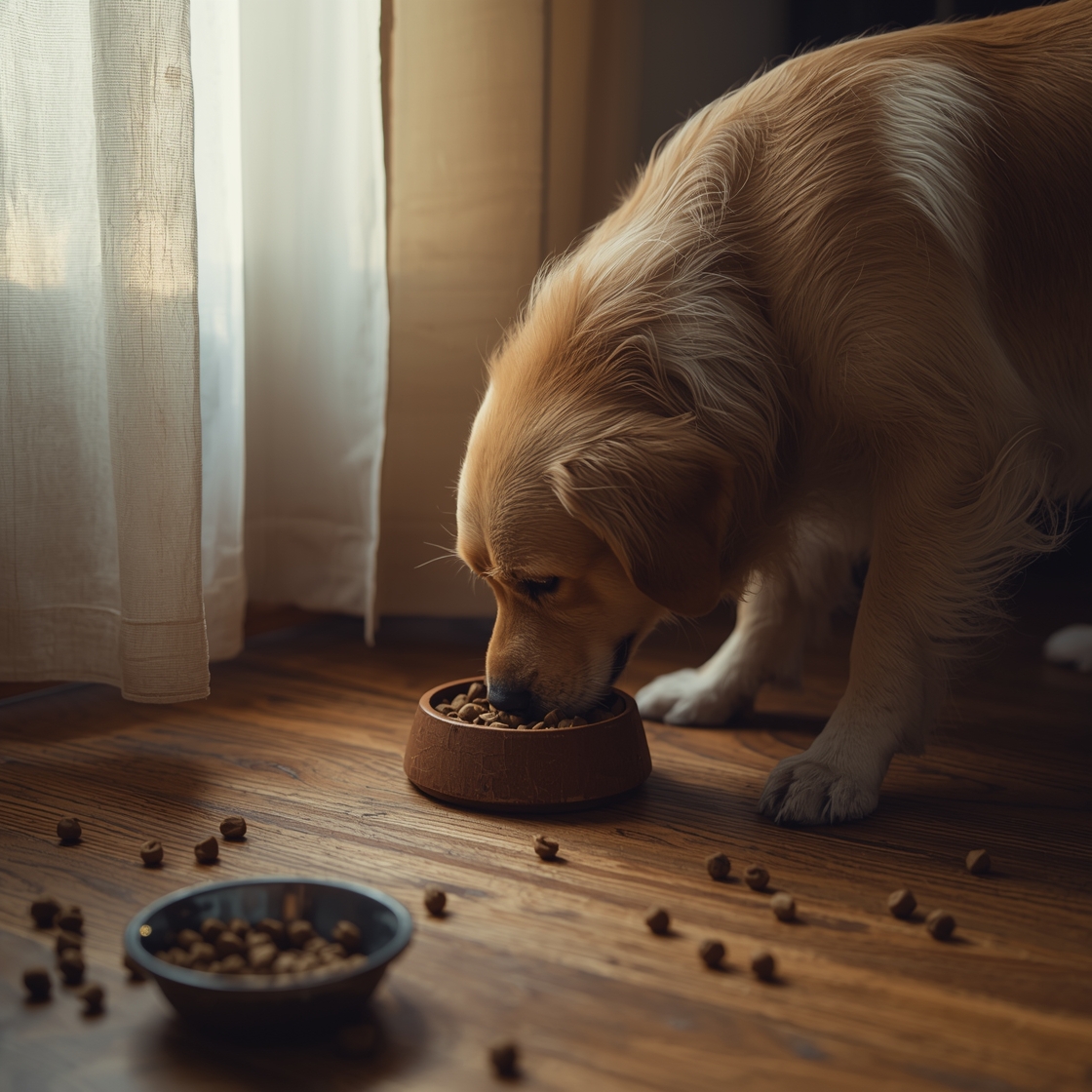

Quick answer: Choose a low-fat veterinary GI diet with a printed fat ceiling, not a generic sensitive-stomach bag. Purina EN Low Fat and Royal Canin Gastrointestinal Low Fat list a 9% fat maximum; Hill’s i/d Low Fat lists 7.5% typical dry-matter fat. Have a clinic rule out other causes first.
Royal Canin Small Digestive Care lists 20% minimum crude fat; its Gastrointestinal Low Fat dry lists a 9% fat maximum. This page is a 2026 comparison of published U.S. dry-food specs. We did not run feeding trials, rank bags, or sit in on clinic visits.
How we decided which foods belong here
Our selection rule is narrow on purpose. A dry formula had to publish a fat figure we could read. We then split those formulas into two groups.
Group A is diets that print a crude-fat maximum of 9%, or a typical dry-matter fat figure under 8%. Group B is diets sold as sensitive-stomach or digestive-care food that print only a fat minimum of 16% or higher.
We left out raw, freeze-dried, homemade, puppy, and wet-only SKUs. Those pages do not publish a comparable fat ceiling. We also left out boutique grain-free lines that never print a fat maximum.
That rule is the whole filter. A bag did not get in because a blog called it gentle. It got in because the maker printed a number we could check.
Top 7 Dog food for acid reflux
The picks below are the 7 dog foods for acid reflux on sale right now, listed with what each suits best and an honest drawback. Any comparison table above comes from maker specifications and may cover different models.
1. Hill's Science Diet Sensitive Stomach & Skin Small Bites Dry Dog Food
Best for: Small dogs needing gentler kibble
Hill’s Science Diet Sensitive Stomach & Skin Small Bites is over-the-counter dry food for dogs that do better on a gentler everyday recipe. The small-bite kibble is the reason this bag exists, not a printed low-fat ceiling. Owners who already feed Science Diet often stay here when a clinic has not moved them to a veterinary GI diet.
Pros: Small-bite kibble size; Sensitive-stomach everyday recipe Cons: Not a low-fat GI diet
2. IAMS Proactive Health Adult Minichunks Dry Dog Food
Best for: Everyday adult minichunk bowls
IAMS Proactive Health Adult Minichunks is everyday adult kibble with a smaller chunk. It is not sold as digestive-care or bland-diet food. Owners treat it as grocery-aisle fuel, which matches the name and the mid-forties price.
Pros: Minichunk adult kibble; Familiar grocery-aisle brand Cons: No digestive-care claim
3. KOHA Limited Ingredient Bland Diet for Dogs
Best for: Short bland-diet GI resets
KOHA Limited Ingredient Bland Diet is a simple, limited-ingredient meal for dogs that need a quieter bowl. The bland-diet name is why it sits on a reflux list. Owners use this style of food for short resets, then return to a complete everyday diet.
Pros: Limited-ingredient bland diet; Built for upset stomachs Cons: Premium price per meal
4. Purina ONE Plus Digestive Health Dry Dog Food
Best for: Grocery digestive-health shoppers
Purina ONE Plus Digestive Health is grocery-aisle dry food with a digestive-health name on the bag. That label is not the same as a veterinary low-fat GI diet. Owners who want a familiar Purina kibble at this $49.98 listing often start here.
Pros: Digestive-health dry formula; Widely known Purina line Cons: Highest price here
5. Blue Buffalo True Solutions Digestive Care Chicken Dry Dog Food
Best for: Blue Buffalo digestive-care buyers
Blue Buffalo True Solutions Digestive Care Chicken is dry food from Blue’s targeted-care line, with chicken named on the bag. The digestive-care framing is clearer than a generic adult recipe. Owners who already buy Blue Buffalo often pick this SKU for that brand’s gut-focused kibble.
Pros: Digestive-care chicken recipe; Targeted True Solutions line Cons: Mid-premium kibble price
6. Nutrish Small Breed Dry Dog Food with Chicken
Best for: Budget small-breed households
Nutrish Small Breed Dry Dog Food with Chicken is value kibble for little jaws at $17.84. The bag does not claim a reflux or digestive-care job. Owners who need an inexpensive chicken recipe for a small dog are buying price and bite size, not a GI diet.
Pros: Lowest price on list; Small-breed chicken kibble Cons: No reflux-specific formula
7. Nutrish Beef Paté Wet Dog Food
Best for: Wet-food mixers and toppers
Nutrish Beef Paté Wet Dog Food is a soft canned meal at $20.28. Wet paté adds moisture that dry kibble cannot, which is why some owners mix it into a reflux bowl. It remains a grocery paté, not a limited-ingredient bland diet.
Pros: Soft beef paté texture; Budget wet-food option Cons: Costs add up daily
Comparison: Dog food for acid reflux at a Glance
Want to browse every option? See the full range of dog food for acid reflux on Amazon →
Why a fat maximum beats a “digestive care” label
Acid reflux is stomach contents moving the wrong way. Fat slows how fast the stomach empties. A slower empty gives acid more time to sit and splash.
A “sensitive stomach” line can still be a high-fat food. Royal Canin’s own Small Digestive Care dry lists 20.0% minimum crude fat. The same company’s Gastrointestinal Low Fat dry lists a 9.0% crude-fat maximum.
Those two bags share a brand, not a fat job. Our research team analyzed the two maker pages side by side. The digestive-care kibble is not a low-fat diet.
Hill’s makes the same split inside one house. Its Prescription Diet i/d Low Fat dry table lists 7.5% fat on a dry-matter basis. Its Science Diet Adult Sensitive Stomach & Skin Chicken & Barley table lists 16.7% fat on a dry-matter basis.
That is more than a twofold gap. A shopper who grabs “sensitive stomach” can still feed a high-fat cup.
Calories tell the same story. Royal Canin lists 247 kcal per cup on Gastrointestinal Low Fat dry. It lists 485 kcal per cup on Small Digestive Care dry.
One cup of the digestive-care kibble packs nearly twice the energy. Extra energy often means extra fat in the bowl.
The Association of American Feed Control Officials treats “lite” and “low-fat” as different claims. AAFCO’s labeling rules say a lite dry dog food cannot contain more than 3,100 kilocalories per kilogram.
Hill’s lists 3,311 kcal/kg on i/d Low Fat dry. Royal Canin lists 3,210 kcal/kg on Gastrointestinal Low Fat dry. Both sit above that lite ceiling.
Low fat is not the same as light. A reflux plan cares about the fat line first.
Specs our research team pulled from maker pages
We compared five currently sold dry formulas: three in Group A and two in Group B. The table uses the maker’s own listing style, not a blended score.
Hill’s publishes typical dry-matter figures. Nestlé Purina and Royal Canin publish as-fed guaranteed analyses. We did not convert one format into the other.
| Product | Fat listing on maker page | Protein listing | kcal per cup | How it is sold |
|---|---|---|---|---|
| Hill’s Prescription Diet i/d Low Fat dry | 7.5% fat, dry-matter typical | 26.1% protein, dry-matter typical | 300 | Veterinary diet; 8.5 lb and 27.5 lb bags |
| Purina Pro Plan Veterinary Diets EN Gastroenteric Low Fat dry | 5.0% min and 9.0% crude fat | 25.0% min crude protein | 327 per 250 ml cup | Veterinary diet; 3.0% max crude fiber |
| Royal Canin Gastrointestinal Low Fat dry | 5.0% min, 9.0% max crude fat | 20.0% min crude protein | 247 | Veterinary diet; bags from 1.5 lb to 28.6 lb |
| Hill’s Science Diet Adult Sensitive Stomach & Skin Chicken & Barley | 16.7% fat, dry-matter typical | 24.8% protein, dry-matter typical | 391 | Over-the-counter adult kibble |
| Royal Canin Small Digestive Care dry | 20.0% min crude fat | 28.0% min crude protein | 485 | Over-the-counter; dogs up to 22 lb |
Purina’s EN Gastroenteric Low Fat dry page also lists 3.0% maximum crude fiber and 12.0% maximum moisture. It lists vitamin E at 460 IU/kg.
Royal Canin Gastrointestinal Low Fat dry lists 4.8% maximum crude fiber and 10.5% maximum moisture. It also prints a 0.08% minimum for EPA plus DHA.
Royal Canin Small Digestive Care dry lists 3.6% maximum crude fiber and 10.0% maximum moisture. It is sold for small dogs 10 months and older that weigh up to 22 lb.
Hill’s tells owners to mix the new food in over a 7-day period. That timeline is on both Hill’s pages we read.
None of these rows is a rank. A clinic may pick any Group A diet for reasons the label cannot show.
What AAFCO and JAVMA say a fat number actually means
AAFCO requires four basic guarantees on a pet food label. Those are minimum crude protein, minimum crude fat, maximum crude fiber, and maximum moisture.
AAFCO says a low-fat claim must guarantee both maximum and minimum crude fat. That is why Purina and Royal Canin print two fat numbers on the GI diets.
A “sensitive stomach” bag that prints only a fat minimum is not making a low-fat claim. Royal Canin Small Digestive Care prints 20.0% minimum fat and no fat maximum. Hill’s Science Diet Sensitive Stomach table is a typical analysis, not a low-fat guarantee.
AAFCO also says its Dog Food Nutrient Profiles contain 37 required nutrient specifications. Fat is one line. It is not the whole diet.
The Journal of the American Veterinary Medical Association published a 2009 comparison of labels and lab results. Researchers matched guaranteed analyses to measured values on 2,208 foods from 204 companies.
Measured crude fat ran 1.0 percentage point above the label minimum, on average. Measured crude protein ran 1.5 percentage points above the protein minimum.
A fat minimum is a legal floor, not the cup in your hand. A fat maximum is the number that matters for a low-fat plan.
The U.S. Food and Drug Administration requires ingredients to be listed by common name in descending order of weight. That rule sits in 21 CFR 501.4.
Read the first three ingredients after you read the fat line. Chicken fat as an early ingredient is a flag on a reflux bowl.
Royal Canin Small Digestive Care lists chicken fat third. Gastrointestinal Low Fat lists chicken fat later, after several low-fat starches and fibers.
Protein meals, kibble density, and meal size
Lean protein still matters. The form on the bag is often a meal, not a raw muscle cut.
Royal Canin Gastrointestinal Low Fat dry leads with brewers rice, then chicken by-product meal. Purina EN Gastroenteric Low Fat dry leads with brewers rice, then barley, then corn protein meal and poultry by-product meal.
A meal is a cooked, dried protein concentrate. It is not a lesser mystery powder by default. Our explainer on what chicken meal is in dog food walks through that label term.
Fresh meat brings water weight. Meal brings more protein per pound of ingredient. We break down that trade in meat meal versus meat in dog food.
Neither article claims a meal causes reflux. A fatty meat cut can. Table scraps and skin-on leftovers are common bowl wreckers.
Royal Canin’s Small Digestive Care page tells owners to avoid human foods and fatty snacks. That is the maker talking, not a forum tip.
Purina’s EN Gastroenteric Low Fat feeding notes say the daily amount should be divided into several small meals. That matches the reflux logic of a less-full stomach.
Hill’s Science Diet Sensitive Stomach lists 391 kcal per cup. Royal Canin Gastrointestinal Low Fat lists 247 kcal per cup. The same “one cup” is not the same meal.
A smaller cup of a denser food can still be a large fat load. Measure the grams, then split the day.
Watch what comes back up. Food that returns in a tube, with little heaving, is often regurgitation. Food that returns with retching is often vomiting.
Those two signs are not the same problem. Our page on why a dog throws up undigested food maps the difference.
Reflux can sit in either picture. A clinic still has to rule out a blockage, a food reaction, or a swallowing disorder.
What a bag change cannot settle
A low-fat GI diet is a tool. It is not a diagnosis.
Some dogs reflux after anesthesia. Some reflux because of a hiatal hernia. Some reflux because they gulp, then run.
Short-nosed breeds bring extra airway pressure. That pressure can shove stomach contents the wrong way even on a careful diet.
A food swap will not fix a hernia. It will not cancel a late-night fatty chew.
Give a new diet time. Hill’s 7-day mix-in window is a start, not a cure clock.
If the dog loses weight, skips water, or brings up blood, stop guessing. That is clinic work the same day.
If nights are quieter, stay on the plan. Do not bounce between bags every three days.
Keep treats inside the same fat logic. A low-fat kibble plus a cheese rind is not a low-fat day.
FAQ
Is sensitive-stomach dog food the same as dog food for acid reflux?
No. Sensitive-stomach labels usually speak to stool quality or ingredient simplicity. They do not have to print a fat maximum.
Royal Canin Small Digestive Care lists 20.0% minimum crude fat. Hill’s Science Diet Sensitive Stomach lists 16.7% fat on a dry-matter basis. Those are not low-fat GI diets.
Do I need a clinic authorization for the low-fat GI diets?
The three Group A diets in this article are sold as veterinary formulas. Royal Canin says Gastrointestinal Low Fat is sold through clinics and select retailers that handle that channel.
Purina sells EN Gastroenteric Low Fat the same way. Over-the-counter sensitive-stomach bags do not replace that step.
How many meals should I feed?
Purina’s EN Gastroenteric Low Fat page says to divide the daily amount into several small meals. That is a practical starting point.
A single large dinner stretches the stomach. A stretched stomach is a reflux risk even on a low-fat kibble. Ask the clinic how to split your dog’s calories.
Does grain-free kibble help acid reflux?
No maker page we used makes that claim. The Group A diets here use rice, barley, or similar starches as early ingredients.
Grain-free was not part of our selection rule. We filtered on a published fat ceiling, not on a grain line.
Can chicken meal trigger reflux?
Chicken meal is a dried protein concentrate. It is not inherently high fat. The fat line on the guaranteed analysis still decides the load.
If a dog already reacts to chicken, a chicken-based GI diet is the wrong tool. That is an allergy question, not a reflux-fat question. Read the meal explainer linked above before you swap proteins.
How long should I wait after a switch?
Hill’s publishes a 7-day mix of old food and new food. Use that as the changeover, not the full test.
If nights stay loud after weeks on a Group A diet, the bowl may not be the only issue. Bring the feeding log to the clinic.
What if my dog still regurgitates after the diet change?
A bag cannot clear a structural problem. Persistent regurgitation needs an exam, not a third brand.
Keep the low-fat logic while you wait for that visit. Cut table scraps the same day. Note whether the food comes back as a tube or with retching.