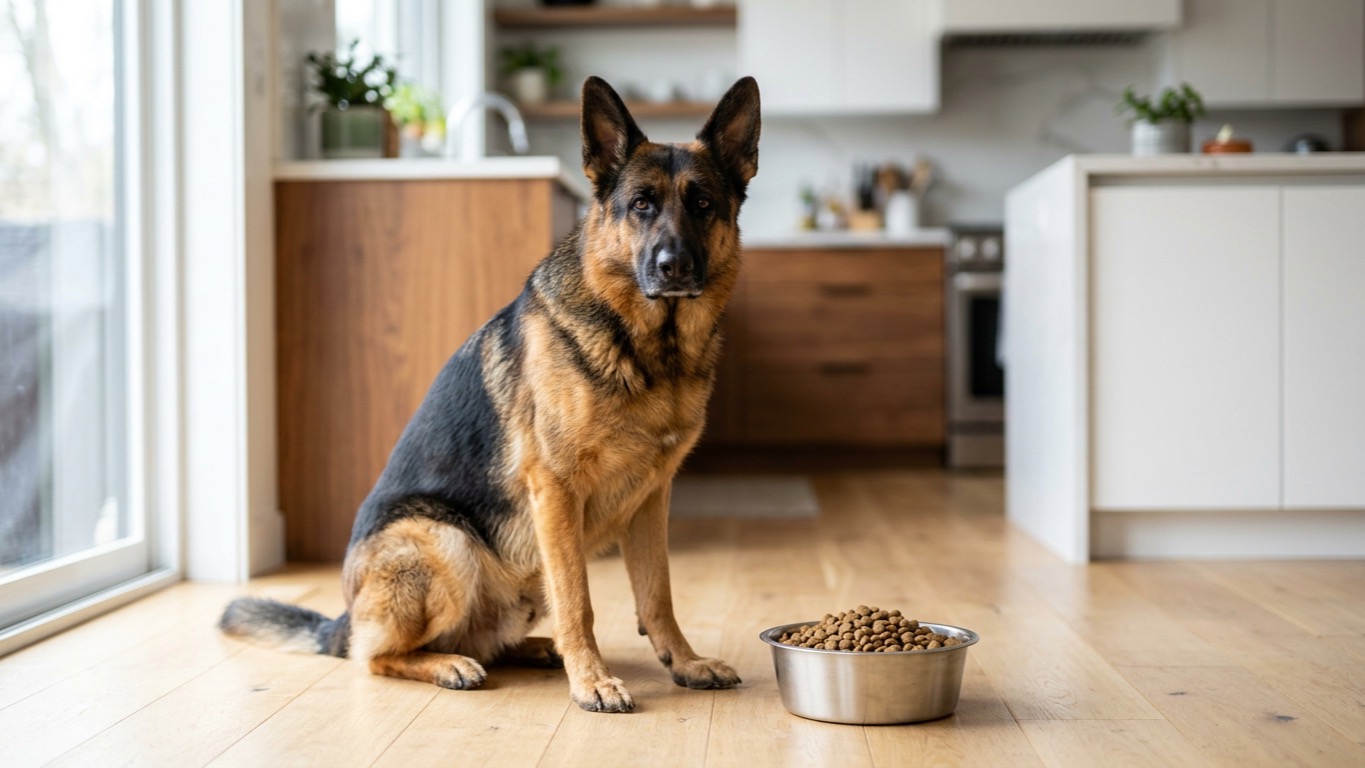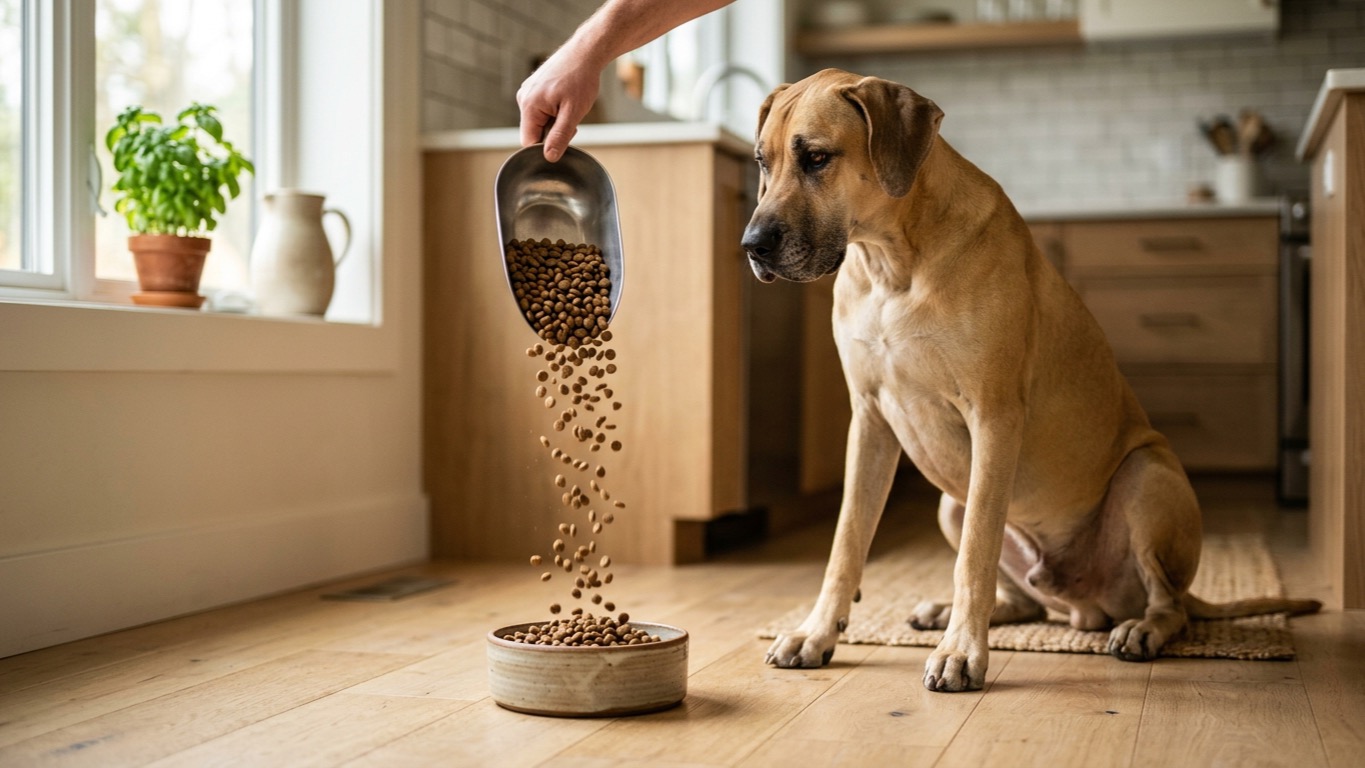
The best dog food for Great Danes is a large- or giant-breed complete food with controlled calcium while the skeleton is still growing — often until 18–24 months. Then adult giant or large-breed maintenance. Feed two or three meals. Never one huge bowl.
7 SKUs. 1 of 7 is giant (Royal Canin Giant Adult). 5 of 7 say large breed (Pro Plan, Hill’s, Blue, Eukanuba, Nutro). 1 of 7 is grain-free (Wellness CORE). Hill’s Science Diet Adult Large Breed Chicken & Barley publishes 365 kcal/cup (3,675 kcal/kg) and is recommended for giant breeds 1–4 years at 110+ lb — not for large-breed puppies. A Royal Canin US Giant Adult page we fetched printed 427 kcal/cup (3,958 kcal/kg) but the adequacy sentence on that same page named Giant Junior. Read the bag. Split meals beat a protein-brag lid.
What is the best dog food for Great Danes in one minute?
If the Dane is still growing, buy giant or large-breed puppy. The adult cards on this URL are the wrong clock. If the Dane is finished, Hill’s Large Breed adult (365 kcal/cup on the Chicken & Barley page) or Royal Canin Giant Adult are examples. Split dinner tonight. No extra calcium. Grain-free CORE is optional, not a default.
Our guides are reader-supported. This article may contain affiliate links. As an Amazon Associate we may earn a commission if you buy through links, at no extra cost to you.
Large-breed overlay: best dog food for large breeds. Puppy calcium: puppy nutrition guide. Weight: best dog food for weight loss. Golden comparison (different growth clock): best dog food for golden retrievers.
Quick picks at a glance
- Best giant-labeled example: Royal Canin Giant Adult — kibble geometry and giant-maintenance copy. Confirm AAFCO sentence on the lot.
- Best widely stocked large-breed example: Pro Plan Large Breed — lean-muscle marketing; easy repurchase.
- Best clinic-aisle large-breed example: Hill’s Science Diet Large Breed — feeding-trial language common on Science Diet adult SKUs; read the bag.
- Best brand-bit large-breed example: Blue Buffalo Life Protection Large Breed — LifeSource Bits are a variable, not a lab result.
- Best energy-balance example: Eukanuba Large Breed Adult — fat/protein balance and kibble-texture dental copy.
- Best grain-free large-breed example (not a default): Wellness CORE Grain-Free Large Breed — DCM conversation with your veterinarian, not a bloat cure.
- Best “cleaner list” example: Nutro Natural Choice Large Breed — simple-panel marketing; still needs an AAFCO sentence.
Five jobs. A 140 lb Dane on one dinner is a failed Index even on the “best” lid.
| Job | What actually works | Kibble role | Fails if you skip the real job |
|---|---|---|---|
| Growth minerals | Large-breed / giant puppy until ~18–24 months | Controlled Ca:P; no extra calcium | Fail — adult “high protein” on a 6-month Dane |
| Adult maintenance | Giant or large-breed complete adult | Moderate protein, measurable kcal | Fail — puppy food forever on a finished 3-year-old |
| Bloat mechanics | 2–3 meals, slow eat, no fetch after food | Digestible complete diet | Fail — one gorge + elevated bowl folklore |
| Joints | Lean BCS, vet ortho plan | Glucosamine on GA is maintenance marketing | Fail — 20 extra pounds “for presence” |
| Grain-free fashion | Only if this dog and this vet choose it | CORE is one SKU | Fail — pulse-heavy swap as a “health upgrade” |
| Bag (this URL) | Lid class | Complete meal? | Growth tool? | Watch |
|---|---|---|---|---|
| Royal Canin Giant Adult | Giant adult | Yes | No — adult | Wrong for a rapidly growing puppy |
| Pro Plan Large Breed | Large-breed | Yes | Only if the lot is puppy LB | Confirm puppy vs adult |
| Hill’s Science Diet Large Breed | Large-breed | Yes | Only puppy SKU | Age/size gates on some Hill’s lines |
| Blue Buffalo Life Protection Large Breed | Large-breed | Yes | Confirm puppy vs adult | Bits + FDA 2019 DCM table for the brand |
| Eukanuba Large Breed Adult | Large-breed adult | Yes | No — adult | Adult card |
| Wellness CORE Grain-Free Large Breed | GF large-breed | Yes | Confirm life stage | FDA DCM conversation |
| Nutro Natural Choice Large Breed | Large-breed | Yes | Confirm life stage | “Natural” is unregulated |
Before you shop: (1) life stage matches this skeleton, (2) meals are split, (3) no calcium powder, (4) unproductive retching or a hard swollen belly is an emergency clinic, not a new bag. Fail gate 4 and this checklist does not matter.
What the best dog food for Great Danes can and cannot do
Great Danes are giant-breed dogs with a slower per-pound metabolism than a terrier and a longer growth window than a Golden. Hip dysplasia and osteoarthritis worsen when fat mass rises and lean mass falls. Puppy growth phases demand controlled calcium. Excess mineral intake during rapid growth can disrupt skeletal formation. Large-breed puppy and giant adult formulas exist to put that control on the label — they are not a license to add bone meal “for big bones.”
Digestive sensitivity and bloat predisposition shape how you feed as much as what you feed. Easily digested complete diets, moderate fat, and meal splitting matter. Cardiovascular support narratives often emphasize omega-3s and moderate sodium — discuss cardiac diets with your veterinarian if murmurs or exercise intolerance appear. Manufacturer “heart” copy is not an echocardiogram.
The best dog food for Great Danes is therefore a complete-and-balanced giant or large-breed food you can measure, on a growth clock that can run to two years, served in more than one bowl. It is not a grain-free flex. It is not an elevated-feeder religion.
What That band is a desk summary of typical adult large-breed labels, not an assay of these seven bags.
Best dog food for Great Danes: puppy to adult timing
Great Danes grow for an extended period. Many clinicians and giant-breed feeding pages suggest large-breed or giant puppy food until roughly eighteen to twenty-four months, then a transition to adult giant or large-breed maintenance. Premature switch to a standard adult grocery bag can miss mineral control during late growth. Delayed switch on a calorie-dense puppy formula can keep a finished Dane too heavy. Coordinate with your veterinarian using weight and wither-height logs — not a calendar app alone.
| Age cue | Typical desk move | Fail |
|---|---|---|
| 8–16 weeks | Giant/LB puppy, growth or ALS + large-breed guidance | Adult “performance” kibble |
| 6–12 months | Still puppy LB/giant; watch BCS | Extra calcium tablets |
| 12–18 months | Individual — many still on puppy | Panic-swap to grain-free |
| 18–24 months | Often the adult transition window | Free-feed the new adult bag |
| 3+ years adult | Giant/LB adult, lean | Puppy food “for joints” |
Photograph standing posture monthly. Roached backs or knuckling over can reflect growth rate and nutrition mismatch — report changes early. Your veterinarian does.
The 7 cards on this URL
We will not invent a sticker. Compare live listings and kcal/cup.
1. Royal Canin Giant Adult
Best for: a finished giant who fits an adult giant-maintenance bag and whose household wants large kibble.
Royal Canin markets this line for giant breeds: kibble size that requires chewing, antioxidant copy for older giants. Chewing can slow some gulpers — a possible bloat-adjacent habit, not a GDV vaccine.
Honest drawback: adult. Wrong mineral story for a rapidly growing puppy. Confirm the AAFCO sentence (formulated vs feeding trial) on the lot. Giant geometry is optional. A Pro Plan Large Breed adult may fit the same finished dog if the calorie math works.
Check Royal Canin Giant Adult listings →
2. Pro Plan Large Breed
Best for: an active adult Dane who needs a widely stocked large-breed complete.
Owner-report themes: lean muscle, energy, palatability. is a company WSAVA-style questions often can answer. Many Pro Plan SKUs carry feeding-test language — read puppy vs adult on the bag.
Honest drawback: “large breed” is not automatically “giant puppy.” A 5-month Dane needs the puppy large-breed lot if that is the growth tool you chose. Adult Pro Plan on a half-grown Dane is a common clock error.
Check Pro Plan Large Breed listings →
3. Hill's Science Diet Large Breed
Best for: a household that wants clinic-aisle consistency and will read Hill’s “recommended for” line.
Owner-report themes: joints, stool, “vet brand.” Glucosamine and chondroitin appear as maintenance-level marketing on many large-breed Science Diet bags. They are not a PennHIP substitute.
Honest drawback: Hill’s US Chicken & Barley large-breed adult page says not for large-breed puppies. It recommends the SKU for giants 1–4 years at 110+ lb. A 6-year-old Dane may be outside that “recommended for” line even if the AAFCO sentence is adult maintenance. Confirm whether your lot is adult or puppy. Soy appears on some Science Diet panels — relevant only if this dog has a diagnosed issue.
Check Hill's Large Breed listings →
4. Blue Buffalo Life Protection Large Breed
Best for: a large-breed Blue bag when you will still measure and will ask WSAVA questions.
LifeSource Bits are a second texture and a vitamin story. Extra bits are extra variables in a food trial. Blue Buffalo appeared on FDA’s 2019 brand-frequency table of DCM reports. That is not a recall of this SKU. Talk to your veterinarian if the diet is pulse-heavy and you are worried.
Honest drawback: “immune balance” is marketing. Giants need calorie control more than a colored bit. Confirm puppy vs adult.
Check Blue Buffalo Large Breed listings →
5. Eukanuba Large Breed Adult
Best for: a finished adult who needs a large-breed maintenance bag with a sustained-energy story.
Owner-report themes: weight stability, kibble texture, activity. Dental-copy kibble is not a substitute for brushing or a dental exam.
Honest drawback: adult. Same growth-clock warning as Royal Canin Giant. If the Dane is 14 months and still growing tall, ask the veterinarian before you leave puppy large-breed.
Check Eukanuba Large Breed listings →
6. Wellness CORE Grain-Free Large Breed
Best for: an owner who already chose grain-free with their veterinarian and wants a large-breed CORE lot.
High-protein, nutrient-dense marketing means smaller cups may hit the same calories. That can help some households manage intake — only if you read kcal/cup.
Honest drawback: grain-free is not a Dane default. FDA’s diet-associated DCM investigation is why we will not crown CORE as healthier. In single-primary-diet reports, about 90% were labeled grain-free; many listed peas or lentils high on the ingredient list. FDA has not told owners of dogs without signs to change diets on their own. Work with your veterinarian. Dense protein is not a bloat shield.
Check Wellness CORE Large Breed listings →
7. Nutro Natural Choice Large Breed
Best for: a Dane with a sensitive gut whose household wants a shorter additive story.
Owner-report themes: stool, “clean” list, non-GMO marketing. “Natural” is unregulated (WSAVA: of little practical value).
Honest drawback: simple lists can still miss a complete mineral story if you home-cook on the side. This is a complete kibble if the AAFCO sentence says so. Confirm puppy vs adult. Sensitive digestion is a reason to transition slowly (7–10 days), not a reason to add table scraps.
Check Nutro Large Breed listings →
How these products compare on labels and price
| Product | Lid | Adult vs growth | Published kcal (maker page / lot) | Desk note |
|---|---|---|---|---|
| Royal Canin Giant Adult | Giant | Adult | RC US page we fetched: 427 kcal/cup — verify; page also named Junior | Geometry / giant class |
| Pro Plan Large Breed | LB | Read lot | Read the bag | Easy find |
| Hill’s Science Diet Large Breed | LB | Adult Chicken & Barley: feeding trial | 365 kcal/cup (Hill’s US) | Giants 1–4 yr, 110+ lb on that SKU |
| Blue Buffalo LB Life Protection | LB | Read lot | Read the bag | Bits + DCM table |
| Eukanuba Large Breed Adult | LB adult | Adult | Read the bag | Energy-balance copy |
| Wellness CORE GF Large Breed | LB GF | Read lot | Often denser — read the bag | FDA conversation |
| Nutro Natural Choice LB | LB | Read lot | Read the bag | Simple-panel marketing |
Desk math (Hill’s 365 kcal/cup, not a prescription): Hill’s chart at 140 lb is 7 cups on that Chicken & Barley page ≈ 2,555 kcal/day before you cut for a BCS 7. Two meals of 3.5 cups beats one 7-cup gorge.
Want to browse current listings? See Great Dane dog food on Amazon →
Bloat risk and feeding mechanics
Gastric dilatation-volvulus (GDV) is life-threatening. Published risk themes include deep-chest conformation, single large meals, rapid eating, and exercise around mealtime. Genetics and prior family history matter. Diet is one layer.
| Mechanic | Desk move | Not a move |
|---|---|---|
| Meal number | At least two; three if this dog gorges | One 10-cup dinner |
| Pace | Slow feeder if they inhale | Racing a second Dane |
| Exercise | Quiet time around meals; know the ER | Fetch in the yard 10 minutes after dinner |
| Bowls | Follow this veterinarian on height | “All giants need elevated feeders” |
| Travel | Smaller meal before a long ride | Full gorge then crate in a hot car |
Elevated bowls were once default advice for large breeds. Later analyses mixed the bloat signal. Do not default every Dane to a raised stand because a forum said so. Do not ban raised stands if your veterinarian named one for this neck or orthopedic picture.
Unproductive retching, a tight swollen abdomen, restlessness, pale gums: emergency. Do not “try pumpkin.” Do not wait for a new kibble to arrive.
Slow-feeder hardware is cheaper than a giant bag. See the anxious-dogs stack for bowl examples — best dog food for anxious dogs — if gulping is the job.
The science desk (minerals, not a white coat)
Moderate protein supplies amino acids for muscle without pushing growth faster than bone maturation — that is the idea behind large-breed puppy formulas. Fat is concentrated energy: enough for daily movement, restrained enough that a 150 lb frame does not carry 20 optional pounds.
Calcium and phosphorus must stay proportioned. Growing Danes are vulnerable to developmental orthopedic disease when minerals overshoot. Adult formulas maintain bone without stimulating inappropriate remodeling. Do not supplement calcium on a complete giant/LB puppy food.
Carbohydrate choice affects gas in some dogs. Highly fermentable residues can increase discomfort. Prioritize a complete diet this dog digests — rice-inclusive formulas are legal and common — over a “filler” scare word.
Omega-3 to omega-6 discussions continue in joint-inflammation literature. Marine-source long-chain omega-3s appear in mobility conversations. Weight control still outperforms a fish-oil lid for most household giants.
Joint support beyond kibble
Kibble glucosamine doses are maintenance-level. Diagnosed arthritis may need therapeutic supplements or medications prescribed separately. Weight control remains the highest-impact joint intervention for giants. PennHIP or radiographs inform expectations. Diet supports but does not replace surgical or medical orthopedic plans. Overweight Danes show lameness earlier — weight loss often outperforms a supplement swap.
Water, urine, and stool volume
Giants drink heavily on dry kibble. Fresh water always; multiple stations in multi-dog homes. Dilute urine supports urinary comfort — especially in males. Wet top-ups increase moisture without a full diet overhaul if the Dane refuses extra bowl water.
Giants produce large stools. Sudden volume spikes may mean indigestible load, not “healthy big dog output.” Compare stool quality, not just quantity, when you change formulas. One variable at a time.
Senior Great Dane adjustments
Seniors lose muscle if protein drops too low. Moderate protein with joint-friendly calories suits many aging giants. Softer kibble or warm water soak helps dental wear. AAFCO has no senior profile — comorbidities drive the plan (AAHA-style assessment). See choosing senior dog food.
Great Danes have shorter average lifespans than small breeds. Maintaining lean body mass through adulthood is the nutrition conversation worth having with your veterinarian. Excess weight accelerates joint decline visible even in young adults.
Raw and home-cooked giants
Home formulations must balance calcium explicitly — giants are unforgiving of mineral errors. Guessing with chicken and rice fails mineral targets for growing puppies especially. Use a board-certified veterinary nutritionist (ACVN / ECVCN). FDA has documented Salmonella and Listeria in commercial raw pet foods and has said raw feeding carries risk to animals and people. We will not print a 70/10/10 ratio.
Household children, chaos, and winter creep
Kids dropping food creates scavenging that breaks diet trials and adds calories. Supervise mealtimes. Random protein scraps undermine elimination diets and weight plans.
Indoor months reduce activity while scoop sizes stay fixed. February weight checks catch five-pound gains that stress young joints before spring. Adjust portions seasonally rather than only when lameness appears.
Vehicle travel after a large meal increases discomfort in deep-chested dogs. Feed smaller pre-travel meals. Wait before loading when you can.
Worked example: two Danes, two clocks
Dog A, 7-month male, 90 lb, growing fast, BCS 5. Job = giant/large-breed puppy, split meals, no calcium powder, monthly height/weight log. Royal Canin Giant Adult is the wrong card. Pro Plan or Hill’s puppy large-breed lots are the shopping problem — confirm the lot. Wellness CORE grain-free is not a growth upgrade.
Dog B, 4-year female, 135 lb, BCS 7, gulps, stairs slowing. Job = adult giant/LB complete + weight cut + slow feed + clinic for the limp. Royal Canin Giant Adult or Hill’s / Eukanuba / Pro Plan adult large-breed are examples. Measure. Split. CORE only if the veterinarian is already fine with grain-free. One dinner is the fail.
Those two dogs can live in the same house. They cannot share a bag or a scoop. Label bins. This checklist is a clock plus a meal count.
How to choose the best dog food for Great Danes this month
Write the job on a sticky note.
- If the job is still growing, buy giant/LB puppy, not the adult cards on this URL unless the veterinarian said switch.
- If the job is finished adult, Royal Canin Giant or any large-breed adult you can feed lean.
- If the job is gulping / bloat fear, split meals and slow the bowl today. The bag can wait until Saturday.
- If the job is grain-free fashion, stop. Talk to the veterinarian. CORE is optional, not a default.
- If the job is unproductive retching, close Amazon. Drive.
That sticky note is the these giant frame listings. The best dog food for Great Danes is the complete giant/large-breed food that matches the skeleton’s age — served at least twice a day.
Keep a log: date, grams, meal times, exercise gaps, weight, stool, any retch. Bring the log to the clinic.
Re-read the label when a new bag arrives. If you switch from Pro Plan to Hill’s because the lid was on sale, write the switch date. Two calorie densities in one month is two variables.
Frequently Asked Questions
How many times a day should I feed the best dog food for Great Danes?
At least two meals daily; three smaller meals may further reduce gorge risk for susceptible dogs. One huge bowl is the mechanic to kill first.
Is grain-free better for Great Danes?
No universal advantage. Digestibility and a complete AAFCO sentence matter more. Some Danes thrive on rice-inclusive formulas. FDA’s DCM investigation is why CORE is not a default upgrade.
When should I switch from puppy to adult food?
Often between eighteen and twenty-four months; individual growth curves vary. Veterinary guidance using weight and height logs — not a Facebook birthday.
How can diet help prevent bloat?
Choose a digestible complete formula, avoid single huge meals, slow eating, and limit vigorous exercise around mealtimes. Diet is one layer. Conformation and genetics also matter. Nothing here prevents GDV.
What protein percentage suits adult Great Danes?
Many adult large-breed labels land around the mid-20s% crude protein as-fed — a desk band, not an assay of these seven. Active dogs may need more energy, not necessarily more protein bragging. Adjust by body condition.
Should I add calcium for big bones?
Do not supplement calcium without professional direction. Excess calcium harms growing giants. Complete giant/LB puppy food already contains a mineral story.
Are elevated feeders required?
No. Follow your veterinarian for this dog. The literature is mixed. Forum default is not a protocol.
How much should a Great Dane drink?
A lot, especially on dry kibble. Fresh water always. Sudden increases or decreases in drinking are clinic data, not a new flavor.
Related pages
- Best dog food for large breeds
- Puppy nutrition guide
- Best dog food for weight loss
- Best dog food for golden retrievers
- Best dog food for anxious dogs
- Choosing senior dog food
A 1,700-word stub that listed seven cards without prices, implied we had ranked “2026 picks,” and treated owner consensus as a feeding trial. Heading stacks after the FAQ looked like outline debris.
We will not tell you a kibble prevents GDV or hip dysplasia. Population risk is not a lid claim.
Storage, cost, and open-bag oxidation
Giant bags are expensive even when the card omits price. A 35 lb sack on a diet-cut Dane can sit open too long. Fat oxidizes. Stale fat is a GI event. Buy a size you will finish in about six weeks, or split storage as the maker allows. Clip the bag. Skip the hot garage.
Cost per day is grams × price per gram, not “premium vs grocery” folklore. A dense CORE cup can cost more than a lighter giant cup if you pour the same scoop. Read kcal/cup. The cards did not print stickers; the lot in your hand will.
WSAVA questions for giant brands
Royal Canin, Hill’s, and Eukanuba (Mars / similar science-aisle families depending on SKU era) are companies WSAVA-style lists often can answer: named nutritionists, feeding trials on many SKUs, a phone number that reaches a person. Blue Buffalo, Wellness, and Nutro vary by lot and by who manufactures. Ask who formulates, how they confirm AAFCO, and what QC looks like. No answer → be cautious, even if the kibble is large.
The method is the point.
Orthopedic screening and the food that cannot replace it
PennHIP or hip radiographs inform joint expectations. A “joint support” line on Hill’s or Eukanuba does not replace that conversation. Overweight Danes show lameness earlier. If the veterinarian already named a surgical or medical orthopedic plan, keep the diet complete and lean — do not add a third glucosamine product the same week you change kibble.
Young Danes who knuckle, bunny-hop, or scream on rising need a clinic, not CORE. Developmental orthopedic disease is a growth-rate and genetics story. the listing review can only refuse extra calcium and refuse free-feeding.
Cardiac and the “heart kibble” myth
Giant breeds appear in cardiac conversations. Taurine lines and omega-3 copy show up on manufacturer pages. An echocardiogram is a clinic tool. If a veterinarian named a cardiac diet, that diet wins over every card on this URL. We will not tell you Royal Canin Giant “supports the heart” as treatment.
Cough, fainting, or exercise collapse is not a protein-percentage problem.
Multi-Dane houses
Two growing littermates on one open bag will steal each other’s cups. Feed separately. Weigh separately. A 10 lb difference at nine months is a different cup, not a character flaw.
Intact vs altered energy needs diverge after a spay/neuter. Re-weigh two weeks later. Many households keep the pre-alter scoop and then wonder why the waist vanished on a frame that still looks “big.”
How we researched this guide
Desk research. The We read the titles and descriptions of seven current listings on lid class (giant vs large-breed vs grain-free), whether the SKU is an adult card, and whether it can sit inside a split-meal bloat mechanic. We read public giant-breed calcium guidance, AAHA-style body-condition emphasis, FDA diet-associated DCM and raw-food pages, and manufacturer large/giant copy. Nothing here is a diagnosis or a treatment plan.
A hard, swollen belly is an emergency clinic.
If you are still scrolling “Dane food” listings after you wrote the job, you are shopping as avoidance. Close the tab. Split tonight’s meal. Open the clinic portal if growth looks crooked or retching starts.
Night restlessness after a single huge dinner is a severity flag. A giant bag that “might help joints by week six” is the wrong clock. Same for unproductive retching. Those are not Amazon problems. The best dog food for Great Danes assumes a dog that can wait for a measured cup. If your dog cannot wait, you already know which building to drive to.
Keep used bags until you photograph the AAFCO sentence and the kcal/cup line. If winter weight returns in February, you will want last October’s panel, not your memory of the lid color. Brands recycle packaging faster than they recycle formulas.
Show Danes and pet Danes can live in the same breed club and still need different cup counts. The complete-and-balanced sentence does not change. The activity line does. Start at the maker’s low-activity number if the dog is a couch giant. Start higher only if the waist says so after two weeks. Re-weigh. That is the whole experiment a household can run without a clinic. Everything after a month of rising weight is a smaller cup, not a third brand. Everything after unproductive retching is a car ride.
A retrieve-obsessed puppy Dane can look “fit” in the face and still hide a waist under a deep chest — hands on ribs beat Instagram. If you cannot feel ribs without pressing hard, the cup is too big, regardless of which of the seven lids you bought. Coat and barrel are camouflage. The scale and the rib check are the checklist.
Two-human households often add a “just one more” scoop at opposite ends of the day. Write the daily gram total on the fridge. One person feeds breakfast. One person feeds dinner. Nobody free-feeds the patio. Scavenged pizza is a bloat-adjacent calorie and a salt load. Teach guests before the party, not after the ER.
If a neighbor swears their Dane “did fine on all-life-stages grocery food from eight weeks,” that neighbor’s growth plates are not a study. All-life-stages is built to the growth profile and can be legal. It is still a calcium-and-calorie conversation with the veterinarian who sees this puppy. the listing review will not adopt a neighbor’s scoop.
Keep a printed emergency clinic address on the fridge next to the gram target. GDV does not wait for you to search maps. The best dog food for Great Danes assumes a household that already knows that drive.
Transition week is not the week you also change the water bowl height, add a probiotic, and start a new chew. One variable. If stools go loose, slow the mix. If the puppy stops eating, that is a clinic text. Giants dehydrate on a skipped day faster than a terrier. Do not “wait it out” on a 100 lb adolescent who refused breakfast and dinner.
Night panting that is new after a single huge meal is a severity flag. A giant bag that “might help joints by week six” is the wrong clock. Split the next meal tonight. Then shop. Then log. Then re-weigh on day fourteen. That order is the checklist. Reverse it and you bought a lid. Hands on ribs beat a pretty Amazon thumbnail every time. Measure twice.
Last reviewed: August 2026. If something looks stale, let us know.